Mastering Apologies in Email That Rebuild Trust
Learn how to write a genuine apology email with our guide. We cover the four pillars of an effective apology, provide real-world examples, and explain common mistakes to avoid.
Josh · Dec 10, 2025 · 16 min read
- apology
- client retention
- customer service
Let's be honest: sooner or later, every service business messes up. When that happens, knowing how to write a genuine apology email is more than just a soft skill—it's a critical tool for client retention. A great apology can do more than just smooth things over; it can actually strengthen a relationship by showing you're a business that takes responsibility.
Why a Sincere Email Apology Matters
In business, an apology isn't about groveling. It's about relationship management. When a client is upset, they aren't just looking for a solution. They're looking for you to acknowledge their frustration and prove you still value their partnership. Get this right, and you can turn a moment of friction into a moment of trust.
But get it wrong, and a minor hiccup can spiral into a lost client and a damaged reputation. That email is a defining moment, and it's one you want to handle with care.
The Psychology of a Good Apology
To write a better apology, you first have to understand why they work. A real apology isn't about you—it’s about validating the other person's experience. It immediately lowers the temperature by showing respect and proving you’re taking them seriously.
I've learned that every effective apology I've ever sent or received has four key ingredients:
- Acknowledgment: A clear, no-excuses statement of what went wrong.
- Responsibility: Owning the mistake and the problems it caused.
- Empathy: Showing you genuinely understand how this impacted them.
- Resolution: Laying out the concrete steps you’re taking to fix it.
When a client sees all four of these, they feel heard. They feel respected. And that’s how you start rebuilding the trust you’ve lost.
The Rise of Digital Miscommunication
This skill is more crucial than ever because so much of our communication is now digital. Without the benefit of tone of voice or body language, it's incredibly easy for an email to be misread. The words you choose for an apology email carry all the weight.
We've also seen a sharp rise in what you might call digital rudeness. The World Economic Forum pointed out a troubling trend: back in 1998, only 25% of employees dealt with workplace incivility on a weekly basis. By 2016, that number had jumped to 62%. This makes a thoughtful, well-crafted apology stand out even more. It’s a powerful way to cut through the noise and show your business operates differently.
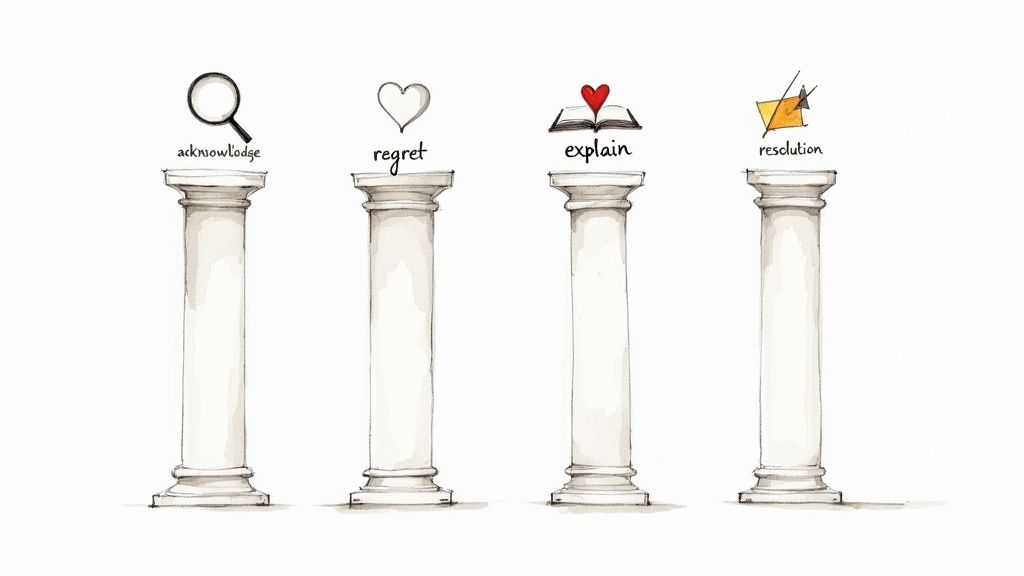
The Four Pillars of an Effective Apology Email
Forget the generic, copy-paste templates that sound like a robot wrote them. A real apology, one that actually works, has a clear structure that shows you're both sincere and competent. When you build your message around these four essential pillars, you take the guesswork out of a tough situation and can respond with confidence when things inevitably go wrong.
Acknowledge the Specific Mistake
First things first: you have to state exactly what went wrong. No dancing around it. Vague phrases like "sorry for the inconvenience" are a waste of time—they feel dismissive and show you haven't bothered to understand the actual problem.
Get straight to the point. Instead of a weak "Apologies for the mix-up," try this: "Please accept my sincere apologies for incorrectly billing you for services on May 15." See the difference? That directness immediately validates their complaint and proves you were paying attention.
Express Genuine Regret for the Impact
Just saying what you did wrong isn't enough. You have to connect the dots and show you get how it affected the client. This is where empathy makes or breaks your apology. It’s not just about your mistake; it’s about their experience.
Link your error to its consequence. After acknowledging the problem, add something like, "I understand this caused a lot of confusion and frustration, and I am truly sorry for the stress it created." That one sentence shifts the focus from your action to their feeling, which is absolutely critical for rebuilding trust.
An apology should focus less on the mistake itself and more on the impact it had on the person you're apologizing to. True accountability is recognizing the consequence of your actions.
Explain What Happened (Without Making Excuses)
Next, you need to offer a brief, honest explanation. This isn't about making excuses; it's about restoring their confidence by showing you know why the mistake happened. Be transparent, but don't get defensive or try to shift blame.
Here are a couple of ways to frame it:
- Human Error: "This was a simple clerical error on our end—the wrong service code was applied to your account."
- System Issue: "Our booking software experienced a temporary glitch that unfortunately failed to register your cancellation."
In both scenarios, you're taking full ownership while clarifying the root cause. It shows you're on top of things and reassures the client it wasn't just a case of carelessness. Keep it short and sweet; one sentence is usually all you need.
Outline a Clear Resolution
Finally, and most importantly, an apology has to be backed by action. This is the part that proves you mean it. Don't just promise you'll fix it—tell them exactly how you're going to make it right.
For that billing error we mentioned, the resolution could be: "I have already corrected the invoice and issued a full refund for the incorrect charge. You should see it reflected in your account within 3-5 business days." This is a perfect example of a clear, actionable statement. It provides immediate reassurance and a concrete timeline, turning a negative experience into proof of your commitment to doing right by your clients.
To make sure you hit all these key points, here’s a quick breakdown of what every apology email needs.
Essential Elements for a Sincere Apology Email
The table below breaks down the crucial components that should be included in any professional apology email to ensure it is effective and well-received.
| Component | Purpose | Example Phrase |
|---|---|---|
| Direct Acknowledgment | Shows you understand the specific issue without ambiguity. | "I am writing to apologize for the scheduling error..." |
| Expression of Regret | Conveys empathy for the customer's frustration or inconvenience. | "I realize this has disrupted your day, and I am truly sorry." |
| Transparent Explanation | Provides context without making excuses or shifting blame. | "This was caused by a system sync issue on our end." |
| Actionable Resolution | Details the concrete steps you are taking to fix the problem. | "I have rescheduled your appointment and applied a 20% discount..." |
| Assurance of Prevention | Rebuilds confidence by showing you're preventing a recurrence. | "We are reviewing our process to ensure this doesn't happen again." |
| Offer for Follow-Up | Opens the door for further communication and shows you care. | "Please feel free to contact me directly if you have any questions." |
Using this structure ensures your apology is not only heard but also felt, paving the way for a stronger client relationship.
Finding the Right Tone in Your Apology
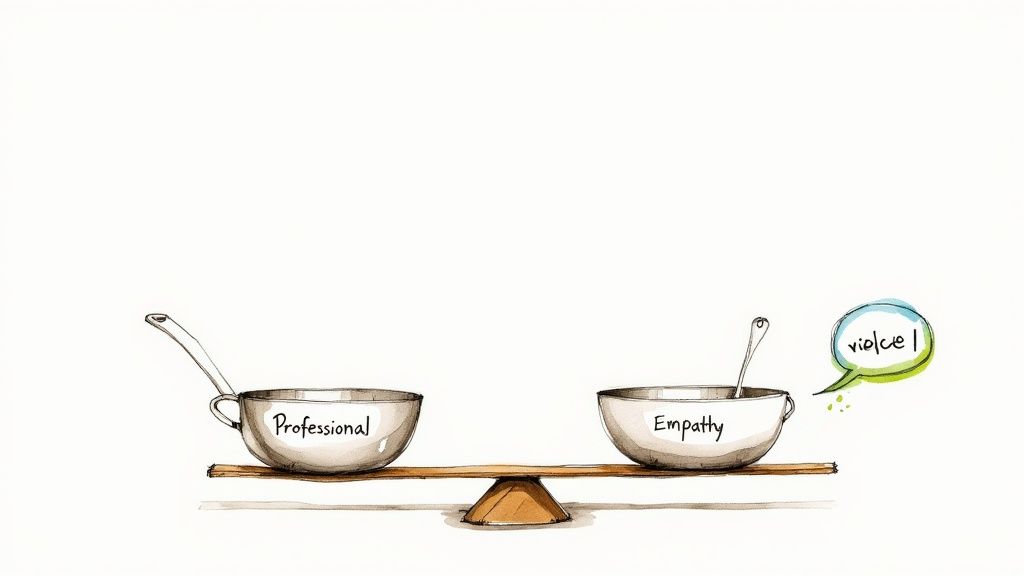
The words you choose matter, but the tone they carry is what ultimately decides if your apology hits the mark or falls flat. You're aiming for that sweet spot right between professional accountability and genuine human empathy. It’s the difference between sounding like a responsible business owner and a corporate robot reading from a script.
A simple tweak in phrasing can make all the difference. For instance, using active "I" statements immediately shows you're taking direct ownership of the situation. Just compare "An error was made" to "I made an error." The second version is far stronger, feels more accountable, and starts rebuilding trust from the get-go.
From Apology to Appreciation
Here’s a powerful tonal shift I’ve found incredibly effective: move from repeatedly saying sorry to expressing appreciation. Apologizing over and over can accidentally weaken your position and make you sound less confident. A better approach is to thank the client for their understanding.
- Instead of: "Sorry again for the long wait."
- Try: "Thank you for your patience as we resolved this."
See the difference? This small change reframes the entire interaction. It acknowledges their grace but also positions you as a capable problem-solver who values their partnership. It helps you maintain your professional standing while repairing the relationship. For future issues, you can also look into better communication management, like exploring options for Outlook scheduling for emails to get ahead of potential delays.
Confidence Without Over-Apologizing
It's also crucial to avoid the trap of over-apologizing. This habit can be influenced by all sorts of workplace communication norms, and some interesting research points to a gender disparity. A 2023 study revealed that 33% of women admitted to over-apologizing in professional emails—that's nearly double the 17% of men who said the same. This often comes from a valid concern about how their communication will be perceived. You can read more about the research into women's workplace communication challenges.
Your goal is to be accountable, not endlessly apologetic. One sincere, well-crafted apology is incredibly powerful. Filling an email with multiple, rambling apologies just dilutes the message and can make you seem less credible.
When you focus on clear, empathetic, and action-focused language, your apology email transforms from a simple "sorry" into a powerful tool for strengthening your client relationships. It shows you respect their experience and reinforces your own professionalism. Getting this balance right can turn a potential client loss into an opportunity to build even greater loyalty.
Real-World Scenarios and How to Handle Them
It’s one thing to talk about the theory behind a good apology, but the real test comes when an unhappy client lands in your inbox. Let’s move past the abstract and dive into the common, everyday blunders that service businesses face. Each situation calls for a slightly different touch, but the core pillars of a great apology never change.
By breaking down these real-world examples, you'll get a feel for adapting your language to fit the specific context, making sure your response always lands as authentic and effective. Think of this as your practical toolkit for crafting thoughtful apologies in email, no matter what went wrong.
Scenario 1: The Scheduling Mix-Up
It happens. A double-booking or an incorrect appointment time is one of the most frequent slip-ups. When this occurs, the key is to act fast, take complete ownership, and make rescheduling as painless as humanly possible for your client.
Here’s an email that gets it right:
Subject: Apology and Rescheduling for our appointment
Hi Sarah,
Please accept my sincerest apologies. I made an error in our booking system and have you scheduled for a time that is unavailable. This is completely my fault.
I understand this is an inconvenience and disrupts your day, and for that, I am truly sorry.
To make this right, I've opened up a few extra slots this week just for you. You can reschedule instantly using my private booking link here: [Link]. As a thank you for your understanding, a 20% discount will be automatically applied to your next service.
Again, I am very sorry for this mistake.
Best, Alex
This email works because it's direct and unapologetically owns the mistake ("This is completely my fault"). More importantly, it offers both an immediate, easy solution and a tangible gesture of goodwill. Dialing in a solid meeting invitation letter template can also help prevent these kinds of headaches from happening in the first place.
Scenario 2: The Billing Error
Mistakes involving a client's money are incredibly sensitive. This is where you need absolute clarity and lightning-fast correction. There’s simply no room for ambiguity when someone has been overcharged or incorrectly billed.
Your main goals here are twofold: fix the financial error immediately and, just as crucial, restore the client’s trust in your business operations.
Here’s how to break down your response:
- Acknowledge the error: "I'm writing to apologize for a billing error on your recent invoice (INV-123). You were incorrectly charged for [Specific Service]."
- Confirm the resolution: "I have already processed a full refund for the incorrect amount of $75. You should see it reflected in your account within 3-5 business days."
- Reassure them it won’t happen again: "I am also reviewing our invoicing process to ensure this does not happen again. Thank you for bringing this to my attention."
Scenario 3: The Service Didn't Meet Expectations
This is probably the toughest apology to write. It can feel personal because the client isn't just pointing out a logistical slip-up—they're telling you they're unhappy with your actual work.
Key Takeaway: When apologizing for a service failure, avoid defensiveness at all costs. Your energy should be focused on listening to their feedback and showing your commitment to getting it right. The goal is to prove you value their satisfaction more than your own ego.
Your response needs to open a dialogue and demonstrate a genuine desire to understand their perspective and deliver the quality they paid for.
A simple framework for that apology email:
- Start with Gratitude and Acknowledgment: "Thank you for sharing your feedback about your recent service. I'm very sorry to hear that the final result did not meet your expectations."
- Express Empathy: "I understand how disappointing it is when a service doesn't turn out the way you envisioned."
- Offer a Concrete Solution: "I would appreciate the opportunity to make this right. Please let me know what time works for you this week to come in for a complimentary correction service."
This approach validates their feelings without getting defensive and immediately pivots toward a solution, reinforcing your commitment to quality.
Common Mistakes That Undermine Your Apology
Writing a good apology is a delicate art. Even when you mean well, a few wrong words can completely miss the mark, turning a chance to reconnect into a reason for more frustration. Knowing what not to do is just as important as knowing what to do.
Let’s be honest, we’ve all seen a bad apology. The most damaging is the "non-apology apology"—those sneaky phrases that sound like an apology but actually shift the blame.
When you say, "I'm sorry if you felt that way" or "I apologize for any misunderstanding," you're subtly suggesting the problem is their perception, not your action. That doesn't fix anything; it just pours salt in the wound.
Another common misstep is over-explaining. Giving a little context can be helpful, but a long, rambling story about why the mistake happened sounds like you're making excuses. Keep the focus squarely on the client’s experience and how you're going to make it right, not on your own internal chaos.
Using Empty, Cliché Phrases
Some phrases are so overused they’ve become completely meaningless. "Sorry for the inconvenience" is probably the worst offender. It’s a cold, corporate platitude that does nothing to acknowledge the real impact your mistake had on your client. It’s a brush-off, not an apology.
You have to get specific.
Instead of that tired, generic line, try something that shows you actually thought about their situation:
- Instead of: "We apologize for the inconvenience."
- Try: "I am so sorry that our scheduling error forced you to rearrange your entire afternoon."
See the difference? The second one validates their frustration. It shows you understand the real-world consequence, which is crucial when dealing with scheduling issues. If you want to dive deeper, we have a whole guide on the schedule conflict meaning and how to manage its fallout.
Making Promises You Can't Keep
In the heat of the moment, it's tempting to promise the moon to make things right. Saying, "I guarantee this will never happen again," feels like a strong, reassuring statement. The problem is, it sets an impossible standard.
Life happens. Systems fail. People make mistakes. If that same issue pops up again, you’ve not only repeated the original error, but you’ve also broken a direct promise. That's a massive blow to your credibility, and it's incredibly hard to recover from.
A much better approach is to promise diligence, not perfection. You can say you’re putting new processes in place or adding extra checks to prevent it from happening again. That’s an honest, achievable commitment that builds real, lasting trust.
Let's face it, email mistakes are a part of professional life. Research on workplace writing habits shows that 93% of email users admit to making them. We’re all in the same boat, which just goes to show how critical it is to get the apology right when it's your turn.
Frequently Asked Questions About Apology Emails
Even with a solid framework, crafting apologies in email can bring up tricky, specific questions. These situations often fall into gray areas where the "right" answer isn't immediately obvious. Here, we'll tackle some of the most common nuanced questions that service providers face.
Providing clear, direct answers will give you the confidence to handle these moments with professionalism and care, ensuring your response strengthens the client relationship rather than causing further damage. Think of this as your guide to navigating the finer points of a difficult conversation.
When Is an Email Apology Not Enough
An email is excellent for a fast, documented acknowledgment of a problem. It’s perfect for logistical errors or minor service issues where a clear solution can be presented in writing. However, its effectiveness has limits.
You should escalate to a phone call if:
- The error caused a significant financial loss or deep emotional distress for the client.
- The situation involves a high-value, long-term client whose relationship is critical to your business.
- The problem is too complex to explain clearly in writing and requires a real-time conversation to resolve.
A direct conversation demonstrates a higher level of care and commitment. You can always send a follow-up email after the call to summarize the resolution you both agreed upon, creating a written record.
Should I Offer a Discount in My Apology Email
Offering a discount or some form of compensation can be a powerful gesture of goodwill, but it should never be the centerpiece of your message. The apology itself must always come first. An offer made too early or without a sincere apology can feel like a bribe to make the problem disappear.
Compensation is most appropriate when your mistake has directly cost the client something tangible, such as their time, money, or a promised result. Frame it as a way of acknowledging their patience and understanding. For example, "To thank you for your patience as we correct this, we've applied a 15% discount to your next appointment." This positions it as a courtesy, not a transaction.
How Quickly Should I Send an Apology Email
Speed is critical. A prompt response shows you are attentive, respect the client's time, and are taking the issue seriously. The longer you wait, the more it feels like you're ignoring the problem, which allows frustration and resentment to build.
Aim to send an acknowledgment as soon as you become aware of the issue. Even if you don’t have a complete solution yet, a quick initial email can de-escalate the situation significantly.
A simple, effective initial response:
"Hi [Client Name], Thank you for letting me know about this. I've received your message and am looking into it right now. I will have a complete update for you by [Time/Day]."
This simple message manages expectations and proves that their concern is a priority. It buys you the time you need to investigate properly without leaving them in the dark.
Managing client communications, especially the difficult ones, is a constant challenge for any service business. With Kejoola, you can centralize your client history, notes, and appointments in one professional portal, ensuring you always have the full context you need to respond thoughtfully. Stop juggling texts and DMs and see how a streamlined system can transform your client relationships. Try it free today at https://kejoola.com.