Get Fully Booked Online: A Guide for PH Businesses
Learn how to get your Philippine-based service business fully booked online with our complete guide on websites, pricing, automation, and local marketing.
Josh · Dec 4, 2025 · 17 min read
- online booking
- local business
- philippines
- seo
Build Your Online Booking Foundation
If you want to get fully booked online, it all starts with one thing: a rock-solid booking foundation. I’m not talking about a pretty website that just looks good. I mean a site that’s built from the ground up to do one job exceptionally well—turn visitors into paying clients. Think of it as your digital front door, open 24/7, guiding people straight to your calendar.
Engineer a High-Converting Booking Website
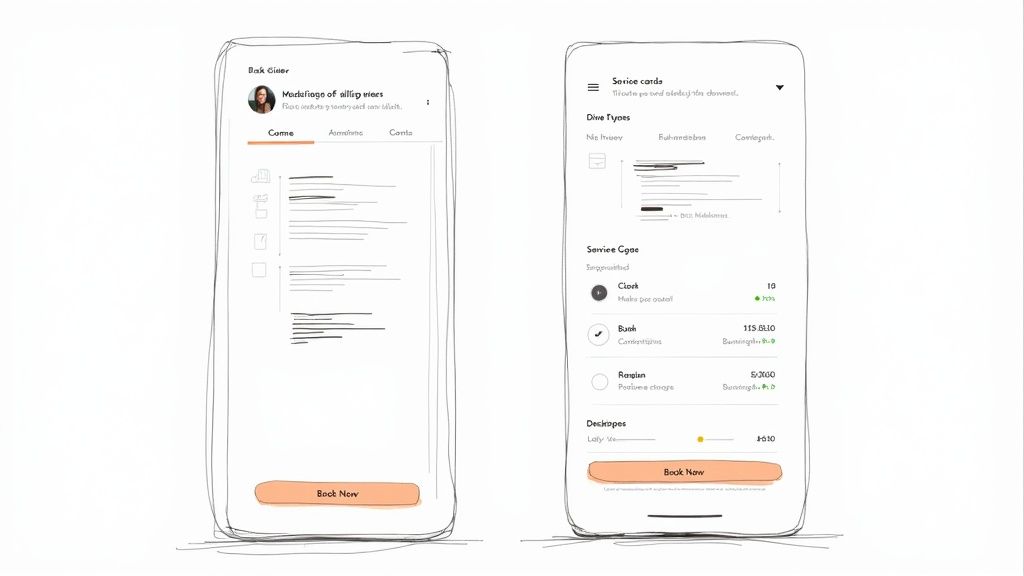
Your path to a packed schedule begins with a website that nudges people to take action. This isn't just an online brochure; it’s a booking machine engineered to take someone from a casual glance to a confirmed appointment with as few clicks as possible. Every photo, every word, every button has to serve that one purpose.
Prioritise Local Payment and Mobile Speed
Here in the Philippines, convenience is king. Your booking platform absolutely must work with the payment methods people here know and trust. If you're not offering options like GCash or PayMaya, you’re practically inviting potential clients to abandon their booking at the last second. It's a deal-breaker. In fact, research shows that a massive 80% of online bookings are made across various channels, which tells you just how important it is to be flexible.
On top of that, remember that most of your clients are finding you and booking appointments on their phones. A slow-loading, clumsy mobile site is the fastest way to lose a customer. Your website has to be quick and responsive, with every page and form designed to look great and work flawlessly on a small screen.
A website that takes 5 seconds to load has a 90% higher bounce rate than one that loads in just 1 second. For any service business, those bounces are lost appointments and money down the drain.
Structure Service Pages for Action
The way you lay out your services can make or break your booking numbers. Ditch the long, flowery paragraphs. Your goal is to be clear, persuasive, and quick.
Here's what every single service page needs to have:
- Clear Service Titles: Don't get clever. Just say what it is.
- Concise Descriptions: Focus on the result for the client. What problem are you solving for them?
- Visible Pricing: No surprises. Show your prices upfront to build trust.
- Prominent Calls-to-Action (CTAs): Big, bold buttons like "Book Now" or "Check Availability" are your best friends.
Your service pages also need to be built with local search in mind. Weave in location-specific keywords naturally. For instance, if you run a spa in Makati, your page should absolutely include phrases like "massage therapy in Makati." This simple step helps you show up when locals are searching for what you offer.
Getting this foundation right is what separates a struggling business from one that’s consistently busy. Using an integrated platform simplifies everything; you can explore powerful booking tools when you sign up and see firsthand how a seamless, all-in-one system works. This is how you stop being just another website and become a real engine for growth.
Fine-Tuning Your Services to Maximise Bookings
Alright, so your booking system is live. What’s next? This is where we move beyond a simple price list and into the strategic art of packaging your services, smart pricing, and managing your availability. The aim is to build a flexible, data-backed strategy that keeps your calendar full and your business profitable.
A static price list is a huge missed opportunity. Your offerings need to be alive, shifting to reflect the real value you deliver and what the market demands. It’s a mindset shift: you’re not just listing services; you're crafting solutions to your clients' problems.
Size Up the Competition to Carve Out Your Niche
To stand out, you have to know what you’re up against. Digging into what your local competitors are doing isn't about copying their prices—far from it. It's about spotting the gaps in the market and finding your sweet spot. Take a good look at what they offer, how they bundle their services, and what their pricing looks like.
Start by asking some tough questions:
- What makes me different? Is it a more personalised touch? Better quality materials? Or maybe you're just plain faster? Pinpoint your unique value.
- Where are the pricing gaps? Could you introduce a premium, all-inclusive package that no one else offers? Or maybe a budget-friendly introductory deal to get new clients in the door?
- How busy are they? Are their calendars always packed, or do they look wide open? This gives you a clue about local demand.
This kind of intel helps you position your services as a unique solution, not just another commodity. It gives you the confidence to justify your pricing and attract the exact clients you want to work with.
Get Smart with Dynamic and Strategic Pricing
Your prices should never be set in stone. One of the most powerful tools in your arsenal is dynamic pricing. This simply means adjusting your rates based on different factors to make more money when you’re busy and attract bookings when things are quiet.
I see so many businesses make the mistake of setting one price and just leaving it there for years. Think about it—by tweaking your rates based on demand, seasonality, or even the day of the week, you can seriously bump up your average booking value.
It's a simple concept with a big impact. A tour operator in Palawan, for instance, would be wise to charge more during the peak summer months. In the same way, a salon in Metro Manila could run a mid-week discount to fill those quieter afternoon slots. This kind of flexibility is absolutely crucial for staying competitive and profitable.
Just look at our local tourism and hospitality sector for proof. Philippine hotels have watched their international bookings climb from just 17% in 2021 to over 50% in 2024. At the same time, their average daily rates went up by nearly 3%. This is a perfect example of how aligning your pricing with market demand delivers real results. You can read more about these hotel booking trends in a recent report from SiteMinder featured on BusinessWorld. And trust me, this strategy isn't just for big hotels; any service business can make it work.
Streamline Your Operations with Automation
Getting fully booked online is an incredible achievement. But let's be honest, the real challenge begins after the bookings flood in. How do you manage that influx of clients without completely burning out? This is where smart automation becomes your secret weapon. It’s what separates a chaotic, stressful business from a smooth, professional operation that practically runs itself.
The whole point is to get rid of the repetitive, manual tasks that eat up your day. Think about it: sending booking confirmations, chasing down payments, answering the same questions before every appointment... each of these little things adds up. By automating them, you reclaim your time to focus on what you actually love doing—delivering your service.
Implement Automated Client Workflows
Your first move should be setting up automated communication sequences. These are messages that trigger at specific points in your client's journey, ensuring every interaction is consistent, timely, and professional, all without you having to lift a finger. The demand for this is huge; research shows that around 80% of accommodations can now be booked online, which tells us that customers strongly prefer self-service and getting that instant confirmation.
This trend isn't just for hotels. The entire Philippine service sector is seeing a similar boom.
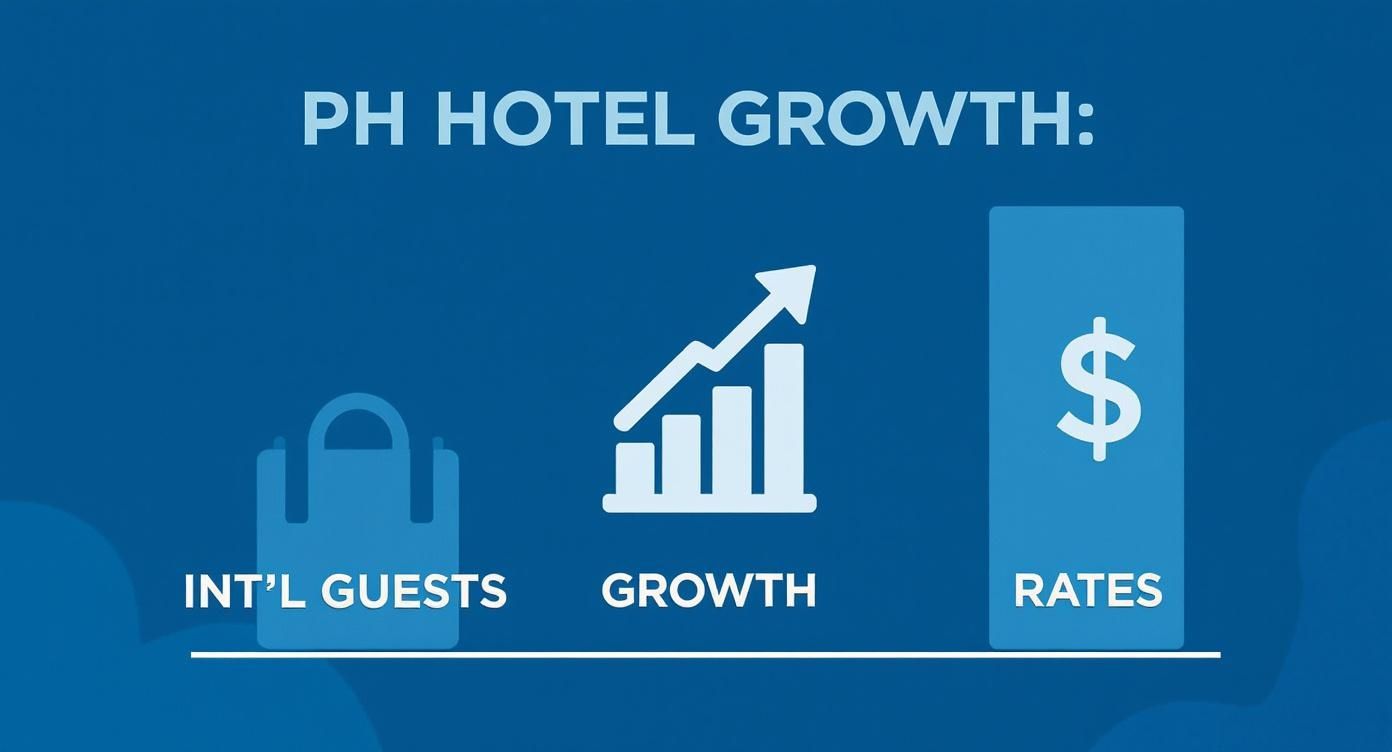
This data paints a clear picture: demand is strong, and the businesses that make it easy for customers to book are the ones who will win.
Here are the must-have automations to put in place right away:
- Booking Confirmations: The moment a client books, an email or SMS should go out with all the appointment details. No delays, no manual work.
- Payment Reminders: Automatically send polite nudges for upcoming or overdue payments. This alone can dramatically improve your cash flow.
- Pre-Arrival Information: A day or two before their appointment, send a helpful message with tips, directions, or what they need to prepare. It’s a small touch that makes a big difference.
To truly understand the shift, let's break down the time saved on everyday tasks.
Booking Automation Impact Analysis
This table compares the old way of doing things versus the new, automated approach for a typical service business in the Philippines.
| Task | Manual Process (Time Spent per Booking) | Automated Process (Time Spent per Booking) | Key Benefit |
|---|---|---|---|
| Sending Confirmation | 5-10 minutes | 0 minutes (Instant) | Frees up staff, eliminates human error |
| Answering FAQs | 10-15 minutes | 0 minutes (Info sent automatically) | Consistent information, better client prep |
| Payment Reminders | 5-10 minutes | 0 minutes (Scheduled nudges) | Improved cash flow, fewer awkward calls |
| Rescheduling | 10-20 minutes (back-and-forth) | 2 minutes (Client self-service) | Massive time savings, client empowerment |
| Feedback Requests | 5 minutes | 0 minutes (Post-service trigger) | More reviews, effortless social proof |
The numbers don't lie. Automation isn't just a "nice-to-have"; it's a fundamental operational upgrade that gives you back hours every single week.
Empower Clients with a Self-Service Portal
A client portal is an absolute game-changer. It’s a secure, online space where your customers can manage their own bookings, check their appointment history, and communicate with you. Instead of you fielding calls and emails for every little change, you empower them to handle it themselves.
Giving clients control over their bookings not only saves you hours of admin time but also massively improves their experience. It shows you respect their time and provides the modern convenience they’ve come to expect.
This approach practically eliminates the frustrating back-and-forth communication that plagues so many service businesses. Better yet, you can set up automated follow-ups after their service to gather those crucial reviews and testimonials you need to build trust and attract new clients.
If you're curious about the mechanics behind this, this detailed guide to tab booking systems is a great resource for seeing how to apply these principles directly to your business.
Drive Local Traffic That Actually Converts
You've built a world-class booking system. Fantastic. But it's only half the battle. Now, we need to shift our focus from the internal machinery to external visibility. The real goal is to build a bridge connecting your perfectly optimised booking engine with a steady stream of ready-to-book customers, right here in the Philippines.
This isn't just about having an online presence; it's about actively capturing local market demand. We're talking about deploying high-impact, cost-effective strategies that deliver qualified local leads straight to your booking page.
Dominate the Local Map Pack
For any service business operating locally, your Google Business Profile (GBP) is your single most valuable piece of digital real estate. It's the engine that powers your appearance in the coveted "map pack" when someone searches for services "near me." Frankly, getting this right is non-negotiable if you want to be found.
Your profile needs to be much more than a digital business card. To truly stand out from the competition, treat it like a dynamic mini-website:
- Keep Information Consistent: Your business name, address, and phone number (what we call NAP) must be absolutely identical everywhere online, from your website to every single directory.
- Be Specific with Service Categories: Don't just pick "Beauty Salon." Choose the most precise categories that describe what you actually do, like "Hair Colouring Services" or "Nail Salon." This is how Google matches you to the right searches.
- Show, Don't Just Tell: Regularly upload clear, professional photos of your space, your team in action, and the results of your work.
- Make Reviews a Priority: Actively and consistently ask your happy clients for Google reviews. A stream of positive, recent reviews is a massive ranking signal to Google.
Uncover What Local Clients Are Searching For
To attract the right audience, you have to speak their language. This means digging deep to find the specific, location-based keywords your ideal clients are typing into Google this very moment. It goes way beyond just "[your service] in [your city]."
You need to get granular. A salon in Cebu City, for instance, should be targeting phrases like "Keratin treatment Mandaue" or "best hair colourist Cebu City." A tour operator in Palawan should be optimising for "private island hopping El Nido" or "best snorkelling tour Coron." Weave these hyper-local phrases into your website's service pages, blog posts, and your Google Business Profile updates.
The online booking landscape in the Philippines is absolutely exploding. Between 2022 and 2023, online travel booking shot up by an incredible 88%, making it the fastest-growing sector of the country's entire digital economy. This is hard proof that Filipinos are online and ready to book; you just have to make it easy for them to find you.
Forge Strategic Local Partnerships
Don't try to go it alone. One of the most powerful, and often overlooked, ways to get fully booked online is by building a referral engine with other local businesses. Your mission is to identify complementary, non-competing businesses that serve the exact same type of customer you do.
Think about it: a wedding photographer could partner with local event planners, florists, and venues. A fitness studio could team up with nearby health food cafes or physiotherapy clinics. These partnerships create a powerful network that sends a steady stream of high-quality leads your way, often with a warm introduction already attached. For more actionable strategies on growing your business, check out our guide on the Kejoola blog for deeper insights.
Measure Success and Iterate for Growth
Getting fully booked isn't a one-time win; it's a constant process of learning, adapting, and fine-tuning your approach. To build real, sustainable growth, you have to stop guessing and start making decisions based on cold, hard data. This means diving deep into your analytics to figure out what’s actually working and, just as importantly, what isn’t.
Think of your website and booking system as treasure troves of customer information. When you track the right numbers, you get a clear picture of your customer’s journey from start to finish. This lets you pinpoint the exact spots where you can make small changes that lead to a big boost in bookings.
Pinpoint Your Key Performance Indicators
First things first, you need to focus on the metrics that actually matter. It's easy to get sidetracked by "vanity metrics" that look good but don't impact your business. Instead, zoom in on the data points that directly affect your bottom line and help keep your calendar packed.
For any service business, these are the numbers you can't ignore:
- Booking Conversion Rate: This is the big one. What percentage of people who visit your website actually end up booking a service? It’s the clearest measure of how well your booking process is working.
- Customer Acquisition Cost (CAC): Simply put, how much are you spending in marketing to land one new paying client? Knowing your CAC is crucial for managing your budget and ensuring your marketing efforts are profitable.
- Revenue Per Available Slot: This helps you understand the real value of your time. Calculating this pushes you to make the most out of every single opening on your calendar.
- Booking Page Drop-off Rate: Where in the booking process are people giving up? Identifying this point of friction is the first and most critical step to fixing it.
A data-driven mindset is non-negotiable for long-term success. By continuously testing and refining everything from your service descriptions to your pricing, you create a system that evolves with your customers' needs and keeps you one step ahead of the competition.
Create a Data-Driven Feedback Loop
Once you have your KPIs on a dashboard, you can start making changes with confidence. Tools like Google Analytics are brilliant for this, as they let you see exactly how users behave on your site—which pages they visit before booking and, crucially, where they leave.
This kind of insight is what allows you to run targeted A/B tests. For instance, you could try two different headlines on your main service page to see which one converts better. Or maybe you experiment with a different pricing package or a limited-time offer. Every test, whether it succeeds or fails, gives you valuable data that helps you refine your strategy over time.
This cycle of continuous improvement is absolutely vital, especially in a market that's growing as quickly as ours. Just look at the Philippines' online travel sector—it's projected to explode from USD 11.33 billion in 2024 to USD 26.34 billion by 2033. This incredible growth, detailed in a comprehensive report from IMARC Group, shows a massive consumer shift towards digital-first solutions. By embracing data, you position your business perfectly to claim your piece of this rapidly expanding digital economy.
Frequently Asked Questions About Online Booking
Shifting your business to an online booking model is a game-changer, but it naturally comes with a few questions. Let's tackle some of the most common hurdles service business owners in the Philippines face when they're aiming to get fully booked online.
What's the Best Online Booking Software for a Small Business Here in the Philippines?
Honestly, there's no single "best" platform for everyone. The right choice for a photography studio will be completely different from what a home cleaning service needs. A one-size-fits-all approach just doesn't cut it.
So, instead of looking for the best software, focus on finding the best software for you. The first step is to sit down and list your non-negotiables.
- Local Payments: Can it easily handle payments via GCash, PayMaya, or local bank transfers? This is crucial for the Filipino market.
- Mobile-First Design: How does the booking process feel on a smartphone? The vast majority of your clients will book this way.
- Smart Scheduling: Can you set custom rules for your services? Think buffer times between appointments, specific staff availability, or different service durations.
- Resource Management: If your business relies on specific rooms or equipment (like a spa or a workshop), can the system manage that inventory to avoid double-bookings?
- Automated Reminders: Does it automatically send email or SMS reminders? This is your secret weapon against no-shows.
Once you’ve got that list, you can start comparing platforms that tick your boxes and fit your budget. My advice? Look for providers with transparent pricing and solid customer support—it'll save you a world of headaches later on.
How Do I Deal With No-Shows and Last-Minute Cancellations?
Ah, the classic revenue killers. No-shows and late cancellations can seriously disrupt your cash flow. You need a solid strategy that protects your income without alienating good clients.
Start by setting up a crystal-clear cancellation policy. Don't hide it in the fine print; make it a mandatory checkbox clients have to agree to before they can confirm a booking. This sets the expectation right from the get-go.
Next, put technology to work. Automated reminders, sent via SMS or email 24-48 hours before an appointment, are incredibly effective. For those premium services or peak time slots, don't be afraid to require a small, non-refundable deposit. This one simple step dramatically increases a client's commitment.
A deposit does more than just secure a booking. It acts as a filter for serious clients, ensuring your valuable time is reserved for people who are genuinely committed. This protects your revenue and helps keep your schedule packed.
How Much Should I Really Spend on Marketing to Get Fully Booked?
Figuring out a marketing budget can feel like throwing darts in the dark, but it doesn't have to be. Forget pulling a random number out of thin air. You need a goal-oriented approach that lets you start small and double down on what actually works.
Begin with the free, high-impact stuff. Fully optimising your Google Business Profile is non-negotiable. Then, actively encourage word-of-mouth referrals and online reviews. These foundational tactics can bring in a surprising amount of local traffic without you spending a single peso.
When you're ready to dip into paid ads on platforms like Facebook or Google, start with a small, testable budget. Your initial goal is data, not just bookings. A good rule of thumb is to allocate around 5-10% of your target revenue to your marketing efforts. The absolute key is to track your return on investment (ROI) for every single channel. The data will tell you exactly where to put your money for the best results.
Can I Get Fully Booked Without Having a Social Media Presence?
Look, it's technically possible, but you'd be making your life so much harder, especially here in the Philippines. Platforms like Facebook and Instagram are absolute powerhouses for discovery, building trust, and talking directly to your customers.
You don't need to be everywhere at once. The smart move is to figure out where your ideal clients hang out online and focus your energy there. Think of your social media profile as a multi-tool for your business:
- It's a visual portfolio showcasing your best work.
- It's a hub for glowing customer reviews and testimonials.
- It’s a direct line for answering questions and building relationships.
- It’s a powerful funnel that drives people straight to your booking website.
Ultimately, the winning formula for most local service businesses is a strong local SEO game combined with a professional, active social media presence. One gets you found in search; the other builds the community and trust that turns browsers into paying clients.
Ready to stop juggling DMs and spreadsheets and finally get your business fully booked online? Kejoola gives you an AI-powered website with smart booking, a professional client portal, and built-in SEO to help you grow. Start your free 14-day trial and launch your booking-ready site in minutes.