A Guide On How To Improve Local SEO For Service Businesses
Discover the essential steps on how to improve local SEO for your service business, from optimizing your Google Business Profile to building local authority and creating community-focused content.
Josh · Jan 16, 2026 · 20 min read
- local seo
- google business profile
- seo guide
- service business
Your Google Business Profile Is Your Most Powerful Local SEO Tool
If you want to improve your local SEO, your Google Business Profile (GBP) is where you start. Period. Think of it as your business's digital storefront—it's what customers see first in Google Maps and the local pack search results. A weak profile is like having a "closed" sign up 24/7, but a well-tuned one becomes a magnet for local leads.
The numbers don't lie. A massive 46% of all Google searches are for local information, and 97% of people turn to the internet to find local businesses. For a service provider, this is a direct pipeline to your next job. The data shows that fully optimized profiles get up to 70% more visits than incomplete ones, which means more calls, more bookings, and more revenue.
Managing your GBP isn't a one-and-done task. It's an ongoing cycle of claiming, optimizing, and engaging with your audience.
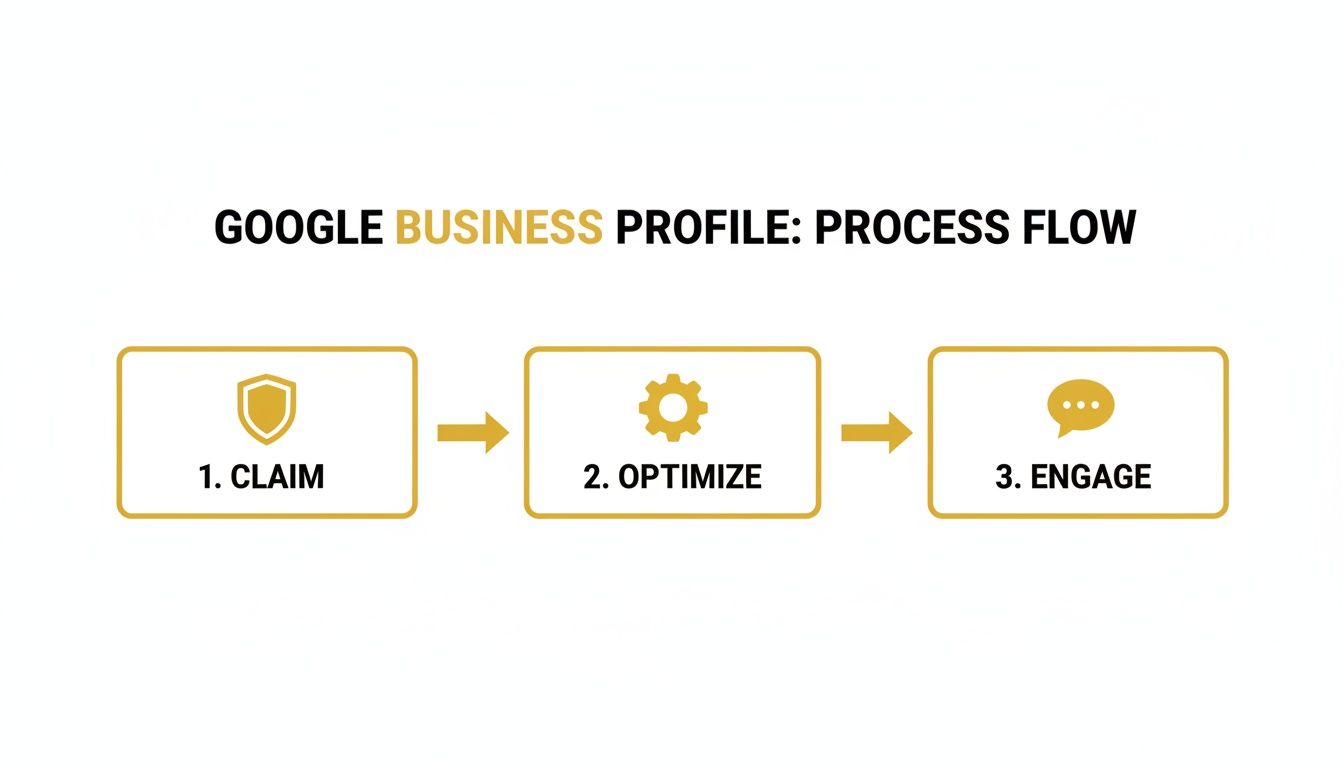
This simple flow shows that your profile is an active marketing channel that needs consistent attention to deliver results.
Nail the Foundational Details
Getting the basics right is non-negotiable. It all begins with claiming and verifying your business profile, which puts you in the driver's seat. After that, it's all about precision.
- Business Name: Your name must be your exact real-world business name. Resist the temptation to stuff it with keywords or locations (like "Phoenix Premier Plumbing" when you're just "Premier Plumbing"). That's a fast track to getting suspended.
- Address and Service Area: If customers visit you, your address needs to be spot-on. If you're a service-area business (SAB) like a mobile mechanic or an electrician, you can hide your address and instead define the specific cities, zip codes, or radius you cover.
- Phone and Website: Always use a local phone number. And make sure the website link points directly to your homepage to create a clear, consistent connection for both Google and your customers.
Get Your Categories Right
Choosing the right categories is one of the single most important things you can do for your profile. Your primary category should be a laser-focused description of your main service—what you're truly an expert in. Think "Plumbing Contractor," not just "Contractor."
From there, you can add secondary categories to cover everything else you do. For example, a roofer (primary category) might add "Gutter Cleaning Service" and "Siding Contractor" as secondary options. This casts a wider net, helping you show up for a much broader range of searches.
Key Takeaway: Your primary category holds the most SEO weight, so choose it wisely to reflect your core expertise. Then, use secondary categories to capture all the other valuable services you offer.
Use GBP's Features to Drive Bookings
With the foundation in place, it’s time to use GBP's dynamic features to pull ahead of the competition. These tools turn your profile from a static listing into an interactive sales channel that actively brings in new customers.
Of course, all this effort works best when it directs users to a website designed to convert. Our guide on building a fully booked website shows how to create a professional online hub that perfectly complements your GBP strategy.
Here’s how to make your profile come alive:
- Google Posts: Think of these as mini-ads right on your profile. Share special offers, updates, or highlight a recent project. A landscaper could post a "20% off fall cleanup" offer to generate immediate interest. Just remember they expire after seven days, so keep them fresh.
- Photos and Videos: People want to see your work. Upload high-quality, geotagged photos of your team on the job, your service vans, and especially before-and-after shots. Nothing builds trust faster than visual proof of a job well done.
- Q&A Section: Don't wait for customers to ask questions—answer them ahead of time. Proactively add common questions and your own answers about things like your service area, pricing, or warranties. This removes friction and helps potential customers make a quick decision.
Building Authority Through NAP Consistency and Citations
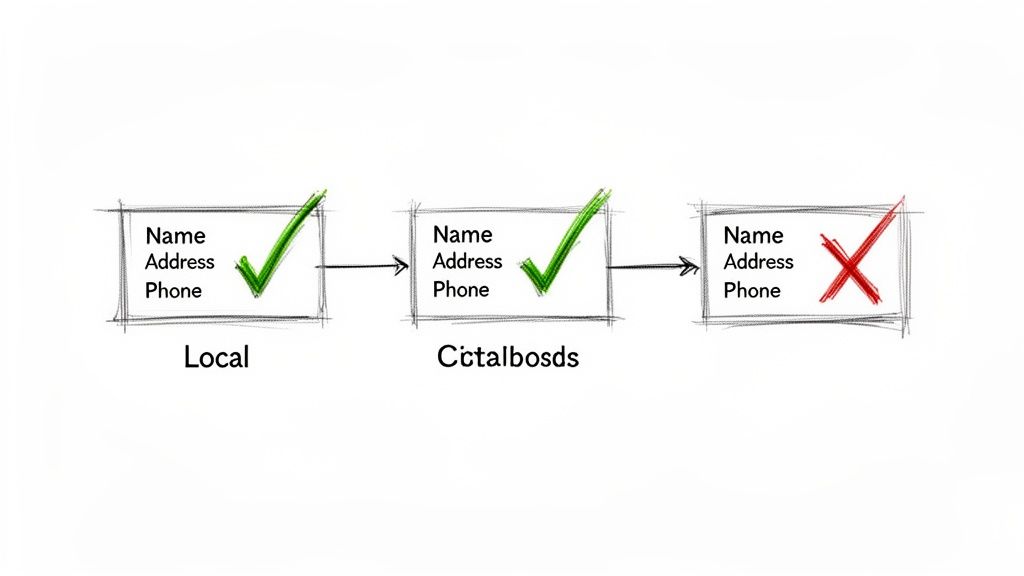
If there’s one thing search engines crave, it's trust. And for local businesses, the fastest way to build that trust is through unwavering consistency. After optimizing your Google Business Profile, the next crucial step is ensuring your digital footprint across the entire web tells the exact same story. Any conflicting information, no matter how small, introduces doubt and can slowly chip away at the authority you’re trying to build.
This all comes down to your NAP data—your business’s Name, Address, and Phone number. Think of it as your company's digital fingerprint. If Google finds multiple versions of this fingerprint scattered online, it gets confused. Is it "Main St." or "Main Street"? Did you list a different phone number on one directory years ago? These tiny details matter more than you think and can hold back your rankings.
Getting your NAP identical everywhere is a powerful signal to search engines that your business is legitimate, active, and reliable. It’s a non-negotiable foundation for any serious local SEO effort.
Uncovering and Fixing NAP Discrepancies
Before you even think about building new citations, you have to clean up the old ones. The first job is to run a full audit of your online presence to hunt down and correct any conflicting details. It takes some detective work, but it’s the only way to establish a clean slate.
Start by Googling your business name, but also search for old addresses and any phone numbers you've used in the past. You'll probably be surprised at what you dig up—an old listing on a forgotten directory, a Yelp profile with an outdated suite number. Keep a running list of every incorrect NAP instance you find in a simple spreadsheet.
With your list in hand, the manual work begins. You'll need to contact each website administrator or log into old profiles to get the information updated. Yes, it can be tedious, but it's absolutely critical. Every correction you make reinforces your true business identity, making your company a far more trustworthy entity in Google's algorithm.
The Power of Strategic Citations
Once your existing listings are squeaky clean, it's time to build new, high-quality citations. A citation is just any online mention of your NAP data. They generally fall into two categories, and you need a healthy mix of both to really build local authority.
- Structured Citations: These are your bread-and-butter listings on online business directories like Yelp, Angie's List, and the Better Business Bureau. They present your NAP in a clean, predictable format.
- Unstructured Citations: These mentions are more organic, often popping up in blog posts, local news articles, or forums. For example, a community blog might write, "We had a great experience with PlumbPerfect (555-123-4567) for our recent renovation on Elm Avenue."
Pro Tip: Don't just chase the big national directories. Hyperlocal and niche-specific directories can be SEO gold. If you're a local plumber, getting listed in your town's Chamber of Commerce directory is huge. A wedding photographer should be on sites like The Knot or WeddingWire.
Identifying High-Value Directories
An effective citation strategy is all about quality over quantity. Blasting your business info to hundreds of generic, low-quality directories won't move the needle. Instead, focus your energy on platforms that are genuinely relevant to your industry and location. This sends much stronger signals to Google.
A great way to find these opportunities is to analyze your top-ranking local competitors. Use an SEO tool to see where they’re getting citations from and pinpoint high-authority directories you might have missed. Look for local business associations, community portals, and industry-specific blogs. Every high-quality citation you build is another vote of confidence, cementing your status as a legitimate local authority and giving your SEO a direct boost.
Optimizing Your Website With Local SEO Signals
Once you've locked down a consistent digital footprint across the web, it's time to turn the focus inward to your own website. Think of your site as the central hub of your online world. It needs to be infused with powerful local signals that tell both customers and search engines exactly where you operate and what you do.
This isn't just about listing your services; it's about transforming your website from a generic brochure into a precision-guided tool for attracting local business. When someone in your town has a problem you can solve, your website should be the first thing that comes to mind—and to the top of their search results.
Uncovering The Keywords Your Customers Use
Great on-page SEO always starts with getting inside your customer's head. You need to understand the exact words and phrases they're typing into Google when they need you most. This is less about guesswork and more about smart research.
Forget generic industry jargon. A homeowner with a flooded basement isn't searching for "hydro-evacuation solutions." They're frantically typing in "emergency plumber in downtown Austin" or "24-hour pipe repair 78701." Your job is to find those high-intent, location-specific terms.
Here are a few practical ways to dig up these local keyword gems:
- Google's Autocomplete: Just start typing one of your services followed by "in" or "near" into the search bar. Google’s suggestions are a direct reflection of what people are actually searching for.
- "People Also Ask" Section: This is a goldmine. Search for a core service and scroll down to this box. It reveals the specific questions your potential customers need answers to, giving you fantastic ideas for long-tail keywords and content.
- Spy on Your Competitors: Take a look at the top-ranking local competitors. What does their homepage title say? What are the headings on their service pages? You'll quickly spot the keywords they're targeting.
Weaving Keywords Into Your Website Naturally
With a solid list of keywords, the next move is to integrate them strategically across your site. The old days of "keyword stuffing" are long gone and will get you penalized. Today's approach is all about natural, logical placement in the spots that matter most to search engines.
This is where your website's fundamental structure plays a critical role. For service providers, the right platform can make this infinitely easier. If you're building from scratch or considering an upgrade, it's worth exploring the best website builder for service businesses to find a foundation that's built for local SEO success.
To get you started, here is a quick-reference checklist for the most critical on-page elements.
| On-Page Local SEO Checklist | ||
|---|---|---|
| Element | Optimization Tactic | Example |
| Title Tags | Include your primary keyword, city, and brand name. This is your main headline in search results. | `Expert HVAC Repair in Scottsdale |
| Meta Descriptions | Write a compelling 155-character summary that includes your keyword and a call to action to encourage clicks. | Need fast HVAC repair in Scottsdale? Cool Comfort Inc. offers 24/7 service. Call now for a free estimate! |
| Header Tags (H1, H2) | Your H1 is the main on-page title. Use your primary keyword here. Use H2s for sub-sections with keyword variations. | H1: Scottsdale HVAC Repair & Installation H2: Our Emergency AC Repair Services |
| Page Content | Naturally mention your keywords and location-specific terms (neighborhoods, landmarks) throughout the text. | We've served homeowners across Scottsdale, from Old Town to North Scottsdale, for over 15 years. |
| Image Alt Text | Describe your images for visually impaired users and search engines, including a keyword where it makes sense. | ac-unit-installation-scottsdale-arizona.jpg |
Following these guidelines helps Google understand the exact purpose and geographic relevance of each page on your site.
Before-and-After Scenario: A painter's homepage title was simply "Welcome to Fine Finish Painting." After optimization, it became "Professional Interior & Exterior Painters in Portland, ME | Fine Finish Painting." This small change immediately communicates service, location, and brand, dramatically improving its local relevance.
Implementing Local Business Schema Markup
This is your secret weapon for speaking Google's language. Schema markup is a bit of code you add to your website that acts like a digital business card, giving search engines a perfectly clear, structured summary of who you are and where you are.
It explicitly confirms your most important information:
- Business Name
- Address and Phone Number (NAP)
- Hours of Operation
- Specific Service Area
- Customer Ratings
This structured data removes all the guesswork for search engines, tightening the connection between your website, your Google Business Profile, and your physical service area. Some platforms, like Kejoola, bake SEO-optimized schema right into your site automatically. If you're on another platform, you can use tools like Google's Structured Data Markup Helper to generate the code.
Don't skip this. It's one of the most powerful technical steps you can take to solidify your authority in local search results.
Creating Content That Connects With Your Community
Let's be honest: generic blog posts about your industry just don't cut it for local search. If you really want to move the needle, your content has to scream "I'm here, I'm active, and I'm the expert in this community." It needs to be undeniable proof that you belong.
That means you have to get granular. Go beyond broad topics and create content that speaks directly to the needs, landmarks, and even the unique quirks of the specific neighborhoods you serve. When a potential customer is looking for help, they want to see a provider who understands their little corner of the world, not just the industry as a whole.
Building Hyper-Local Service Area Pages
If your business covers multiple towns, cities, or even distinct neighborhoods, building out dedicated landing pages for each is an absolute game-changer. These aren't just pages; they're magnets for highly specific searches like "HVAC repair in the North End" or "landscaping services for Georgetown residents."
The key is to make each page a unique resource. Don't just copy a template and swap out the city name.
- Talk About Local Landmarks: Reference well-known streets, parks, or community hubs. This immediately grounds your business in a real-world, recognizable context.
- Feature Neighborhood-Specific Testimonials: A review from a client in that exact area is pure gold. It builds trust and reinforces your local relevance.
- Address Unique Local Challenges: Does one neighborhood have older homes with tricky plumbing? Does another have a specific type of soil that affects landscaping? Talk about it!
This tactic transforms a generic service page into a high-value asset that sends powerful local relevance signals to Google.
Here's a real-world example: An electrician in Denver could create a page specifically for the Capitol Hill neighborhood. They could mention their expertise in "rewiring historic Victorian homes near Cheesman Park" and feature a glowing testimonial from a client on Logan Street. That’s infinitely more compelling than a generic "Denver Electrician" page.
Leveraging Local Case Studies and Project Spotlights
Think of every job you complete as a potential piece of content. Instead of just tossing another photo into a gallery, turn your significant local projects into brief case studies or project spotlights. This strategy does more than just show off your skills—it anchors your expertise in a real, physical location.
Get into the details. What was the client's problem? How did you solve it? And where, specifically, was the job? A roofer could write a post titled, "A Complete Roof Replacement for a Home in the Maplewood District." This approach naturally weaves in local keywords and offers tangible proof of your work in the community.
Consider this: 84% of local searches happen on mobile, with those queries growing 50% faster than general searches. And a massive 78% of them lead directly to a purchase. While Google uses around 149 ranking factors, on-page signals like dedicated service pages and geo-keywords carry 36% of the influence. At Kejoola, we see how fast hosting boosts behavioral signals (9% weight), which is critical. These aren't just numbers; they're a roadmap to getting more local customers.
Proving Your Community Involvement
Content that showcases your genuine participation in the local community sends powerful, authentic signals to both search engines and potential customers. It proves you’re not just a business operating in a town—you're an active part of it.
Try creating content around activities like these:
- Sponsorship Recaps: If you sponsor a local little league team or a summer festival, write a blog post about the experience. Post photos and give a shout-out to the event organizers.
- Neighborhood Guides: Create something genuinely helpful, like "Our Favorite Dog-Friendly Patios in the Arts District" or "The Best Walking Trails in Westlake."
- Local Event Calendars: Put together a simple list of upcoming community events that your customers might actually enjoy.
This type of content builds incredible goodwill and can earn valuable backlinks from other local organizations, which is a huge boost for your authority. To help you build a more robust plan for engaging your local audience, explore this comprehensive guide on developing a winning small business content marketing strategy.
Ultimately, this hyperlocal approach positions you as the obvious choice for customers who are ready to hire someone they know, like, and trust.
Turning Customer Reviews Into A Growth Engine
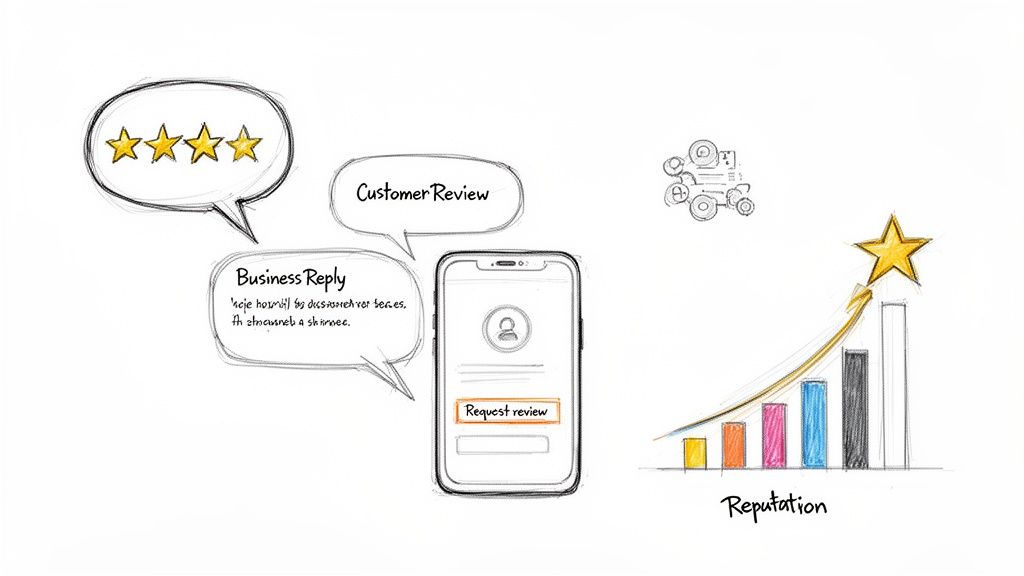
Think of positive reviews as the modern-day version of word-of-mouth. They’re a direct line to building trust and credibility, and they happen to be one of the most powerful ranking factors in local search. When was the last time you hired a local service without at least glancing at their star rating? Probably never.
This social proof is a massive signal to both potential customers and search engines that your business is legitimate, reliable, and valued by the community. A steady stream of authentic feedback isn’t just a “nice-to-have”—it’s an absolute cornerstone of any serious local SEO strategy.
But great reviews don't just happen by accident. You can't just sit back and hope for the best. It requires a proactive, systematic approach to requesting, managing, and, most importantly, responding to every single piece of feedback you receive.
Proactively Generating Authentic Reviews
The absolute best time to ask for a review is right after you’ve completed a job and the client is thrilled with the result. Their satisfaction is at its peak. But how you ask makes all the difference. A generic, pushy request feels impersonal and is easy to ignore. The real goal is to make it incredibly simple and natural for a happy customer to share their experience.
This means building the "ask" right into your workflow. For example, a quick follow-up email or text message sent a few hours after the service is done can be wildly effective. The key is to include a direct link straight to your Google review page to remove every ounce of friction.
Making the right ask at the right time is crucial. Here’s a look at what separates a successful request from one that gets ignored.
Effective Vs Ineffective Review Request Strategies
| Strategy | Why It Works (or Fails) | Implementation Tip |
|---|---|---|
| Personalized Email Follow-Up | It feels personal and shows you value their specific business. It works because it's timely and direct. | "Hi [Client Name], we loved helping you with [specific service] today. Would you mind sharing your experience on Google? It helps us a lot!" |
| Generic Mass Email Blast | This often fails because it's impersonal and easily ignored. Customers see it as a generic marketing email, not a genuine request. | Avoid sending a blanket request to your entire email list at once. Personalization is key. |
| Direct Link via SMS | This method has a very high open rate and makes it incredibly easy for the customer to act immediately from their phone. | "Thanks for choosing us! Here's a quick link to leave us a review: [shortened Google link]." |
| Verbally Asking at End of Service | This can be effective but often fails because the customer forgets by the time they get home. There's no direct call to action. | If you ask in person, always follow up with a text or email containing the link to make it easy for them. |
Ultimately, a multi-channel approach often works best, but the guiding principle is always to make it personal and easy.
The Critical Importance of Responding to Every Review
Getting reviews is only half the battle. How you respond to them—both the glowing and the critical—is just as important. Responding to reviews shows potential customers that you're engaged, attentive, and genuinely care about feedback. It also sends strong positive signals to Google's algorithm.
A simple thank you on a positive review reinforces that customer's good feelings and shows appreciation to anyone reading it. For a negative review, a thoughtful and professional response can completely turn a bad situation around, demonstrating accountability and your commitment to making things right.
Key Insight: Never, ever ignore a negative review. A public, professional response can be more powerful than ten positive reviews because it shows future customers how you handle problems. It proves you're a business that stands by its work.
Creating a Simple and Effective Response Workflow
Managing responses doesn't need to be a huge time-sink. Consistency is the key. You just need a simple system to acknowledge feedback promptly. For positive reviews, a genuine "Thank you for your business, we're so glad you're happy!" goes a long way.
For negative feedback, a structured approach is your best friend:
- Acknowledge and Apologize: Start by thanking them for the feedback and apologizing that their experience wasn’t what it should have been.
- Take It Offline: Offer to resolve the issue directly. Provide a phone number or email for them to contact a specific person. This shows you're serious about fixing it without getting into a public back-and-forth.
- Keep it Professional: Stay calm and avoid getting defensive. The real audience for your response is every future customer reading it, not just the upset client.
Strong client communication is the bedrock of a stellar reputation. For a deeper dive, our article on client communication best practices is packed with actionable advice that can help improve every customer interaction, including your review responses. When you start turning customer feedback into a conversation, you transform simple ratings into a powerful engine for local growth.
Answering Your Top Local SEO Questions
Even with a solid plan in place, local SEO can throw some curveballs. It’s natural to have questions pop up as you get into the weeds of optimizing your business. Let’s clear up some of the most common uncertainties I hear from service business owners.
Getting these details right is often the difference between a strategy that works and one that just spins its wheels. Think of this as the practical Q&A session that bridges the gap between theory and real-world results.
How Long Does It Take to See Local SEO Results?
This is the big one, isn't it? The honest answer is, it's a marathon, not a sprint. Local SEO is all about building trust and authority with search engines, and that simply doesn't happen overnight.
You can typically expect to see the first signs of life—maybe some upward movement in the local pack rankings or a small bump in "near me" traffic—within three to six months of consistent work.
However, for those game-changing results where you have a steady, predictable stream of local leads coming in, you should plan for a timeline of six months to a full year. Several things can speed this up or slow it down:
- Your Competition: Trying to rank as a plumber in a major city is a different ballgame than being the only specialized landscaper in a small town. The more crowded your market, the longer the climb.
- Your Starting Point: If you're starting from scratch or, worse, have a digital footprint riddled with incorrect information, there's cleanup to do before you can even start building.
- Your Consistency: This isn't a "set it and forget it" deal. Sustainable momentum comes from regularly updating your GBP, actively seeking reviews, and creating fresh local content.
Do I Need a Physical Address to Rank Locally?
This is a huge point of confusion for service-area businesses—the plumbers, electricians, and landscapers who travel to their customers. The short answer is no, you don't need to display a physical address to show up in local search results.
Google is built for this. When you set up your Google Business Profile, you can classify yourself as a Service-Area Business (SAB). This lets you hide your home address while clearly defining the specific towns, counties, or zip codes you serve. Your business will still absolutely appear on Google Maps for relevant searches within that service area.
One crucial detail: You must have a legitimate physical address (not a P.O. Box or a virtual office) where you can receive mail. Google will send a verification postcard here to confirm your business is real. You just don't have to make that address public on your profile.
For an even deeper dive into every facet of local search, this comprehensive guide on how to improve local SEO is an excellent resource.