HVAC Maintenance Checklist: 7 Templates for Service Techs
Run the cooling checklist in spring and the heating checklist in fall. Seven copy-paste HVAC maintenance checklists cover AC, furnace, heat pump, mini split, packaged and light commercial units, plus a customer report.
Josh · Nov 6, 2026 · 16 min read
- hvac maintenance checklist
- hvac tune-up checklist
- preventive maintenance checklist
- hvac service template
- hvac business
An HVAC maintenance checklist is a one-page list of the checks you run during a tune-up, with room for readings, findings and a customer signature. Run the cooling checklist in spring and the heating checklist in fall, and keep one version for each type of system you service. The seven templates below cover central AC, gas furnaces, heat pumps, mini splits, packaged units, light commercial mechanical rooms, and the visit report you leave behind. Copy them, replace the brackets with your own details, and print them or load them on a tablet.
What every HVAC maintenance checklist needs
ENERGY STAR advises annual pre-season check-ups, with the cooling system checked in spring and the heating system in fall. It adds that contractors get busy once summer and winter arrive. That timing is your booking calendar, so offer tune-up slots before the weather fills your schedule with breakdowns.
Every checklist, whatever the system, needs five parts:
- A header with the customer, address, date, tech, and the equipment make, model, serial number and age.
- One line per task, marked OK, fixed, not applicable, or needs repair.
- Blanks for the readings you take, such as voltage and amps.
- A findings section that lists each repair in plain words, with the price and whether the customer approved it.
- A sign-off line for the customer's name and the date.
The timing differs by system. Trane's guidance sorts it like this:
| System | Visit timing | Source |
|---|---|---|
| Central AC | Once a year, in spring before cooling season | Trane AC page |
| Gas furnace | Once a year, in fall before heating season | Trane furnace page |
| Heat pump | Twice a year, fall and spring | Trane heat pump page |
| Ductless mini split | Twice a year, before heating and before cooling | Trane ductless page |
| Packaged system | Twice a year, before heating and before cooling | Trane packaged page |
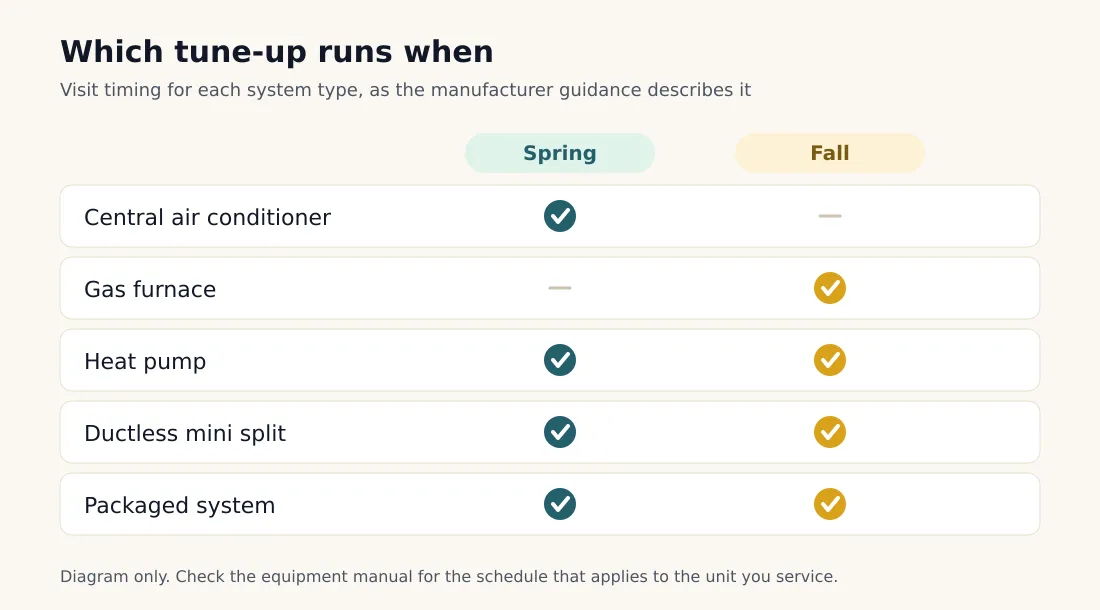
Spring and fall visits by system type. Diagram only.
ENERGY STAR even suggests tying the check-ups to the spring and fall clock changes. That is an easy cue to put on your own reminder list.
1. Central AC spring tune-up checklist
This one fits a split-system central air conditioner before cooling season. It follows the items ENERGY STAR and Trane list for a typical check-up: electrical connections, moving parts, drain, controls, coils, refrigerant and blower.
CENTRAL AC SPRING TUNE-UP
[Business name] · [Phone] · License #: [Number]
Customer: [Name]    Date: [Date]    Tech: [Name]
Address: [Street, city]
Equipment: [Make] [Model]  Serial: [Number]  Age: [Years]
Refrigerant type (data plate): [Type]

Mark each line: OK / FIXED / N/A / NEEDS REPAIR

OUTDOOR UNIT
[ ] Plants and debris cleared back 2 ft from the unit
[ ] Condenser coil inspected    [ ] Cleaned    [ ] Extra charge approved
[ ] Fan motor and blade checked, lubricated where required
[ ] Electrical connections tightened
[ ] Voltage: [V]    Compressor amps: [A]    Fan amps: [A]

INDOOR UNIT
[ ] Filter checked    [ ] Changed    Size: [__ x __ x __]
[ ] Evaporator coil inspected    [ ] Cleaned
[ ] Blower motor and wheel inspected and cleaned
[ ] Condensate drain line and pan checked, water flows
[ ] Supply registers and return vents open

SYSTEM
[ ] Thermostat settings and operation checked
[ ] Controls checked: starts, runs and shuts off properly
[ ] Refrigerant charge checked: [Reading]    Adjusted: [Y/N]
[ ] Refrigerant leak check done: [Result]
[ ] Refrigerant added or recovered: [Amount]
[ ] Supply air temp: [F]    Return air temp: [F]

FINDINGS AND RECOMMENDED REPAIRS
1. [Finding]    Price: [Amount]    Approved: [Y/N]
2. [Finding]    Price: [Amount]    Approved: [Y/N]

Customer: ____________________    Date: [Date]
A few edits make it yours:
- Give coil cleaning its own line and price. Trane notes that cleaning the coils is most likely an additional charge, so the customer should see it before you start.
- ENERGY STAR says airflow problems can reduce a system's efficiency by up to 15 percent. If you measure airflow or static pressure, add a blank for it next to the blower line.
- Log any refrigerant you add or recover. EPA's Section 608 program prohibits intentionally venting refrigerants while servicing air conditioning equipment, and its pages list the recordkeeping rules that apply to your work.
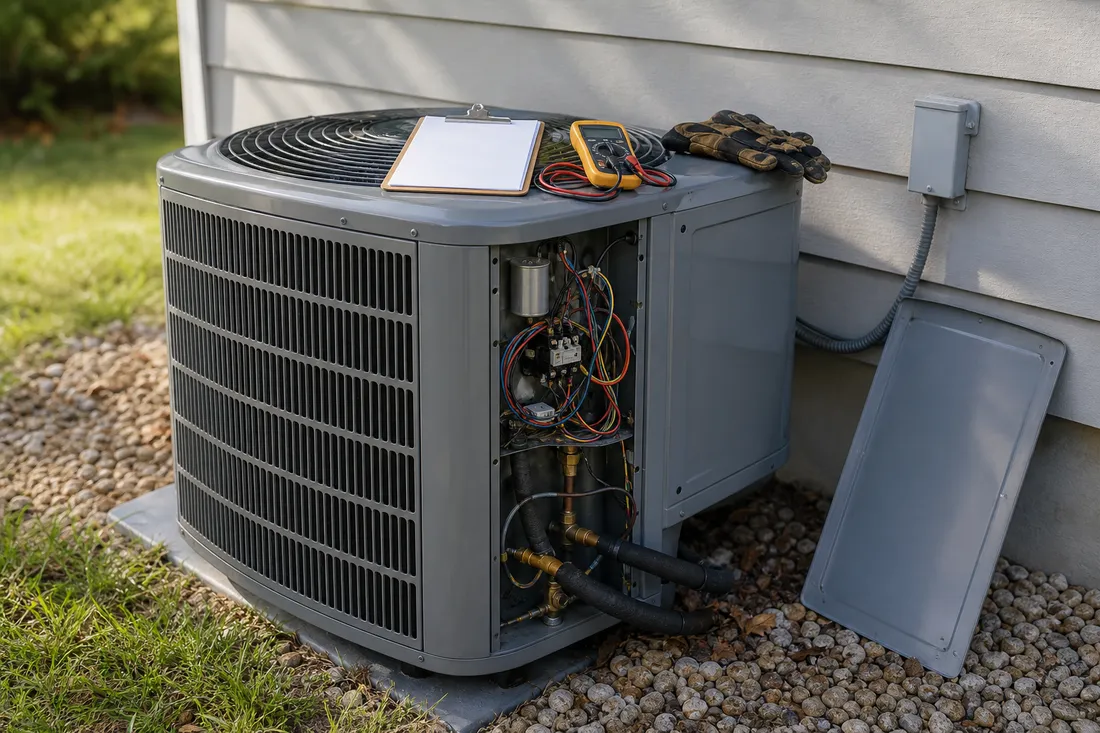
A condenser opened up for a spring tune-up. Generated scene, not a customer photo.
2. Gas furnace fall tune-up checklist
Run this before heating season on a gas furnace. The items come from Trane's list of what a dealer does during annual furnace maintenance, plus the gas and combustion checks ENERGY STAR names.
GAS FURNACE FALL TUNE-UP
[Business name] · [Phone] · License #: [Number]
Customer: [Name]    Date: [Date]    Tech: [Name]
Address: [Street, city]
Equipment: [Make] [Model]  Serial: [Number]  Age: [Years]

Mark each line: OK / FIXED / N/A / NEEDS REPAIR

VENTING AND AIR
[ ] Flue pipe, chimney and vent connector clear of obstruction
[ ] Vent connector in place, slopes upward, no holes or heavy corrosion
[ ] Condensing furnace: intake and exhaust lines sound
[ ] Return air duct connections sealed and sound
[ ] Furnace support: no sagging, cracks or gaps at the base
[ ] Filter checked    [ ] Changed    Size: [__ x __ x __]

COMBUSTION
[ ] Burners and flame sensor checked and cleaned
[ ] Burner flames steady and in adjustment: [Color, steady Y/N]
[ ] Gas valve checked    Gas pressure: [Reading]    Adjusted: [Y/N]
[ ] Heat exchanger checked for cracks, holes or leaks
[ ] Older furnace: pilot system cleaned and tuned

AIR MOVEMENT AND CONTROLS
[ ] Blower and blower motor inspected and cleaned
[ ] Condensate drain line and pan checked for cracks or clogs
[ ] Thermostat operation checked
[ ] Run in heating mode: output within manufacturer's specs
[ ] Voltage: [V]    Blower amps: [A]

SAFETY
[ ] Carbon monoxide detector present in the home
[ ] Customer told what to do if they smell gas

FINDINGS AND RECOMMENDED REPAIRS
1. [Finding]    Price: [Amount]    Approved: [Y/N]
2. [Finding]    Price: [Amount]    Approved: [Y/N]

Customer: ____________________    Date: [Date]
Trane's furnace page recommends carbon monoxide detectors installed according to local laws, which is why the safety lines are on the form. It also tells homeowners that a steady blue flame is normal and yellow or orange flickering is a reason to call. Write what you saw in the flame line, so the customer has a record to compare next year.
Trane puts a yearly furnace tune-up at roughly $70 to $200 and says a furnace with yearly maintenance can last 15 to 20 years or more. Those two numbers make a good line for your price sheet or your plan flyer.
3. Heat pump spring and fall checklist
A heat pump works in both seasons, so it gets two visits. Trane lists the same core checks for both and adds a defrost control check in fall only. Keep one form and tick the season.
HEAT PUMP SERVICE VISIT
[Business name] · [Phone] · License #: [Number]
Customer: [Name]    Date: [Date]    Tech: [Name]
Season:  [ ] Spring    [ ] Fall
Equipment: [Make] [Model]  Serial: [Number]  Age: [Years]

Mark each line: OK / FIXED / N/A / NEEDS REPAIR

AIRFLOW
[ ] Ducts, filters, blower and condenser fan motor checked for dirt
[ ] Indoor and outdoor coils checked    [ ] Cleaned
[ ] Adequate airflow confirmed
[ ] Shrubs and plants 2 ft or more from the unit on all sides
[ ] Unit raised above the ground, not under a leaking gutter
[ ] Condensing unit base-pan drain holes clear
[ ] Registers and return vents open and clear

REFRIGERANT AND CONTROLS
[ ] Refrigerant level checked: [Reading]
[ ] Leak check done: [Result]    Refrigerant added: [Amount]
[ ] Reversing valve inspected
[ ] Defrost control operation checked (fall only)
[ ] Heating locked out when thermostat calls for cooling, and the reverse
[ ] Sensors verified

ELECTRICAL
[ ] Terminals inspected, cleaned and tightened as needed
[ ] Non-conductive coating applied where needed
[ ] Motors lubricated, belts checked for tightness and wear
[ ] Voltage: [V]    Compressor amps: [A]    Fan amps: [A]

FINDINGS AND RECOMMENDED REPAIRS
1. [Finding]    Price: [Amount]    Approved: [Y/N]
2. [Finding]    Price: [Amount]    Approved: [Y/N]

Customer: ____________________    Date: [Date]
The airflow clearances come from Trane's homeowner tips. They say to keep shrubs at least 2 ft away on all sides and to raise a heat pump 4 to 8 inches off the ground for drainage. Trane also says minor icing is handled by the defrost cycle, while heavy snow or ice build-up that restricts airflow needs attention. Add a line for it on winter visits in cold areas.
Trane's page cites a range of $100 to $300 for a heat pump tune-up, and says the cost may be lower with a maintenance plan.
4. Ductless mini split checklist
Mini splits have no ducts to inspect, but they have several indoor heads and a lot of small drains. Trane recommends service twice a year, once before heating season and once before cooling season. Add a row for each indoor unit.
DUCTLESS MINI SPLIT SERVICE VISIT
[Business name] · [Phone] · License #: [Number]
Customer: [Name]    Date: [Date]    Tech: [Name]
Season:  [ ] Before heating    [ ] Before cooling
Outdoor unit: [Make] [Model]  Serial: [Number]
Indoor units: [Number]   Zones: [Single / Multi]

Mark each line: OK / FIXED / N/A / NEEDS REPAIR

OUTDOOR UNIT
[ ] Electrical connections spot-checked for looseness,
    shorts or signs of overheating
[ ] Run capacitors checked for bulging, deformation or leaks
[ ] Condenser coil rinsed with low-pressure water,
    power off first
[ ] Fins checked    [ ] Straightened with fin comb
[ ] Refrigerant lines checked for leaks, flare connections
    checked and tightened
[ ] Voltage: [V]    Compressor amps: [A]

INDOOR UNITS (repeat for each head)
Head 1: [Room]
[ ] Filter removed and cleaned
[ ] Drain hose checked, water flows freely
[ ] Unit exterior wiped down
[ ] Clearance around unit: no shelves or furniture crowding it
Head 2: [Room]
[ ] Filter removed and cleaned
[ ] Drain hose checked, water flows freely
[ ] Unit exterior wiped down
[ ] Clearance around unit

FINDINGS AND RECOMMENDED REPAIRS
1. [Finding]    Price: [Amount]    Approved: [Y/N]

Customer: ____________________    Date: [Date]
The items match Trane's dealer list for ductless systems: electrical connections, run capacitors, refrigerant leaks, and drain hoses. Trane notes that leaks are especially common at flare connections. It also warns against high water pressure on the outdoor coil because the fins bend easily, and says a fin comb can straighten them.
Ask the customer which filters they clean themselves. Trane says to clean them at least as often as the owner manual recommends, or more often with pets or dust sensitivity.
5. Packaged unit checklist
Packaged systems put the air conditioner, heat pump or furnace, and air handler in one cabinet, usually on a roof or in a garage. Trane recommends a professional check before heating season and again before cooling season.
PACKAGED SYSTEM SERVICE VISIT
[Business name] · [Phone] · License #: [Number]
Customer: [Name]    Date: [Date]    Tech: [Name]
Season:  [ ] Before heating    [ ] Before cooling
Unit location: [Roof / Ground / Garage]
Type: [ ] AC  [ ] Heat pump  [ ] Gas-electric  [ ] Dual fuel
Equipment: [Make] [Model]  Serial: [Number]  Age: [Years]

Mark each line: OK / FIXED / N/A / NEEDS REPAIR

AIR SIDE
[ ] Ducts, filters, blower and outdoor coil checked for dirt
[ ] Duct leakage checked
[ ] Airflow confirmed adequate
[ ] Filter changed    Size: [__ x __ x __]
[ ] Outdoor coil cleaned if dirty

REFRIGERANT
[ ] Refrigerant charge corrected: [Reading]
[ ] Leaks repaired: [Location]
[ ] Refrigerant added or recovered: [Amount]

ELECTRICAL AND CONTROLS
[ ] Terminals cleaned and tightened, non-conductive
    coating applied if needed
[ ] Motors lubricated, belts checked for tightness and wear
[ ] Heating locked out when thermostat calls for cooling,
    and the reverse
[ ] Thermostat operation checked
[ ] Voltage: [V]    Compressor amps: [A]    Fan amps: [A]

GAS-ELECTRIC AND DUAL FUEL ONLY
[ ] Burners, flame sensor and gas pressure checked
[ ] Heat exchanger checked for cracks, holes or leaks
[ ] Flue and vent clear

FINDINGS AND RECOMMENDED REPAIRS
1. [Finding]    Price: [Amount]    Approved: [Y/N]

Customer: ____________________    Date: [Date]
The first three sections mirror Trane's packaged system dealer checklist. The gas-electric block borrows the furnace checks from template 2, since a gas-electric cabinet holds a gas furnace.
Trane tells owners to maintain the system according to the manufacturer's manual. If the manual lists a step your form does not, add the line. The form is a floor, not a ceiling.
6. Light commercial mechanical room walk-through
Shops, small offices and apartment buildings often hire the same tech for the building's mechanical room. EPA publishes a short-form HVAC checklist for buildings, and this template borrows its mechanical room, controls, outdoor air and air handler prompts. It adds your own service lines.
LIGHT COMMERCIAL HVAC WALK-THROUGH
[Business name] · [Phone] · License #: [Number]
Building: [Name]    Address: [Street, city]
Completed by: [Name]    Date: [Date]    File #: [Number]
Contact on site: [Name, phone]

MECHANICAL ROOM
[ ] Room clean and dry
[ ] No stored refuse or chemicals
[ ] Items needing attention: [Describe]
[ ] Written preventive maintenance plan in use: [Y/N]

CONTROLS
[ ] Control system type: [Type]
[ ] System operates as designed
[ ] Date of last calibration: [Date]

BOILER (if present)
[ ] Rated Btu input: [Number]
[ ] Combustion air: at least 1 sq in of free area
    per 2,000 Btu input
[ ] Fuel or combustion odors: [Y/N]

AIR HANDLING UNIT
Unit ID: [Tag]    Area served: [Space]
[ ] Outdoor air intake location noted: [Location]
[ ] Nearby contaminant sources: [Describe]
[ ] Bird screen in place and unobstructed
[ ] Filters checked    [ ] Changed    Size: [__ x __ x __]
[ ] Coils, drain pan and blower inspected
[ ] Belts and motors checked for wear

ROOFTOP AND PACKAGED UNITS
[ ] Unit ID: [Tag]    Service completed: [Template 5]

FINDINGS AND RECOMMENDED REPAIRS
1. [Finding]    Price: [Amount]    Approved: [Y/N]

Site contact: ____________________    Date: [Date]
The boiler line, the bird screen and the mechanical room questions all come from EPA's form. Delete any section that does not apply to the building.
Property managers can often handle a few items themselves. Buildium's guidance says they can change filters, clear debris around units and check thermostat settings, while electrical and refrigerant work should go to a professional. It also notes that service contracts often include twice-a-year check-ups at a fixed price with priority service in emergencies.
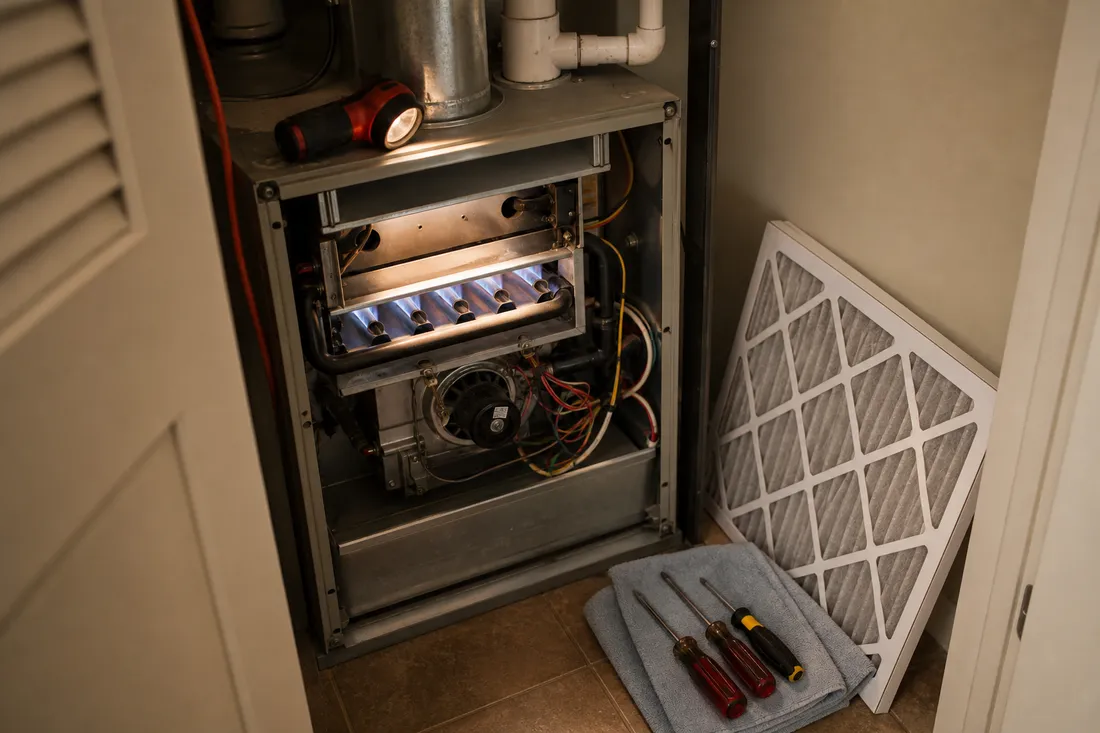
A furnace closet set up for service. Generated scene, not a customer photo.
7. Customer visit report and filter leave-behind
The checklist is your record. The visit report is the customer's. It turns your tick marks into a page a homeowner can read in a minute and file.
YOUR HVAC SERVICE REPORT
[Business name] · [Phone] · [Email]
Customer: [Name]    Address: [Street]
Visit date: [Date]    Tech: [Name]
System serviced: [Type, make, model]

WHAT WE DID
- [e.g. Cleaned the outdoor coil and checked the electrical connections]
- [e.g. Checked the refrigerant charge and the condensate drain]
- [e.g. Changed the filter, size 16 x 25 x 1]

WHAT WE FOUND
[ ] Nothing needing repair
[ ] Repairs recommended (below)

1. [Plain-language finding]    Price: [Amount]
2. [Plain-language finding]    Price: [Amount]
Repairs are priced separately from this maintenance visit.

YOUR FILTER
Size: [__ x __ x __]    Type: [Brand, thickness]
Check it again by: [Date]
Change it sooner if you have pets or allergies.

NEXT VISIT
Recommended: [Spring / Fall], [Month]
Your plan: [Plan name or "No plan"]

Questions? Call [Phone] or reply to this email.
Trane's furnace page gives filter guidelines you can print on the leave-behind:
- A home with no pets: every 30 to 90 days.
- A home with one pet: every 30 to 60 days.
- More than one pet, or people with allergies or asthma: every 20 to 45 days.
Trane's AC page says to plan on every one to three months. Its furnace and heat pump pages add that thicker filters may need changing less often than thin 1-inch ones. Pick the range that matches the system you serviced, and write a date, not a range, on the report.
The line "Repairs are priced separately" matches how Trane describes it: the cost of parts and repairs is not included in the maintenance charge. Saying so up front avoids a tense conversation at the door.
What to tell customers about price
Customers will search before they book, and Trane publishes ranges you can compare yourself to. Its AC page says an annual visit should run between $100 and $350. Its furnace page says $70 to about $200, and its heat pump page cites $100 to $300. All three say cost varies by region and by system condition, and that a maintenance plan can lower it.
Trane also tells homeowners to ask to see a company's maintenance checklist before scheduling, because some companies charge extra for certain tasks. That is a reason to publish yours. A customer who can read what a tune-up includes will not wonder what they are paying for.
Three habits keep the price conversation short:
- Put the coil cleaning and any refrigerant charge on separate lines with their own prices.
- List repairs on the report with a price and an approval box, never inside the tune-up total.
- Offer a plan with two visits a year for the systems that need both, such as heat pumps, mini splits and packaged units.
FAQ
How often should an HVAC system get maintenance?
Once a year for a central AC or a gas furnace, and twice a year for heat pumps, mini splits and packaged systems. Trane schedules the AC in spring and the furnace in fall. ENERGY STAR gives the same split: cooling in spring, heating in fall, before contractors get busy.
What does an HVAC maintenance visit include?
Electrical checks, lubrication, the drain, controls and the thermostat, plus cooling or heating items. ENERGY STAR's list adds coils, refrigerant level and blower cleaning for cooling, and gas connections, burner combustion and the heat exchanger for heating. Your checklist should name each one.
Is the filter change the tech's job or the customer's?
Both. ENERGY STAR tells homeowners to inspect, clean or change filters once a month. Trane says every one to three months for an AC, depending on the home. Change it during the visit, then leave a dated reminder with the report.
Can I use one checklist for every system?
No. A furnace needs combustion and venting checks that an AC does not, and a mini split needs a row for each indoor head. Keep one form per system type, and follow the manufacturer's manual where it asks for more.
How much does an HVAC tune-up cost?
Trane puts it at $100 to $350 for an AC, $70 to about $200 for a furnace, and $100 to $300 for a heat pump. Your price depends on your market and what your checklist includes.
Put your tune-up visits on a site customers can book
A checklist only helps if the visit gets booked. Kejoola builds a four-page site for your business, with Home, Services, Blog and Contact pages, and online booking. The booking form asks for name, email, phone and a notes box, so a customer can write the system type, its age and the last service date in the notes before you arrive.
Sources
- ENERGY STAR: Maintenance Checklist
- Trane: Air Conditioner Maintenance
- Trane: Gas Furnace Maintenance
- Trane: Heat Pump Maintenance
- Trane: Ductless System Maintenance
- Trane: Packaged System Maintenance
- EPA: HVAC Checklist, Short Form
- EPA: Section 608 Refrigerant Management
- Buildium: Preventative HVAC Maintenance Checklist