Handyman Contract: 6 Free Templates to Copy and Use
A handyman contract names both parties, lists the tasks, sets the price and payment dates, and carries two signatures. Six forms to copy: one-visit repair, hourly work, fixed-price project, change order, recurring maintenance and completion sign-off.
Josh · Nov 10, 2026 · 12 min read
- handyman contract
- handyman contract template
- handyman services agreement
- handyman change order
- handyman scope of work
- handyman business
A handyman contract is a written agreement between you and a homeowner that lists the tasks, the price, the payment dates and the schedule, and carries both signatures. The six forms below cover the paperwork most handyman jobs need: a one-visit repair agreement, an hourly work agreement, a fixed-price project contract, a change order, a recurring maintenance agreement and a completion sign-off. Copy one into a document, replace the brackets with your own details, and have it checked against your state's rules before you use it.
What a handyman contract has to cover
eForms lists six items for a handyman contract: the scope of work, the payment, the location, the timeline, insurance and licensing. ContractsCounsel adds materials and supplies, a warranty, a change order process, and terms for ending or canceling the agreement.
The scope of work carries the most weight. eForms points out that handyman jobs are nearly limitless and rarely come with supporting paperwork, so the contract should describe each task as specifically as you can. It should also say who supplies the materials and who supplies any special tools. If you buy the parts, note their cost on the form. If the homeowner buys them, say so, so nobody argues about a faucet that was the wrong size.
Payment comes next. eForms notes that handymen often work for individuals rather than businesses, and that many ask for a down payment. The contract should show the price, the payment method and when each payment is due.
Timeline is easy to skip on a small job and easy to regret. A start date and an expected finish date are the minimum. For hourly work, eForms suggests naming the hours of the day as well.
Check three rules before you send a contract
These rules differ by state, so confirm each one with your licensing board or a local attorney.
License limits. Many states set a dollar limit on work you can do without a contractor's license. California is one example. The state's contractor board says a law effective January 1, 2025 lets an unlicensed person complete projects up to $1,000, covering labor, materials and all other costs, as long as they hire no workers and no building permit is needed. An unlicensed person who advertises must state that they are not licensed. Your state may set a different limit or none, so look up yours.
Deposits and progress payments. The same California board advises that a down payment should not exceed 10 percent of the contract price, and that later payments should not exceed the value of the work completed or materials delivered. Whether that is a rule or advice where you work is a question for your own state's board.
The three-day cancellation right. The FTC's Cooling-Off Rule gives buyers three days to cancel certain sales made at their home, and it applies when a homeowner invites a salesperson to make a presentation there. The FTC says the sale must come with two copies of a cancellation form. The rule does not cover sales under $25 made at the buyer's home, sales needed to meet an emergency, or sales made entirely online, by mail or by phone. It also does not cover a sale made because the buyer asked the seller to visit and repair or maintain personal property, although anything bought beyond that request is covered. Read the FTC's guidance and decide whether your jobs fall inside the rule or one of its exceptions.
Template 1: One-visit repair agreement
Use this for a single visit that fixes a short list of small things: a door that sticks, a loose railing, a leaking trap under a sink. It fits on one page, which is why homeowners will actually read it.
HANDYMAN REPAIR AGREEMENT (ONE VISIT)

Date: [date]
Handyman: [name or business], [phone], [email]
License no.: [number, if your state requires one]
Homeowner: [name], [property address], [phone], [email]

1. TASKS
The handyman will complete these tasks at the address above:
a. [task and location, for example "re-hang bedroom door, adjust strike plate"]
b. [task and location]
c. [task and location]
Not included: [anything the homeowner may assume is covered].

2. MATERIALS AND TOOLS
Materials supplied by: [handyman / homeowner].
Materials cost, if supplied by the handyman: $[amount], billed at [cost / cost plus [percent]].
The handyman brings the tools needed for these tasks.

3. PRICE
[Flat price of $[amount] for all tasks above] OR
[Hourly rate of $[amount] with a [minimum] hour minimum].
Payment is due [on completion / within [number] days] by [cash, check or card].

4. SCHEDULE
Visit date: [date], between [start time] and [end time].
The homeowner or an adult they name will give access to the work area.

5. ANYTHING NEW
Work that is not listed in section 1 needs a written change order,
signed by both of us, before the handyman starts it.

Signed: ____________________ Handyman    Date: ________
Signed: ____________________ Homeowner   Date: ________
Keep the task list in plain words. "Fix the fence" invites a different reading from each person, while "replace three cracked pickets on the east side and re-fasten the gate latch" does not.
Template 2: Hourly work agreement
Use this when the job is open-ended and a flat price would be a guess, such as a day of small repairs around a rental or a list that keeps growing. The homeowner pays for time, so the form has to say how time is counted.
HANDYMAN HOURLY WORK AGREEMENT

Date: [date]
Handyman: [name or business], [phone], [email]
Homeowner: [name], [property address], [phone], [email]

1. WORK
The handyman will work through the homeowner's task list, attached as
page 2, in the order the homeowner chooses.

2. RATE AND TIME
Rate: $[amount] per hour, billed in [15 / 30 / 60]-minute increments.
Time starts when the handyman begins work at the property
[and includes / and does not include] travel between job sites.
Estimated total: [number] hours. The handyman will call the homeowner
before passing [number] hours.

3. MATERIALS
Supplied by: [handyman / homeowner].
Materials bought by the handyman are billed at [receipt cost / receipt
cost plus [percent]]. Receipts are attached to the final bill.

4. PAYMENT
Payment is due [at the end of each visit / within [number] days of the
bill] by [cash, check or card].

5. ACCESS AND SCHEDULE
Start date: [date]. Daily hours: [start] to [end].
The homeowner will make sure the handyman has access to each work area
and a place to park.

6. WORK OUTSIDE THE LIST
Tasks added to the list after signing are recorded on a change order
before work begins on them.

Signed: ____________________ Handyman    Date: ________
Signed: ____________________ Homeowner   Date: ________
The call-before line is worth keeping. An hourly job with an estimate and a promise to call is easier to approve than one that ends with a surprise bill.
Template 3: Fixed-price project contract
Use this for a multi-task job with one total: refreshing a bathroom, finishing a basement wall, or installing shelving and trim through a house. PandaDoc's handyman contract is built around the same sections, and this version is shortened for small projects.
HANDYMAN PROJECT CONTRACT (FIXED PRICE)

Date: [date]
Handyman: [name or business], [address], [phone], [email]
License no.: [number, if required]   Insurance: [carrier, policy no.]
Homeowner: [name], [property address], [phone], [email]

1. SCOPE OF WORK
The handyman will complete the work described below at the property.
[Numbered list of tasks, with rooms and quantities.]
Excluded: [electrical, plumbing, structural, permitted work, or other
items you will not do].

2. PERMITS AND APPROVALS
[Homeowner / Handyman] will get any permit the work requires.
The handyman holds the licenses that the work in section 1 requires.

3. PRICE AND PAYMENT SCHEDULE
Total price: $[amount], including labor and [materials / labor only].
Deposit: $[amount], due at signing.
Progress payment: $[amount], due [milestone].
Final payment: $[amount], due when the homeowner signs the completion
sign-off.

4. SCHEDULE
Start: [date]. Expected finish: [date].
Weather, material delivery delays and homeowner changes can move
these dates.

5. SITE CONDITIONS
The price is based on the walk-through on [date]. If the handyman finds
hidden damage, such as rot, mold, pests, damaged framing or code
problems, the handyman stops work on that area and writes a change order
before continuing.

6. INSURANCE
The handyman carries liability insurance. Each party will share a
copy of the insurance certificate on request.

7. CHANGES
Work outside section 1 is done only after a signed change order.

8. WARRANTY
The handyman will correct faulty workmanship reported within [number]
months of completion at no charge. Materials carry the manufacturer's
warranty, if any.

9. IF WE DISAGREE
We will try to settle any disagreement directly first. If that fails,
we will use [mediation / small claims court / the courts in [county]].
This contract follows the laws of [state].

Signed: ____________________ Handyman    Date: ________
Signed: ____________________ Homeowner   Date: ________
Section 5 does the quiet work. PandaDoc's version names mold, termites, structural damage and code violations as examples of unforeseen complications, and tells the handyman to stop and draft a change order. A clause like that turns an argument into a procedure.
Template 4: Change order
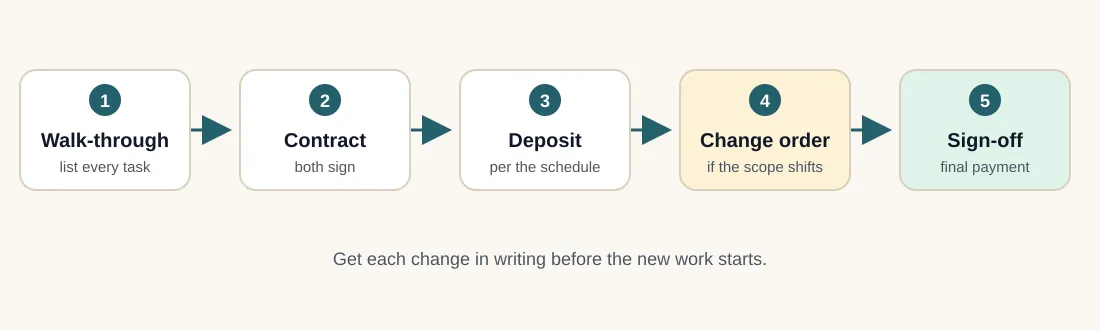
Use this every time the work moves away from the signed scope, in either direction. Both PandaDoc and ContractsCounsel treat the change order as a standard part of a handyman agreement, and PandaDoc says the change order should be signed by both parties before the new work starts.
CHANGE ORDER No. [number]

Original contract dated: [date]
Handyman: [name or business]
Homeowner: [name], [property address]

CHANGE REQUESTED BY: [homeowner / handyman]
REASON: [homeowner request / hidden damage found / material
unavailable / other]

DESCRIPTION OF CHANGE
[Plain description of what is added, removed or replaced.]

EFFECT ON PRICE
Original total:            $[amount]
This change:               [+/-] $[amount]
New total:                 $[amount]

EFFECT ON SCHEDULE
Original finish date: [date]    New finish date: [date]

Work described here will not start until both signatures are below.

Signed: ____________________ Handyman    Date: ________
Signed: ____________________ Homeowner   Date: ________
Number each change order and staple it to the contract. When a project has three of them, the numbers show which one the homeowner approved.
Template 5: Recurring maintenance agreement
Use this for a landlord, a property manager or a homeowner who wants the same set of small jobs done on a regular visit: smoke alarm batteries, caulk touch-ups, loose hardware, door adjustments. The tasks repeat, so the agreement runs for a term instead of one job.
HANDYMAN MAINTENANCE AGREEMENT

Start date: [date]    Term: [number] months, renewing [monthly / yearly]
Handyman: [name or business], [phone], [email]
Client: [name or company], [billing address], [phone], [email]
Properties covered: [list of addresses]

1. VISITS
The handyman will visit each property [monthly / quarterly / twice a
year] and complete the checklist attached as page 2.

2. REQUESTS BETWEEN VISITS
The client can send a repair request by [phone / email / text]. The
handyman will reply within [number] business days with a visit time or a
price for work outside the checklist.

3. PRICE
Visit fee: $[amount] per visit, covering up to [number] hours.
Extra time: $[amount] per hour.
Materials are billed at [cost / cost plus [percent]].
Billed [after each visit / on the [day] of each month], due within
[number] days.

4. ACCESS
The client will make sure the handyman can enter each property and will
tell the handyman about pets, alarms and tenants who need notice.

5. LIMITS
The handyman does not do [electrical panel work, gas lines, roofing,
work needing a permit, other exclusions]. The handyman will say so in
writing when a request falls outside the agreement.

6. ENDING THE AGREEMENT
Either of us can end this agreement with [number] days' written notice.
The client pays for visits and materials up to the end date.

7. INSURANCE
The handyman carries liability insurance and will provide a certificate
on request.

Signed: ____________________ Handyman    Date: ________
Signed: ____________________ Client      Date: ________
The exclusions line keeps a friendly relationship from stretching into work you are not licensed or insured to do. If a repair is outside the list, the agreement already says you will put that in writing.
Template 6: Completion sign-off and final payment
Use this on the last day of any job, whichever of the five contracts you started with. PandaDoc's contract gives the homeowner a chance to review the finished work with the handyman before final payment and allows the homeowner to withhold final payment until problems are fixed. A one-page sign-off puts that conversation on paper.
COMPLETION SIGN-OFF

Contract dated: [date]    Change orders: [numbers, or "none"]
Handyman: [name or business]
Homeowner: [name], [property address]
Walk-through date: [date]

WORK COMPLETED
[ ] All tasks in the contract and change orders are done.
[ ] The work area has been cleaned up.

PUNCH LIST (items still to be corrected)
1. [item]    Due: [date]
2. [item]    Due: [date]

The homeowner accepts the work, except for the punch list above.

Final payment: $[amount], due [on signing / within [number] days].
Labor warranty runs [number] months from [date].

Signed: ____________________ Handyman    Date: ________
Signed: ____________________ Homeowner   Date: ________
Take photos of the finished work at the walk-through and send them to the homeowner. They answer later questions about what the room looked like on the last day.
Questions handymen ask
Do I need a contract for a small job?
Yes, a one-page agreement is enough. The Template 1 form takes a few minutes, and it settles the three questions that cause most small-job disputes: what you are fixing, who buys the parts, and what it costs.
Do I need a license to use these contracts?
That depends on your state and the size of the job. California, for example, lets an unlicensed person take projects up to $1,000 if they hire no workers and need no permit, and it requires the person to say they are unlicensed in any advertising. Check your own board's limit before you quote a larger job, and put your license number on the contract if your state requires one.
Can I ask for a deposit?
Often, but the amount may be limited. eForms notes that many handymen ask for a down payment, and California's contractor board advises keeping it to 10 percent of the contract price. Ask your licensing board what applies where you work.
Do I need a lawyer to review the templates?
Yes, once. State rules on deposits, cancellation notices, license numbers and lien rights differ, and the forms above are starting points rather than legal advice. A local attorney can adjust the clauses one time, and you can reuse the result.
Get repair requests online
A contract starts after a homeowner has asked for help, and many of those requests arrive while you are on a ladder. Kejoola gives a handyman business a four-page website with Home, Services, Blog and Contact pages and an online booking form. The form asks for a name, email, phone number and a notes box, so a homeowner can list the three things that need fixing and ask for a visit at night or on a weekend. The request is waiting when you climb down, and you call back to confirm the visit and send the agreement.