Painting Contract Template: 6 Free Forms to Copy and Use
A painting contract template names the painter and the owner, lists the surfaces, prep, products and coats, and sets the price, payment dates and signatures. Six forms to copy: interior, exterior, payment schedule, change order, warranty and sign-off.
Josh · Nov 7, 2026 · 11 min read
- painting contract template
- painting contract
- house painting agreement
- painting change order
- painting warranty
- painting contractor
A painting contract template is a written agreement that names the painter and the property owner, lists what gets painted and how, sets the price and payment dates, and carries both signatures. The six forms below cover the paperwork a painting job usually needs: an interior contract, an exterior contract, a payment schedule, a change order, a warranty statement and a completion sign-off. Copy one into a document, replace the brackets with your own details, and have it checked against your state's rules before you use it.

What a painting contract has to cover
PandaDoc's painting contract lists the parties, a detailed scope of work, the term of the agreement, the compensation and the termination clauses. It also says any change to the scope needs a change order, which may add fees that the original price did not include.
The scope does most of the work. Paintviz argues that most painting disputes are not about money but about what "painting the living room" meant. Did it include the ceiling, the closet interior or the window sashes? Its template answers that surface by surface, with the prep work, the product and sheen, and the number of coats written down, and it adds a line for work that is not included.
eForms adds a few points worth copying. It suggests the contract require work to meet industry standards, with minimums such as two coats of paint, proper priming, covering surfaces that are not being painted, and finishing edges and corners cleanly. It also says the client should name the preferred paint, because cheaper paints are less durable.
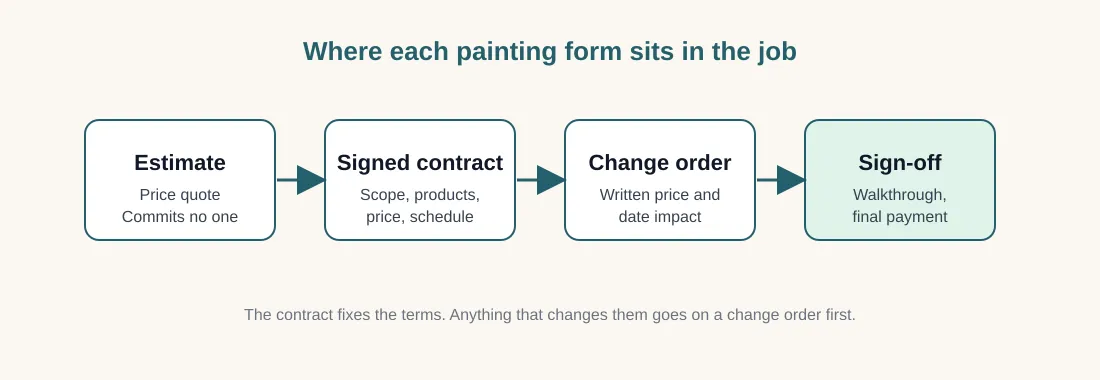
A contract is also where the estimate becomes binding. Paintviz puts it plainly: the estimate is the price quote and the contract is the binding agreement. An estimate commits nobody, and a contract locks in the scope, the products, the schedule and the payment terms. If you need the pricing side first, the painting estimate template covers it.
Before you send a contract
Check four things before any form goes to a customer.
First, state rules. Paintviz says contractor licensing, right-to-cancel windows and lien rules vary by state, and that several states cap deposits on home improvement contracts. It gives California's cap as $1,000 or 10 percent of the contract, whichever is less. Look up your own state's limit before you fill in the deposit line.
Second, the right to cancel. Paintviz notes that most states give homeowners a window to cancel a home improvement contract signed in their home, commonly three business days, and that the FTC's Cooling-Off Rule works the same way for door-to-door sales. Whether it applies to your job depends on where and how the contract was signed, so ask your licensing board.
Third, lead paint. The EPA says anyone paid to perform work that disturbs paint in homes, childcare facilities and preschools built before 1978 must be certified in lead-safe work practices, and that this includes sole proprietorships. If a house was built before 1978, add a line to the scope saying how you will handle it, and confirm your certification before you quote.
Fourth, a signature before paint. Paintviz warns that starting on a handshake leaves every later disagreement as your word against the customer's. Get the signed contract first.
Form 1: Interior painting contract
Use this for rooms, hallways and trim inside the home. PandaDoc's version commits the painter to cleaning, sanding, patching and priming where needed, protecting furniture and floors, and removing debris. The form below keeps that structure and adds the surface table that Paintviz recommends.
INTERIOR PAINTING CONTRACT

This agreement is between [Painter or company name] ("Painter") and
[Owner name] ("Owner") for the property at [address], dated [date].

SCOPE OF WORK
Area / surface | Prep included | Product, color and sheen | Coats
[Living room walls] | [Patch, sand, spot-prime] | [Brand, line, color number, sheen] | [2]
[Living room ceiling] | [Clean, patch] | [Brand, line, color number, sheen] | [2]
[Trim and doors] | [Sand, caulk] | [Brand, line, color number, sheen] | [2]

Not included: [carpentry repairs, wallpaper removal, moving heavy furniture].

MATERIALS
The Painter supplies all paint, tools and equipment. Substitutions of
product or color need the Owner's written approval.

PROTECTION AND CLEANUP
The Painter will cover floors and furniture, mask surfaces that are not
being painted, and remove debris at the end of each work day and at
completion.

SCHEDULE
Start: [date]. Finish: [date]. Dates may move for Owner-requested
changes or access delays.

PRICE
Total price: $[amount]. Payment follows the attached payment schedule.

CHANGES
Any change to scope, product or color after signing is made by a written
change order, signed by both parties before the changed work begins.

SIGNATURES
Painter: ____________________  Date: ________
Owner:   ____________________  Date: ________
Fill the product column from the paint order, not from memory. A line such as "premium interior paint" invites a dispute. A brand, line, color number and sheen does not.
Form 2: Exterior painting contract
Exterior work depends on weather and on the condition of the surface, so the form carries a weather clause and an allowance for rot or failed substrate found during prep. PandaDoc's exterior section lists walls, doors, trim and windows, with cleaning, scraping, sanding and priming as needed. Paintviz adds that dates may shift for weather and drying conditions, which is why it frames dates as approximate.
EXTERIOR PAINTING CONTRACT

This agreement is between [Painter or company name] ("Painter") and
[Owner name] ("Owner") for the property at [address], dated [date].

SCOPE OF WORK
Surface | Prep included | Product, color and sheen | Coats
[Siding, front and sides] | [Wash, scrape, sand, prime bare wood] | [Brand, line, color number, sheen] | [2]
[Trim and fascia] | [Scrape, caulk, spot-prime] | [Brand, line, color number, sheen] | [2]
[Front door] | [Sand, prime] | [Brand, line, color number, sheen] | [2]

Not included: [replacement of rotted boards, gutter repair, fence painting].

PRE-1978 PROPERTIES
If the home was built before 1978, the Painter will follow lead-safe
work practices and will [describe notice and cleanup steps].

HIDDEN CONDITIONS
If rot, failed substrate or other damage is found during prep, the
Painter will stop, show the Owner, and price the repair on a change order.

WEATHER AND SCHEDULE
Start: [date]. Finish: [date]. Dates move for rain, wind, temperature
or surface moisture. The Painter will tell the Owner of any new date.

PRICE
Total price: $[amount]. Payment follows the attached payment schedule.

SIGNATURES
Painter: ____________________  Date: ________
Owner:   ____________________  Date: ________
The hidden-conditions clause matters because the damage you find under old paint is rarely on the estimate. Writing down how it will be priced means the conversation happens once, with a form, instead of as an argument on the porch.
Form 3: Payment schedule
eForms recommends paying the painter over the course of the job rather than all up front, so the client keeps leverage if the painter does not show up or does not perform. Its suggested checkpoints are a payment on accepting the contract, a payment after preparation (washing, priming and sanding) and a payment once the work is complete, including cleanup. PandaDoc's template uses a deposit on signing and the balance on completion. Paintviz uses a deposit, a progress payment at a milestone and a final payment after the completion walkthrough.
All three agree on the shape: money tied to stages the owner can see. The form below uses the three-stage version.
PAYMENT SCHEDULE

Contract total: $[amount]

1. Deposit on signing ([percent]%): $[amount]
   Due: when both parties have signed.
2. Progress payment after prep is finished ([percent]%): $[amount]
   Due: when washing, scraping, sanding and priming are done.
3. Final payment after walkthrough ([percent]%): $[amount]
   Due: [on completion / within [number] days of the walkthrough].

Approved change orders are added to the total and billed with the
next payment due.

Accepted forms of payment: [check, bank transfer, card].
Late payments: [your terms, if any].

Painter: ____________________  Date: ________
Owner:   ____________________  Date: ________
Set the deposit percentage after you check your state's cap. A deposit that exceeds a legal limit can expose you to penalties, and Paintviz lists it among the mistakes that cost painters real money.
Form 4: Change order
A change order is how a job grows without becoming a fight. Both PandaDoc and eForms say changes to the scope must be agreed in writing by both parties, and PandaDoc notes they may change the price. Paintviz describes the failure it prevents: an unpriced "sure, we can do the hallway too" becomes free work once the customer's memory differs from yours.
Keep the form to one page, and fill it in before the extra work starts.
CHANGE ORDER No. [number]

Contract: [Painting contract title] dated [date]
Property: [address]
Painter: [name]    Owner: [name]

DESCRIPTION OF CHANGE
[Add hallway walls and trim to the interior scope. Two coats, same
product and sheen as the living room.]

PRICE CHANGE
Add / deduct: $[amount]
New contract total: $[amount]

SCHEDULE CHANGE
Add [number] days. New finish date: [date].

PAYMENT
This amount is billed [with the next payment due / on completion].

The rest of the contract stays the same.

Painter: ____________________  Date: ________
Owner:   ____________________  Date: ________
Color changes belong here too. Paintviz makes color changes after the first coat is applied a written change order, since the paint and the labor are already spent.
Form 5: Workmanship warranty
A warranty tells the owner what you stand behind and, just as important, what you do not. Paintviz's sample warrants labor and workmanship for two years against peeling, blistering and chipping caused by improper application, and excludes moisture intrusion, settling, abuse and normal wear. It also says manufacturer product warranties apply separately. The two-year term is the template's example, so set a period you are willing to honor.
Paintviz warns against a bare warranty with no exclusions, which makes you the insurer of the house.
WORKMANSHIP WARRANTY

The Painter warrants the labor and workmanship on the job at [address]
for [number] years from the completion date of [date].

COVERED
Peeling, blistering or chipping that results from the Painter's
application.

NOT COVERED
Damage from moisture or leaks, settling or structural movement, abuse
or impact, normal wear, and surfaces the Owner declined to have
prepared as recommended.

PRODUCT WARRANTIES
Paint manufacturers' warranties apply separately and are handled by
the manufacturer.

TO MAKE A CLAIM
Contact [name] at [phone or email] with photos and the location of the
problem. The Painter will inspect within [number] days.

Painter: ____________________  Date: ________
Form 6: Completion sign-off
The last form closes the job. Paintviz ties final payment to a completion walkthrough, and it calls the difference between a punch list and a standoff the work of writing the scope down early. A sign-off turns the walkthrough into a record.
COMPLETION SIGN-OFF

Property: [address]
Contract dated: [date]    Change orders: [numbers, or none]
Walkthrough date: [date]

PUNCH LIST
[ ] [Touch up trim in hallway]
[ ] [Remove tape residue at kitchen window]
[ ] [Replace switch plate covers]

When every item above is finished, the Owner will sign the second
section below.

ACCEPTANCE
The work listed in the contract and its change orders is complete and
accepted, except for the punch list items above.
Final payment of $[amount] is due [on signing / within [number] days].

Painter: ____________________  Date: ________
Owner:   ____________________  Date: ________
Photograph each room at the end of the day, and send the photos with the sign-off. They answer later questions about the condition of the walls without anyone relying on memory.
Keeping the paperwork consistent
One master contract with the right form attached to each job is easier to maintain than six separate files. A small interior repaint needs Form 1 and Form 6. A full exterior job uses Forms 2, 3, 4, 5 and 6. The estimate comes first, and a copy of its line items can sit inside the scope table so the numbers match.
Paintviz suggests saving a master copy with your company details and your state's clauses filled in, then sending it as a PDF or through an e-signature tool so the customer can sign from a phone. PandaDoc describes the same idea with its own template and e-signature flow. Either way, a signed copy should reach the owner before any masking tape goes up.
Questions painters ask
Does a painting contract need to be notarized?
No, according to Paintviz, which says a painting contract is binding once both parties sign it and that notarization adds nothing legally for ordinary residential work. What matters is that it exists in writing, names both parties and the property, and states the price and scope. Some states require specific language or a cancellation notice, so check yours.
Can a homeowner cancel a signed painting contract?
Often yes, within a window. Paintviz says most states give homeowners a right to cancel a home improvement contract signed in their home, commonly three business days. After that window, your contract's cancellation terms apply, so state what happens to the deposit and to any materials already bought.
Should the contract name the paint brand and color?
Yes, by brand, line, color name or number, and sheen for each surface. Paintviz calls vague product language one of the most common sources of disputes, and eForms advises naming the preferred paint because cheaper paints wear out sooner. Naming products also gives you a written basis for a change order if the customer switches colors later.
Do I need a lawyer to review the template?
Yes, once. PandaDoc and Paintviz both say their templates are general information and not legal advice, and state rules on licensing, deposits, cancellation and liens differ. A local attorney can adjust the clauses one time and you can reuse the result across jobs.
Get painting requests online
A contract starts after a homeowner has asked for a quote, and those requests tend to arrive while you are up a ladder. Kejoola gives a painting business a four-page website with Home, Services, Blog and Contact pages and an online booking form. The form asks for a name, email, phone number and a notes box, so a homeowner can describe the rooms and the timeline at any hour. The request is waiting when you finish for the day, and you call back to set up the walkthrough.