Commercial Cleaning Checklist: 8 Templates by Facility Type
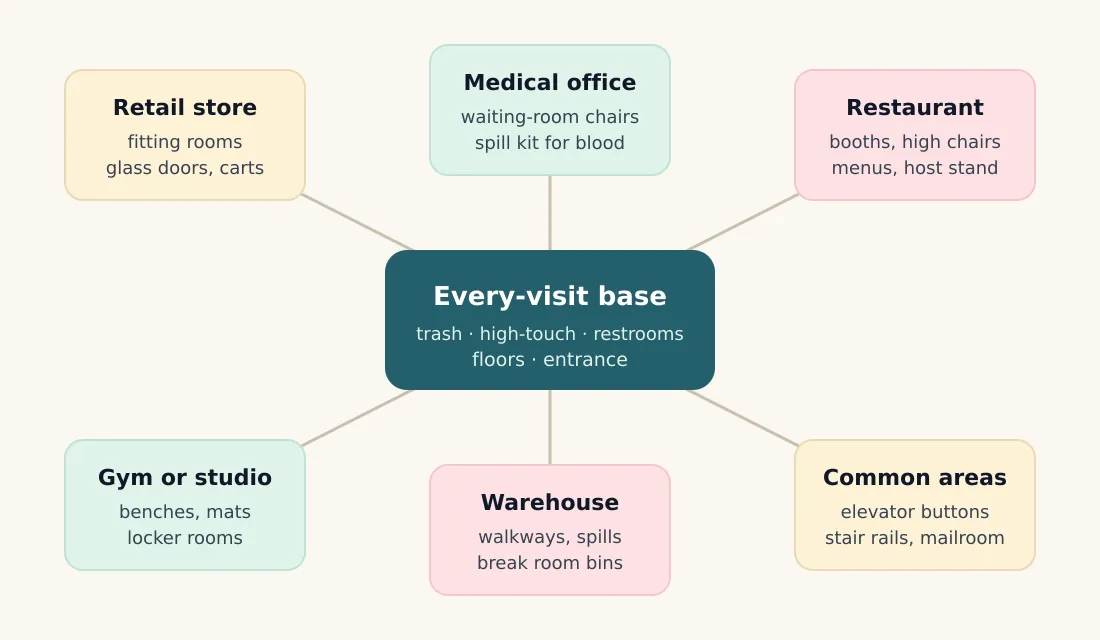
A commercial cleaning checklist starts with one every-visit base (trash, high-touch points, restrooms, floors and the entrance) and adds the tasks each facility type needs. Eight templates to copy: the base, retail, medical office, restaurant dining room, gym, warehouse, shared common areas, and periodic work.
Josh · Nov 24, 2026 · 15 min read
- commercial cleaning checklist
- janitorial checklist
- commercial cleaning checklist template
- retail store cleaning checklist
- gym cleaning checklist
- cleaning business
A commercial cleaning checklist is a written list of every task your crew does at a business account, grouped by area and by how often it is done. The easiest way to build one is to start with a single every-visit base and then add the tasks that one type of facility needs. The eight templates below give you that base, six facility add-ons (retail, medical office, restaurant dining room, gym, warehouse and shared common areas), and a periodic list for weekly, monthly and quarterly work. Copy the ones that match your accounts and cut anything the client has not paid for.
What changes from one facility to the next
Most commercial accounts share the same core work. Every one of them has trash, door handles, restrooms, floors and an entrance the owner looks at first. What changes is the extra layer: fitting rooms in a boutique, gym benches that touch bare skin, a blood spill in a dental office, a forklift aisle in a warehouse.
If you write a new checklist from scratch for each account, the core tasks drift. One crew wipes light switches and another forgets them. A shared base keeps the core identical across accounts, and the add-on page carries only what is different. When a lead asks what is included, you hand them the base plus the add-on for their building.
The rules also change by facility. The CDC's guidance for cleaning facilities covers community settings such as offices, gyms and businesses. The same page says it does not apply to healthcare settings, food preparation and food service areas, or early care and childcare settings, where specific regulations may apply. So a medical office or a restaurant needs a page of its own, built around the rules that do apply there.
Each template uses the same header so a lead can check work at any site:
| Field | What to write | Example |
|---|---|---|
| Account | Business name, address, suite | "Main Street Boutique, front entrance" |
| Visit | Date, crew, time in and out | "Thu, in 9:40 pm, out 11:10 pm" |
| Access | Keys, alarm, doors that stay locked | "Stockroom stays locked" |
| Products | Cleaner and disinfectant on site, with registration numbers | "Disinfectant: EPA Reg. No. on the label" |
| Skipped | Any task not done, and why | "Fitting room 3 in use until close" |
| Sign-off | Who checked the work | "Checked by [Lead name]" |
Template 1: Every-visit base for any commercial account
This is the page every crew carries, whatever the building. The CDC lists examples of high-touch surfaces: pens, counters, shopping carts, door handles, stair rails, elevator buttons, touchpads, restroom fixtures and desks. Its guidance is to clean those regularly and to clean other surfaces when they are visibly dirty.
EVERY-VISIT BASE
Account: [Name]   Date: [ ]   Crew: [ ]   In: [ ]   Out: [ ]

ENTRANCE
[ ] Clean glass on entry doors, handles and push bars
[ ] Vacuum or shake out entry mats
[ ] Sweep the entry and pick up litter outside the door

TRASH AND RECYCLING
[ ] Empty every bin and replace liners
[ ] Wipe bin lids and push flaps
[ ] Take bags to the dumpster or the client's collection point

HIGH-TOUCH POINTS (clean)
[ ] Door handles, push plates, light switches
[ ] Counters, desks and shared tables
[ ] Touchpads, card readers and keypads (manufacturer's method)
[ ] Stair rails and elevator buttons, if any

RESTROOMS
[ ] Clean and disinfect toilets, urinals, sinks, faucets
[ ] Clean mirrors and partitions, spot-clean walls
[ ] Restock paper, soap, liners; note anything low
[ ] Mop the floor last, working toward the door

FLOORS
[ ] Vacuum carpet in traffic lanes
[ ] Sweep and mop hard floors; place wet-floor signs

CLOSE-OUT
[ ] Lights, doors and alarm set as the access notes say
[ ] Note skipped tasks and damage: [ ]
Checked by: [ ]
Write "clean" where you mean clean and "disinfect" only where the client asked for it or the area calls for it, as in restrooms. The CDC page says cleaning alone removes most types of harmful germs from surfaces, and it saves disinfecting for areas where people have obviously been ill. That difference changes your products, your dwell time and your price.
Template 2: Retail store
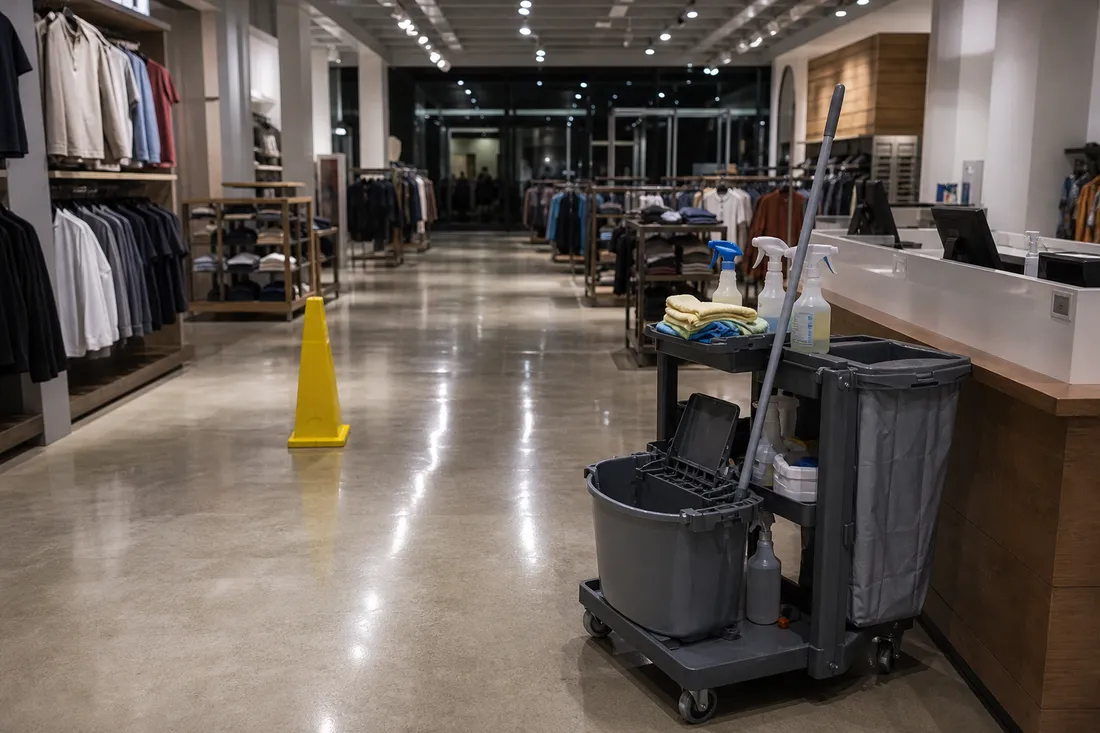
Retail is judged by the shopper who walks in at opening. The add-on focuses on glass, fitting rooms, checkout and the sales floor. Work around displays: your crew moves nothing on a shelf unless the store asks.
RETAIL ADD-ON (with Template 1)
CHECKOUT
[ ] Wipe counters, card readers and the bag well
[ ] Clean the customer side of any glass or acrylic shield
[ ] Empty the bin behind the counter

SALES FLOOR
[ ] Dust display tables and reachable shelf edges (do not move product)
[ ] Clean fingerprints from display cases and mirrors
[ ] Wipe cart and basket handles, if the store has them
[ ] Vacuum or dust-mop aisles; spot-mop spills

FITTING ROOMS
[ ] Clear hangers and tags left behind (leave on the return rack)
[ ] Clean mirrors, benches and hooks
[ ] Vacuum or mop each room

STOCKROOM AND STAFF AREA (if in scope)
[ ] Empty bins; sweep the walkway; clean the staff restroom
[ ] Note blocked exits or boxes on the floor for the manager: [ ]
Shopping carts appear by name in the CDC's high-touch list, so wiping handles belongs on a grocery or hardware account. A boutique with no carts can drop that line. The last line matters because OSHA's walking-working surfaces rule requires employers to keep passageways and storerooms clean and orderly, and free of hazards such as spills and protruding objects. Your note helps the manager catch a problem before it hurts someone.
Template 3: Medical and dental office
A medical or dental office is a healthcare setting, so the CDC's general facility guidance does not cover it. The rule your crew most needs to know is OSHA's bloodborne pathogens standard. It says equipment and environmental and working surfaces must be cleaned and decontaminated after contact with blood or other potentially infectious materials. It also says broken glass that may be contaminated must not be picked up directly with the hands, but with a brush and dustpan, tongs or forceps.
Agree in writing which areas you clean and which the clinic's own staff handle. Clinical surfaces, instruments and sharps containers often stay with the practice. Your crew handles the waiting room, restrooms, offices, hallways and floors.
MEDICAL / DENTAL OFFICE ADD-ON (with Template 1)
SCOPE CONFIRMED WITH: [Office manager]   Clinical areas in scope: [Y/N]

WAITING ROOM
[ ] Clean and disinfect chair arms and seats (vinyl or wipeable)
[ ] Clean the check-in counter, pens and clipboards
[ ] Wipe children's play area surfaces, if any
[ ] Vacuum or mop under and between chairs

HALLWAYS AND EXAM ROOM FLOORS (if in scope)
[ ] Mop hard floors; do not touch equipment or sharps containers
[ ] Empty regular trash only; leave red bags and sharps for staff

SPILLS
[ ] Blood or body fluid seen: stop, glove up, follow the office's spill procedure
[ ] Broken glass: brush and dustpan or tongs, never hands
[ ] Report every spill to the office manager: [time, location]

PRODUCTS
[ ] Disinfectant approved by the office for these surfaces: [ ]
Leave red bags and sharps containers to the practice unless your contract and training say otherwise. If a client asks you to take on regulated waste, that is a separate conversation with its own rules.
Template 4: Restaurant dining room and restrooms
Restaurants are a food service setting, which the CDC excludes from its general facility guidance. The FDA publishes the Food Code as a model, and its 2022 edition notes that every state has adopted some edition of the model food codes. It says food-contact surfaces used with time and temperature control for safety foods must be cleaned throughout the day, at least every 4 hours. It also says nonfood-contact surfaces of equipment must be cleaned often enough to stop soil building up.
In practice, the kitchen's food-contact surfaces are the restaurant staff's job during service. Many restaurants hire an outside crew for the dining room, restrooms and floors after close, plus kitchen floors if the contract says so. Write that split at the top of the page.
RESTAURANT ADD-ON (with Template 1)
KITCHEN FOOD-CONTACT SURFACES: restaurant staff, not crew
KITCHEN FLOORS IN SCOPE: [Y/N]

DINING ROOM
[ ] Clean tables, chair seats and backs, booth seats
[ ] Wipe high chairs and booster seats, including trays
[ ] Clean menus, condiment caddies and table tents if the client asks
[ ] Clean the host stand and the payment station
[ ] Sweep under tables, then mop; check for gum under tables

RESTROOMS
[ ] Full restroom routine from Template 1
[ ] Check the baby changing station and wipe it clean

KITCHEN FLOORS (if in scope)
[ ] Degrease and mop; clear floor drains of debris
[ ] Do not move food, open coolers or touch prep tables
[ ] Note anything a pest technician should see: [ ]
OSHA's sanitation standard says receptacles for waste food must be emptied at least once each working day, unless unused, and kept clean and sanitary. That makes the dining room bins a nightly task, even on a slow Monday.
Template 5: Gym or fitness studio
The CDC's MRSA guidance for athletic facilities says MRSA spreads in gyms, locker rooms and health clubs through shared equipment and skin-to-skin contact. It tells facilities to clean shared equipment after each use and let it dry, and to focus on surfaces that touch people's bare skin each day. During open hours that wiping falls to members and staff. Your crew does the deeper pass after close.
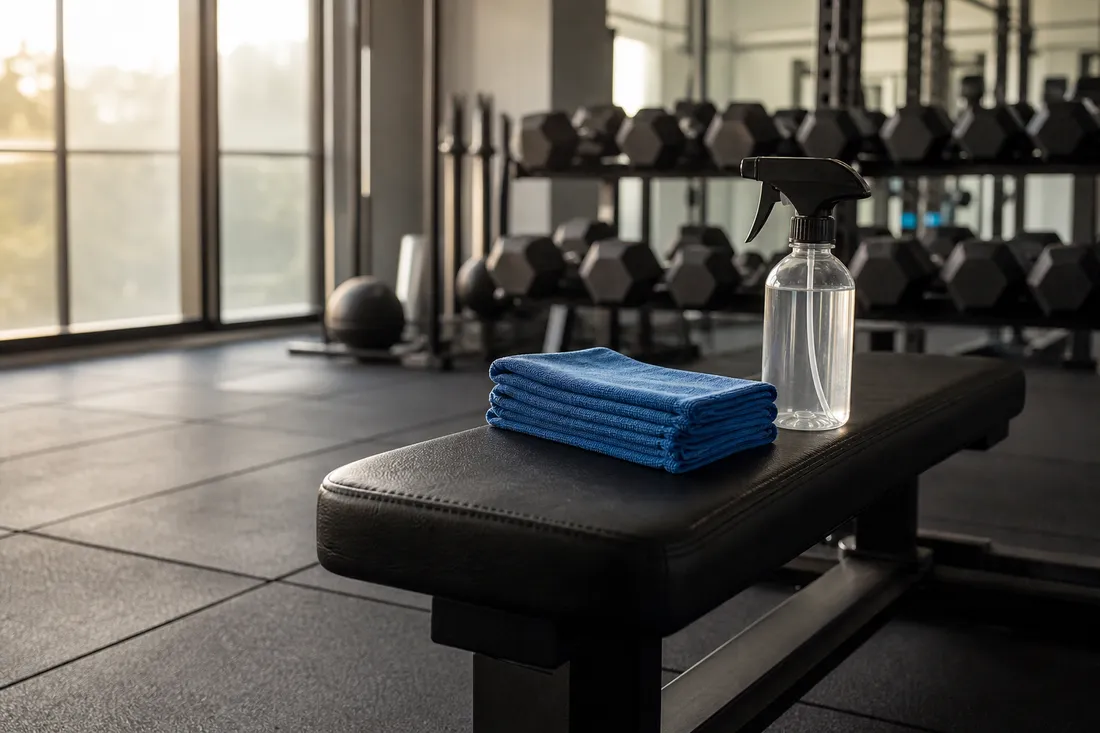
GYM / STUDIO ADD-ON (with Template 1)
EQUIPMENT (clean, then disinfect where the label allows)
[ ] Bench pads, seat pads and grips
[ ] Dumbbell and kettlebell handles, barbell sleeves if requested
[ ] Cardio machine consoles, handles and seats (manufacturer's method)
[ ] Mats, foam rollers and stretching areas
[ ] Note torn upholstery or cracked pads for the owner: [ ]

LOCKER ROOMS AND SHOWERS
[ ] Clean and disinfect benches, locker handles, shower walls and floors
[ ] Clear hair and debris from shower drains
[ ] Mop floors; leave wet-floor signs until dry

FRONT DESK AND STUDIO FLOORS
[ ] Wipe the front desk and check-in screen
[ ] Vacuum carpet; dust-mop and damp-mop studio floors
[ ] Refill wipe dispensers and hand sanitizer stations
The torn-pad note has a reason behind it. The same CDC page says equipment with damaged surfaces that do not allow adequate cleaning should be repaired or thrown away. A crew that reports a split bench pad is doing part of the job the guidance describes.
For disinfectant, the CDC page says EPA-registered products on List H, which work against MRSA, will remove it from surfaces. Check the label for the contact time before you add a product to the gym caddy.
Template 6: Warehouse and light industrial
A warehouse account is less about shine and more about safe floors and clean shared rooms. OSHA's walking-working surfaces rule says the floor of each workroom must be kept clean and, as far as feasible, dry. It also requires walking surfaces to be free of hazards such as spills, leaks, snow and ice. Your crew does not move inventory or work near running equipment, but it keeps the walkways, offices, break room and restrooms in order.
WAREHOUSE ADD-ON (with Template 1)
SAFETY NOTES: [Forklift hours, marked walkways, areas off-limits]

WALKWAYS AND DOCK OFFICE
[ ] Sweep marked pedestrian walkways; do not enter racking aisles
[ ] Spot-mop spills; mark wet areas until dry
[ ] Report leaks, ice, damaged mats or broken floor to the supervisor: [ ]
[ ] Dust and wipe the dock office desk, counters and phones

BREAK ROOM
[ ] Empty food waste bins and replace liners
[ ] Wipe tables, chairs, counters and the microwave inside and out
[ ] Clean the sink and faucet; wipe fridge and vending machine handles

RESTROOMS AND LOCKERS
[ ] Full restroom routine from Template 1
[ ] Wipe locker handles and benches
The break room bins fall under the same OSHA rule as a restaurant: food waste receptacles are emptied at least once each working day. On a site that runs two shifts, ask whether the client wants a second pass.
Template 7: Shared common areas in a multi-tenant building
Many property managers hire one crew for the lobby, corridors, elevators and stairs, while each tenant hires its own cleaner for their suite. This page covers only the shared space. If you also clean offices in the same building, the companion office cleaning checklist has templates for the suites themselves.
COMMON AREAS ADD-ON (with Template 1)
LOBBY
[ ] Clean entry glass, directory board and reception counter
[ ] Dust and wipe seating; straighten furniture
[ ] Vacuum or mop; detail the area inside the doors

ELEVATORS
[ ] Clean call and cabin buttons, handrails and door tracks
[ ] Wipe stainless walls with the grain; vacuum or mop cab floor

STAIRWELLS AND CORRIDORS
[ ] Wipe stair rails top to bottom
[ ] Sweep and damp-mop stairs; report burned-out lights: [ ]
[ ] Vacuum corridor carpet; spot-clean doors and push plates

MAILROOM AND AMENITIES
[ ] Wipe mailbox doors and parcel lockers
[ ] Clean the shared kitchen or fitness room if in scope
Outside, the CDC says spraying cleaning or disinfecting products on low-touch outdoor surfaces such as sidewalks is not necessary, effective or recommended. It suggests cleaning plastic or metal high-touch items like railings when they are visibly dirty. So the exterior task on a common-area list is to pick up litter and clean the rail at the front steps, not to spray the walk.
Template 8: Weekly, monthly and quarterly tasks
The facility pages above cover each visit. Detail work goes on its own sheet so it gets done on a fixed day and the client can see it happened.
PERIODIC TASKS
Account: [ ]    Visit day for weekly tasks: [ ]

WEEKLY
[ ] Dust baseboards, window sills and door frames
[ ] Wipe vents and return grilles within reach
[ ] Detail vacuum carpet edges and under furniture
[ ] Descale restroom fixtures; scrub grout lines by hand
[ ] Clean inside microwaves and wipe out break room fridges (client's call on contents)

MONTHLY
[ ] High dusting: light fixtures, ledges and tops of partitions
[ ] Clean interior glass partitions and inside window glass
[ ] Spot-clean upholstered chairs
[ ] Machine-scrub hard floors (quote separately if not in contract)

QUARTERLY OR AS QUOTED
[ ] Carpet extraction in traffic lanes
[ ] Strip and refinish resilient floors
[ ] Exterior windows and pressure washing at the entrance

Done on: [date]   By: [ ]   Notes: [ ]
You may want to price carpet extraction and floor refinishing as add-ons rather than build them into the monthly rate. Either way, mark each line "included" or "quoted" in the contract so the client knows which is which.
Products, labels and the paperwork behind the checklist
The tasks only work if the crew uses products the right way. The EPA's six steps for disinfectant use are short enough to tape inside a supply closet: check that the product is EPA-registered, read the directions, pre-clean the surface, keep the surface wet for the full contact time, wear gloves and wash your hands, and keep lids closed and products locked up.
The CDC adds three rules worth printing on every template. Do not mix products. Read Section 8 of the safety data sheet for the protective equipment each product needs. In most cases, do not use fogging or wide-area spraying as the main way to disinfect unless the label says it can be used that way.
OSHA's hazard communication standard is why every bottle on the cart needs a label and every product needs a safety data sheet the crew can reach. For a cleaning business with several accounts, keep one binder per site with the sheets for the products used there.
Frequently asked questions
What should a commercial cleaning checklist include?
It should include an every-visit base and the extras for that building. The base covers the entrance, trash, high-touch points, restrooms and floors. Then add the facility's own tasks, a periodic list for weekly and monthly work, a header with access notes, and a line for skipped tasks and sign-off.
How often should a commercial space be cleaned?
As often as its traffic needs, which the client and you agree in the contract. The CDC says to clean high-touch surfaces regularly and other surfaces when they are visibly dirty, and to clean more often in high-traffic areas. A busy gym or restaurant may need nightly service, while a small office may need two or three visits a week.
Do I need to disinfect everything on the checklist?
No, most surfaces need cleaning, not disinfecting. The CDC says cleaning alone removes most harmful germs and suggests disinfecting where people have been ill, with more disinfecting allowed in high-traffic areas. Restrooms, gym equipment and medical waiting rooms are common places for a client to ask for it.
Is an office cleaning checklist the same as a commercial cleaning checklist?
No, an office checklist is one kind of commercial checklist. Offices share the every-visit base, but a retail store, gym, restaurant or warehouse adds tasks an office never has. If most of your accounts are offices, the office cleaning checklist goes deeper on suites, conference rooms and lock-up.
Who cleans the kitchen in a restaurant account?
In most setups the restaurant's own staff cleans food-contact surfaces during service. The Food Code sets a 4-hour cleaning rule for food-contact surfaces used with temperature-controlled foods, which only staff on shift can meet. Your contract should say whether your crew handles kitchen floors, hoods or anything else after close.
Let facility managers find you and ask for a walkthrough
A store manager or gym owner looking for a cleaner will search during their workday and want to send a request without a phone call. Kejoola gives a cleaning business a four-page website with Home, Services, Blog and Contact pages, plus online booking. The booking form asks for a name, email, phone number and a notes box, where a manager can describe the building and the hours they need. You read the request, call back, and bring the matching template to the walkthrough.
Sources
- CDC: When and How to Clean and Disinfect a Facility
- CDC: Athletic Facilities, MRSA Prevention and Control
- EPA: Six Steps for Safe and Effective Disinfectant Use
- FDA: Food Code 2022
- OSHA: 29 CFR 1910.1030, Bloodborne Pathogens
- OSHA: 29 CFR 1910.22, Walking-Working Surfaces
- OSHA: 29 CFR 1910.141, Sanitation
- OSHA: Hazard Communication