Office Cleaning Checklist: 8 Templates for Cleaning Crews
An office cleaning checklist lists every task by area and by how often it is done: each visit, weekly, or monthly. Eight copy-ready templates for cleaning businesses: site walkthrough, offices and lobby, restrooms, break room, weekly, monthly, lock-up, and a supply closet safety check.
Josh · Nov 15, 2026 · 15 min read
- office cleaning checklist
- commercial cleaning checklist
- janitorial checklist
- office cleaning checklist template
- restroom cleaning checklist
- cleaning business
An office cleaning checklist is a written list of every task your crew does in a client's office, grouped by area and by how often each task is done. A workable list has three layers: tasks for every visit, tasks for once a week, and tasks for once a month. The eight templates below cover a site walkthrough, the offices and lobby, restrooms, the break room, weekly and monthly work, a lock-up check, and a supply closet safety check. Copy each one, replace the brackets with the account's details, and cut any task the client has not paid for.
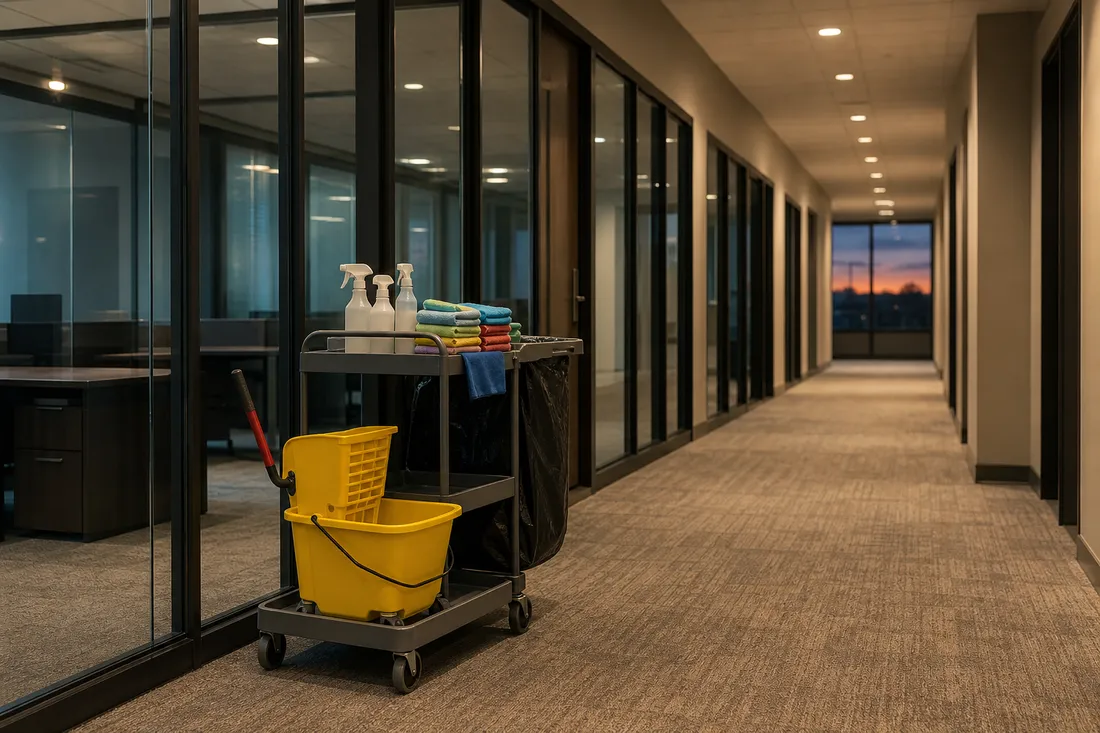
What an office cleaning checklist has to cover
An office is different from a house in three ways. Your crew usually works after hours with nobody to ask. The building has alarm, key and lighting rules. And the client judges the work the next morning, when you are not there to explain a skipped task. The checklist has to answer those questions on paper.
| Part | What to write | Example line |
|---|---|---|
| Account header | Client, suite, date, crew, time in and out | "Suite 210, Tuesday, in 6:15 pm, out 8:05 pm" |
| Access notes | Keys, alarm, lights, doors that stay locked | "Server room stays locked. Do not enter." |
| Area tasks | One verb and one object per line, in cleaning order | "Wipe door handles and push plates" |
| Frequency | Each visit, weekly or monthly, with the day | "Fridge interior: Fridays" |
| Limits | What the crew never touches or moves | "Do not move papers on desks" |
| Skipped and why | Anything not done, with the reason | "Conference B in use until 7 pm, not cleaned" |
| Sign-off | Who checked the work and when | "Checked by [Lead name], 8:00 pm" |
The split between cleaning and disinfecting belongs on the page too. The CDC's facility guidance, which covers offices but not healthcare settings, says to clean high-touch surfaces regularly and other surfaces when they are visibly dirty. Its examples include door handles, stair rails, elevator buttons, touchpads, restroom fixtures and desks. The same guidance says cleaning alone removes most types of harmful germs from surfaces. It reserves disinfecting for areas where people have obviously been ill, and it lets you add disinfecting in high-traffic spaces.
That matters for pricing as much as for health. If every line on your checklist says "disinfect," you are promising a product, a contact time and labor on every surface. Write "clean" where you mean clean. Write "disinfect" only where the client asked for it or where the area calls for it, such as restrooms.
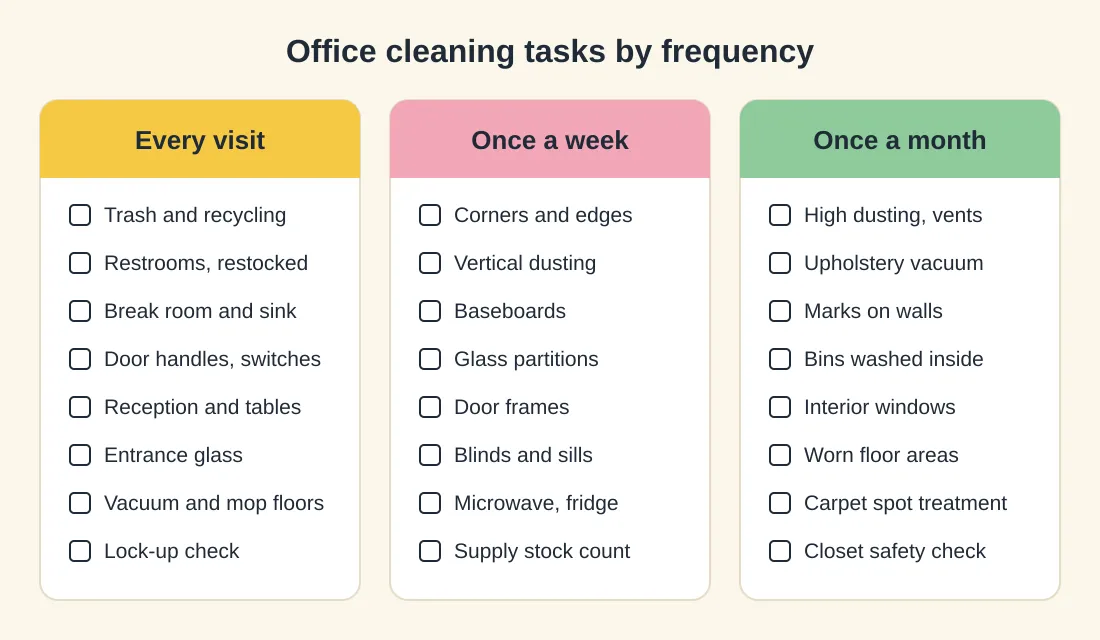
One way to sort tasks by frequency. Diagram only. Match the columns to each client's contract.
Template 1: Site walkthrough sheet
Fill this in before you price a new office and again before the first clean. It collects the access rules and the scope, so the lists that follow are accurate. The scope you write here should match your cleaning contract word for word.
OFFICE WALKTHROUGH: [Client name]
Address and suite: [Address]        Date: [Date]
Contact on site: [Name, phone]
After-hours contact: [Name, phone]

ACCESS
[ ] Keys or fobs issued: [#]   Held by: [Who]
[ ] Alarm: [Yes / No]   Code shared by: [Who]
[ ] Cleaning window: [Days], [Start] to [End]
[ ] Lights and thermostat: [Leave as found / off]
[ ] Doors that stay locked: [Rooms]
[ ] Loading dock or dumpster location: [Where]

SPACE
Private offices: [#]      Workstations: [#]
Conference rooms: [#]     Restrooms: [#]
Break rooms: [#]          Reception areas: [#]
Floor types: [Carpet / tile / vinyl / wood]
Supply closet and water source: [Where]

SCOPE
Visits per week: [#]   Days: [Days]
Who supplies paper and soap: [Client / us]
Who supplies liners: [Client / us]
Disinfect on every visit: [Restrooms / other]
Never touch or move: [Desk papers, monitors]
Areas not included: [Server room, storage]

Walkthrough done by: [Your name]
Client initials: ______
Keep alarm codes off any paper that rides in the van. Write who shared the code and store the code itself somewhere locked. If the client wants a price on the spot, the room counts on this sheet feed straight into your cleaning estimate.
Template 2: Offices, lobby and conference rooms
This is the main list for every visit. It runs top to bottom and dry to wet, so dust falls onto floors you have not vacuumed yet. Jani-King's published office checklist follows the same pattern: trash first, then dusting and damp wiping, then floors, then entrance glass.
OFFICES, LOBBY, CONFERENCE: [Client name]   [Date]
Crew: [Names]     Time in: [Time]

[ ] Empty trash and recycling, replace liners as needed
[ ] Take trash to the collection point: [Where]
[ ] Dust cleared desktops, file cabinets and sills
[ ] Damp wipe tables and counters for rings and spills
[ ] Wipe reception desk and visitor chair arms
[ ] Wipe conference tables, push chairs in
[ ] Wipe door handles, push plates and light switches
[ ] Wipe elevator buttons and stair rails in our area
[ ] Clean fingerprints from entrance glass
[ ] Spot clean interior glass and partitions
[ ] Clean and polish the water cooler or fountain
[ ] Vacuum carpet and entry mats
[ ] Dust mop hard floors
[ ] Damp mop hard floors, wet floor sign out
[ ] Pick up the building entrance area as needed

Desks: wipe only cleared surfaces. Do not move papers.
Skipped and why: ____________________________
Phones, keyboards and touch screens need their own rule. The CDC says to follow the manufacturer's instructions when you clean electronics, and it suggests wipeable covers to make the job easier. Agree with the client on which devices your crew touches, and write the answer on the "never touch" line.
Wet floors are a client-safety issue, not only a finish issue. OSHA's walking-working surfaces rule requires employers to keep workroom floors clean and, as far as feasible, dry. Mop toward the exit and leave the sign out until the floor is dry.
Template 3: Restrooms
Use one sheet per restroom on every visit. A two-restroom suite gets two sheets, which keeps the second one from being rushed. Restrooms are where disinfecting belongs on a routine list, so this template says so on the lines that need it.
RESTROOM [#]: [Client name]   [Date]
Gloves on. Wet floor sign at the door.

[ ] Restock toilet paper, hand towels and hand soap
[ ] Empty trash, wipe the bin, new liner
[ ] Empty sanitary receptacles, wipe with disinfectant
[ ] Apply disinfectant to toilets and urinals, let it sit
[ ] Dust partition tops, mirror frames and vents
[ ] Clean and polish mirrors
[ ] Clean and disinfect sinks, polish faucets
[ ] Wipe counters and dispenser covers
[ ] Remove splash marks from walls near sinks
[ ] Scrub toilets and urinals inside and out
[ ] Wipe both sides of toilet seats with disinfectant
[ ] Wipe stall doors, latches and the entry handle
[ ] Sweep, then mop the floor with disinfectant
[ ] Report leaks, clogs or burned-out lights: [To whom]

Product used: [Name]   Contact time on label: [Minutes]
Supplies low: ______________________________
The order of the toilet lines is deliberate. EPA's six steps for disinfectant use say the surface must stay wet for the whole contact time printed in the product directions. Applying the product first and dusting while it sits covers that wait without adding minutes to the visit. The same steps say to pre-clean a surface that is visibly dirty, because disinfectant works on a clean surface.
Restocking is more than a courtesy. OSHA's sanitation standard requires employers to provide hand soap and individual hand towels or air blowers at lavatories. When your crew notes "supplies low" before the dispenser runs empty, you are helping the client meet a rule that applies to them.
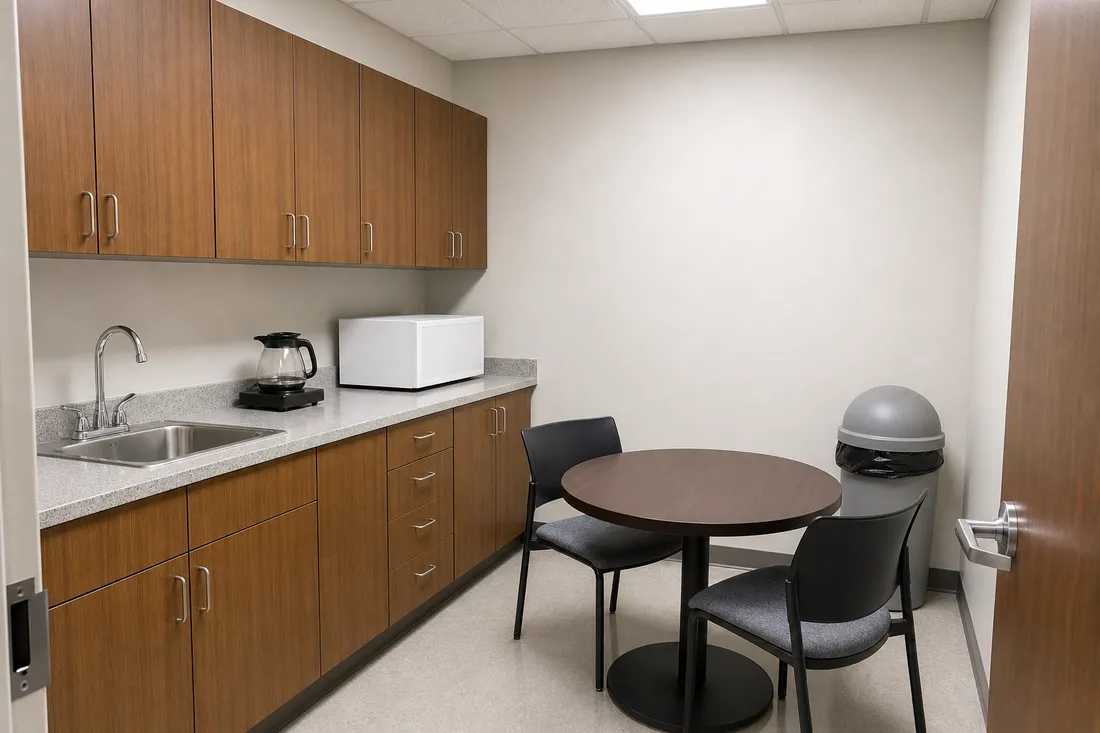
Template 4: Break room and kitchen
Break rooms collect food waste, so trash and sinks come first. This list covers every visit and adds two jobs for one fixed day a week. ServiceMaster Clean's published checklist puts the microwave and the refrigerator on Fridays, which gives staff a known day to clear their food.
BREAK ROOM: [Client name]   [Date]

[ ] Clear counters and floor of trash and food debris
[ ] Empty coffee grounds into the trash
[ ] Empty trash and recycling, wipe bins, new liners
[ ] Load or stack dishes per client note: [Note]
[ ] Clean counters and backsplash
[ ] Wipe tables and chair seats
[ ] Wipe appliance fronts and handles
[ ] Wipe microwave handle and keypad
[ ] Clean the sink, polish the faucet
[ ] Spot clean cabinet fronts and walls near bins
[ ] Refill cups and paper towels: [Client stock / ours]
[ ] Sweep or dust mop the floor
[ ] Damp mop the floor, wet floor sign out

[Day] ONLY
[ ] Clean the microwave inside and out
[ ] Remove food past the posted date, wipe fridge shelves

Skipped and why: ____________________________
Ask the client to post the refrigerator rule on the door before your first weekly clean-out. A sign that says "Unlabeled food is removed on Fridays" protects your crew from the argument on Monday. Use a product that is labeled for food-contact surfaces on counters and tables, and check that label before you buy in bulk.
Template 5: Weekly tasks
Weekly tasks are the ones that show within a few days if they are missed: edges, corners, vertical surfaces and glass. Pick one visit a week for this sheet and write the day on it. Jani-King's weekly list centers on the same idea, with vertical dusting and detail vacuuming along edges and beneath furniture.
WEEKLY TASKS: [Client name]   Week of: [Date]
Done on: [Day]     Crew: [Names]

[ ] Dust vertical sides of desks, cabinets and chairs
[ ] Vacuum corners, edges and under furniture
[ ] Damp mop corners and edges of hard floors
[ ] Wipe baseboards in lobby and halls
[ ] Clean interior glass partitions fully
[ ] Wipe door frames and around light switches
[ ] Wipe conference chairs, arms and bases
[ ] Dust blinds and window sills
[ ] Wipe fronts of trash and recycling bins
[ ] Buff hard floors if needed
[ ] Check supply closet stock, list what to order

Skipped and why: ____________________________
Checked by: [Lead name]   Time: [Time]
If the account is three visits a week or fewer, move some of these lines onto the every-visit sheet. An office cleaned once a week has no separate weekly layer. Its regular visit is the weekly clean, and the price should reflect that longer list.
Template 6: Monthly and periodic tasks
Monthly work covers the high, the hidden and the heavy. Schedule it on a fixed visit, such as the first Friday, and tell the client when it happens. Quote floor care beyond this list, such as stripping and refinishing or carpet extraction, as a separate job.
MONTHLY TASKS: [Client name]   Month: [Month]
Done on: [Date]     Crew: [Names]

[ ] High dust light fixtures, vents and door tops
[ ] Dust tops of cabinets and tall shelving
[ ] Vacuum upholstered chairs and sofas
[ ] Remove marks around switches and door frames
[ ] Wipe phones with disinfectant if the client approved
[ ] Wash trash and recycling bins inside
[ ] Clean interior windows: [Included / quoted]
[ ] Machine scrub worn hard floor areas: [Included / quoted]
[ ] Spot treat carpet stains, note any that remain
[ ] Walk the suite with the client contact if on site

QUOTED SEPARATELY
[ ] Carpet extraction     Last done: [Date]
[ ] Strip and refinish    Last done: [Date]
[ ] Exterior windows      Last done: [Date]

Notes for client: ___________________________
The "last done" dates give you a reason to call. When the carpet line shows a date from last spring, send a quote with the next cleaning invoice. Jani-King's checklist also lists an initial clean option for new accounts, with machine scrubbing, carpet extraction and full high dusting. Offer the same on your first visit, so the routine lists start from a clean baseline.
Template 7: Lock-up and security check
The last five minutes of an after-hours clean carry the most risk for your business. One unlocked door costs more goodwill than a missed baseboard. Give the lock-up its own sheet, signed by the last person out.
LOCK-UP CHECK: [Client name]   [Date]
Last person out: [Name]     Time out: [Time]

[ ] All trash removed to: [Dumpster / dock]
[ ] Wet floor signs collected, floors dry
[ ] Equipment and chemicals back in the closet
[ ] Supply closet locked
[ ] Windows closed
[ ] Appliances as found: [Coffee maker off]
[ ] Lights: [Off / as found]
[ ] Thermostat: [As found]
[ ] Interior doors: [Open / closed / locked per note]
[ ] Exterior doors locked and pulled to test
[ ] Alarm set
[ ] Keys and fobs accounted for: [#]

Anything unusual seen tonight: _______________
Reported to: [Client contact]   How: [Text / email]
Send the "anything unusual" line the same night, not at the end of the month. A leak under the break room sink or a door that would not latch is something the client wants to know before staff arrive.
Template 8: Supply closet and chemical safety check
Run this once a month for every account where you store products on site. It keeps the closet stocked and keeps you on the right side of OSHA's Hazard Communication standard, which requires labels, Safety Data Sheets and training for workers who handle hazardous chemicals.
SUPPLY CLOSET CHECK: [Client name]   [Date]
Checked by: [Name]

STOCK
[ ] Liners: [Sizes, count]
[ ] Toilet paper and hand towels: [Count]
[ ] Hand soap refills: [Count]
[ ] Clean cloths and mop heads: [Count]
[ ] Vacuum bag or bin emptied, filter checked
[ ] Wet floor signs: [#]

CHEMICALS
[ ] Every bottle labeled with product name and hazards
[ ] No unlabeled spray bottles
[ ] Safety Data Sheet on hand for every product
[ ] Bleach and ammonia products stored apart
[ ] Dilution chart posted for concentrates
[ ] Disinfectant shows an EPA registration number
[ ] Lids closed, closet locked

CREW
[ ] Gloves and goggles stocked: [Sizes]
[ ] New crew trained before first use: [Name, date]
[ ] Spill steps posted

Order needed: _______________________________
OSHA and NIOSH state the reason for the bleach line plainly: mixing cleaning products that contain bleach and ammonia can cause severe lung damage or death. Their guidance also says Safety Data Sheets must be readily accessible to workers. Training has to happen before a worker begins using a hazardous cleaner, in a language they understand.
The same guidance recommends choosing the least hazardous product that does the job. It notes that disinfectants and sanitizers are generally more hazardous than cleaners. It also lists equipment that reduces chemical use, including walk-off mats at entries, microfiber cloths and mops, and HEPA vacuums.
How to roll the checklists out on a new account
Start with the walkthrough sheet and build the other seven from it. Delete lines for rooms the office does not have. Move lines between the every-visit, weekly and monthly sheets until they match the visit count in the contract. Then walk the suite once with your lead, sheet in hand, before the first clean.
Keep one copy in the supply closet in a plastic sleeve and one with the crew lead. The CDC advises washing your hands with soap and water for 20 seconds after cleaning, so add that as the last line on any sheet your crew finishes with.
Review the sheets after the first month. Tasks the crew skips every week are either unneeded or under-priced. Tasks the client keeps asking for are missing from the list. If you also clean homes, keep those lists separate. A house cleaning checklist is built around rooms and client belongings, while an office list is built around shared areas and access rules.
Questions cleaning business owners ask
What should an office cleaning checklist include?
It should include an account header, access notes, tasks by area, a frequency for each task and a sign-off. Add a line for limits, such as desks the crew never clears, and a line for anything skipped. The walkthrough sheet above collects all of it before the first visit.
How often should an office be cleaned?
It depends on traffic, and three layers cover it. Trash, restrooms, break rooms and high-touch surfaces are done every visit. Edges, glass and vertical dusting are weekly. High dusting and upholstery are monthly. The CDC says to clean high-touch surfaces regularly and other surfaces when visibly dirty.
Does every surface need to be disinfected on each visit?
No. The CDC says cleaning regularly is enough in most situations, and it reserves disinfecting for areas where people have obviously been ill. It adds that you may disinfect in high-traffic spaces. Restrooms are the clearest case for routine disinfecting. Write "disinfect" only on the lines where you do it.
In what order should a crew clean an office?
Work from trash to dusting to wiping to floors, and finish with the lock-up check. Jani-King's published checklist follows that pattern in each area. Apply restroom disinfectant early, so its contact time passes while you dust and clean mirrors.
Who supplies the paper products and soap?
Either party can, and the checklist should say which. One workable split is for the client to buy paper and soap while you supply chemicals and equipment. Record the choice on the walkthrough sheet, so the crew knows whose stock to refill from.
Let office managers request a walkthrough online
An office manager who needs a cleaner will look during the workday, often while your crew is off after a night shift. Kejoola gives a cleaning business a four-page website with Home, Services, Blog and Contact pages and an online booking form. The form asks for a name, email, phone number and a notes box, so a manager can describe the suite and request a walkthrough. You read the request when you start your day, call back, and bring Template 1 to the visit.
Sources
- CDC: When and How to Clean and Disinfect a Facility
- EPA: Six Steps for Safe and Effective Disinfectant Use
- OSHA: 29 CFR 1910.22, Walking-Working Surfaces
- OSHA: 29 CFR 1910.141, Sanitation
- OSHA and NIOSH: Protecting Workers Who Use Cleaning Chemicals
- OSHA: Hazard Communication
- Jani-King: Office Cleaning Checklist
- ServiceMaster Clean: The Office Cleaning Checklist You Need