Deep Cleaning Checklist: 8 Templates for Cleaning Businesses
A deep cleaning checklist lists the work a routine visit skips: inside appliances, grout, baseboards, vents, window tracks, and under furniture. Eight copy-ready templates for cleaning businesses: scope sheet, client prep note, kitchen, bathrooms, bedrooms, living areas, whole-house details, and a final sign-off.
Josh · Nov 22, 2026 · 16 min read
- deep cleaning checklist
- deep clean checklist
- house deep cleaning checklist
- cleaning checklist template
- cleaning business
- residential cleaning
A deep cleaning checklist is the written task list for a top-to-bottom clean that covers what a routine visit skips: inside appliances, grout, baseboards, vents, window tracks, and the floor under and behind furniture. For a cleaning business it works best as a set of sheets, one per area, with a scope sheet up front and a sign-off at the end. The eight templates below follow that order. Copy each one, replace the brackets with the job's details, and strike any line the client did not pay for. A crew lead can then run the whole job from these pages.
What separates a deep clean from a standard clean
Your clients will ask what they get for the higher price, so your checklist has to show it. Three differences do most of the work.
The first is inside versus outside. MaidPro's 49-point checklist for its regular service lists appliance exteriors as cleaned, with interiors "upon request." A deep clean puts the oven, fridge and cabinet interiors on the sheet, unless the client opts out.
The second is scrubbing versus dusting. On MaidPro's standard list, baseboards are dusted and blinds are dusted on request. On the Clean Day Housekeeping deep clean list, baseboards, doors, switch plates and outlet covers are scrubbed with hot soapy water.
The third is moving things. A routine visit cleans around the sofa and the bed. A deep clean moves what can be moved safely and cleans the floor underneath.
Green Planet Cleaning, a San Francisco Bay Area company, defines the job the same way. Its deep cleaning checklist covers areas a maintenance visit "doesn't reach," and it names appliance and cabinet interiors, grout lines, ceiling fans, window interiors, and the space under and behind furniture.
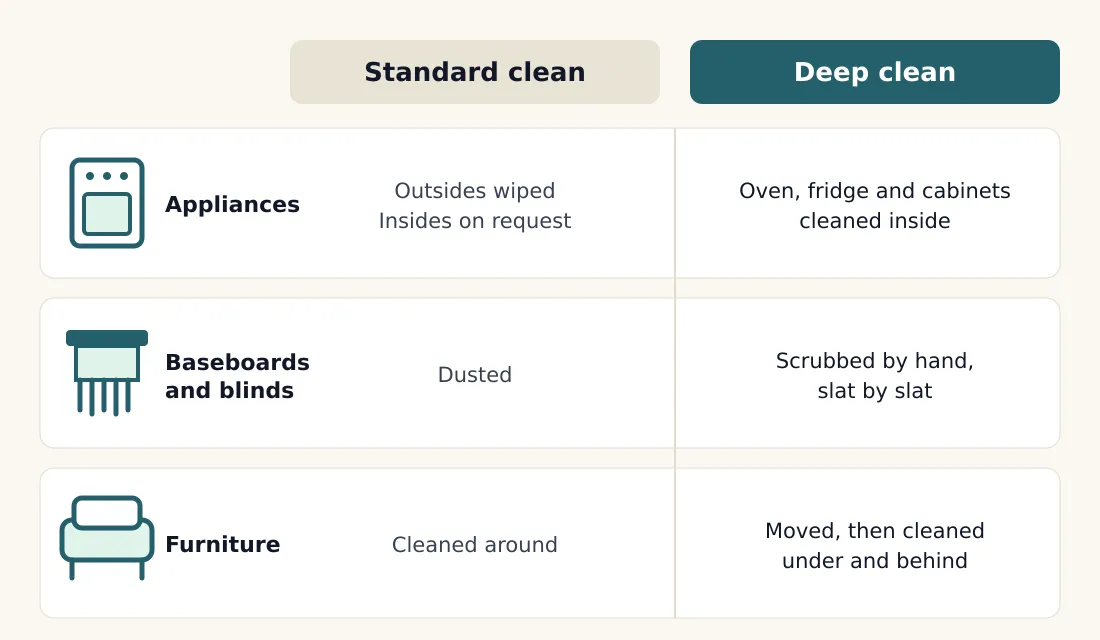
The three differences a client pays for. Your own service lists can draw the line elsewhere. Diagram only.
That company lists 45 tasks, a typical 4 to 6 hours for a three-bedroom home, and a starting price of $480, as checked in November 2026. Treat those as one company's figures in an expensive market. Time your own first few deep cleans, and price from your own hours.
Four situations call for a deep clean most often: a first visit for a new recurring client, a seasonal reset, a move, and the clean after a renovation. Clean Day suggests that every new client start with a deep clean and then switch to standard visits. A move-out has its own list, with empty rooms and a landlord's standards, which the house cleaning checklist covers.
Four rules that apply to every sheet
Work top to bottom, and dry before wet. Dust the fan and the door frames first, so the debris falls onto a floor you have not cleaned yet. Clean Day's kitchen list splits the room into "waist up" and "waist down" for the same reason.
Clean first, and disinfect only where it is needed. The CDC's home cleaning guidance says cleaning alone removes most harmful viruses and bacteria from surfaces. It adds that sanitizing or disinfecting at home is likely not needed unless someone in the home is sick. When you do disinfect, the surface has to stay wet for the contact time on the label. The EPA's six steps for disinfectant use puts pre-cleaning before that step for a visibly dirty surface.
Never mix products. The CDC's bleach guidance says not to mix household bleach or any disinfectant with other cleaners, because the vapors can be dangerous to breathe. Deep cleans are where this goes wrong, since a crew reaches for stronger products on old buildup. Rinse a surface before you switch products, and keep the room ventilated.
Match the product to the surface. The Natural Stone Institute's care guide warns that products containing lemon, vinegar or other acids may dull or etch calcium-based stone. It also says scouring powders may scratch some stones. It recommends a neutral cleaner, stone soap, or mild dish detergent with warm water. If nobody knows what a counter is made of, treat it as stone.
If you have employees, one more rule applies. OSHA's Hazard Communication Standard requires employers with hazardous chemicals in the workplace to keep labels and safety data sheets for exposed workers, and to train them to handle those chemicals.
Template 1: Scope and walkthrough sheet
Fill this in on the walkthrough or the booking call, before you quote. It records what the client is paying for and what condition the home is in. Every later sheet gets edited to match it.
DEEP CLEAN SCOPE SHEET
Client: [Name]              Phone: [Phone]
Address: [Address]          Date of clean: [Date]
Reason: [ ] First clean  [ ] Seasonal  [ ] Before or after an event
        [ ] After renovation  [ ] Other: [Reason]

HOME
Bedrooms: [#]   Bathrooms: [#]   Floors: [#]   Stairs: [ ] Yes [ ] No
Flooring: [Hardwood / tile / carpet / vinyl, by room]
Counters: [Material, or "unknown: treat as stone"]
Pets: [Type and where they will be during the clean]

INCLUDED INTERIORS (tick what the client is paying for)
[ ] Oven        [ ] Refrigerator   [ ] Freezer
[ ] Microwave   [ ] Dishwasher filter
[ ] Kitchen cabinets and drawers, emptied by client
[ ] Bathroom cabinets and drawers, emptied by client
[ ] Interior windows: [#]   [ ] Window tracks
[ ] Blinds: [#] sets        [ ] Closet shelves and floors

NOT INCLUDED ON THIS JOB
[Exterior windows, carpet shampooing, garage, wall washing, other]

CONDITION NOTED BEFORE STARTING (take photos)
[Existing stains, chips, scratches, broken blinds, loose fixtures]

ACCESS
Entry: [Key / code held by office / client home]
Parking: [Where]    Water and power on: [ ] Yes [ ] No

Crew size: [#]   Estimated hours: [Hours]   Price quoted: [$]
Client signature: ____________   Date: ______
The "not included" box prevents the most common dispute on a deep clean, which is a client who assumed carpets or exterior glass were part of it. Photos of existing damage protect your crew for the same reason. The room counts and ticked interiors feed straight into your cleaning estimate.
Template 2: Client prep note
Send this two or three days before the job. A deep clean slows down badly when the crew has to clear counters and empty a fridge first.
BEFORE YOUR DEEP CLEAN ON [Date]

Hi [Client name],

Your deep clean is booked for [Date], arriving between [Time window].
A few things you can do beforehand so we spend our time cleaning:

[ ] Clear counters, floors and the shower of loose items where you can
[ ] Empty the refrigerator shelves you want cleaned
[ ] Empty any cabinets or drawers you want wiped inside
[ ] Remove pans and trays from the oven and its drawer
[ ] Put away valuables, medication and paperwork
[ ] Keep pets in [one room / the yard / away for the day]
[ ] Tell us about anything fragile, loose or already damaged

What we bring: [Supplies and equipment]
What we need from you: [Hot water, power, a parking spot]
What is not part of this visit: [Items from the scope sheet]

Questions before the day? Call or text [Phone].
[Your business name]
Change the list to match the scope sheet, and delete lines for interiors the client did not book. If a client has not emptied a cabinet on the day, skip it and note it on the sign-off. Do not unpack their belongings yourself.
Template 3: Kitchen deep clean
The kitchen takes the longest, so start it first and let the soaking items sit while the crew works elsewhere. Lines marked with an asterisk depend on the scope sheet.
KITCHEN DEEP CLEAN: [Client name]   [Date]   Cleaner: [Initials]

START SOAKING
[ ] Oven racks out and soaking *
[ ] Stove grates and drip pans out and soaking
[ ] Range hood filter out and soaking in hot soapy water

WAIST UP
[ ] Tops of cabinets and top of refrigerator dusted, then wiped
[ ] Light fixtures and ceiling fan wiped
[ ] Range hood wiped inside and out, filter rinsed and refitted
[ ] Cabinet fronts, edges and handles degreased
[ ] Inside cabinets and drawers wiped, where emptied *
[ ] Backsplash and grout scrubbed
[ ] Microwave cleaned inside, turntable washed, outside wiped
[ ] Small appliances wiped, counters cleared and cleaned underneath
[ ] Counters cleaned with a product suited to the material
[ ] Inside oven scrubbed, door glass cleaned, racks refitted *
[ ] Stovetop scrubbed, knobs cleaned, grates refitted
[ ] Refrigerator shelves and bins out, washed, dried, refitted *
[ ] Refrigerator door seals and handles wiped
[ ] Dishwasher filter rinsed, door edges and seal wiped *
[ ] Sink scrubbed, faucet base detailed, drain and stopper cleaned

WAIST DOWN
[ ] Lower cabinet fronts and toe kicks wiped
[ ] Floor pulled back from under movable items and vacuumed
[ ] Baseboards, door and door frame scrubbed
[ ] Switch plates and outlet covers wiped with a damp cloth
[ ] Trash can washed inside and out, liner replaced
[ ] Floor vacuumed, then mopped, edges and corners by hand

Not done and why: [Notes]
For more detail on a single appliance, the kitchen cleaning checklist has separate sheets for the fridge and the oven. Tell cleaners to wring the cloth well before wiping switch plates and outlets, so no liquid runs behind the cover.
Template 4: Bathroom deep clean
Bathrooms hold the buildup that a weekly wipe never removes: scale on glass, soap scum in tracks, and dark grout. Apply the tub and shower product first and let it work while you dust.
BATHROOM DEEP CLEAN: [Which bathroom]   [Date]   Cleaner: [Initials]

[ ] Loose items, mats and trash can moved out of the room
[ ] Floor swept or vacuumed dry to lift hair
[ ] Shower and tub product applied, left to work per the label
[ ] Exhaust fan cover and light fixtures dusted and wiped
[ ] Tops of door frame, mirror and cabinets dusted
[ ] Shower walls scrubbed top to bottom, grout brushed
[ ] Shower door glass descaled, tracks and seals detailed
[ ] Showerhead, faucets and handles descaled and polished
[ ] Tub scrubbed, including the drain and overflow plate
[ ] Toilet cleaned: tank, handle, seat hinges, bowl, base, behind
[ ] Vanity top cleared and cleaned, items wiped and returned
[ ] Sink scrubbed around the faucet base and the drain ring
[ ] Inside vanity cabinet and drawers wiped, where emptied *
[ ] Mirror and any glass shelves cleaned
[ ] Cabinet fronts, door, door frame and baseboards scrubbed
[ ] Switch plates and outlet covers wiped with a damp cloth
[ ] Trash can washed, liner replaced
[ ] Floor scrubbed, grout brushed, corners and toilet base by hand
[ ] Disinfectant used on: [Surfaces]   Contact time kept: [ ] Yes

Stone or special surfaces in this room: [Material and product used]
Not done and why: [Notes]
The disinfectant line makes the cleaner record where they used it and whether it stayed wet long enough. Where a bleach label gives no instructions, the CDC says to leave a diluted bleach solution on the surface for at least one minute. The bathroom cleaning checklist covers the routine visits that follow.
Template 5: Bedroom deep clean
Bedrooms are mostly dust, and most of it sits above eye level or under the bed. Do the ceiling fan before you make the bed, or the dust lands on clean linen.
BEDROOM DEEP CLEAN: [Which bedroom]   [Date]   Cleaner: [Initials]

[ ] Ceiling fan blades and light fixture wiped
[ ] Tops of door frame, window frames, wardrobes and shelves dusted
[ ] Vents and return grilles vacuumed and wiped
[ ] Blinds wiped slat by slat, or curtains vacuumed *
[ ] Interior window glass cleaned, sills and tracks detailed *
[ ] Wall hangings, frames and mirrors dusted and cleaned
[ ] Furniture dusted on top, front, sides and legs
[ ] Items lifted, surface cleaned underneath, items returned
[ ] Lamps and lampshades dusted
[ ] Closet shelf and closet floor wiped or vacuumed *
[ ] Bed stripped and remade with client's linen, if requested
[ ] Mattress surface vacuumed, if bed is stripped
[ ] Door, door frame and handles scrubbed
[ ] Switch plates and outlet covers wiped with a damp cloth
[ ] Baseboards scrubbed by hand
[ ] Under the bed and behind movable furniture vacuumed
[ ] Upholstered chair or headboard vacuumed
[ ] Floor vacuumed edge to edge, hard floors then mopped

Could not move: [Furniture]   Not done and why: [Notes]
Write a moving rule into your training and keep to it. Two people move a bed or a dresser, and nobody moves a piece that is wired in, wall-mounted or heavier than the crew can lift cleanly. The "could not move" line tells the client why a spot behind the wardrobe was left.
Template 6: Living areas, halls and stairs
Living rooms have the most furniture to move and the most upholstery to vacuum. This sheet also covers the dining room, entry, hallways and stairs, which share the same tasks.
LIVING AREAS DEEP CLEAN: [Client name]   [Date]   Cleaner: [Initials]
Rooms covered: [Living / dining / entry / hall / stairs / office]

[ ] Ceiling fans, light fixtures and corners dusted for cobwebs
[ ] Tops of door frames, shelves, cabinets and picture rails dusted
[ ] Vents and return grilles vacuumed and wiped
[ ] Blinds wiped slat by slat, or curtains vacuumed *
[ ] Interior window glass cleaned, sills and tracks detailed *
[ ] Shelves cleared in sections, wiped, items dusted and returned
[ ] Frames, mirrors and glass tabletops cleaned
[ ] Screens and electronics dusted with a dry cloth only
[ ] Tables, chairs and chair legs wiped
[ ] Sofa cushions lifted, frame and cushions vacuumed
[ ] Fireplace mantel and hearth surround wiped
[ ] Doors, door frames and handles scrubbed
[ ] Switch plates and outlet covers wiped with a damp cloth
[ ] Handrails and banister spindles wiped
[ ] Stair treads and risers vacuumed, edges by hand
[ ] Baseboards scrubbed by hand, all rooms on this sheet
[ ] Behind and under movable furniture vacuumed
[ ] Entry mat shaken out, entry floor and threshold scrubbed
[ ] Floors vacuumed edge to edge, hard floors then mopped

Could not move: [Furniture]   Not done and why: [Notes]
Keep liquid away from screens and speakers. The CDC's guidance for electronics is to follow the manufacturer's cleaning instructions, so a dry cloth is the safe default on a client's television.
Template 7: Whole-house detail tracker
Some deep clean tasks run through every room, and they are the first to be half-finished when the day runs long. Give one person this sheet, so each item has a single owner.
WHOLE-HOUSE DETAILS: [Client name]   [Date]   Owner: [Initials]

Task                          Rooms done (write room names)
Baseboards scrubbed           [                              ]
Doors and frames, both sides  [                              ]
Switch plates and outlets     [                              ]
Vents and return grilles      [                              ]
Window sills and tracks *     [                              ]
Blinds, slat by slat *        [                              ]
Interior glass *              [                              ]
Ceiling fans and fixtures     [                              ]
Cobwebs, corners and ceilings [                              ]
Wall spot cleaning            [                              ]

Wall spots: test a hidden area first. Stop if paint lifts.
Marks that would not come off: [Room and location]

Extra time used: [Minutes]   Approved by client: [ ] Yes [ ] No
Use this sheet with the room sheets on a large home, where two cleaners split up. On a small apartment, the room sheets already cover these lines and you can leave it out. The record of marks that would not come off belongs in your message to the client afterward.
Template 8: Final walk and sign-off
The crew lead walks every room with this sheet before anyone packs the van. The client signs it if they are home. If they are not, send photos with it.
DEEP CLEAN FINAL WALK: [Client name]   [Date]   Lead: [Name]

EVERY ROOM
[ ] Checked from the doorway, then at eye level, then low
[ ] No streaks on glass, mirrors, steel or stone
[ ] No product residue or damp patches left on floors
[ ] Furniture and items back where they started
[ ] Trash and vacuum debris removed from the home

KITCHEN AND BATHROOMS
[ ] Oven racks, grates, hood filter and fridge shelves refitted
[ ] Oven and stove off, refrigerator door shut and running
[ ] Faucets off, no standing water in sinks, tubs or showers
[ ] Toilet seats down, fresh liners in every trash can

LEAVING
[ ] All cloths, brushes, bottles and equipment counted back in
[ ] Windows closed, lights off or left as found
[ ] Doors locked: [Which]     Key or code returned: [How]

Scope items completed: [All / all except those listed below]
Not completed and why: [Item and reason]
Damage or problems found: [Details and photos]
Suggested next visit: [Standard clean on (date) / next deep clean]

Start: [Time]   Finish: [Time]   Crew: [Names]
Client signature: ____________   Lead signature: ____________
The start and finish times matter more than they look. After five or six jobs you will know how long your crew takes per bedroom and per bathroom, and your quotes get more accurate. The "suggested next visit" line is where a one-time deep clean turns into a recurring client. If they say yes, put the routine scope in a cleaning contract.
Questions cleaning business owners ask
What is included in a deep cleaning checklist?
Everything on a standard clean, plus the inside, scrubbed and moved-furniture tasks. That means appliance and cabinet interiors, grout, baseboards and doors washed by hand, vents, blinds, window sills and tracks, and the floor under and behind furniture. What counts as included varies by company, so your scope sheet should list each interior the client booked.
How long does a deep clean take?
Several hours longer than a standard visit to the same home. One Bay Area company lists a typical 4 to 6 hours for a three-bedroom home on its 45-task deep clean. Your time depends on crew size and the home's condition, so record start and finish times on every sign-off sheet.
How often should a home be deep cleaned?
Once or twice a year suits most homes. Merry Maids tells customers that a deep cleaning every 6 to 12 months is usually sufficient for most homeowners, and more often for homes without regular service. For a recurring client, you can also rotate one deep task into each standard visit.
Should a new recurring client start with a deep clean?
Yes, in most cases. A standard visit is priced to maintain a clean home, and a first visit usually has months of buildup. Clean Day Housekeeping suggests that all new clients start with a deep clean before recurring service. If a client declines, write on the scope sheet that the first visit covers standard tasks only.
Do you have to disinfect every surface on a deep clean?
No. The CDC says cleaning alone removes most harmful germs, and that disinfecting at home is likely not needed unless someone is sick. Disinfect where the client asks for it or where someone has been ill. Clean the surface first, and keep it wet for the label's contact time.
Let clients book a deep clean online
People often decide they need a deep clean in the evening, after looking at the oven or before guests arrive. Kejoola gives a cleaning business a four-page website with Home, Services, Blog and Contact pages and an online booking form. You can list the deep clean as its own service. The form asks for a name, email, phone number and a notes box, so a client can say how many bedrooms and bathrooms they have. You call back, fill in Template 1, and send the prep note.
Sources
- MaidPro: 49-Point Checklist
- Clean Day Housekeeping: Deep Clean Checklist
- Green Planet Cleaning: The Professional Deep Cleaning Checklist
- Merry Maids: Deep Cleaning
- CDC: When and How to Clean and Disinfect Your Home
- CDC: Cleaning and Disinfecting with Bleach
- EPA: Six Steps for Safe and Effective Disinfectant Use
- Natural Stone Institute: Care and Cleaning of Natural Stone
- OSHA: Hazard Communication
- Homemade Simple: A Comprehensive Checklist for Deep Cleaning Your House