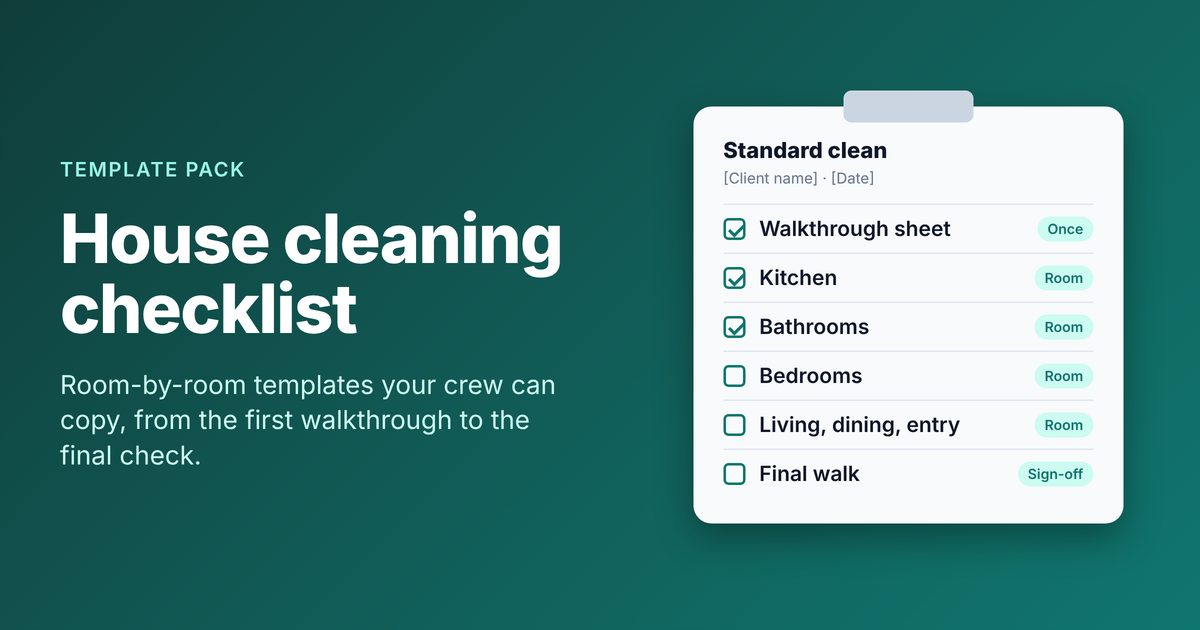
House Cleaning Checklist: Room-by-Room Templates for Cleaners
Ten copy-paste house cleaning checklist templates for cleaning businesses: a first-visit walkthrough, room lists, a final check, deep clean, move-out, and a caddy safety card.
Josh · Oct 8, 2026 · 17 min read
- house cleaning checklist
- cleaning checklist template
- cleaning business
- deep cleaning checklist
- move out cleaning checklist
- residential cleaning
A house cleaning checklist for a cleaning business is a room-by-room list your crew follows on every job, so a clean means the same thing no matter who does it. The 10 templates below cover a first-visit walkthrough, four room lists, a final walk, deep-clean add-ons, move-outs, a client-facing list, and a supply caddy check.
The rule that matters most is order. Work top to bottom and dry to wet in every room, and finish one room before you start the next. Copy each template, cut what you don't offer, and write each client's requests on their own copy.
What every house cleaning checklist needs
A checklist only works if a new hire can follow it without calling you. That means a header with the job details, the house notes up top, tasks in cleaning order, and a line for anything skipped.
| Part | What to write | Example line |
|---|---|---|
| Job header | Client, address, date, crew, type of clean | "[Client name], standard clean, 9:00 arrival" |
| House notes | Entry, alarm, pets, parking | "Key in lockbox. Dog stays in the yard." |
| Room tasks | One verb and one object per line, in cleaning order | "Wipe switch plates and door handles" |
| Client requests | Extras they asked for and things you never touch | "Change guest room sheets. Skip the office desk." |
| Skipped and why | Anything not done, with the reason | "Oven not cleaned, not booked" |
| Sign-off | Who checked the work and when | "Checked by [Lead name], 1:40 pm" |
Write every task as a verb plus a thing, like "Dust ceiling fan blades" instead of "Fan." A vague line gets a vague result. Keep the order the same in every room. Dust high surfaces before you wipe counters, and vacuum before you mop, so falling dust lands on spots you haven't cleaned yet.
A useful habit in bathrooms is to spray the tub and toilet first, then dust while the product sits. Disinfectants need the surface to stay wet for the contact time printed on the label, as EPA's six steps for safe and effective disinfectant use explain. Dusting the room covers that wait.
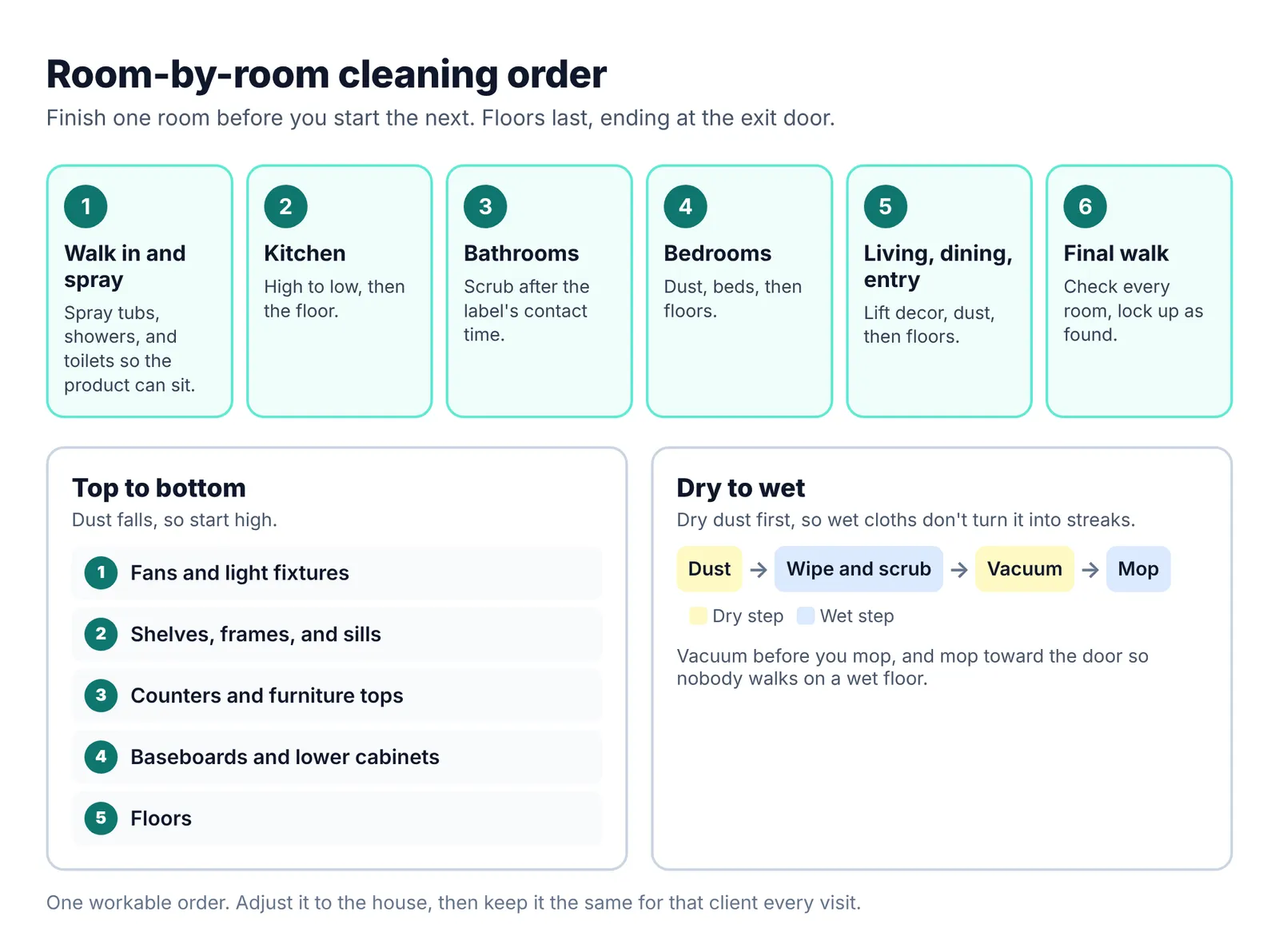
One workable room order and the top-to-bottom, dry-to-wet method used in every template below. Diagram only.
If you are still writing your service agreement and price sheet, the room checklist belongs next to them. The steps to start a cleaning business cover the paperwork that goes with it.
1. First-visit walkthrough sheet
When to use it: Before the first clean for any new client, on a walkthrough visit or a phone call. It collects what your crew needs before they reach the door.
FIRST-VISIT WALKTHROUGH: [Client name]
Address: [Address]            Date: [Date]
Type of clean: [Standard / Deep / Move-out]
Arrival window: [Arrival window]

ACCESS
[ ] Entry: [Key / lockbox / code / client home]
[ ] Alarm: [Yes / No]   Code shared by: [Who]
[ ] Parking: [Driveway / street / permit]
[ ] Pets: [Name, type, where they stay]

HOUSE
Bedrooms: [#]   Bathrooms: [#]   Levels: [#]
Floor types: [Hardwood / tile / carpet / vinyl]
Surfaces that need care: [Marble, unsealed wood]
Client products to use: [Product, room]
Where fresh sheets are kept: [Closet]

PRIORITIES AND LIMITS
Top 3 priorities: [1] [2] [3]
Never touch or move: [Desk papers, collections]
Rooms to skip: [Room]
Allergies or scent limits: [Fragrance-free]

Walkthrough done by: [Your name]
Client initials: ______
How to customize it:
- Send the access and pet questions with your appointment confirmation email, so the answers come back before the visit.
- Copy the access, pet, and "never touch" notes to the top of every room sheet for that house.
- Keep alarm codes off paper that rides in the van. Write who shared the code and store the code itself somewhere locked.
2. Kitchen checklist
When to use it: Every standard clean. The kitchen has the most surfaces in the house, so give it a fixed order.
KITCHEN: [Client name]   [Date]
Work high to low, dry to wet.

[ ] Load or stack dishes per client note
[ ] Dust light fixtures and reachable cabinet tops
[ ] Wipe cabinet fronts and handles for drips
[ ] Wipe outside of toaster and coffee maker
[ ] Clean microwave inside and out
[ ] Wipe stove top, knobs, and range hood front
[ ] Wipe fridge and dishwasher fronts and handles
[ ] Clean counters and backsplash, items moved back
[ ] Scrub sink and faucet, dry and shine fixtures
[ ] Wipe table and chair seats
[ ] Wipe switch plates and door handles
[ ] Empty trash, wipe lid, new liner
[ ] Vacuum floor and edges
[ ] Mop floor, working toward the exit

Not included unless booked: inside oven,
inside fridge, inside cabinets, interior windows
Notes: ______________________________________
How to customize it:
- Clean counters with soap or detergent first. CDC's home cleaning guidance says to then sanitize any surface that touched raw meat or poultry, including the inner sink.
- Match the "not included" line to your price sheet word for word.
- Add the client's stone or wood care rules here. CDC also says to use a product suitable for each surface and follow its label.
3. Bathroom checklist
When to use it: Every standard clean, one sheet per bathroom. A three-bath house gets three sheets, which keeps a half bath from being skipped.
BATHROOM [#]: [Client name]   [Date]
Spray tub, shower, and toilet first. Let the
product sit for the label's contact time.

[ ] Spray tub, shower walls, and toilet, step out
[ ] Dust light fixture, vent cover, and shelves
[ ] Clean mirror and glass
[ ] Wipe cabinet fronts and handles
[ ] Clean counter, sink, and faucet
[ ] Scrub tub and shower walls, rinse, wipe dry
[ ] Clean shower door or track per client note
[ ] Toilet: tank, handle, seat, hinges, base, bowl
[ ] Wipe switch plates, door handles, towel bars
[ ] Hang or fold towels the client's way
[ ] Empty trash, new liner
[ ] Restock paper if the client leaves it out
[ ] Vacuum floor, mop behind toilet, mop out

Products used: [Product]   Contact time: [Minutes]
Notes: ______________________________________
How to customize it:
- Fill in the contact time from the product label. EPA's six steps say the surface should stay wet for that whole time, so a quick spray and wipe doesn't count.
- Keep a separate cloth color for toilets so it never touches a sink or counter.
- If the client wants a fragrance-free clean, list the approved products on the sheet so nobody grabs the wrong bottle.
4. Bedroom checklist
When to use it: Every standard clean, one sheet per bedroom. Bedrooms hold the most personal things, so the "straighten, don't put away" line matters.
BEDROOM [#]: [Client name]   [Date]

[ ] Dust ceiling fan blades and light fixture
[ ] Dust frames, shelves, and window sills
[ ] Dust lamps and shades
[ ] Dust dresser, nightstands, and headboard
[ ] Wipe mirrors
[ ] Change sheets if a fresh set is out, or make bed
[ ] Dirty linens to [hamper / washer per note]
[ ] Straighten items on surfaces, don't put away
[ ] Wipe switch plates and door handles
[ ] Empty trash, new liner
[ ] Vacuum floor, bed edges, and corners
[ ] Mop hard floors toward the door

Kids' rooms: pick up floor items? [Yes / No]
Notes: ______________________________________
How to customize it:
- Pull the fresh-sheet location from the walkthrough sheet so the crew doesn't open closets to look.
- Ask whether you should start laundry. Some clients want it, others never want anyone near the washer.
- For carpets and rugs, CDC's home guidance says to vacuum and dispose of the dirt safely, so bag the vacuum contents before they go in the trash.
5. Living, dining, and entry checklist
When to use it: Every standard clean. These rooms hold the most small objects, so the list spells out lifting decor rather than dusting around it.
LIVING, DINING, ENTRY: [Client name]   [Date]

[ ] Dust ceiling fan, light fixtures, vent covers
[ ] Dust shelves, frames, and decor, lift each item
[ ] Dust TV stand and electronics with a dry cloth
[ ] Wipe remotes per the maker's instructions
[ ] Straighten sofa cushions and throws
[ ] Vacuum under sofa cushions if on the job list
[ ] Wipe dining table and chair backs
[ ] Clean glass on doors and tabletops
[ ] Wipe switch plates, door handles, stair rail
[ ] Shake out or vacuum the entry mat
[ ] Wipe front door inside and the outside handle
[ ] Vacuum floors, rugs, edges, and stairs
[ ] Mop hard floors, ending at the exit door

Notes: ______________________________________
How to customize it:
- CDC's home guidance says to follow the manufacturer's instructions for electronics like phones, tablets, and remotes. Never spray a TV screen directly.
- Light switches, doorknobs, and stair rails are the high-touch surfaces CDC says to clean regularly, so they stay on every visit.
- If the home has stairs, decide whether they belong on this sheet or a separate one, and keep it the same for that house every time.
6. Final walk and quality check
When to use it: At the end of every visit, done by the crew lead or by you. This is the sheet that catches streaks, hair, and an open back door before the client does.
FINAL WALK: [Client name]   [Date]
Lead: [Lead name]   Finish time: [Time]

[ ] Every room sheet done or marked skipped
[ ] No streaks on mirrors or glass in good light
[ ] No hair in sinks, tubs, or around toilet base
[ ] Floors dry, or wet areas noted for the client
[ ] Trash bagged and taken to [bin location]
[ ] Lights, fans, and blinds set as found
[ ] Windows and doors locked as found
[ ] Thermostat set as found
[ ] Pets in their spot, gates closed
[ ] Caddy, vacuum, and cloths out of the house
[ ] Key back in [lockbox / spot] or locked inside

Skipped and why: _____________________________
Damage or issues seen: ________________________
Checked by: [Name]   Time: [Time]
How to customize it:
- Send the client a short "all done" message from your phone that names anything skipped and why. A skipped oven the client hears about first is a note, not a complaint.
- Write down damage you see on arrival before you start, not at the end.
- A clean that passes this check is a good moment to ask for a review. Here is when to ask for reviews without being pushy.
7. Deep clean add-on checklist
When to use it: For a first clean on a new recurring client, a seasonal deep clean, or any add-on the client booked. Only tick what was paid for.
DEEP CLEAN ADD-ONS: [Client name]   [Date]
Booked add-ons only. Tick what the client paid for.

[ ] Baseboards wiped by hand, every room
[ ] Doors and door frames, both sides
[ ] Window sills and tracks
[ ] Blinds, slat by slat
[ ] Interior windows: [#] windows
[ ] Inside oven, racks soaked
[ ] Inside fridge, shelves out and wiped
[ ] Microwave and range hood filter
[ ] Inside kitchen cabinets, emptied by client
[ ] Grout lines in tub and shower
[ ] Scale on showerhead and faucets
[ ] Switch plates and outlet covers, all rooms
[ ] Behind and under movable furniture
[ ] Wall spot cleaning, test a hidden spot first

Extra time used: [Minutes]   Approved by: [Client]
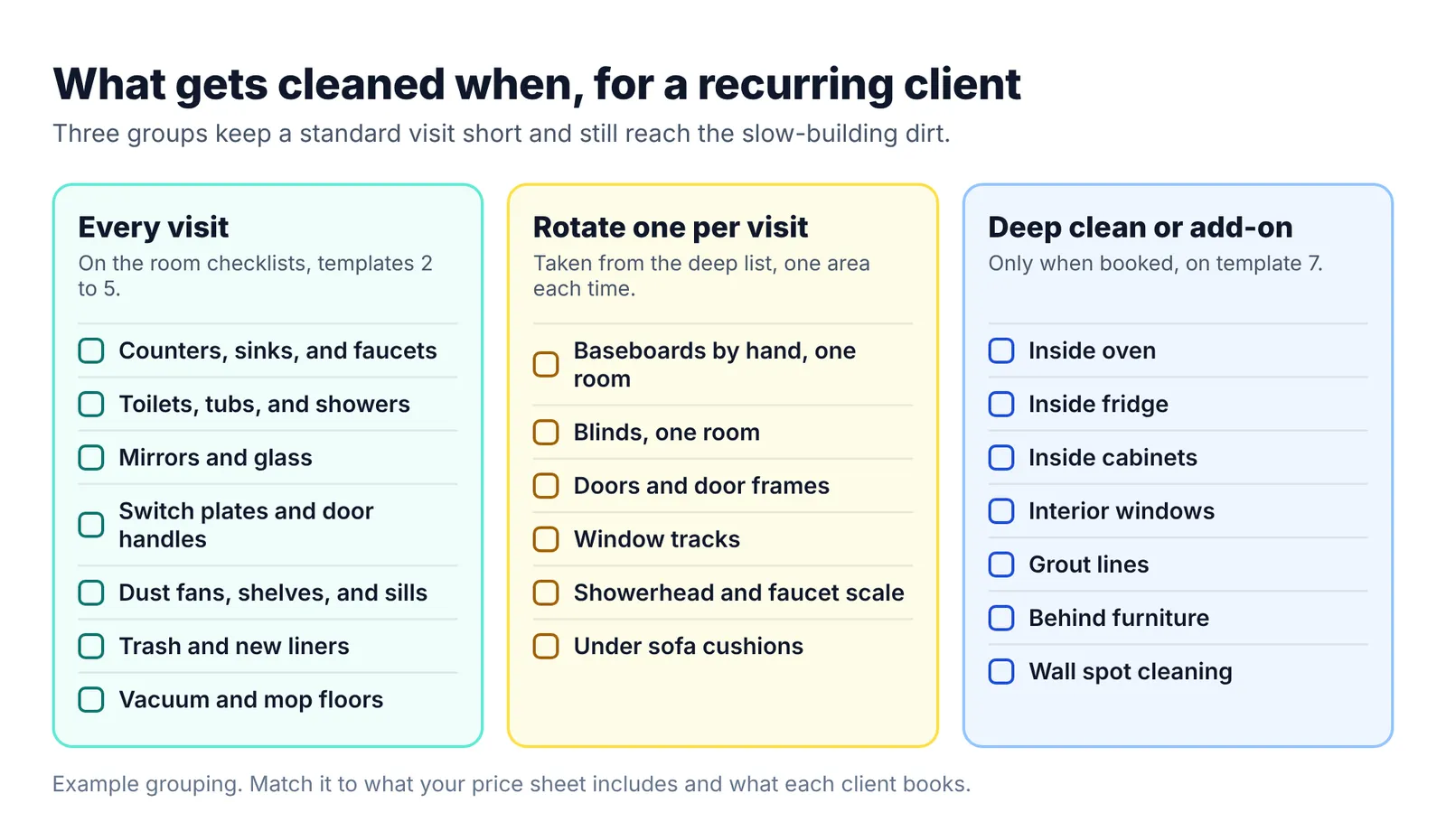
How the task lists split for a recurring client. Your own groups can differ. Diagram only.
How to customize it:
- Give each line its own price on your price sheet, so the client can pick two add-ons instead of the whole list.
- Write down the minutes each add-on takes on your first few jobs. Your next quote is then based on your own times, not a guess.
- For recurring clients, rotate one deep task per visit, like baseboards in one room, so deep tasks get done in small pieces between full deep cleans.
8. Move-out and move-in checklist
When to use it: For an empty home between tenants, before a sale, or before a family moves in. Someone else usually checks the work, so the list is stricter.
MOVE-OUT / MOVE-IN: [Address]   [Date]
Home must be empty. Utilities on: [Water / power]
Who checks the work: [Tenant / landlord / agent]

WHOLE HOME
[ ] Dust ceiling fans, light fixtures, vent covers
[ ] Wipe wall spots, test a hidden spot first
[ ] Wipe doors, frames, and baseboards
[ ] Clean window sills and tracks
[ ] Wipe switch plates and outlet covers
[ ] Wipe closet shelves and rods
KITCHEN
[ ] Inside and outside of all cabinets and drawers
[ ] Inside oven, fridge, and freezer
[ ] Inside dishwasher and microwave
[ ] Counters, sink, and backsplash
BATHROOMS
[ ] Inside vanity, drawers, and medicine cabinet
[ ] Tub, shower, toilet, sink, and mirror
FLOORS
[ ] Vacuum every room and closet
[ ] Mop hard floors, farthest room first, out

Items left in the home: _______________________
Not cleanable (stain, damage): ________________
How to customize it:
- Ask for the landlord's or property manager's own move-out list and merge it in, since that is the list the final inspection uses.
- Confirm water and power will be on before you set the date. An empty house with no water is a wasted trip.
- Never promise a tenant they will get their deposit back. Promise the tasks on the list.
9. Client-facing "what's included" list
When to use it: Send it with quotes, put it on your services page, and attach it to your service agreement. It is the short version of your crew sheets, written for the client.
WHAT'S INCLUDED IN YOUR [STANDARD] CLEAN
[Business name]

Every room
- Dust reachable surfaces, fixtures, and fans
- Wipe switch plates and door handles
- Empty trash and replace liners
- Vacuum and mop floors

Kitchen
- Counters, sink, stove top, appliance fronts
- Outside of cabinets, microwave inside and out

Bathrooms
- Tub, shower, toilet, sink, counter, and mirror

Bedrooms
- Dust surfaces, make beds, change sheets
  if a fresh set is laid out

Add-ons you can book
- Inside oven, inside fridge, interior windows,
  baseboards by hand, inside cabinets

Questions? [Phone] or [Email]
How to customize it:
- Use the same words as the crew sheets, so the client and the crew read the same promise.
- Keep add-ons in their own block, so it's clear what costs extra.
- Skip "sanitized" or "disinfected" unless your crew actually does that step. CDC defines cleaning, sanitizing, and disinfecting as different steps with different products.
10. Crew caddy and chemical safety check
When to use it: At the start of each shift, before the van leaves. It keeps the right products in labeled bottles and puts the safety rules where the crew can see them.
CADDY CHECK: [Crew lead]   [Date]

PRODUCTS (labeled bottles only)
[ ] All-purpose cleaner      [ ] Glass cleaner
[ ] Bathroom cleaner         [ ] Disinfectant
[ ] Degreaser                [ ] Wood or stone cleaner
[ ] Every spray bottle labeled with product name
[ ] Safety data sheets in the van binder

TOOLS
[ ] Microfiber cloths, sorted by color and room
[ ] Toilet brush and separate toilet cloths
[ ] Scrub brushes and grout brush
[ ] Duster with extension pole
[ ] Vacuum emptied, filter checked
[ ] Mop with clean pads or heads
[ ] Gloves, eye protection, trash liners

RULES ON THE CARD
- Never mix bleach with ammonia or other cleaners
- Open a window or run the fan when you spray
- Follow the label's dilution and contact time
- Wash your hands after the gloves come off
How to customize it:
- If you have employees, OSHA's Hazard Communication Standard requires labels and safety data sheets for hazardous chemicals at work, plus training. The OSHA and NIOSH infosheet on cleaning chemicals says that training must come before a worker starts using the product.
- If a bleach bottle has no dilution directions, CDC's bleach guidance gives 5 tablespoons (1/3 cup) per gallon of room-temperature water, mixed fresh each day.
- Swap the product lines for the brands you actually stock, so the card matches what is in the caddy.
Which checklist to use for each job
Most jobs use three or four of these sheets together. A standard clean is the walkthrough once, then the caddy check, the room sheets, and the final walk on every visit.
| Template | Use it when | Who fills it in |
|---|---|---|
| 1. First-visit walkthrough | Before the first clean | You or the crew lead |
| 2 to 5. Room checklists | Every standard clean | The cleaner in that room |
| 6. Final walk | End of every visit | Crew lead |
| 7. Deep clean add-ons | First clean, seasonal clean, or a booked add-on | Cleaner, lead signs off |
| 8. Move-out and move-in | Empty home | Crew lead |
| 9. What's included | Quotes, services page, agreement | You |
| 10. Caddy check | Start of each shift | Crew lead |
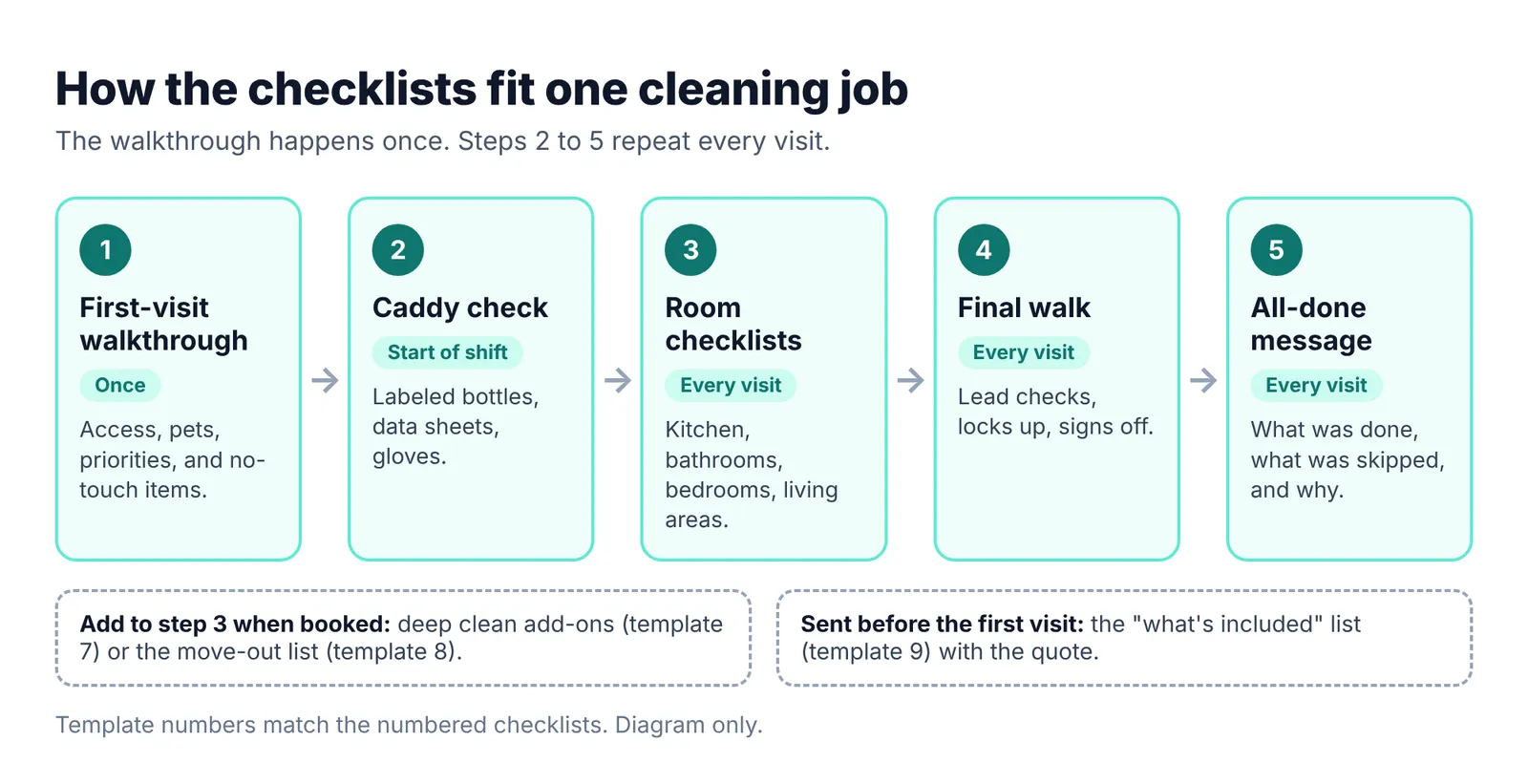
How the sheets fit into one job, from the first call to the all-done message. Diagram only.
Mistakes that get checklists ignored
- One list for the whole house. A cleaner can't finish and tick a page-long list. Split it by room so each sheet gets done.
- Tasks with no verb. "Bathroom" tells nobody what done looks like. "Clean toilet base and hinges" does.
- Client requests kept in your head. If the request isn't on that client's copy, the new hire won't know it.
- No line for skipped work. Without it, the first sign of a skipped room is the client's call.
- A list that never changes. When a client complains about the same miss twice, add a line for it. Once you have several crews, cleaning service scheduling software can keep each client's checklist with their jobs instead of in a binder.
Questions cleaning business owners ask about house cleaning checklists
What should a house cleaning checklist include?
A job header, the house notes, room-by-room tasks in cleaning order, client requests, a skipped-work line, and a sign-off. The header names the client, address, date, and type of clean. The house notes cover entry, alarm, pets, and parking. Each task should be one verb and one object, like "Wipe switch plates," so any cleaner on your crew knows what done looks like.
What is the difference between a standard clean and a deep clean checklist?
A standard clean covers the surfaces people touch and see every week. A deep clean adds the work that builds up slowly, like baseboards by hand, inside the oven and fridge, grout, blinds, and behind furniture. Keep the deep clean as a separate add-on sheet on top of the room lists. Then the client can book only the extras they want.
In what order should you clean a house?
Top to bottom and dry to wet, one room at a time. In each room, dust high surfaces first, then wipe, scrub, vacuum, and mop last. Spraying bathrooms early lets the product sit for its label contact time while you dust. Finish floors on the way out of each room, ending at the exit door, so nobody walks on wet floors.
Should clients get a copy of your checklist?
Yes, but give them the short "what's included" version, not the crew sheets. The client list sets expectations and shows what costs extra. The crew sheets carry access codes, pet notes, and product details that don't belong in a client's inbox. Use the same wording on both so the promise and the work match.
Should cleaners disinfect every surface on a standard clean?
No. CDC says cleaning with soap or detergent removes most germs, and disinfecting at home is likely not needed unless someone in the home is sick or at higher risk. Clean first on every visit. Disinfect high-touch areas when the client asks or someone is ill, and follow the product label's directions and contact time.
Let clients book their next clean
Your walkthrough sheet works best when the client's details arrive before the first visit. If you want a site where clients can see your cleaning services and book a time, you can get a site customers can book from with Kejoola. Clients can type gate codes, pet notes, and add-on requests in the booking notes box. Already have a Google Business listing? Paste your listing link to get a first draft of your site, then finish it with your own services, towns, and photos. For what the site should cover, see what a cleaning business website needs.
14-day free trial, no card needed. Online booking starts on the Starter plan.