Handyman Business Names: Ideas and How to Pick One
Eight handyman business name patterns with example ideas, plus the USPTO, state, DBA, domain, and Google Business Profile checks to clear the name you pick.
Josh · Oct 7, 2026 · 15 min read
- handyman business names
- handyman business
- business naming
- trademark search
- google business profile
- home services
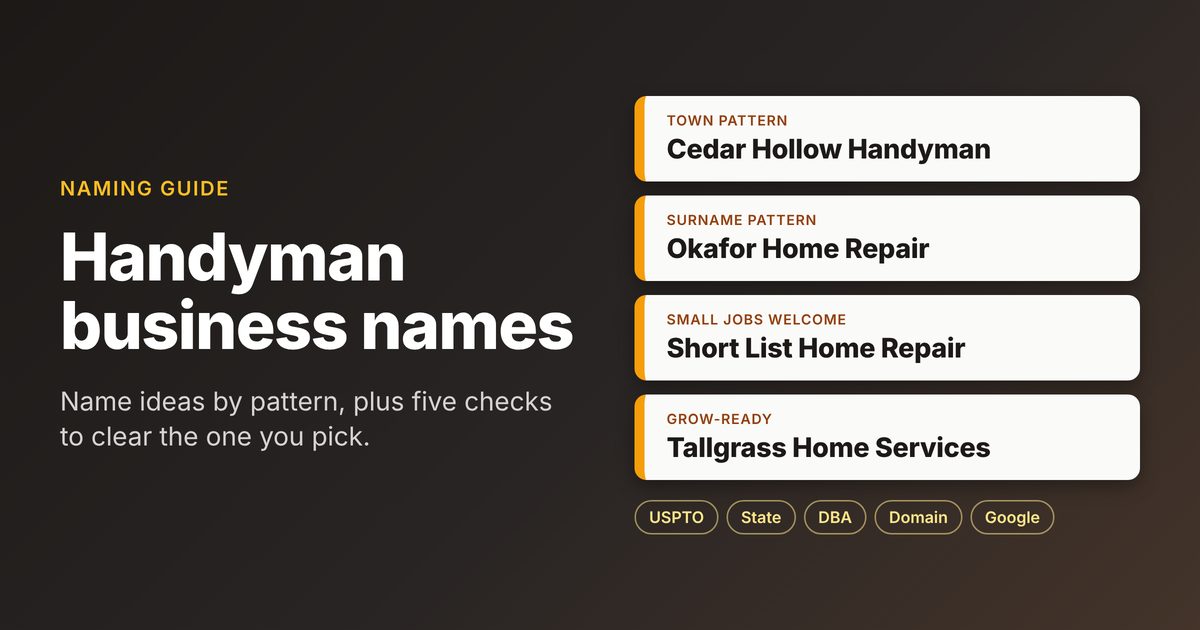
The best handyman business names are easy to say on the phone and tell people you fix things around the house. They also pass a trademark and state name search. This list covers eight name patterns with example ideas, one word rule that helps you avoid license problems, and five checks to clear the name you pick.
If you want the quickest safe shortlist, start with a town name or your surname. Every example below is a starting idea only, not a cleared or registered name. Run each finalist through items 10 to 14 before you letter a truck.
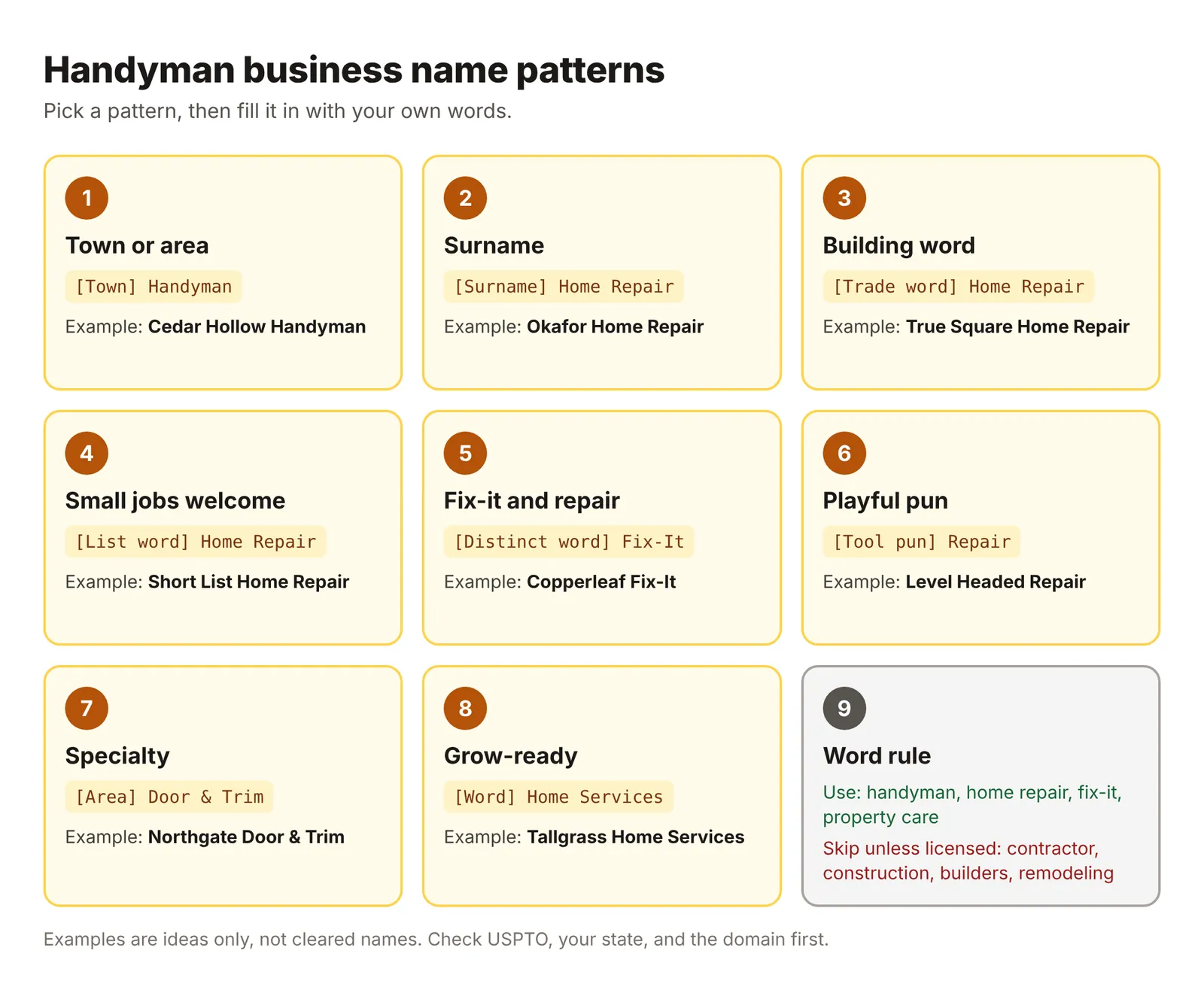
Eight name patterns with one example each, plus the word rule from item 9. Examples are ideas only, not cleared names. Diagram only.
1. Pair "handyman" with your town or area
A place name tells homeowners at a glance that you are close by. Town, county, valley, and neighborhood names also sound settled, as if you have worked the area for years. The catch is that a small place name can feel tight once you start taking jobs in the next county.
How to do it:
- Patterns:
[Town] Handyman,[County] Home Repair,[Landmark] Fix-It Co., or[Area] Handyman Services. - Starter ideas (not cleared): Cedar Hollow Handyman, Millbrook Home Repair, Lakeshore Fix-It Co., Twin Rivers Handyman, Old Mill Home Repair, Ridgeway Handyman Services, Bayside Repair Co., Prairie View Handyman.
- Pick an area you will still serve in five years. Your own subdivision is usually too small.
- Search the place name plus "handyman" on Google Maps to see who already uses it.
Good fit if: you plan to work one town or county for the long haul and want neighbors to place you fast.
2. Use your surname with an ending that can outlive you
Owner names build trust because people refer a person they met. A first-name brand like "Mike's Handyman" gets awkward when you hire help, take a week off, or try to sell. A surname with a neutral ending keeps the personal feel and still works when there are three trucks.
How to do it:
- Patterns:
[Surname] Home Repair,[Surname] & Sons Handyman,[Surname] Property Care, or[Initials] Handyman Services. - Starter ideas (not cleared): Okafor Home Repair, Delgado Handyman Co., Brandt & Daughters Repair, Whitlock Property Care, JM Handyman Services, Kowalski Fix-It, Haskins Home Repair, Moreno Handyman Works.
- Your LLC can carry your full legal name while trucks and invoices show the shorter brand.
- Ask two past customers which version they would repeat to a neighbor.
Good fit if: referrals bring in most of your work and you still answer most calls yourself.
3. Choose a steady, trustworthy building word
Some names win on calm reliability. Words from the trade, like square, level, sill, joist, and lintel, suggest careful work without a claim you would have to prove. These names read well on a property manager's invoice and on a yard sign.
How to do it:
- Patterns:
[Building word] Home Repair,[Building word] Handyman, orTrue/Square + [noun]. - Starter ideas (not cleared): True Square Home Repair, Square Corner Handyman, Sill Plate Repair Co., Joist & Jamb Home Repair, Trueline Fix-It, Lintel Home Services, Cornerboard Handyman, Rafter Lane Repair.
- Leave out "best," "#1," and "guaranteed." They read as claims, and customers will hold you to them.
- Check that the word means something to a homeowner, not only to you. "Lintel" may need explaining.
Good fit if: you want to sound established from day one and work for landlords as well as homeowners.
4. Tell people small jobs are welcome
The handyman promise is the list nobody else wants: the sticking door, the loose railing, the blinds that never got hung. Names built on lists and odd jobs say a two-hour visit is worth booking. They also help homeowners who can't tell whether a job is big enough to call anyone.
How to do it:
- Patterns:
[List word] Home Repair,[Weekday] Fix-It, orLoose Ends + [noun]. - Starter ideas (not cleared): Short List Home Repair, Tuesday Fix-It Co., Odd Jobs Bench, Little Fixes Handyman, Half-Day Handyman, Chore Board Repair, Loose Ends Home Repair, Back Burner Fix-It.
- Put your minimum visit or trip charge on your website and estimates, never in the name.
- Make sure the name still fits if you start taking bigger jobs, like a full deck board replacement.
Good fit if: most of your tickets are short visits with several small tasks at one house.
5. Put fix-it and repair words up front
Plain repair words leave no doubt about what you do. "Fix-It," "Repair," "Patch," and "Mend" are easy to spot when a homeowner scans names on Google Maps or Nextdoor. The trade-off is that plain repair names are crowded, so the first word has to be distinct.
How to do it:
- Patterns:
[Distinct word] Fix-It,[Distinct word] Home Repair, orPatch & [noun]. - Starter ideas (not cleared): Copperleaf Fix-It, Patch & Hinge, Wren Home Repair, Mend Street Handyman, Bluejay Fix-It Co., Fernway Repair, Patchwork Home Repair, Hinge & Hammer Co.
- Lead with the distinct word so a short form like "Copperleaf" still works in conversation.
- Search the full name and the first word on its own.
Good fit if: you do general repair in every room and want the name to say so without explanation.
6. Go playful with tool puns, then run the invoice test
A pun can make a name stick after one look at a yard sign. It can also feel wrong on an invoice to a property manager or an older homeowner who wants a careful pro. Pick humor that is warm and clean, and test it in writing before you commit.
How to do it:
- Patterns: tool puns, trade idioms, and short rhymes.
- Starter ideas (not cleared): Level Headed Repair, Bit by Bit Handyman, Spackle & Grace, Hammered Out Home Repair, Snug Fit Fix-It, On the Mend Handyman, Tighten Up Home Repair, Elbow Room Repairs.
- Write the name on a sample invoice and an estimate email, then read it as a landlord would.
- Skip puns that point to another trade. "Plumb" can sound like plumbing, and "Sparky" sounds like electrical work.
- Keep a plain short form for Google and legal filings if the pun runs long.
Good fit if: your customers are mostly homeowners and your trucks and posts already have a friendly tone.
7. Name a specialty you already do well
Some handymen get known for one kind of job: door and trim repair, furniture assembly and TV mounting, or turnover work between renters. A specialty name pulls in that work and makes it easier to price it well. It also narrows what people think to call you for, so use it only when that work fills most of your week.
How to do it:
- Patterns:
[Area] Door & Trim,[Specialty] & Repair, orRental Ready + [noun]. - Starter ideas (not cleared): Northgate Door & Trim, Hang It Right Mounting, Flat-Pack Assembly Co., Jamb & Casing Co., Rental Ready Handyman, Turnover Fix-It, Gate & Hinge Repair, Clean Patch Drywall.
- Keep to specialties that don't need a trade license in your state. Plumbing, electrical, and HVAC words often do (see item 9).
- Plan a broader DBA for later in case the specialty slows down.
Good fit if: one type of job already brings in most of your revenue or referrals.
8. Use "home services" or "property care" if you plan to grow
If the plan is a few techs and maybe a sale someday, the name has to work without you in it. Broad endings like "Home Services," "Property Care," and "Maintenance Co." let you add people, seasonal work, or landlord contracts without a rebrand. They are less personal, so your photos and reviews have to carry the warmth.
How to do it:
- Patterns:
[Distinct word] Home Services,[Distinct word] Property Care, or[Distinct word] Maintenance Co. - Starter ideas (not cleared): Tallgrass Home Services, Brightwater Property Care, Ironwood Maintenance Co., Westbrook Home Services, Highfield Property Care, Stonecrop Maintenance, Larkspur Home Services, Fairhaven Property Care.
- Say the distinct word next to "Home Services" out loud, the way it would read on a truck door.
- List the home maintenance services you want to offer in three years and make sure the name covers them.
Good fit if: you expect to hire within a year or two, or you already work for property managers.
9. Keep "contractor" and "construction" out unless you hold the license
Some states let handymen do small jobs without a contractor license, and the name you pick can matter there. Words like "contractor," "construction," "builders," or "remodeling" can suggest to the public that you hold a license. California is one example. The Contractors State License Board says you don't need a license only if you don't advertise yourself as a licensed contractor. The job also has to need no building permit, use no employee labor, and cost less than $1,000 in total.
How to do it:
- Look up your state contractor board's rules on unlicensed work and advertising before you file a name.
- Lean on words like handyman, home repair, fix-it, and property care for small-job work.
- Leave trade words like "electric," "plumbing," or "roofing" out unless you hold that license.
- If you get licensed later, add a new DBA instead of renaming everything.
Good fit if: you plan to work under your state's small-job or handyman rules, at least at first.
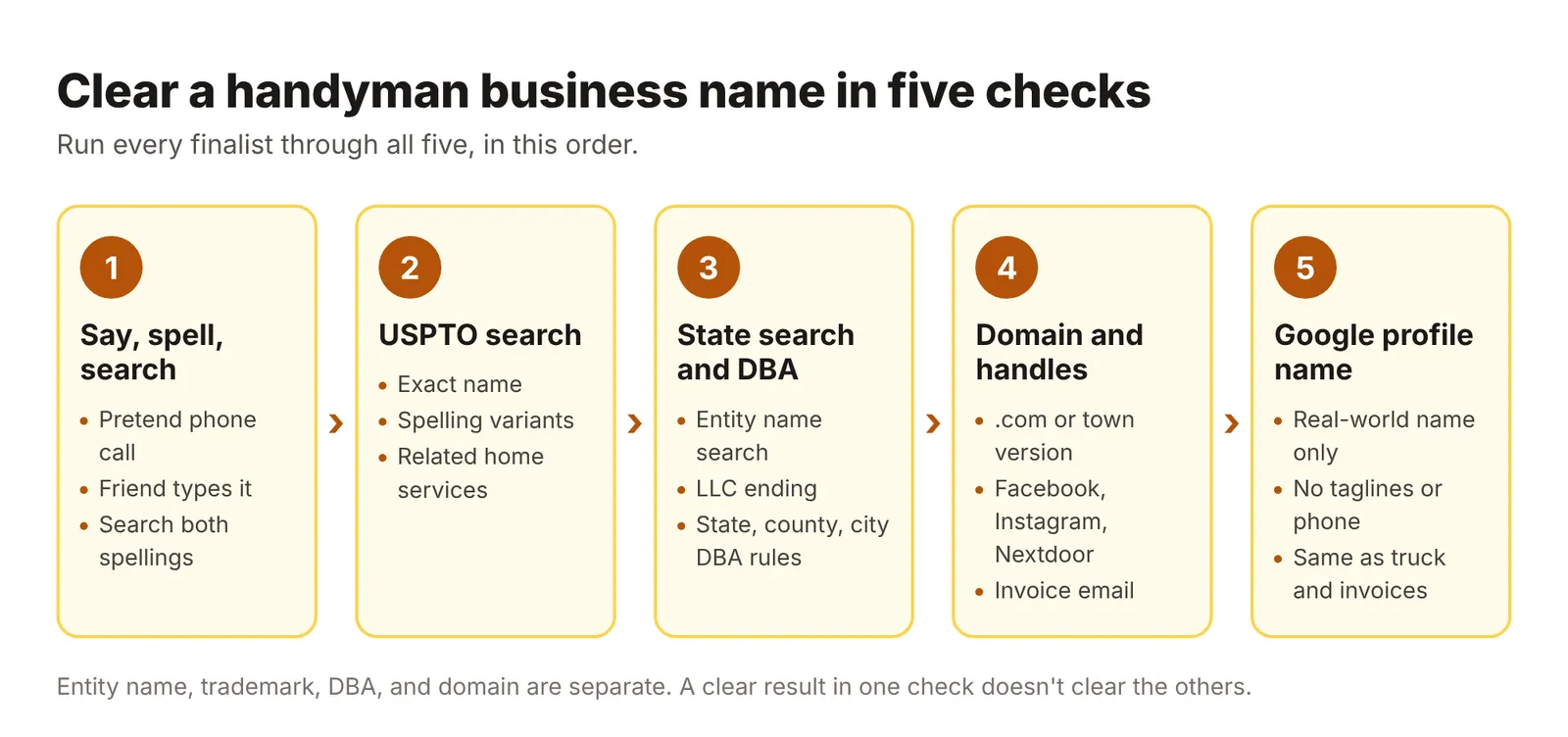
Run every finalist through these five checks in order. Diagram only.
10. Run the say-spell-search test on your shortlist
A name that looks good on paper can fail on the phone. Customers hear it once, then type whatever spelling they guessed into Google. A short test with a friend catches most of these problems before you pay for anything.
How to do it:
- Answer a pretend call: "Thanks for calling [Name], this is [First name]."
- Say the name once to a friend and ask them to type it into a search bar.
- Search the spelling they typed, then search your spelling.
- Cut any name with a silent letter, a "K" for "C" swap, or a number you would have to explain.
- Keep two or three finalists for the legal checks.
Good fit if: you have more than three names on your list and need to cut it down fast.
11. Search USPTO for look-alike and sound-alike marks
A clear state name says nothing about a federal trademark. The SBA's guide to choosing a business name explains that entity names work at the state level and trademarks work nationally. It tells owners to check names against the USPTO database. The USPTO's page on likelihood of confusion adds that marks don't have to be identical to conflict. Names similar in sound, appearance, or meaning can clash when the services are related.
How to do it:
- Search each finalist in USPTO Trademark Search.
- Search spelling variants too, such as Fix-It, Fixit, Fix It, and Phix.
- Note live marks for home repair, maintenance, painting, or other related home services.
- Treat a close match in related services as a stop sign for that name.
- If anything looks close, ask a trademark attorney before you buy a van wrap.
Good fit if: you plan to advertise beyond your town, build a team, or sell the business later.
12. Check your state's name search and file a DBA if you need one
The SBA lists four ways to register a name: entity name, trademark, DBA, and domain. Each one is legally independent. The state uses your entity name to identify your business, and most states won't register a name someone already holds. A DBA lets you work under a public name that differs from your own name or your LLC's name. It gives no legal protection by itself, but most states require you to register one if you use it.
How to do it:
- Start from the SBA's register your business section to find your state's filing office.
- Search the exact name, plus close spellings, in your state's business search.
- If you form an LLC, check the ending your state requires.
- If customers will see a different name, check DBA rules with your state, county, and city.
- File only after the USPTO and domain checks still look clear.
Good fit if: you plan to form an LLC, or you work solo under a brand that isn't your own name.
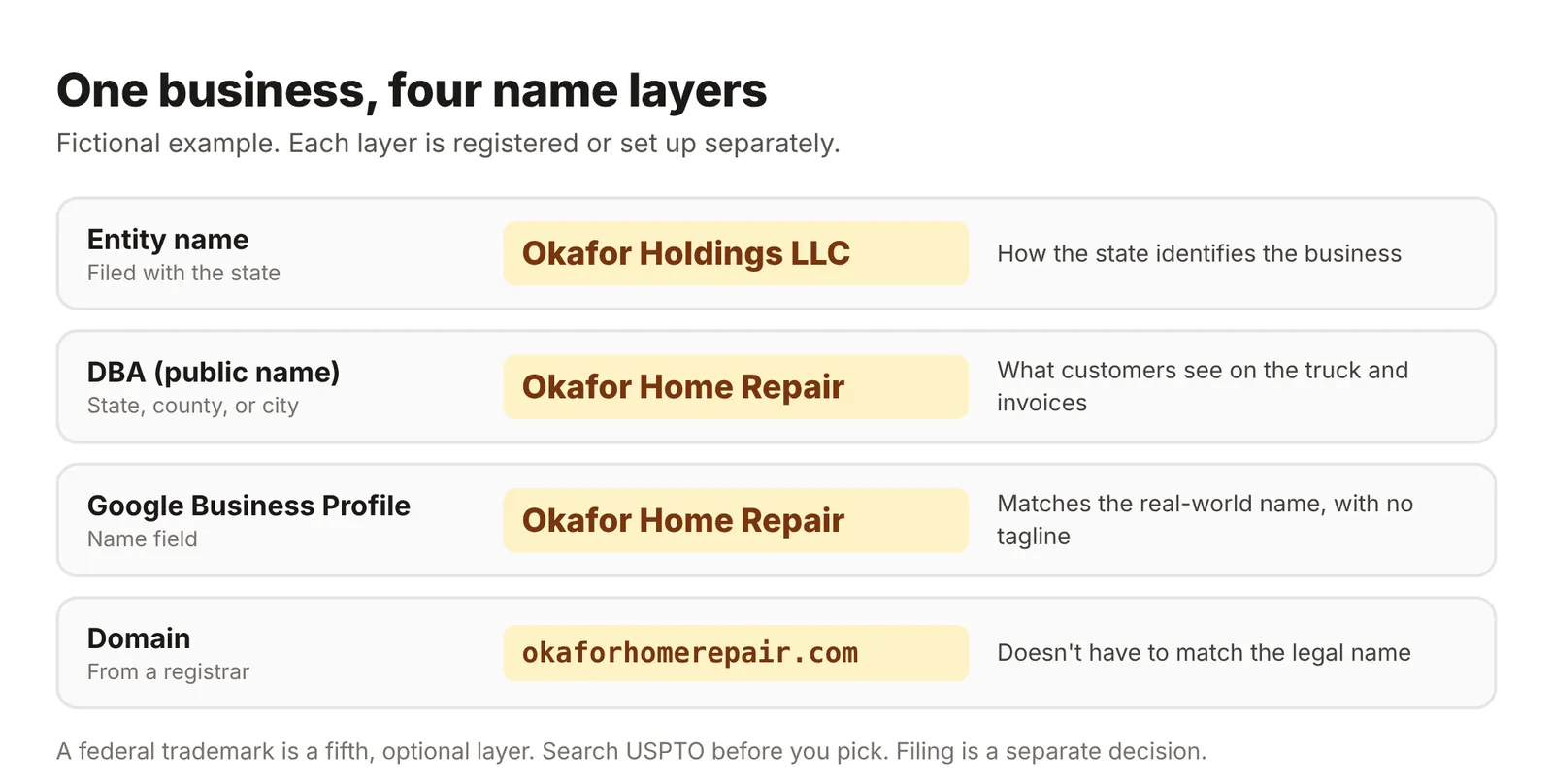
How one fictional business can use a legal name, a DBA, a Google name, and a domain. Diagram only.
13. Claim the domain and the same social handles
Once a name clears the legal checks, claim the web address and handles before someone else does. The SBA notes that your domain doesn't have to match your legal name, so a version with your town or "homerepair" is fine if the exact .com is gone. For the trade-offs between endings and lengths, see how to choose a domain name.
How to do it:
- Check the .com first, then a version with your town or "homerepair" added.
- Check Facebook, Instagram, and Nextdoor for the same name.
- Skip hyphens and number swaps you would have to spell out on every call.
- Set up an email address you can print on invoices, such as office@ or jobs@ at your domain.
- Register the domain the same day you file the name.
Good fit if: you want customers to find you after one look at your truck or yard sign.
14. Use the same real-world name on Google Business Profile
Google wants your profile name to match the name on your signage, website, and stationery. Its guidelines for representing your business on Google don't allow marketing taglines, phone numbers, URLs, hours, or extra service and location details in the name field. Legal endings like "LLC" need real-world proof, such as signs or invoices, that you use them as part of the name.
How to do it:
- Enter the public name exactly as it appears on your truck and invoices.
- Put your towns in the service area and your repair types in categories and services.
- Leave lines like "Same-Day Repairs" or "Licensed & Insured" out of the name.
- Rename only when the business really changes. Under Google's rebranding rules, a change to the proper nouns or services in the name counts as a new business. You mark the old profile closed and create a new one.
- Once the name is set, add a booking link to your Google Business Profile so people can pick a time.
Good fit if: new customers find you on Google Maps and Search.
Which ideas to start with
| Idea | Effort | Cost | Best for |
|---|---|---|---|
| 1. Town or area names | Low | Free to shortlist | One town or county |
| 2. Surname with a lasting ending | Low | Free to shortlist | Referral-driven solo owners |
| 3. Trustworthy building words | Low | Free to shortlist | Landlord and homeowner work |
| 4. Small-jobs-welcome names | Low | Free to shortlist | Short multi-task visits |
| 5. Fix-it and repair words | Low | Free to shortlist | General repair in every room |
| 6. Playful tool puns | Medium | Free to shortlist, more risk of a rebrand later | Friendly homeowner markets |
| 7. Specialty names | Low | Free to shortlist | One job type that fills your week |
| 8. Home services or property care | Low | Free to shortlist | Owners who plan to hire |
| 9. No contractor words without a license | Low | Free | Small-job work under state rules |
| 10. Say-spell-search test | Low | Free | Cutting a long shortlist |
| 11. USPTO search | Medium | Free to search | Advertising beyond one town |
| 12. State search and DBA | Medium | State and local fees vary | LLCs and public names that differ |
| 13. Domain and handles | Low | Domain renewal | One name everywhere online |
| 14. Google Business Profile name | Low | Free | Maps and local search |
Questions handyman owners ask about business names
Should I put "handyman" in my business name?
Usually, yes. It tells people what you do before they read anything else, and it fits small repair work. Skip it if you plan to grow into broader home services, where "Home Repair" or "Property Care" will age better. Even then, keep handyman work in your Google categories and on your services page.
Can I use my own name without registering anything?
Often, yes. The SBA notes that if you do business as yourself under your legal name, you don't need to register a name anywhere. A brand like "Okafor Home Repair" is not your legal name, though, so it likely needs a DBA. Working without an entity also means you may miss the personal liability protection an LLC can offer.
What if a handyman in another state uses the same name?
It can still be a problem. Your state's name search only covers your state, but a federal trademark can reach across state lines. Search USPTO, and if a live mark for related home services matches or sounds close, pick another name. A trademark attorney can tell you how close is too close.
Should I trademark my handyman business name right away?
Not always on day one. A careful USPTO search before you commit is the low-cost first step, and filing is a separate decision. Filing makes more sense once you advertise across a wider area, add trucks, or plan to sell. If you do file, a USPTO examining attorney will search for conflicting marks during review either way.
Are the example names in this list available?
Treat them as ideas only. None of them were checked against USPTO, state, or domain records, and availability changes all the time. Run your own shortlist through items 10 to 14, and talk to a trademark attorney if the name matters for the long term.
Put your new name on a site customers can book
Once the name clears, use it the same way on your truck, invoices, Google profile, and website. For what the site itself should cover, see what a handyman website needs.
If you want a site where customers can see your services and book a time, you can get a site customers can book from with Kejoola. Already have a Google Business listing under the new name? Paste your listing link to get a first draft of your site, then finish it with your own services, towns, and photos.
14-day free trial, no card needed. Online booking starts on the Starter plan.
Sources
- Choose your business name (U.S. Small Business Administration)
- Register your business (U.S. Small Business Administration)
- Trademark search (USPTO)
- Likelihood of confusion (USPTO)
- Guidelines for representing your business on Google (Google Business Profile Help)
- Before applying for a contractor license (California Contractors State License Board)