Landscaping Business Names: Ideas That Sound Local
Eight landscaping business name patterns with example ideas, one license word rule, and the USPTO, state, domain, and Google checks to clear the name you pick.
Josh · Oct 12, 2026 · 15 min read
- landscaping business names
- landscaping business
- business naming
- trademark search
- google business profile
- home services
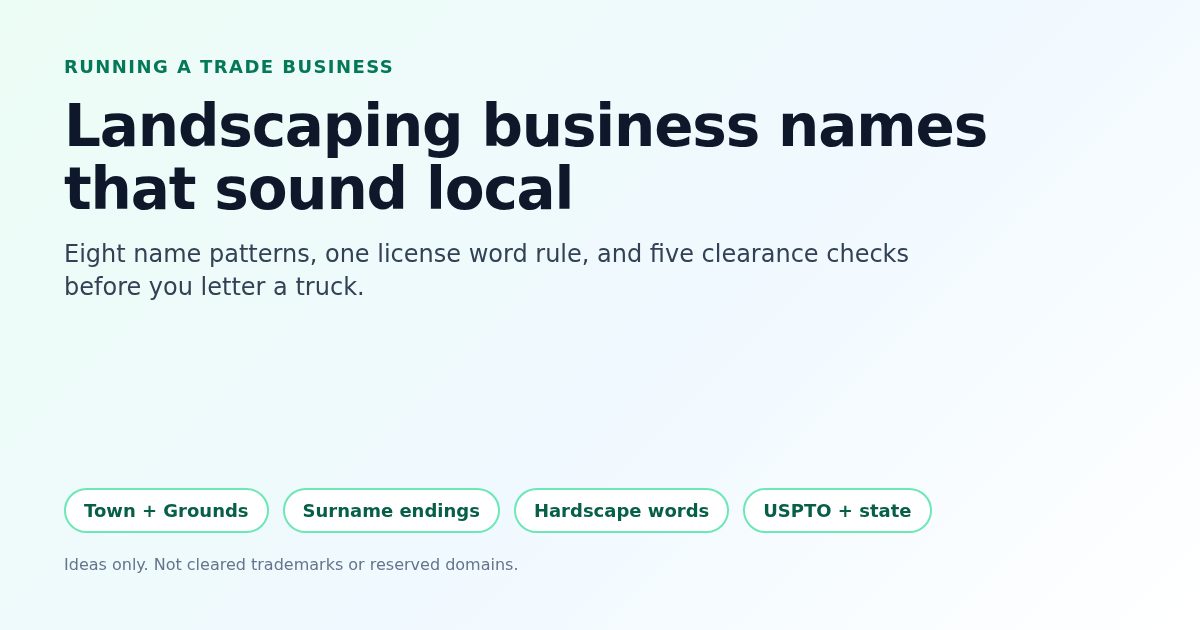
Good landscaping business names tell a homeowner what you do outdoors and where you work. They also read clearly on a truck door and clear a trademark and state name search. This list covers eight name patterns, one license word rule, and five checks to clear the name you pick.
Start with a town or surname shortlist. Every example is an idea only, not a cleared name. Run each finalist through items 10 to 14 before you order a wrap.
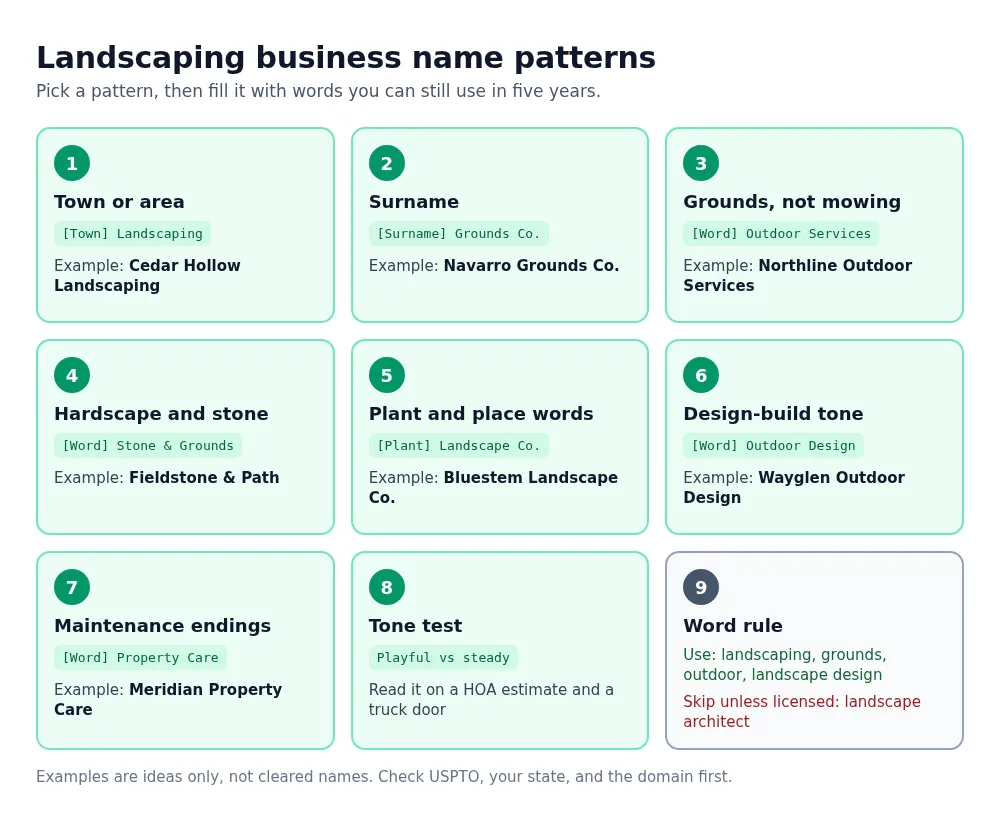
Eight patterns plus the item 9 word rule. Ideas only, not cleared names. Diagram only.
1. Pair landscaping with your town or area
A place name tells a homeowner you are close enough to show up after a storm or for a Saturday plant install. Town, county, lake, and ridge names also match how people search when they want a crew nearby. The risk is picking a place so small that the name feels wrong once you take work in the next county.
How to do it:
- Patterns:
[Town] Landscaping,[County] Landscape Co.,[Lake or river] Grounds, or[Area] Outdoor Services. - Starter ideas (not cleared): Cedar Hollow Landscaping, Millpond Landscape Co., Twin Rivers Grounds, Harbor Ridge Outdoor Services, Oak Crossing Landscaping, Prairie View Grounds Care, Bay Hollow Landscape Co., Three Forks Outdoor Services.
- Pick the widest area you can reach with a full crew day and still turn a profit.
- Search the place name plus "landscaping" on Google Maps to see who already uses it.
Good fit if: you plan to work one metro or county for years and want neighbors to place you fast.
2. Put your surname in front of a lasting ending
Homeowners let a crew dig, prune, and rebuild around their house, so a real family name helps. A first-name brand like "Jake's Landscaping" gets awkward when Jake hires a second crew or sells the routes. A surname with a neutral ending keeps the personal feel and still works with three trucks.
How to do it:
- Patterns:
[Surname] Landscaping,[Surname] & Sons Grounds,[Surname] Outdoor Services, or[Initials] Landscape Co. - Starter ideas (not cleared): Navarro Grounds Co., Castillo Landscaping, Lindqvist Outdoor Services, Pruitt & Sons Landscape, Nakamura Grounds Care, DM Landscape Co., Whitaker Outdoor Works, Odum Brothers Landscaping.
- Your LLC can carry the full legal name while the truck and invoices show the shorter brand.
- Ask two past customers which version they would repeat to a neighbor.
Good fit if: referrals and repeat seasonal contracts bring in most of your work.
3. Prefer "grounds" or "outdoor services" over "mowing"
A name that says only mowing or lawn care can lock you into weekly cuts. That is fine if grass is your whole business. It becomes a liability the first time you quote a patio, a retaining wall, lighting, or winter cleanup. Broader endings leave room to grow without a rebrand.
How to do it:
- Patterns:
[Distinct word] Grounds Co.,[Distinct word] Outdoor Services,[Distinct word] Landscape Group, or[Distinct word] Property Care. - Starter ideas (not cleared): Northline Outdoor Services, Evergreen Grounds Co., Summit Landscape Group, Ironwood Property Care, Heritage Grounds Management, Cedarline Outdoor Services, Meridian Landscape Co., Anchor Grounds Co.
- List the services you want to sell in three years and make sure the name covers them.
- Keep "lawn care" for a DBA or service line if you still want that search phrase.
Good fit if: you already install plants, hardscape, or seasonal work, or you plan to within a year.
4. Borrow hardscape and stone words
Patios, walls, paths, and gravel beds are easy for homeowners to picture. Stone and path words also look strong on a truck door and signal more than a push mower. They work best when masonry or flatwork is a real part of how you sell.
How to do it:
- Patterns:
[Stone word] Landscape Co.,[Word] Stone & Grounds,[Word] Path & Patio, or[Word] Hardscape. - Starter ideas (not cleared): Fieldstone & Path, Granite Ridge Landscape Co., Flagstone Grounds, Bluestone Outdoor Works, Mason Path Landscaping, Terrace & Stone Co., Ledgerock Grounds, Courtyard Hardscape Co.
- Say the first word alone and check that it still sounds like your business.
- Avoid promising "custom stone" in the name if you only set precast pavers for now.
Good fit if: hardscape or outdoor living builds bring solid revenue, not one-off add-ons.
5. Use plant and place words that match your work
Plant names and prairie or meadow words can signal native plantings, beds, and design without sounding like a generic "green" claim. Pick words you can back with the plants and methods you actually install. A name that implies a style you do not sell will confuse the first walkthrough.
How to do it:
- Patterns:
[Plant] Landscape Co.,[Meadow or grove word] Outdoor Design, or[Plant] & Stone Grounds. - Starter ideas (not cleared): Bluestem Landscape Co., Switchgrass Grounds, Alder Grove Outdoor Design, Dogwood & Stone, Fernbrook Landscape Co., Hickory Meadow Grounds, Redbud Outdoor Works, Willowbend Landscape Co.
- Match the word to your climate and plant list so the brand stays honest.
- Skip invented spellings that need a pronunciation tip every time you answer the phone.
Good fit if: planting, beds, and outdoor design are central to how customers describe you.
6. Choose a design-build tone when plans and installs stay together
Some crews sell a plan and then build it. A design-leaning name can help those customers find you, and it can also scare off people who only want weekly maintenance. Use it when a sketch, site visit, and install are how you usually sell.
How to do it:
- Patterns:
[Distinct word] Outdoor Design,[Distinct word] Landscape Studio, or[Distinct word] Design & Build. - Starter ideas (not cleared): Wayglen Outdoor Design, Terrace Studio Landscape, Draftline Outdoor Design, Hillform Landscape Studio, Plot & Path Design, Northlot Design & Build, Studio Ridge Outdoor, Keepform Landscape Co.
- Keep the public name shorter than the legal entity if the studio wording runs long.
- Put maintenance in your services list so weekly customers still know you mow and prune.
Good fit if: design and install already travel together on most of your jobs.
7. Pick a maintenance ending if routes pay the bills
Weekly and biweekly work needs a calm, reliable name more than a clever one. Property managers and HOA boards often prefer "grounds," "property care," and "landscape maintenance" over playful brands. Those endings also age well when you add crews.
How to do it:
- Patterns:
[Distinct word] Property Care,[Distinct word] Grounds Maintenance, or[Area] Landscape Maintenance. - Starter ideas (not cleared): Meridian Property Care, Steadyline Grounds Maintenance, Civic Grove Landscape Maintenance, Fairmont Property Care, Baseline Grounds Care, Westwind Landscape Maintenance, Clearline Property Services, Harborlot Grounds Maintenance.
- Prefer words buyers already type into vendor lists.
- Keep one name across proposals, invoices, and your Google profile so procurement can match records.
Good fit if: recurring maintenance routes are most of your revenue.
8. Test playful names on a truck and an HOA estimate
A pun or warm joke can stick after one look at a trailer in traffic. It can also feel wrong on an estimate for a property manager. Pick humor that stays clean, and test it where people will actually see it.
How to do it:
- Patterns: plant puns, yard rhymes, and short twists on common phrases.
- Starter ideas (not cleared): Lawn & Order Grounds, Dig It Outdoor Co., Branch Manager Landscaping, Yard Work Heroes, Mulch Ado About Nothing Co., The Hedge Fund (likely too cute for commercial bids), Grow Steady Grounds, Cut Above Outdoor Care.
- Mock up the name on a truck photo and an estimate email, then read it as an HOA manager would.
- Keep a plain short form for Google and legal filings if the pun runs long.
Good fit if: your customers are mostly homeowners and your posts already have a friendly tone.
9. Keep "landscape architect" out unless you hold the license
"Landscape architect" is a regulated title across the United States. The American Society of Landscape Architects notes that all 50 states license landscape architects, with title acts and practice acts that limit who may use the title or perform that licensed work. If you are not licensed in your state, do not put "landscape architect" or "landscape architecture" in the business name.
How to do it:
- Use "landscaping," "landscape design," "grounds," or "outdoor services" instead.
- Confirm your state's rules before you advertise design stamps, sealed plans, or architect-style titles.
- If a partner is the licensed landscape architect, put the licensed person's credentials on proposals, not in a shared public name that overclaims.
- Lean on town, surname, grounds, or hardscape words for the name itself.
Good fit if: you sell landscape work without holding a landscape architect license in your state.
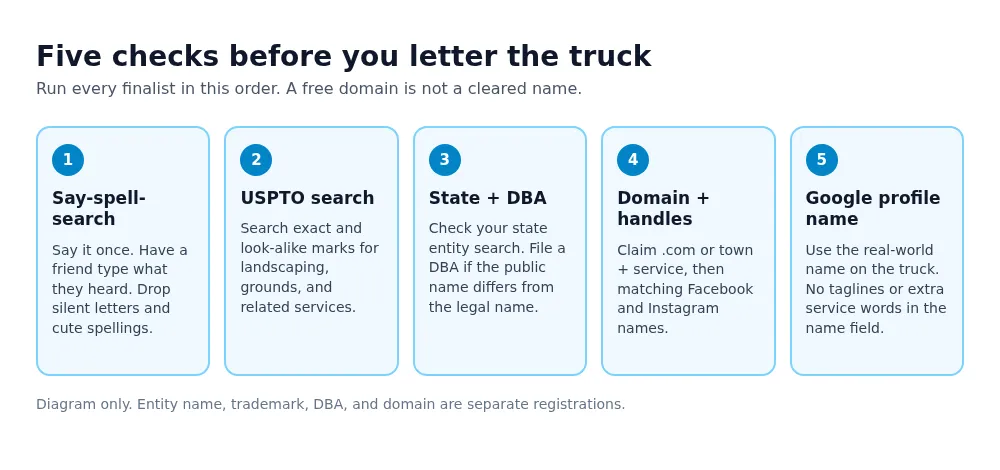
Run every finalist through these five checks in order. Diagram only.
10. Run the say-spell-search test on your shortlist
Most landscaping crews get seen before they get heard. A homeowner spots your truck at a stoplight or a yard sign on a corner lot, then tries to find you later from memory. If they misremember the spelling, the call goes to whoever ranks for their guess, so test each finalist with a friend before money changes hands.
How to do it:
- Answer a pretend call: "Thanks for calling [Name], this is [First name]."
- Say the name once to a friend and have them type what they heard into Google.
- Flash the name on your phone for three seconds, like a truck passing by, and ask them to write it down.
- Drop any name with a silent letter, a "K" for "C" swap, or a shortcut like "Lndscp" or "Grnds."
- Carry two or three survivors into the legal checks below.
Good fit if: your list is longer than three names and you need a quick, free way to trim it.
11. Search USPTO for look-alike and sound-alike marks
Your state approving a name tells you nothing about federal trademarks. The SBA's page on choosing your business name separates the two: a state entity name covers one state, while a trademark protects a brand across the country. The SBA points owners to the USPTO database before they commit. On likelihood of confusion, the USPTO explains that two marks can conflict without being identical, if they look, sound, or mean something similar and the services are related.
How to do it:
- Enter every finalist in USPTO Trademark Search.
- Try the spellings a customer might use, such as Fieldstone, Field Stone, and Feeldstone.
- Write down any live mark covering landscaping, lawn care, grounds keeping, or outdoor construction.
- Drop a finalist when a close mark covers related services. Don't argue yourself into it.
- Get a trademark attorney's opinion before you spend on a wrap if anything sits close.
Good fit if: you want to run ads past your county line, add crews, or sell the routes someday.
12. Check your state's name search and file a DBA if you need one
Per the SBA, a business name can be registered four separate ways: as an entity name, a trademark, a DBA, and a domain, and none of them depends on the others. Your entity name is how the state knows you, and a name already on file usually can't be taken again. A DBA, short for "doing business as," covers the public name on your truck when it differs from your personal or LLC name. The SBA notes a DBA doesn't protect the name, though most states still require one.
How to do it:
- Use the SBA's register your business section to find the office that handles filings in your state.
- Run the exact name and near spellings through your state's business entity search.
- Confirm the LLC ending your state wants, such as "LLC" or "L.L.C."
- Ask your state, county, and city whether the public name needs a DBA filing.
- Hold off on filing until the USPTO and domain checks come back clean.
Good fit if: you are forming an LLC, or the name on your truck isn't your own legal name.
13. Claim the domain and the same social handles
A name that passes the legal checks is worth locking down online the same day. The SBA points out that a domain can differ from your legal name. So if the exact .com is gone, a version with your town or "grounds" works fine. For help comparing endings and lengths, read how to choose a domain name.
How to do it:
- Try the .com first, then add your town or the word "grounds" if it's taken.
- Grab the matching name on Facebook, Instagram, and Nextdoor, where before-and-after yard photos get shared.
- Avoid hyphens and number swaps that need spelling out on every call.
- Create an address like quotes@ or office@ at the domain for estimates.
- Buy the domain on the day you file the name, not a week later.
Good fit if: you want people who saw your truck once to land on your site, not a competitor's.
14. Use the same real-world name on Google Business Profile
On Google, your profile name should be the name customers see on your truck, site, and paperwork. Google's guidelines for representing your business rule out taglines, phone numbers, web addresses, hours, and added service or location words in the name field. An ending like "LLC" is allowed only when signs or invoices show you really use it.
How to do it:
- Type the public name exactly as it is lettered on your truck.
- Use the service area for towns and the categories and services for lawn, planting, and hardscape work. Working from home? See how to hide your address and set a service area.
- Keep add-ons like "Best Landscapers" or "Licensed & Insured" out of the name field.
- Change the name only for a real rebrand. Google treats new proper nouns or services in the name as a new business, and the old profile is marked closed.
- With the name settled, add a booking link to your Google Business Profile so searchers can choose a time.
Good fit if: most new customers find you through Google Maps or a local search.
Which ideas to start with
| Idea | Effort | Cost | Best for |
|---|---|---|---|
| 1. Town or area names | Low | Free to shortlist | One metro or county |
| 2. Surname with a lasting ending | Low | Free to shortlist | Referral-driven owners |
| 3. Grounds or outdoor services | Low | Free to shortlist | Crews adding hardscape or seasonal work |
| 4. Hardscape and stone words | Low | Free to shortlist | Patio and wall-heavy shops |
| 5. Plant and place words | Low | Free to shortlist | Planting and design-led crews |
| 6. Design-build tone | Medium | Free to shortlist | Plan-and-install sellers |
| 7. Maintenance endings | Low | Free to shortlist | Route and HOA work |
| 8. Playful tone test | Medium | Free to shortlist, more risk later | Friendly homeowner markets |
| 9. No unlicensed architect title | Low | Free | Honest naming under state license rules |
| 10. Say-spell-search test | Low | Free | Cutting a long shortlist |
| 11. USPTO search | Medium | Free to search | Advertising beyond one town |
| 12. State search and DBA | Medium | State and local fees vary | LLCs and public names that differ |
| 13. Domain and handles | Low | Domain renewal | One name everywhere online |
| 14. Google Business Profile name | Low | Free | Maps and local search |
Questions owners ask about landscaping business names
Should my name say landscaping or lawn care?
Use the phrase that matches the work you want for the next few years. "Lawn care" pulls weekly cut customers. "Landscaping," "grounds," and "outdoor services" leave room for planting, hardscape, and seasonal jobs. You can still list lawn care as a service even when the legal name is broader. For startup steps beyond the name, see how to start a landscaping business.
Do I need to register a name if I use my own?
Not always. According to the SBA, working under your own legal name doesn't require a name registration. "Castillo Landscaping" adds words to your name, so it likely needs a DBA. Keep in mind that skipping an entity like an LLC can leave your personal assets exposed if a job goes wrong.
What if a landscaper in another state already uses my name?
That can still cause trouble. A state search only looks inside your state, while a federal trademark reaches every state. If USPTO shows a live mark for related outdoor services that matches or sounds close, choose a different name. A trademark attorney can judge the gray areas.
Should I put my city in the business name?
It helps if you plan to stay in that area, because neighbors place you fast. It hurts if you expand, since a town name can feel wrong two counties away. Don't add a city to your Google profile name unless it is part of your real name on the truck and invoices.
Can I use one of the example names above?
Only as a starting point. Nobody checked them against USPTO, state, or domain records, and a name that is open today can be taken next month. Put your own finalists through items 10 to 14, and get a trademark attorney's view if you plan to build the brand for years.
Put your new name on a site customers can book
When the name is clear, letter it the same way on the truck, the estimates, the Google profile, and the website. The site itself should show your outdoor services, towns, and photos, as covered in what a landscaping website needs.
If you want a site where customers can see your services and book a time, you can get a site customers can book from with Kejoola. Already have a Google Business listing under the new name? Paste your listing link to get a first draft of your site, then finish it with your own services, towns, and photos.
14-day free trial, no card needed. Online booking starts on the Starter plan.
Sources
- Choose your business name (U.S. Small Business Administration)
- Register your business (U.S. Small Business Administration)
- Trademark search (USPTO)
- Likelihood of confusion (USPTO)
- Guidelines for representing your business on Google (Google Business Profile Help)
- Will I need a license? (American Society of Landscape Architects)