How to Start a Handyman Business: Licenses, Pricing, and First Jobs
How to start a handyman business: check your state's license threshold, register and insure the company, pick a short service list, price each job against a day target, and win first customers.
Josh · Nov 3, 2026 · 14 min read
- how to start a handyman business
- handyman business
- handyman license
- handyman insurance
- handyman pricing
- small business
Here is how to start a handyman business: confirm your state's contractor threshold and city rules, then register, insure, and bond the company under one legal name. After that, pick a short list of jobs you already do well, set prices that cover a full working day, and win your first jobs from people who already trust your work plus a clean Google profile.
These steps are written for a U.S. owner going out solo or with one helper. Licensing rules change from state to state and city to city, so confirm each one with your own board before you advertise.
Why the order matters when you start a handyman business
Handyman work is one of the most flexible trades to own. You can start with skills you already have, a truck, and a short list of repairs. The Bureau of Labor Statistics projects employment of general maintenance and repair workers to grow 4 percent from 2025 to 2035, about as fast as average, with about 148,700 openings a year. The median wage was $49,590 in May 2025, and that figure doesn't include self-employed workers.
The flexibility is also the trap. Many states let you do small repairs under a dollar threshold without a full contractor license, then require a license, registration, or specialty credential once the job grows, needs a permit, or touches electrical, plumbing, gas, or structural work. Taking a kitchen remodel, a new circuit, or a roof patch because "it's just handyman work" can put you past the legal line and past your insurance.
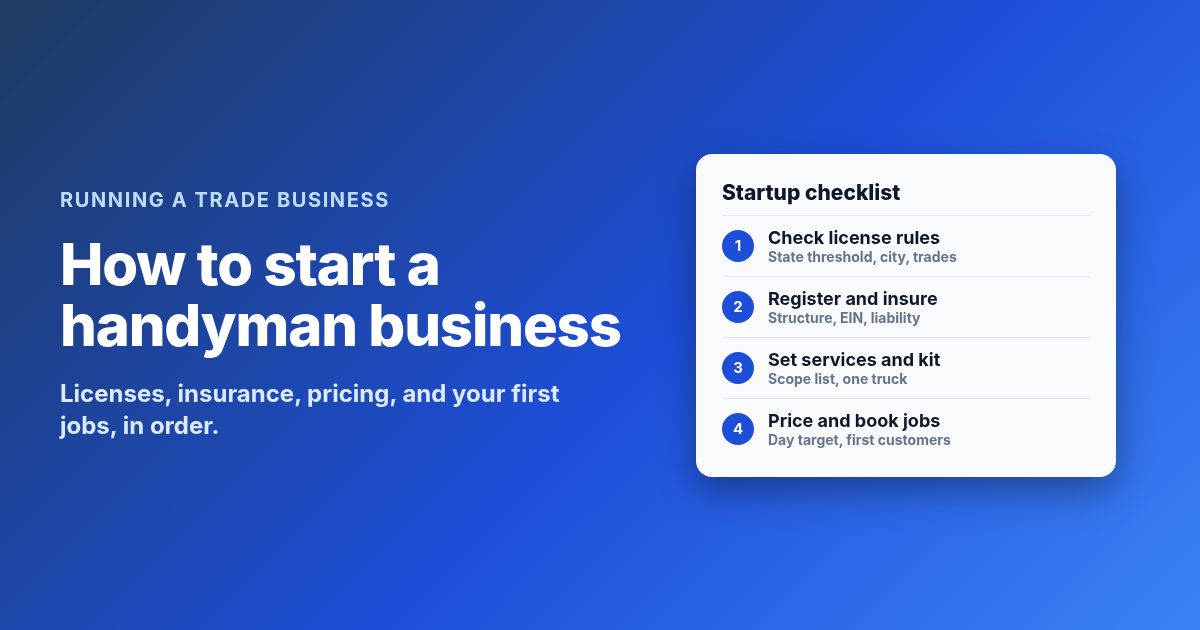
Work through the steps below in order. Keep your current job until you know which jobs you can legally take, and until general liability is in force.
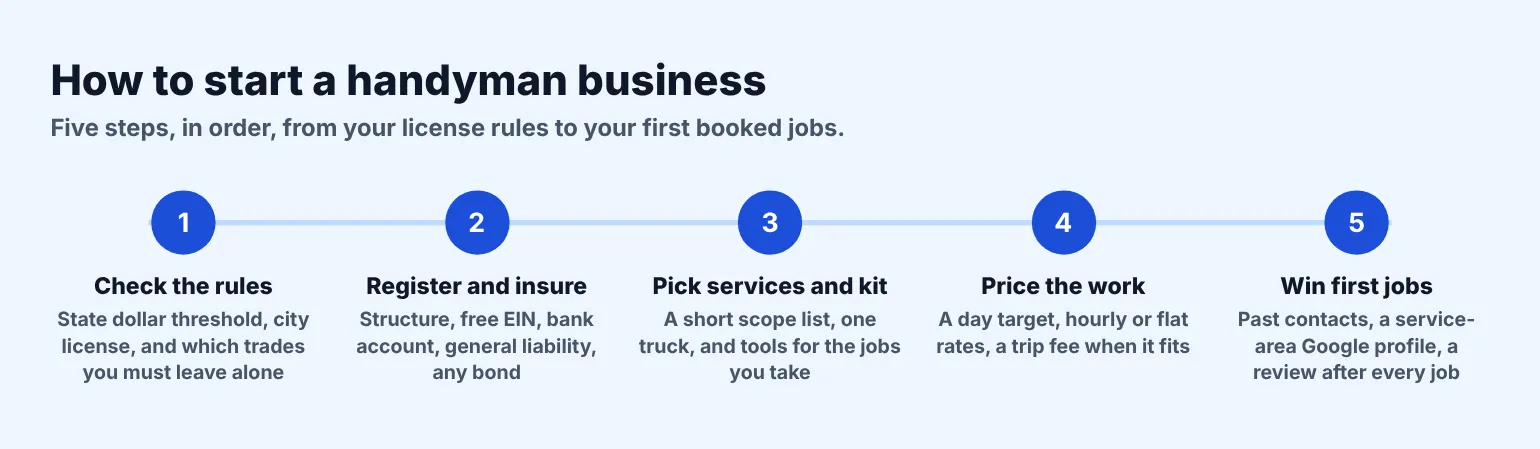
The order to work through, from your state's rules to your first booked jobs. Diagram only.
Step 1: Check your license threshold and local rules
There is no national handyman license. What you need depends on your state, and often your county and city on top of that.
Read your state's contractor threshold
Many states set a dollar amount for "minor" or "casual" work. Below that figure, and with other limits, you may not need a full contractor license. Above it, you do. California and Washington show how different the paths can be:
| Requirement | California (CSLB) | Washington (L&I) |
|---|---|---|
| Rule for small work | Minor-work exemption under Business and Professions Code section 7048 | Handyman specialty contractor registration, or a narrow under-$500 exemption |
| Dollar limit | Aggregate contract price under $1,000 for labor, materials, and all other items | Handyman specialty: under $2,000 in time and materials; separate exemption under $500 for casual work |
| Extra limits | No building permit, and you cannot employ anyone on the job | Handyman specialty: one person does all work, no employees or other specialty contractors, existing residential maintenance and repair only, no permit work |
| Advertising | Unlicensed ads for under-$1,000 work must say you are not licensed | Registered contractors must put the registration number on ads, bids, and estimates |
| Bond / insurance when registered | Ask CSLB for the classification you need if you go past the exemption | Specialty contractors: $15,000 bond; liability of $200,000 public / $50,000 property damage, or $250,000 combined |
In California, the CSLB explains who must be licensed: a project needs a license when it requires a building permit, uses employee labor, or totals $1,000 or more in labor and materials. You also can't split a larger job into contracts under $1,000 to stay exempt. A first offense of contracting without a license is usually a misdemeanor, with a possible six months in jail and a $500 fine, plus an administrative fine of $200 to $15,000.
In Washington, L&I requires construction contractors to register, with a bond and liability insurance before you bid, advertise, or perform work. The handyman specialty under WAC 296-200A-016 is for one individual doing minor residential maintenance and repair under $2,000 in time and materials, with no employees and no permit work. Specialty registration currently costs $150.20 and needs a $15,000 bond plus the liability minimums above.
Call your city or county building department
Even when the state leaves small jobs alone, cities often add a business license, a contractor registration, or permit rules. Ask these questions and write down the answers with the date and the person's name:
- Do I need a state license, a local license, or both for residential repair work here?
- What is the current dollar threshold, and does it include materials?
- Which common handyman jobs need a permit, such as electrical outlets, water heaters, or exterior structural repairs?
- Do I need a separate registration in each town I plan to cover?
Decide which trades you will not take
Electrical, plumbing, gas, HVAC refrigerant work, and structural framing usually sit outside a handyman exemption even when the dollar amount is small. Keep a short "no" list on your phone, and keep a short list of licensed specialists you can refer. Saying no early protects your license status and your insurance.
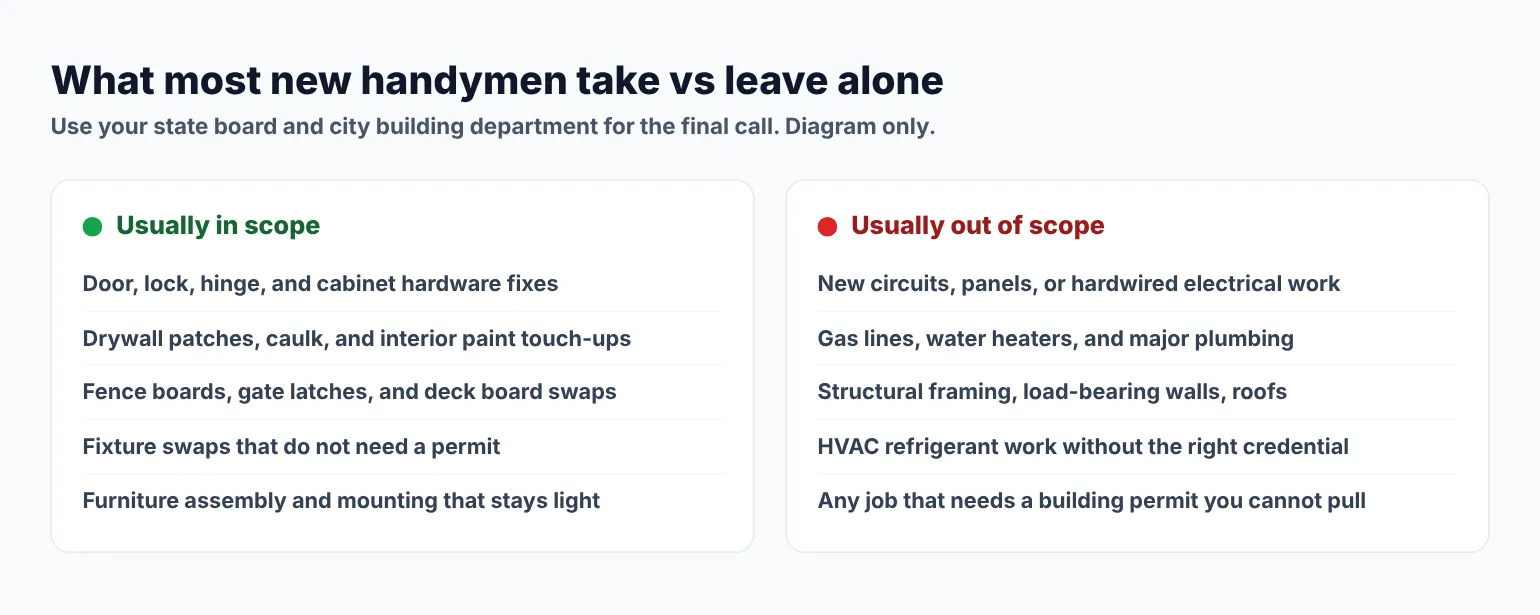
A practical scope split for a new owner. Confirm the final line with your board and building department.
Step 2: Register, insure, and set up the money
Once you know which jobs you can take, set up the company so the license, insurance, and bank account all carry the same legal name.
Choose a structure and register it
The SBA explains that a sole proprietor can be held personally liable for the business's debts and obligations. An LLC protects personal assets like your vehicle, house, and savings in most instances. The SBA also says registering usually costs less than $300, though fees vary by state and structure.
Talk to an accountant before you file, because the structure changes how you're taxed. If your state issues a contractor license or registration to a legal entity, decide the structure before you apply, not after.
Get a free EIN and open a business account
Apply for an EIN directly from the IRS. It's free, and the IRS warns that you should never pay a fee for one.
Open a business checking account the same week. Run every materials order, fuel stop, and customer payment through it. Move a share of each payment into a separate savings account for taxes, since nobody withholds tax from an owner's pay.
Insure and bond the business
General liability is the coverage customers and property managers ask for first. It is meant to help with third-party injury and property damage while you work. It is not a substitute for a contractor license, and it usually does not pay to redo your own bad workmanship. Ask a commercial insurance agent these questions before your first paid call:
- Does general liability cover damage to the customer's home while I work, and damage that shows up after I leave?
- Are the tools in my truck covered against theft, and is the truck covered for business use?
- Which trades are excluded on the policy, such as roofing, structural work, or plumbing?
- When I hire my first helper, when do I need workers' compensation?
If your state requires a bond, buy it through the same agent or a surety company. Keep a digital copy of your certificate of insurance on your phone so you can send it the same day a customer asks.
Step 3: Pick your services and equip one truck
Buy for the jobs you'll take in the next six months, not the business you want in five years.
Write a short service list
Most new owners start with the work they already do well. Pick two or three of these and say no to the rest for now:
- Doors, locks, hinges, and cabinet hardware
- Drywall patches, caulk, and interior paint touch-ups
- Fence boards, gate latches, and simple deck repairs
- Fixture swaps that do not need a permit in your city
- Furniture assembly and light mounting for homeowners and small offices
Write the list in plain language on your Google profile and your invoices. Clear scope reduces the "while you're here" jobs that push you past your license or your skill.
Build the core kit
Most of the starter kit fits in one truck or van:
- Cordless drill/driver set, impact driver, and a solid bit kit
- Hand saw, circular saw, and a level
- Stud finder, multimeter for basic checks you're allowed to do, and a non-contact voltage tester
- Caulk gun, putty knives, drywall tools, and a shop vac
- Ladder suited to the work you'll take, drop cloths, and shoe covers
- A small stock of screws, anchors, caulk, filler, and common hardware
Open accounts at one or two local supply houses. Early will-call hours save a second trip when a door hinge or faucet cartridge doesn't match.
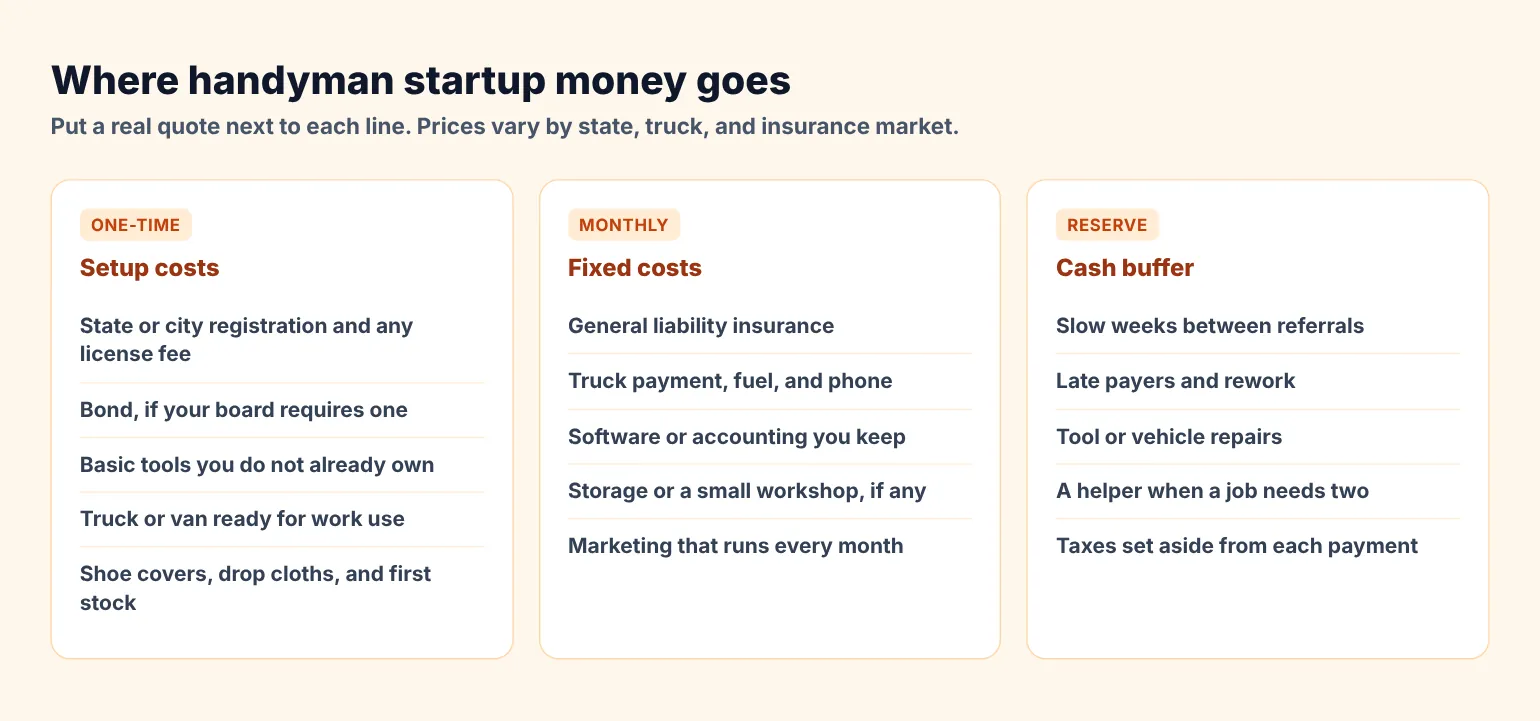
Where startup money goes. Put a real quote next to each line, since prices vary by state and market.
Step 4: Price the work so each job covers the day
Your prices have to cover your time on site, the drive, materials, insurance, the truck, and the quotes that never turn into work. Start with a day target, then pick a pricing method.
Work out your day target
Add up your monthly fixed costs, like insurance, the truck payment, your phone, and any software. Divide by the days you plan to work. Then add the pay you want for each day, and remember that the BLS median for employed maintenance workers is your floor, not your goal. That total is your day target.
Check each job against it. If a punch-list visit takes half a day with drive time, it should bring in at least half your day target after materials.
Choose hourly, flat rate, or a written bid
| Pricing method | Best for | Trade-off |
|---|---|---|
| Hourly with a minimum | Short, unpredictable repairs and punch lists | Customers worry about the clock, so give a range up front |
| Flat rate by task | Common jobs you have timed, like a lockset swap | A slow job eats your margin until your price book is solid |
| Written bid per visit | Multi-room punch lists and small renovation assist work | You carry the risk if the scope grows, so walk the site first |
Many owners mix the three. They charge a trip or diagnosis fee for the first visit, flat rates for common tasks, and a written bid when the list has more than a few items.
Set a trip fee and an after-hours rate
A trip fee pays for the drive and the first look, even when the customer decides not to proceed. Tell the customer the fee on the phone before you book the visit. Set a higher rate for nights, weekends, and holidays, and decide in advance how often you'll take those calls.
Step 5: Win your first handyman jobs
Start with people who already trust your work
Past customers, neighbors, friends, landlords, and real estate agents are the fastest first jobs. Property managers and small offices also need dependable punch-list help on short notice. If you signed a noncompete or nonsolicitation agreement with your old employer, read it before you contact anyone from their customer list, and ask a lawyer if it's unclear.
Choose a clear business name
Pick a name people can say on the phone and spell when they search. The post on handyman business names walks through patterns that work on a van door and a Google listing.
Set up a Google Business Profile as a service-area business
You go to the customer, so set up the profile as a service-area business with the towns you actually cover. If you run the business from home, the steps to hide your address on Google Business Profile keep your house off the map. Add each service you offer and real photos from your own jobs.
Ask for a review after every job
Ask while the customer can see the finished work. The steps to get Google reviews from happy customers take a few minutes once your review link is saved on your phone.
Add a simple online presence when referrals are working
Once people start looking you up before they call, a clean handyman website with your services, towns, and a way to request a time helps more than another marketplace profile. The same order of licenses, insurance, and first jobs shows up when people start a lawn care business. Keep marketplace leads as a supplement, not the whole plan, so one algorithm change doesn't empty your week.
Common problems and how to fix them
A customer asks for work past your threshold or license
Don't take it. A job that needs a permit, crosses your state's dollar limit, or requires a specialty license belongs with someone who holds that credential. Offer to coordinate with a licensed electrician, plumber, or contractor you trust, and keep the parts of the punch list that stay inside your rules.
"While you're here" requests keep growing the scope
Write the agreed tasks on the work order before you start. If the customer adds more, pause and give a new price for the extra work. Scope creep is how a $400 visit turns into an unlicensed $2,000 project.
Cash is tied up in materials and late payers
Collect payment when the job is done, before you leave the driveway. For larger material runs, agree on payment terms in writing before you buy. Keep your truck stock to what you use every week, and order the rest per job.
Slow weeks after a busy month
Use quiet days for follow-ups with past customers, Google photo updates, and a short list of landlords or agents you already know. Set aside cash during busy weeks so a quiet week doesn't force bad pricing.
Where a bookable site fits
Once reviews and referrals start, many homeowners will look you up before they call. A Kejoola site, for example, is four pages (Home, Services, Blog, Contact) with online booking. A homeowner picks a time and types the address and the punch list in the notes box, and the booking lands in your bookings.
Questions owners ask about starting a handyman business
Do you need a license to start a handyman business?
It depends on your state and city. Many places allow small residential repairs under a dollar threshold without a full contractor license, then require one once the job is larger, needs a permit, or uses employees. California's minor-work exemption is under $1,000 with no permit and no employees. Washington registers handymen as specialty contractors for work under $2,000. Check your own board before you advertise.
How much does it cost to start a handyman business?
It depends mostly on the truck and tools you already own, plus your state's fees and insurance. The SBA says registering a business usually costs less than $300, and the IRS issues EINs for free. Washington currently charges $150.20 to register a specialty contractor and requires a $15,000 bond plus liability insurance. Get real quotes for insurance, the bond, and any tools you still need before you quit a steady job.
What insurance does a handyman need?
Start with general liability. Customers and property managers usually ask for a certificate before you begin. Add commercial auto if you use the truck for work, and tools coverage if your kit is worth protecting. Workers' compensation comes into play when you hire help. Ask your agent which trades your policy excludes.
Can you start a handyman business part time?
Yes, if your license and insurance allow the jobs you take, and if your current employer agreements allow outside work. Keep the service list short, book jobs you can finish without rushing, and treat every review as carefully as a full-time owner would.
Is a handyman business a good business to start?
Demand for maintenance and repair help stays steady, and the BLS projects about 148,700 openings a year for general maintenance and repair workers through 2035. The work is physical, the legal lines are easy to cross, and slow weeks are real. A business makes sense once you know your rules, carry insurance, and price each job above what a steady paycheck would pay after expenses.
Get a website where customers book your handyman jobs
If you want a site where customers can see your services and book a time, you can get a website with online booking from Kejoola. Already have a Google Business listing? Paste your listing link and get a website with online booking, so customers book themselves.
14-day free trial, no card needed. Online booking starts on the Starter plan.
Sources
- General Maintenance and Repair Workers (BLS Occupational Outlook Handbook)
- Before Applying for the Examination (California Contractors State License Board)
- California Business and Professions Code section 7048 (California Legislative Information)
- Register as a Contractor (Washington State Department of Labor & Industries)
- Choose a business structure (U.S. Small Business Administration)
- Get an employer identification number (IRS)