How to Price Pressure Washing Jobs: Rates, Formulas, and Examples
To price pressure washing jobs, measure each surface, work out your real cost per hour on the clock, pick a method per job type, then add a minimum and condition adders.
Josh · Oct 26, 2026 · 13 min read
- how to price pressure washing jobs
- pressure washing pricing
- pressure washing rates
- pressure washing business
- power washing estimate
To price pressure washing jobs, measure every surface, work out what an hour on the clock really costs you, and pick a pricing method for each kind of job. Then build a rate card, check it against local market ranges, and add a minimum charge and adders for stains, height, and hard access.
The steps fit a U.S. owner-operator or a small crew washing driveways, houses, decks, fences, and roofs. Market numbers below come from published cost guides and are a sanity check, not your price list.
Why pricing matters for a pressure washing business
A common way new wash businesses lose money is pricing only the time the trigger is pulled. The drive, the hose run to the backyard, the tarps over the hydrangeas, and the wash-water cleanup all happen on your clock, whether you charged for them or not.
Underpricing also shapes your schedule. A cheap driveway rate fills the calendar with small jobs that each carry a full setup and teardown. You end the week tired and short on cash, with no open days for the house washes and commercial pads that actually pay.
Overpricing has its own cost. Homeowners compare quotes, and published guides tell them what's normal. Angi's 2026 pressure washing cost data puts the national average for washing a house at $312, with most homeowners paying between $213 and $449. If your house wash lands far outside that range, be ready to explain why on the quote.
A clear method fixes both problems. You can defend every price with the surface, the time, and the condition, and you can say no to jobs that don't pay.
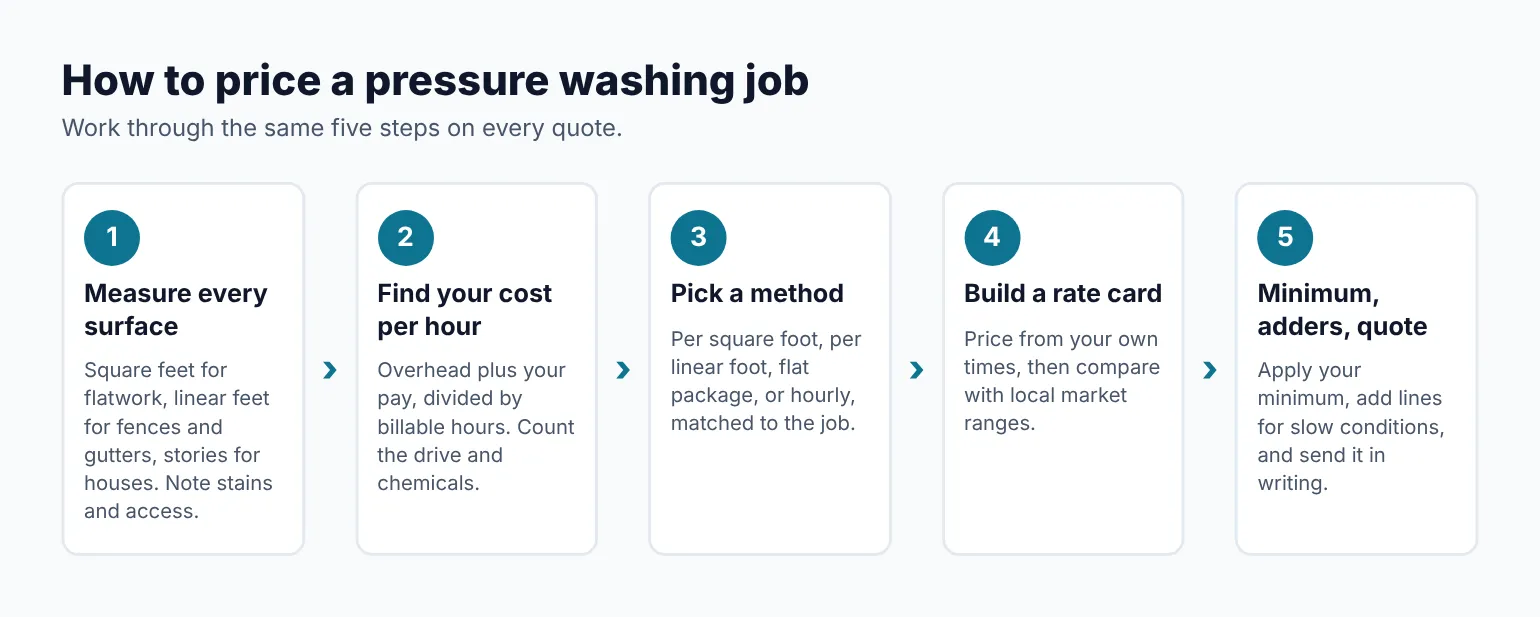
The order to work through for each new quote. Diagram only.
Step 1: Measure every surface and note its condition
You can't price what you haven't measured. Write each surface down on its own line, because each one can need a different method, chemical, and time.
Measure flatwork in square feet
For driveways, patios, sidewalks, and pool decks, multiply length by width. Break odd shapes into rectangles and add them up. A measuring wheel is fast on site. For phone quotes, a satellite map or the county property record gives you a starting number, which you confirm before you start.
Measure the walkway, the front steps, and the side strip by the garage separately. Customers often call it "the driveway" and mean all of it.
Measure houses, fences, and gutters the way you'll quote them
Houses can be priced by wall area, by linear foot of the perimeter, or as a flat price by size and stories. Pick one way and use it every time. Fences and gutters are usually measured in linear feet, so walk them or count panels.
Note the number of stories on every house. Height changes your setup, your reach, and your risk. Angi's data shows the jump clearly, with one-story house washes at $150 to $750 and two-story homes at $400 to $1,400.
Note the conditions that slow you down
Write down anything that adds time or risk:
- Oil spots, rust from irrigation, or gutter-overflow stains that need a pretreatment
- Mildew or algae on siding or a north-facing roof
- Painted, stained, or sealed surfaces that need a test spot and low-pressure cleaning
- No working spigot, a long hose run, or a locked side gate
- Delicate plants, pool equipment, or outdoor electrical that need covering
- Storm drains near the work area
Ask for photos of every surface when the customer books. Photos miss texture, though, so walk any large or heavily stained job before you commit to a firm price.
Step 2: Work out your real cost per hour on the clock
Your price has to cover more than your pay. Start from cost, then add profit on top.
Add up overhead and your pay
List your monthly fixed costs: insurance, truck or trailer payments, phone, software, equipment repairs, and marketing. Add a monthly amount for replacing the pump, hoses, and surface cleaner, since they wear out.
Then estimate your billable hours per month. Be honest here. Rain days, quote visits, and supply runs aren't billable. Divide your monthly fixed costs by your billable hours. That's your overhead per hour. Add the hourly pay you want for yourself and any helper, including payroll costs if you have employees.
Count the drive
Drive time costs you twice: once in vehicle wear and fuel, and again in hours you can't wash. For the vehicle side, the IRS standard mileage rate for business use is 76 cents per mile for July 1 to December 31, 2026. It's a tax figure, not a pricing rule, but it's a reasonable stand-in for what a mile costs if you don't track your own.
For the time side, count the round trip in the job's hours. A 25-minute drive each way turns a 90-minute driveway into a job that takes well over two hours of your day.
Count chemicals, water, and wash-water handling
Add the chemicals each surface needs, such as degreaser for oil or a soft-wash mix for siding. If you bring your own water, count the fill.
Wash-water rules can add real time. Portland, Oregon's guidance for mobile washers says the washer should contain and collect all wash water, block storm drains before cleaning, and hold a Discharge Authorization with the city. The EPA's wash water best practice sheet describes using a bermed area and a wet/dry vacuum to capture wash water on a small job. Rules differ by city, so check yours. If a job needs berms, drain covers, and a recovery vacuum, that's labor and gear you should price in.
Put the pieces into one formula
Once you know your numbers, a job price comes from:
Job price = (hours on the clock × your cost per hour) + chemicals + mileage, then add your profit margin
Here is how that plays out on one house, with example times. Say a house wash takes 2.5 hours on site, plus 1 hour of round-trip driving, so 3.5 hours on the clock. Multiply 3.5 by your cost per hour, add the soft-wash mix and the miles, then add your margin. That total is your floor for that house. Anything lower loses money, however busy you look.
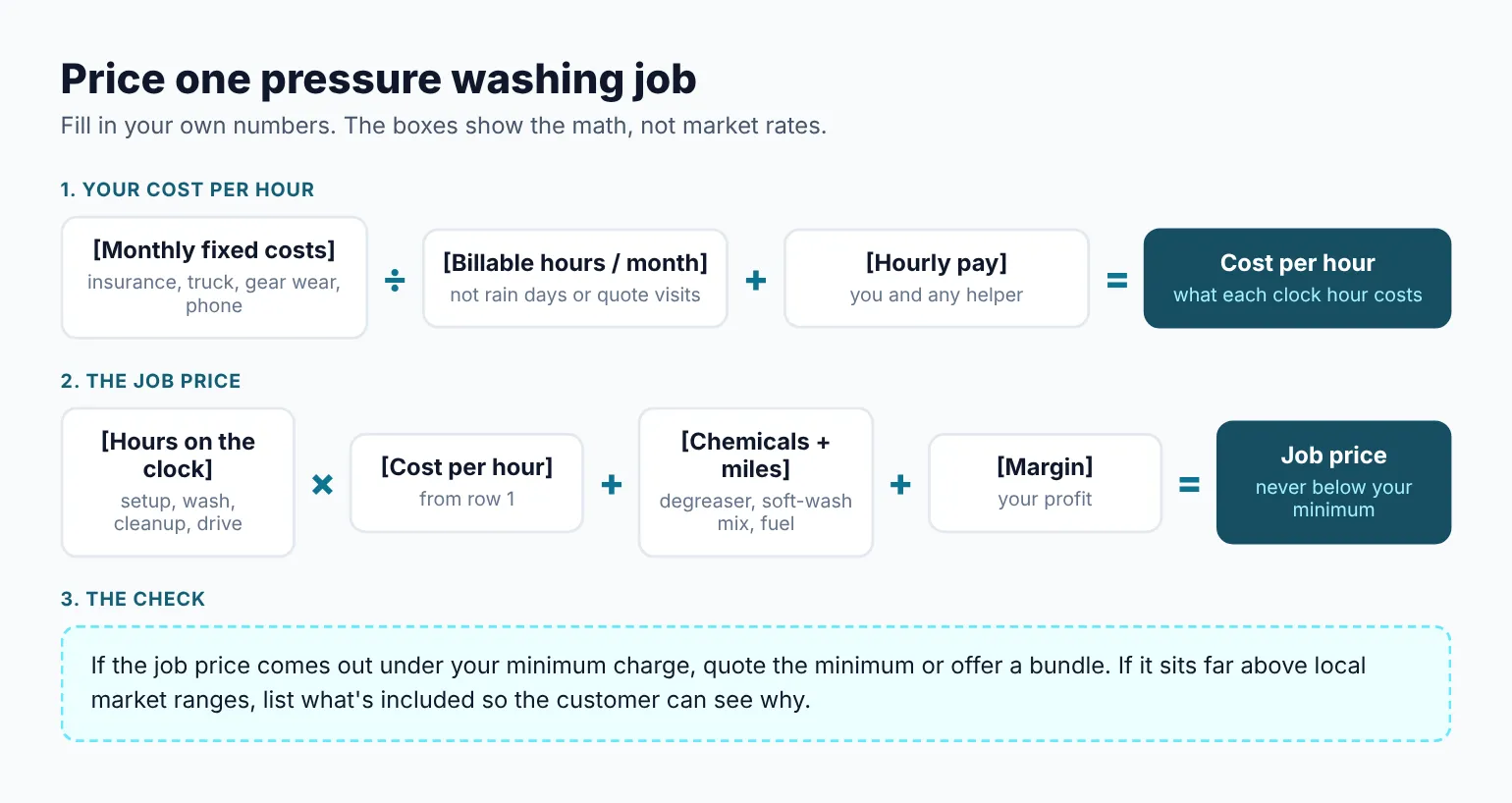
A worksheet for one quote. Fill in your own costs. The boxes show the math, not market rates.
Step 3: Pick a pricing method for each kind of job
Most wash businesses use more than one method. Match the method to how predictable the job is.
| Pricing method | Best for | Trade-off |
|---|---|---|
| Per square foot | Driveways, patios, pool decks, commercial flatwork | Small areas lose money unless a minimum applies |
| Per linear foot | Fences, gutters, house perimeters | You need an accurate walk-around count |
| Flat price by package | Standard homes: "two-car driveway," "one-story house wash" | Big or heavily stained jobs can blow past the package |
| Hourly or day rate | Restoration, graffiti, heavy equipment, unclear scope | Customers worry about the total, so give a written range |
Square-foot and linear-foot pricing
These methods are easy to explain and easy to check. Angi lists $0.10 to $0.50 per square foot for professional pressure washing overall, and $0.20 to $0.40 per square foot for driveways. Gutter washing runs $0.50 to $1.50 per foot in the same data.
Notice the spread in those ranges. Condition, region, and method move the price more than area alone. Use square-foot rates to build your packages and check odd jobs, not as the only number on the quote.
Flat packages
Flat packages work once you know your times. If your standard two-car driveway takes a known amount of time with your surface cleaner, you can quote it on the phone in seconds. Customers like a single number, and you stop measuring every small job.
Spell out what the package covers, like the driveway apron and the front walk, and what costs extra, like oil treatment or sealing.
Hourly pricing
Hourly pricing protects you when you can't predict the work. HomeGuide's pressure washing price guide lists professional rates of $50 to $160 per hour depending on job size. Most homeowners are wary of an open-ended clock, so give a written estimate range and say when you'll call if the job runs long.
Step 4: Build a rate card and check it against the market
A rate card lists your price for each common job and size. It keeps your quotes consistent, and it lets a helper quote the same way you would.
Draft your card from your own times
Time yourself on your first ten to twenty jobs. Note the surface, the size, the condition, and the hours from arrival to departure. Group similar jobs, and set package prices that cover your cost per hour plus margin with some room for bad days.
Compare your card with published ranges
Angi's 2026 data gives these typical project ranges for homeowners:
| Job | Typical range (Angi, 2026) |
|---|---|
| Driveway | $100 to $250 |
| Patio | $100 to $200 |
| Fence | $150 to $300 |
| Gutters | $50 to $150 |
| Roof | $450 to $700 |
| One-story house | $150 to $750 |
| Two-story house | $400 to $1,400 |
Location matters too. The same Angi data puts the average house wash at $190 in Phoenix and $420 in Portland, Maine. If your card sits well above local norms, make sure your quote says what's included. If it sits well below, you're probably leaving money on the table or skipping costs.
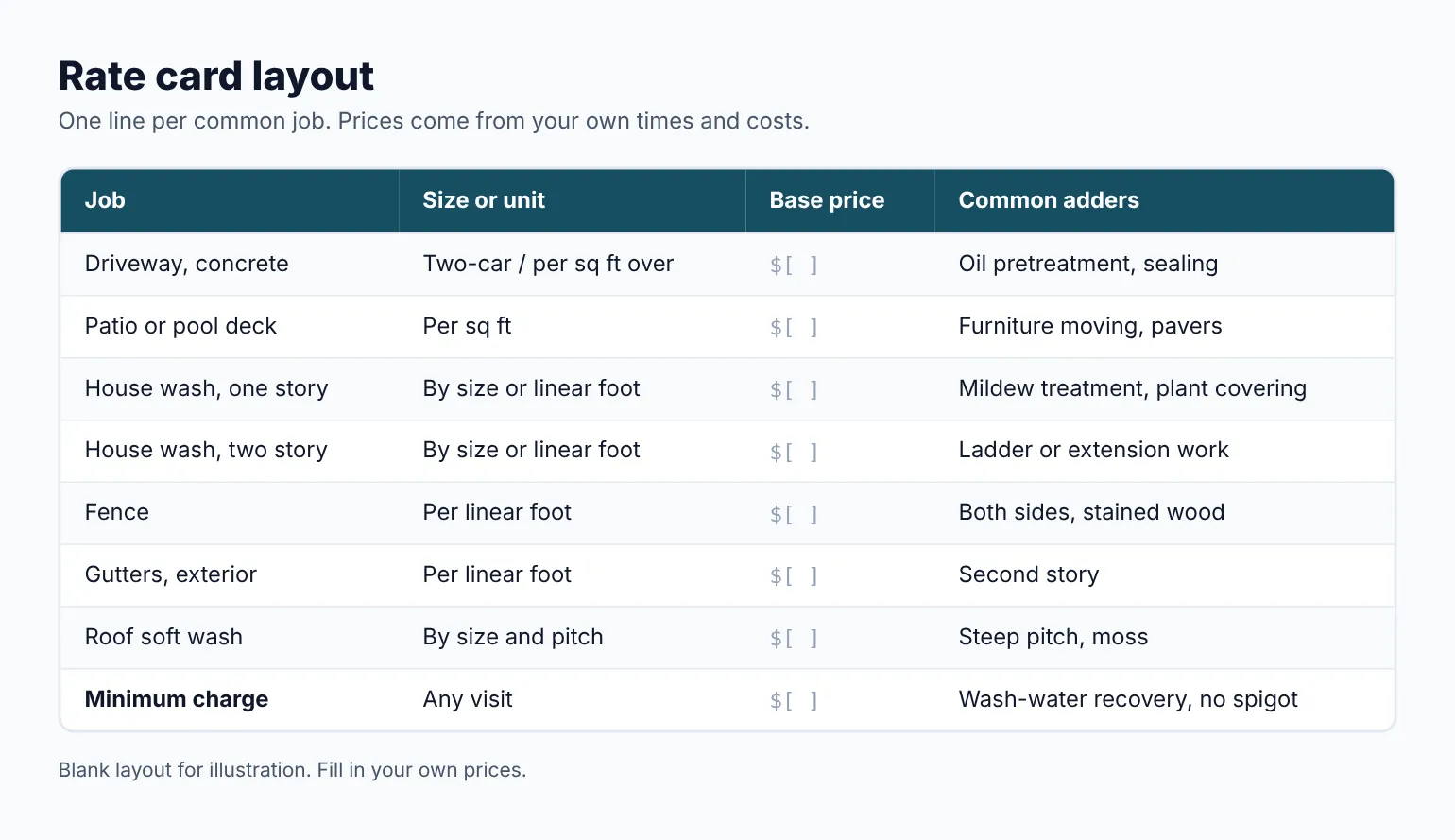
A blank rate card layout. Fill in prices from your own times and costs.
Decide whether to show prices online
Some owners post "starting at" prices for driveways and house washes so callers self-qualify. Others keep prices off the site and quote after photos. The tradeoffs are covered in our post on putting prices on your website.
Step 5: Set a minimum, add adders, and write the quote
Set a minimum charge
Every trip carries the same setup, hose run, and cleanup, however small the surface. HomeGuide notes that small jobs cost more per square foot because of the minimum service charge. Set yours at what a short job really costs once the drive and setup are counted. A customer who wants only the front walk can be offered the walk plus the driveway as a bundle that clears the minimum.
Add adders for slow conditions
Price the slow parts as separate lines so customers see why one house costs more than another:
- Oil or rust pretreatment
- Second-story walls or a steep roof
- No spigot on site, or a long hose run
- Heavy plant covering or furniture moving
- Wash-water containment and recovery
- Sealing after the wash
Write the quote and send it the same day
A written quote protects you and the customer. Here's a short one you can copy and adjust:
Subject: Your pressure washing quote for [Street]

Hi [Customer first name],

Thanks for showing me around today. Here is
your quote for [Address]:

- [Surface 1], about [size]: $[price]
- [Surface 2], about [size]: $[price]
- Oil pretreatment on [area]: $[price]

Total: $[total]

Included: surface cleaning, rinse, covering
plants near the work area, and cleanup.
Not included: [sealing / windows / roof].

We'll need a working outdoor spigot and access
through [gate]. This quote is good for [30]
days. Reply or call [Phone] to pick a date.

[Your name]
[Business name] · [Phone]
List each surface, the method, what's excluded, and how long the price holds. If you want more wording for follow-ups, the cleaning estimate templates adapt easily to wash jobs.
Common problems and how to fix them
Your days are full but the bank account isn't
You're likely booked with jobs priced below your cost per hour. Divide each job's price by its hours on the clock, drive included. Raise the package price or the minimum on any job type that falls under your target, starting with the most common one.
A customer says your quote is much higher than another one
Ask what the other quote included. Cheaper quotes often skip insurance, pretreatment, plant protection, or wash-water handling. Walk through your line items without discounting. If they still want the lower price, let the job go.
A job took twice as long as you quoted
Write down why: heavier staining, a surprise second story, or no spigot. Add that condition to your adder list and to your booking questions. If you quoted a firm price, finish the job at that price and fix the card for next time.
Small jobs keep eating your mornings
Raise the minimum, bundle small surfaces into packages, and group nearby jobs on the same day. Neighbor bookings on one street save drive time you can pass on as a small bundle price.
Where a bookable site fits
Once your packages and minimum are set, many homeowners will want to book without a phone call. A Kejoola site, for example, is four pages (Home, Services, Blog, Contact) with online booking. A customer picks a time and types the address, the surfaces, and rough sizes in the notes box, and the booking lands in your bookings. You confirm the scope and the price before you load the truck. Our pressure washing website guide shows how to list your packages on that kind of page.
Questions owners ask about pricing pressure washing jobs
How much should I charge to pressure wash a house?
Charge what your hours, drive, and chemicals cost plus your margin, then check it against local norms. Angi's 2026 data puts the national average at $312, with most homeowners paying $213 to $449. Two-story homes run higher because of the extra setup and reach.
Is it better to charge by the square foot or a flat rate?
Use both. Square-foot rates help you build packages and price unusual flatwork. Flat packages are faster to quote and easier for customers to accept. Switch to hourly or a written range only when the scope is hard to predict, like restoration or graffiti work.
What minimum charge should a pressure washing business set?
Set it at the real cost of your shortest job, including the drive, setup, hose run, and cleanup. HomeGuide notes that small jobs cost more per square foot because of minimum charges. Offer bundles to customers whose single surface falls under the minimum.
How do I price my first pressure washing jobs with no history?
Start from your cost per hour and estimated times, and price a little above that floor. Time every job carefully, including drive and setup. After ten to twenty jobs, rebuild your rate card from real times. If you're still setting up the business itself, our guide on how to start a pressure washing business covers the steps before pricing.
Should I charge extra for wash-water recovery?
Yes, when the job needs it. Containment and recovery take extra gear and labor, and some cities require them. Portland, Oregon, for example, expects mobile washers to block storm drains and collect wash water. Check your city's stormwater rules and list recovery as its own line on the quote.
Give homeowners a way to book your wash packages
If you want a site where customers can see your services and book a time, you can get a site customers can book from with Kejoola. Already have a Google Business listing? Paste your listing link to get a first draft of your site, then finish it with your own services, towns, and photos.
14-day free trial, no card needed. Online booking starts on the Starter plan.
Sources
- How much does it cost to pressure wash a house? (Angi, updated October 2026)
- Pressure washing prices (HomeGuide, checked October 2026)
- Standard mileage rates (IRS)
- Prevent pollution when washing vehicles and equipment (Portland.gov)
- Stormwater best management practice: vehicle and equipment washing (EPA)