How to Start a Pressure Washing Business, Step by Step
How to start a pressure washing business in the U.S.: pick services, form an LLC or sole prop, get an EIN, licenses and insurance, buy a starter kit, price jobs, and win first customers.
Josh · Oct 3, 2026 · 12 min read
- how to start a pressure washing business
- pressure washing business
- power washing
- home services
- google business profile
- small business
How to start a pressure washing business comes down to six moves in order: pick the wash niches you can sell, make the business legal, get an EIN and a bank account, lock licenses and insurance, buy a kit that matches those jobs, then price work and find the first customers. Skip the order and you risk buying a washer before you can legally take a check.
The steps fit a U.S. mobile wash crew doing driveways, house soft-wash, decks, patios, sidewalks, and concrete. Local license, stormwater, and insurance rules always win when they differ from a general note.
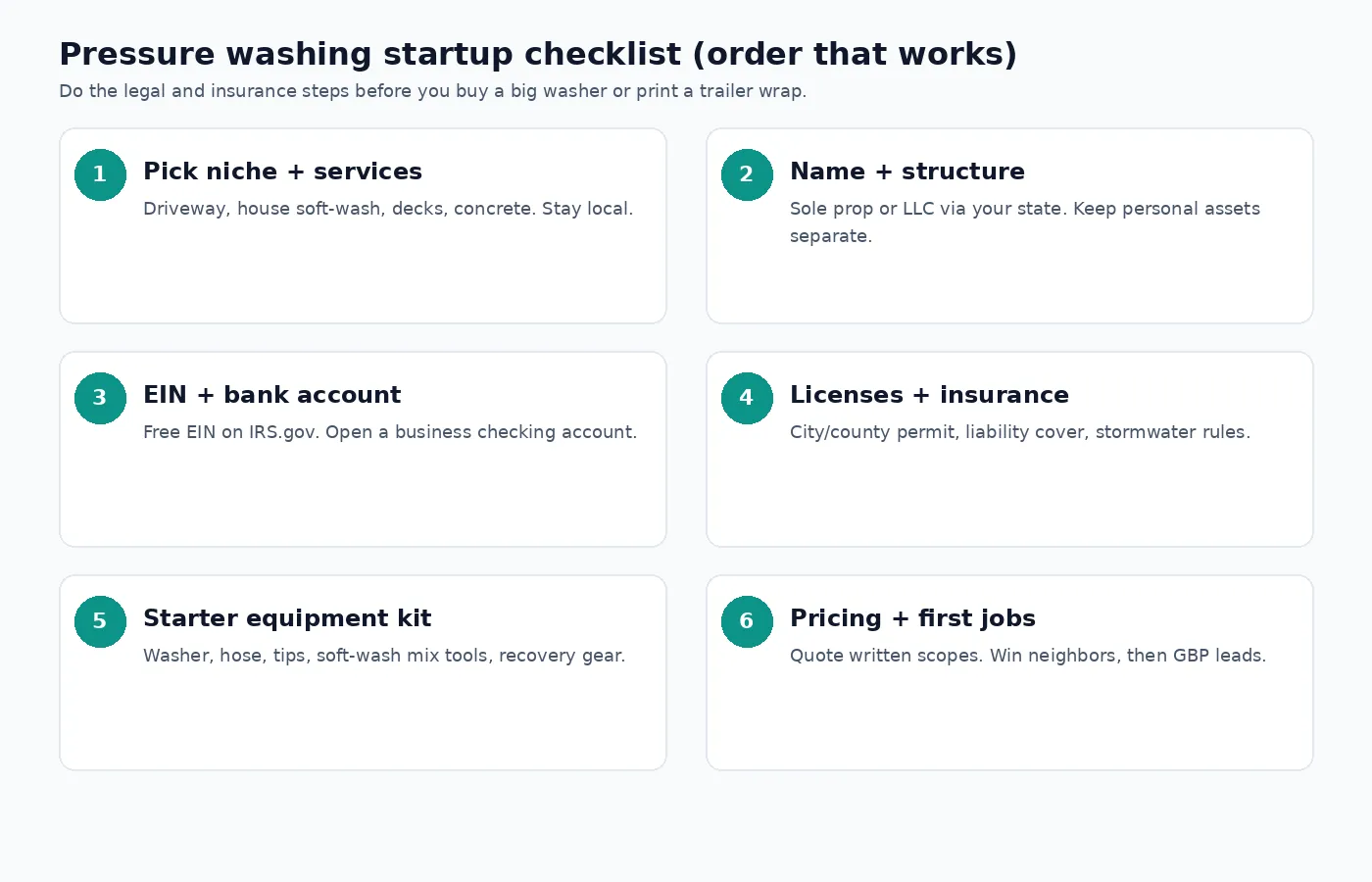
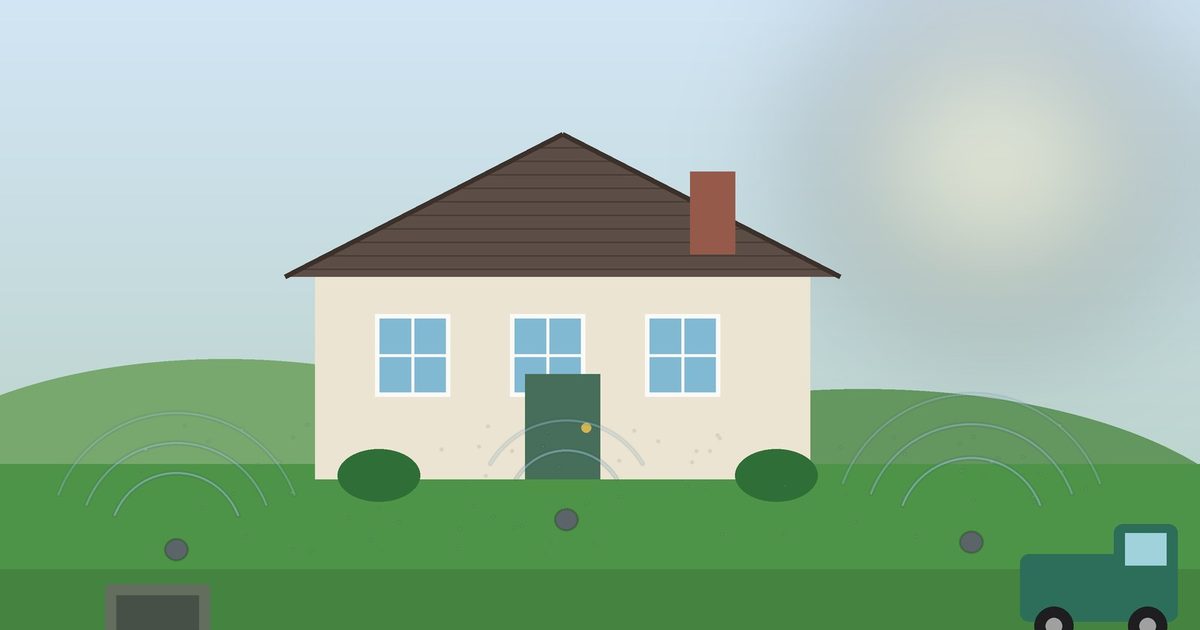
Startup order that keeps legal and insurance ahead of big equipment buys. Diagram only.
Why starting clean matters for a wash business
A pressure washing business looks simple from the curb. Water, a machine, and a driveway. The real risk sits in three places: personal liability if a job goes wrong, wash water that hits a storm drain, and a schedule that fills with underpriced jobs you cannot finish.
Homeowners hire wash crews for oil-stained pads, algae on siding, and decks that look gray after winter. They also expect a written scope, proof of insurance, and a clear arrival window. When those pieces are missing, you compete only on the lowest phone quote.
Starting clean also keeps marketing honest. A Google Business Profile, a truck magnet, and a bookable site all work better when your legal name, service towns, and wash nouns already match. The marketing section below assumes you already finished the legal and insurance steps.
Step 1: Pick your niche and service menu
Do not launch as “we wash everything.” Pick two or three services you can finish well with the kit you will buy first.
Strong starter niches for most U.S. metros:
- Driveway and sidewalk pressure wash
- House soft-wash (painted siding, lower pressure, different chemistry)
- Deck and patio clean (wood vs composite need different care)
- Concrete cleanup around garages and dumpster pads
Hold for later unless you already know the work:
- Roof washing (fall risk, warranty issues, extra insurance questions)
- Fleet or engine degreasing (wastewater and chemical rules tighten fast)
- Large commercial contracts that demand certified recovery gear on day one
Write each service as a noun a homeowner would search or text: “driveway pressure wash,” not only “exterior cleaning.” Add what is included, what is excluded, and what you need on site (hose bib, gate code, trailer parking, pets indoors). Soft-wash for siding is not the same booking as high-pressure concrete. Keep those as separate line items.
| Service | Best first kit | Watch out for |
|---|---|---|
| Driveway / sidewalk | Mid-range washer + surface cleaner | Oil spots need pretreatment time |
| House soft-wash | Soft-wash setup, long reach, plant care plan | Wrong pressure can scar paint |
| Deck / patio | Lower pressure, wood-safe approach | Composite and cedar need different care |
| Light commercial pads | Containment plan before you bid | Storm drain rules at the property |
End this step with a one-page menu you can email or text. Pricing comes later. Clarity comes first.
Step 2: Choose a structure, register, and get an EIN
The U.S. Small Business Administration walks through a full startup path: plan, structure, name, register, tax IDs, licenses, bank account. For a wash crew, the early legal fork is usually sole proprietorship vs LLC.
Sole proprietorship vs LLC
A sole proprietorship is the simplest path. You and the business are the same for liability. An LLC creates a separate legal entity when you file with your state, which is the path many owners take when they want clearer separation between personal and business risk. The SBA covers how registration works by structure and state. File where you actually work. Out-of-state “cheap LLC” setups usually create more paperwork, not less.
Name and DBA
Pick a name customers can say on the phone. Check your state business registry and, if you care about brand protection, USPTO Trademark Search. If you operate under a name different from your legal entity name, ask your city or county about a DBA or assumed-name filing.
Get a free EIN from the IRS
After the state filing (for an LLC or corporation), get a federal Employer Identification Number. The IRS issues EINs online for free. Complete the session in one sitting. Print the confirmation. Do not pay a random website that charges for an EIN. You will use the EIN to open a business bank account, file taxes, and apply for many licenses.
Open a business bank account
Route every customer payment into the business account. Pay fuel, chemicals, insurance, and software from that account. Clean books make tax time survivable and make you look real when a property manager asks for an invoice on letterhead.
Step 3: Licenses, permits, insurance, and wash-water rules
Licenses are local. The SBA’s guidance on licenses and permits is the right starting map: federal rules only when your activity is federally regulated, then state and city layers. A pressure washing business often needs a general business license from the city or county, plus any contractor or specialty rules your state applies to exterior cleaning. Call the clerk before you spend on a trailer wrap. Bring your EIN and formation docs.
Insurance you should treat as required
Talk to a commercial agent who already writes policies for mobile wash or cleaning trades. Typical asks from property managers and HOAs:
- General liability (ask what limits they require in writing)
- Commercial auto if you use a work vehicle
- Inland marine or tools coverage if your kit rides in a trailer
- Workers’ compensation before you hire anyone (state rules decide when it is required)
Do not invent premium numbers from a blog. Get quotes dated for your zip code, equipment list, and revenue plan. Keep certificates of insurance ready as PDFs.
Stormwater and wash-water disposal
Wash water can carry oils, detergents, paint chips, and sediment into storm drains that lead to creeks and rivers. Many cities treat that as an illicit discharge. Local stormwater programs publish best management practices for mobile washers: contain runoff, collect wastewater, and dispose to the sanitary sewer only with permission, never assume the street grate is fine. Read your city’s stormwater page and your sewer utility’s rules before you bid a parking-lot job. If you use soaps, hot water, or degreasers, plan recovery gear and written disposal steps as part of the job, not as an afterthought.
Step 4: Buy a starter equipment kit that matches the menu
Buy for the niches you already wrote down. A driveway-only launch does not need a full commercial recovery trailer on day one, but a soft-wash house offer does need more than a big PSI number on a box.
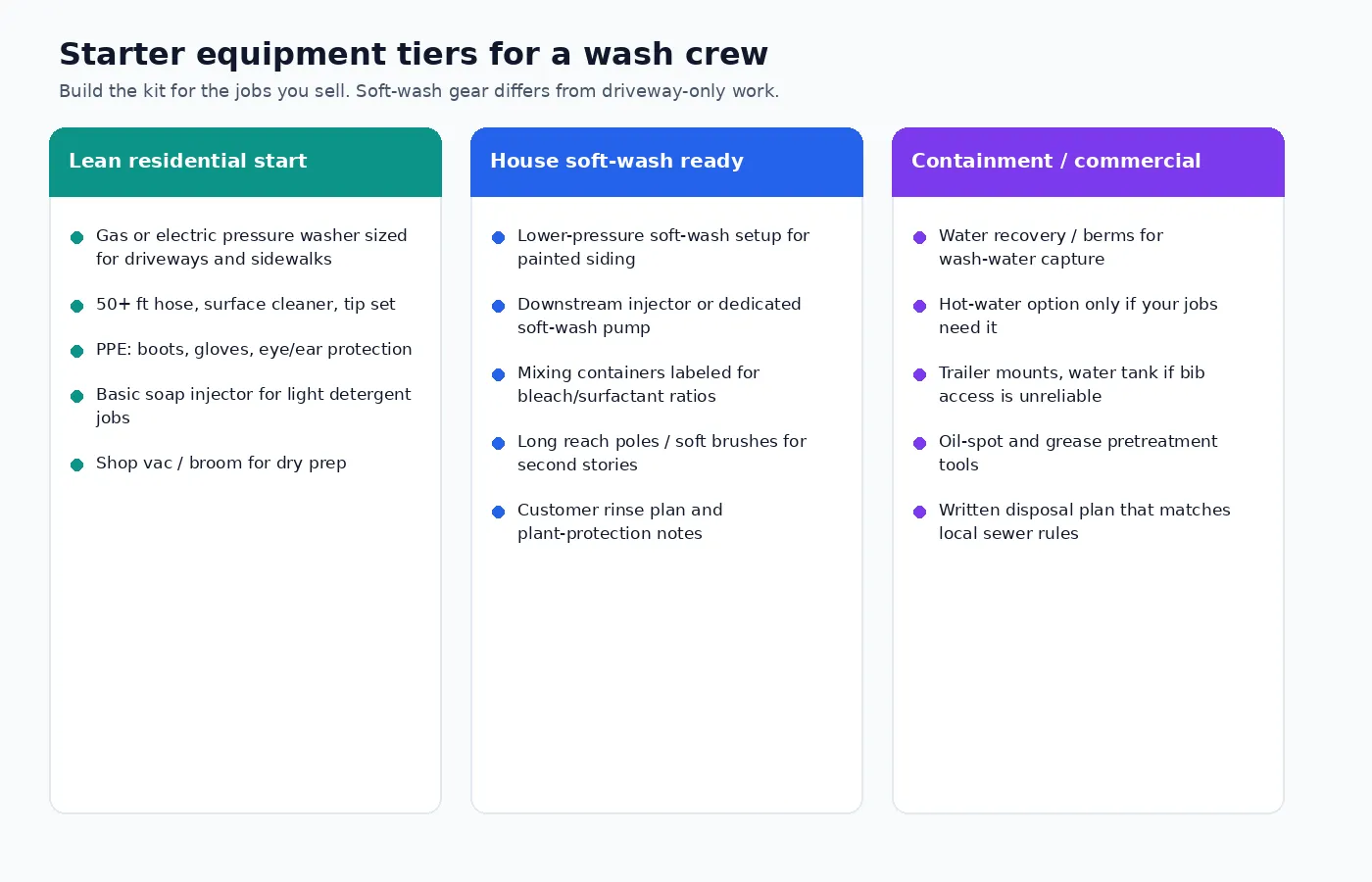
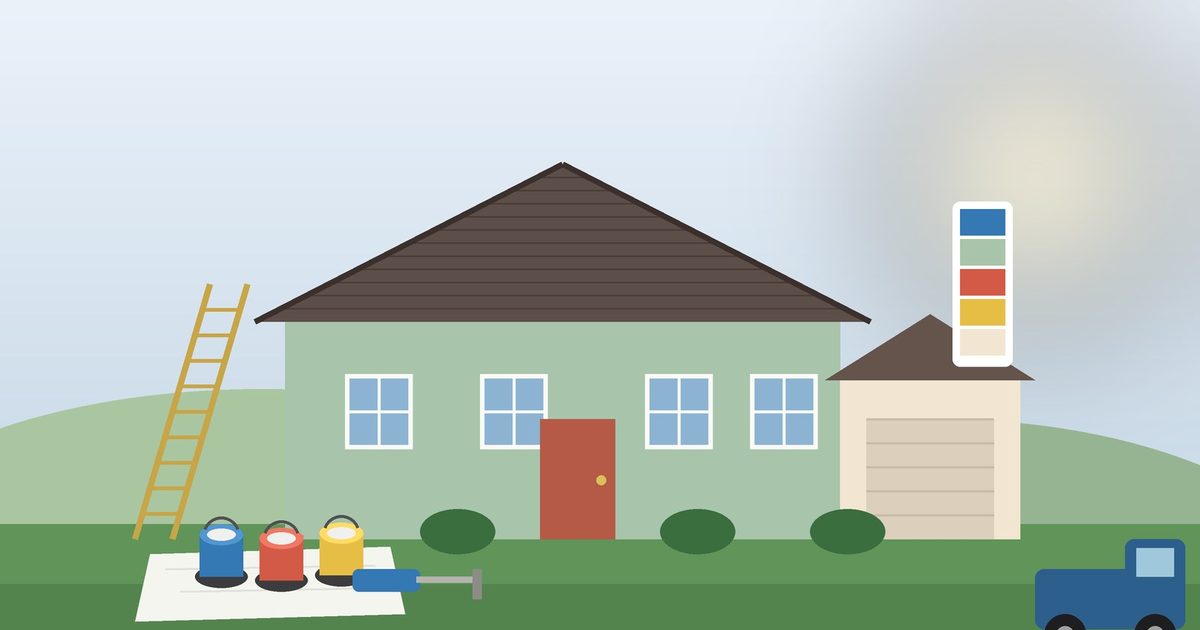
Match the kit to the jobs you sell. Soft-wash and containment are separate upgrades. Diagram only.
Lean residential start (driveways and sidewalks):
- Washer sized for concrete pads (follow the manufacturer’s duty rating, not marketing PSI alone)
- Surface cleaner, tip set, 50+ ft hose
- PPE: boots, gloves, eye and ear protection
- Basic detergent injector for light soap jobs
- Dry prep tools (broom, blower) so you are not blasting loose debris into a neighbor’s yard
House soft-wash ready:
- Soft-wash setup for painted siding and delicate surfaces
- Mixing gear with clear labels and ratios
- Reach poles or wash brushes for higher stories
- A plant and window protection routine you can explain to the homeowner
Containment / light commercial:
- Berms, vacuum recovery, or a portable wash pad when the site drains to storm inlets
- Trailer mounts and, if needed, a water tank when bib access is unreliable
- A written disposal path that matches the local sewer authority
Shop used only if you can inspect hours, pumps, and seals. Keep receipts. Skip invented “average kit cost” claims unless you are quoting a dated vendor listing. Describe what you need, then price it from suppliers you trust.
Train on a friend’s driveway before you sell. Learn how far overspray travels and how long a two-car pad really takes with a surface cleaner.
Step 5: Set pricing that covers trips, not just spray time
Price for the whole visit: drive time, setup, dry prep, wash, rinse, cleanup, and the buffer to the next property. Flat fees work well for standard driveways and sidewalk packages. Hourly or day-rate quotes fit odd commercial pads where access and recovery time swing widely.
Build a simple quote sheet:
- Service name and square-footage or “standard two-car driveway” package
- What is included (soft-wash mix, oil pretreatment, second rinse)
- What is excluded (second-story windows, roof, paint repair)
- Access needs (hose bib, gate, trailer parking)
- Payment timing (many small crews collect in person after the job)
Walk the property when the job is large or stained. Photos from a text thread miss oil, weathered wood, and locked side yards. Put the price in writing before you pull the trigger. Underpricing your first ten jobs trains the market to expect free add-ons.
If you later add a bookable site, keep the same service nouns and visit-length notes so online bookings match what you quote on the phone. The sister guide on a pressure washing website covers how those services should appear on a bookable page.
Step 6: Win first customers and prove the brand locally
You do not need a national ad budget. You need proof in one metro: finished photos, a few reviews, and a reliable phone answer.
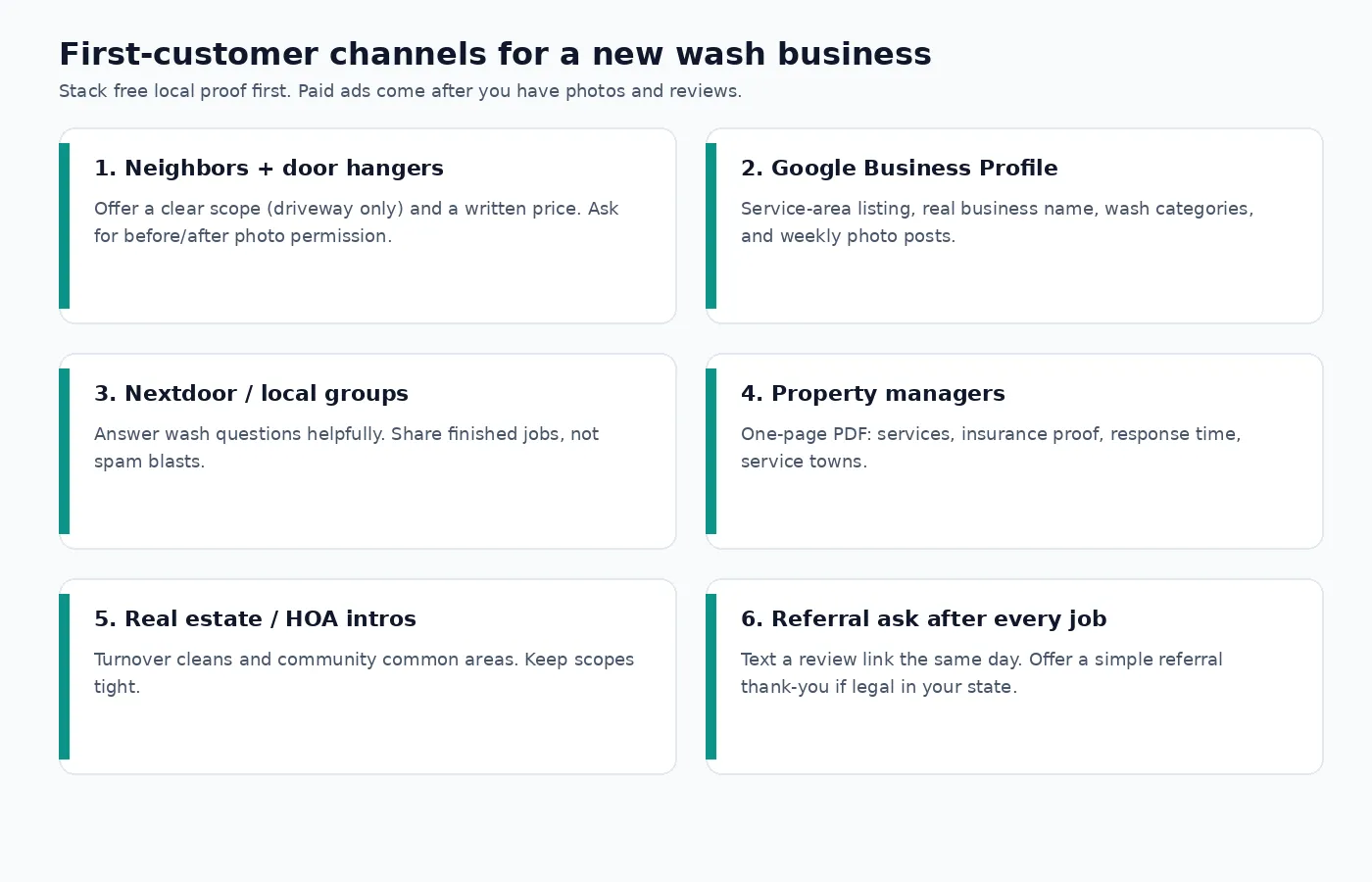
Stack free local proof before you spend on ads. Diagram only.
Neighbors and door-to-door with a tight offer
Offer a clear package (driveway only, or driveway plus front walk) with a written price. Ask permission for before-and-after photos. Those photos become your Google posts and your estimate texts.
Google Business Profile
Create a Google Business Profile that uses your real-world business name. Skip taglines, phone numbers, and “#1 wash” keywords in the name field. If you visit customers and do not serve walk-ins at a shop, set up as a service-area business and manage service areas for the towns you actually cover. Add categories that match wash work, upload real job photos weekly, and ask every happy customer for a review the same day.
Local groups and Nextdoor
Answer wash questions with useful detail. Share finished jobs. Avoid spam blasts that get you muted. The same calm pattern shows up in broader home services marketing playbooks.
Property managers and agents
Send a one-page PDF: services, towns, insurance proof, response time, and a sample before/after. Turnover cleans and HOA common areas can fill midweek gaps once you have recovery gear and certificates ready.
Referrals after every job
Text a direct review link when you leave. If you run a referral thank-you, keep it simple and legal in your state. Consistency beats cleverness.
When you are ready for a site customers can book from, keep it short: services, towns, phone, and a booking flow where they leave address, hose, gate, and surface notes in the notes box. That house-call pattern is the same one used across home-service booking sites, including cleaning business website setups with different service nouns. For another trade startup path with a similar legal-first order, see how to start a handyman business.
Common problems and how to fix them
The city says you need a license you never heard of
Stop advertising in that city until you file. Call the business license desk with your EIN and formation docs. Ask whether exterior cleaning or mobile washing has a separate permit. Put renewal dates on a calendar.
Wash water ran toward a storm drain
Stop the job. Deploy berms or a wet vac if you have them. Do not keep spraying into the grate. Call the property contact. Review your city’s stormwater BMP sheet before the next commercial pad. Price recovery time into those bids.
A homeowner says the siding looks etched or streaked
Document with photos. Soft-wash chemistry and pressure are the usual causes. Own the fix if your method caused it. Update your menu so soft-wash and high-pressure concrete are never sold as the same line item.
You are booked solid with low-profit driveways
Raise the package price for new customers, add a trip minimum, or carve out one weekday for higher-ticket soft-wash or commercial pads. Crews that keep underpricing burn out before the brand takes off.
Nobody answers your phone while you are spraying
Use a voicemail that states towns and the two services you want. Call back the same day. Move estimate requests to text with photo intake so you are not writing quotes with wet gloves.
Questions owners ask about starting a pressure washing business
Do I need a contractor license to start a pressure washing business?
It depends on your state and city. Some places treat small exterior cleaning under a general business license. Others fold wash work into contractor rules once the job value or the surfaces change. Check the SBA licenses and permits overview, then confirm with your state contractor board and city clerk. Do not guess from a forum post.
How much does it cost to start?
Costs swing with the vehicle you already own, new vs used equipment, insurance quotes, and whether you form an LLC. Build a shortlist: formation fees, EIN (free from the IRS), business license, liability insurance binder, starter washer kit, hose and tips, PPE, basic marketing (magnets, cards, Google profile). Price each line from real vendors and agents. Skip blog “average startup cost” numbers that do not show a dated source.
Is pressure washing the same as power washing?
People use the names interchangeably in search. In the field, “power washing” often implies heated water, while “pressure washing” may mean cold water at high pressure. Soft-wash for siding is a different method again. Sell the method that matches the surface, and use the words your local customers already type.
Can I dump wash water in the street if it looks clean?
Usually no. Storm drains are not sinks. Even water that looks clear can carry detergents and sediment. Follow local stormwater rules: contain, collect, and dispose through an approved path. When in doubt, ask the sewer utility before the job, not after a fine.
When should I get a website?
After you can describe services, towns, and a real phone number. A simple site with online booking helps when you are mid-wash and cannot answer every call. Customers should leave the property address and wash notes in the booking notes box. Wire the same URL into your Google Business Profile Website and Booking fields when you are ready.
Get a site customers can book when you are ready
If you want a 4-page site (Home, Services, Blog, Contact) where customers pick a wash service and leave job notes, you can get a site customers can book from with Kejoola. Already have a Google Business listing? Paste your listing link to get a first draft of your site, then finish it with your own services, towns, and photos.
14-day free trial, no card needed. Online booking starts on the Starter plan.
Sources
- 10 steps to start your business (U.S. Small Business Administration)
- Register your business (U.S. Small Business Administration)
- Apply for licenses and permits (U.S. Small Business Administration)
- Get an employer identification number (IRS)
- USPTO Trademark Search
- Guidelines for representing your business on Google
- Manage your service areas (Google Business Profile Help)