How to Start a Service Business That Thrives: A 5-Step Guide
A complete guide on how to start a service business, from validating your idea and setting up legal structures to acquiring your first clients and scaling your operations.
Josh · Jan 19, 2026 · 23 min read
- service business
- entrepreneurship
- small business
- client acquisition
Starting a service business really comes down to four key phases: validating your idea, getting your legal and financial house in order, building your online presence, and finally, winning those first few clients. But let's be honest, the whole thing lives or dies on that first step. Before you sink a dime or a weekend into this, you have to be sure a real market need actually exists.
Validating Your Service Idea Before You Go All In
The fate of your new business is often sealed long before you send that first invoice. A brilliant idea is only brilliant if people are willing to open their wallets for it. This early validation isn't about getting everything perfect; it's about gathering enough evidence to move forward with confidence, not just blind optimism.
The service industry has become a huge playground for new entrepreneurs. Think about it: between 2021 and 2024, people filed over 5.2 million new business applications every year, with professional and home services leading the pack. That tells you two things: the opportunity is massive, but so is the need to have a solid, validated concept to cut through the noise. You can see the full research on service industry trends to get a sense of how small businesses are really driving the economy.
This diagram breaks down the three pillars of a viable idea: the market, the client, and the budget.
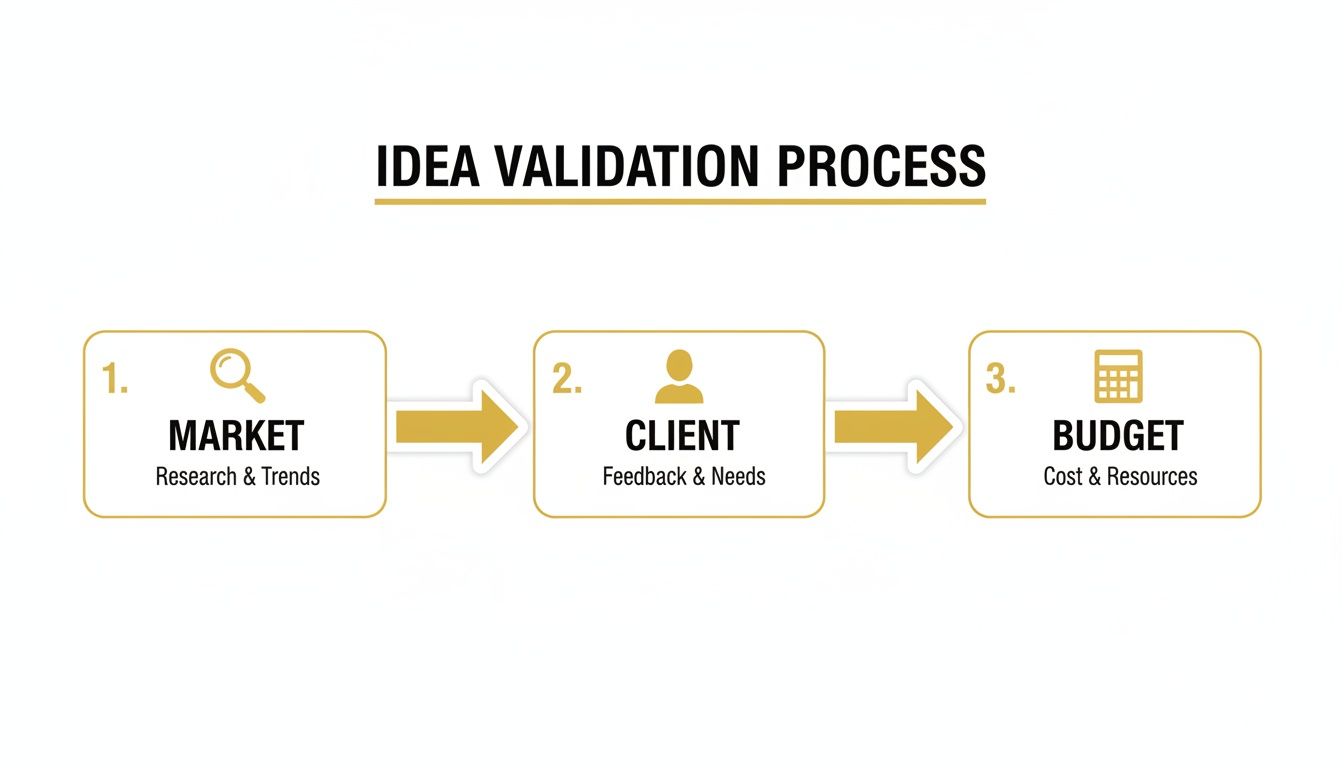
The takeaway here is simple but critical. A business idea has to check all three boxes—a clear market need, a specific client you can reach, and a realistic budget—before you should even think about building a website.
Pinpoint a Genuine Market Problem
Every single successful service business starts by solving a real problem. Your first job is to get out of your own head and identify a tangible pain point that a specific group of people is struggling with. Stop thinking about the service you want to offer and start focusing on the problem you're uniquely equipped to solve.
For instance, don't just decide you want to be a "social media manager." Instead, notice that local bakeries are terrible at creating consistent, appealing photos for Instagram, which is killing their foot traffic. Suddenly, your service isn't just "managing social media"—it's "helping bakeries sell more croissants with professional Instagram content." See the difference?
Here's how you can dig up these problems:
- Mine online reviews: Go read the 1- and 2-star reviews for businesses in your niche. The recurring complaints are a goldmine of unmet needs.
- Lurk in online communities: Join Facebook groups, Reddit subreddits, or local forums where your potential clients congregate. Listen to the questions they ask and the frustrations they vent about.
- Run simple surveys: Use a tool like Google Forms to whip up a short survey. Share it with your network or in those online groups to get direct, unfiltered feedback.
Define Your Ideal Client with Laser Precision
Once you’ve found a problem, you need to know exactly who has it. Creating an ideal client profile (ICP) is a non-negotiable step that will guide your marketing, your pricing, and how you deliver your service. A vague target like "small businesses" is useless.
A well-defined ideal client profile acts as a compass for all your business decisions. It ensures you’re not just shouting into the void but speaking directly to the people most likely to value and pay for your expertise.
Get granular. If you're a freelance writer, is your ideal client a B2B SaaS company that needs deeply technical blog posts? Or is it a wellness coach who needs empathetic, story-driven email newsletters? These are two completely different worlds, with different budgets, needs, and communication styles. Your ICP should spell out their demographics, biggest challenges, professional goals, and where they go to find solutions.
Assess Your Competition and Find Your Angle
Checking out the competition isn't about stealing their ideas. It's about finding the gaps they've left wide open for you. Look at other businesses offering something similar and ask yourself:
- What are they genuinely good at?
- Where are their services falling short?
- How are their prices and packages structured?
- What’s their unique selling proposition (USP)? What makes them special?
Your mission is to carve out your own unique space. Maybe your competitors are generalists, but you can specialize and become the go-to expert for one specific thing. Perhaps they only work with giant corporations, leaving a huge opportunity for you to serve startups with more flexible, accessible packages. This analysis is how you build an offer that makes a potential client think, "Ah, this is exactly what I've been looking for."
To make this process more concrete, use this checklist to systematically vet your idea.
Idea Validation Checklist
| Validation Step | Action Item | Success Metric |
|---|---|---|
| Market Problem | Identify a recurring pain point in online forums or reviews. | You can list at least 3-5 specific, repeated complaints. |
| Ideal Client | Create a detailed one-page Ideal Client Profile (ICP). | You can clearly describe who they are, what they need, and where to find them. |
| Competition | Analyze 3-5 direct competitors' offerings and pricing. | You can articulate a unique angle or gap your service will fill. |
| Test Offer | Pitch a "minimum viable service" to 5-10 people in your network. | At least 1-2 people express genuine interest or ask about pricing. |
| Financial Viability | Draft a basic budget for your first 3 months of operation. | Your projected startup costs are realistic and manageable for you. |
Walking through these steps doesn't guarantee success, but it dramatically improves your odds. It forces you to build a business based on evidence, not just a hunch, setting you up for a much stronger start.
Establishing Your Legal and Financial Foundation
Okay, you’ve got a killer idea that you know people will pay for. Now it's time to build the scaffolding that will support your business. This part might seem like boring paperwork, but getting your legal and financial house in order from the start is what separates a professional operation from a hobby. It's about protecting yourself, building trust with clients, and setting the stage for real growth.
Your first big decision is choosing a legal structure. This isn't just a box you tick on a form; it directly affects how much personal risk you’re taking on and how you'll handle your taxes. For most of us flying solo or starting small, it really comes down to a few key choices.
Comparing Common Business Structures
Every business structure is a trade-off. You're usually balancing simplicity and cost against liability protection. Here’s a no-fluff breakdown of what that means for a service provider like you:
-
Sole Proprietorship: This is the path of least resistance. If you just start doing business as yourself, you’re a sole proprietor. It's simple and free to form, but there's a huge catch: there is no legal separation between you and the business. If something goes wrong and a client sues, your personal assets—your car, your savings, your house—are on the line.
-
Limited Liability Company (LLC): This is a massive step up. An LLC forms a separate legal entity, creating a protective wall between your business and personal finances. If the business gets into debt or faces a lawsuit, your personal assets are shielded. It costs a bit to set up and maintain, but for most service businesses, the peace of mind is well worth it.
-
S Corporation (S-Corp): Think of this as a tax strategy, not a business structure itself. You can elect for your LLC to be taxed as an S-Corp. This can save you money on self-employment taxes once your profits hit a certain level, as you can pay yourself a formal salary and take the rest as distributions. The downside? More rules, more paperwork, and you’ll definitely need an accountant to handle payroll.
Choosing your path can feel daunting. This guide to business types in Canada has a great breakdown that can help clarify your options, with principles that apply in many places.
Ultimately, choosing your legal structure is a risk management decision. A sole proprietorship is easy, but an LLC provides a critical layer of protection that any serious entrepreneur should strongly consider from day one.
Setting Up Your Financial Systems
Once you're legally established, you absolutely must separate your business finances from your personal life. Mixing them is a recipe for disaster come tax time and can even invalidate the legal protection your LLC provides.
First on the list is getting an Employer Identification Number (EIN) from the IRS. It’s free and takes just a few minutes online. Think of it as a Social Security number for your business. You’ll need it to open a bank account and will eventually need it if you hire help.
With your EIN in hand, march right into a bank (or go online) and open a dedicated business checking account. No more excuses. All client payments go in, and all business expenses come out. This simple act will save you countless hours of accounting headaches later.
Finally, let's talk about insurance. At a minimum, you'll want general liability insurance, which covers things like property damage or someone getting injured. But if you're offering professional advice—as a consultant, designer, or coach—you also need professional liability insurance (often called errors and omissions or E&O). This covers you if a client claims your work was negligent or cost them money. Think of insurance not as an expense, but as your financial safety net.
Defining Your Services and Pricing for Profitability
With your legal structure in place, it's time to define what you actually sell and how you get paid. This is where many new entrepreneurs stumble, defaulting to a simple hourly rate because it feels easy. But selling your time is the fastest way to cap your income and burn out.
The goal is to move from selling hours to selling outcomes. Your clients don't care about your time; they care about their results. Packaging your services into clear, value-driven offers makes it easier for clients to understand what they’re buying and easier for you to earn predictable revenue.
Craft Service Packages Instead of Hourly Rates
Think about your ideal client's journey. What is the entire arc of their problem, from initial pain point to desired outcome? Your services should be structured to guide them through that transformation.
Instead of saying you're a "web designer for $75/hour," create distinct packages that solve specific problems. A home services provider might shift from charging by the hour for odd jobs to offering tiered maintenance plans.
Here are a few models to consider:
- Project-Based Fees: You charge a flat fee for a defined scope of work, like designing a logo or completing a home landscaping project. This is perfect for one-off projects with clear deliverables.
- Monthly Retainers: Clients pay a recurring fee for ongoing access to your expertise or services. This model works well for consultants, marketing managers, and bookkeepers, providing stable, predictable income.
- Tiered Packages: Offer several package levels (e.g., Basic, Pro, Premium) with increasing features and support. This allows clients to self-select the option that best fits their budget and needs, maximizing your sales potential.
The key is to describe these packages in terms of the value they deliver. Don't just list tasks; articulate the tangible benefits. For example, a "Social Media Starter Pack" for a local restaurant becomes "Get 20 High-Quality Food Photos and a Content Calendar to Attract More Diners."
How to Calculate Your Prices for Profit
Setting your prices can feel like a guessing game, but it should be a calculated decision based on data. Your pricing must cover your expenses, pay you a fair salary, and leave room for profit to reinvest in the business.
A simple formula to start is your Target Annual Income + Annual Business Expenses + Profit Margin. Divide that total by the number of projects or clients you can realistically handle in a year.
Remember to factor in everything: software subscriptions, insurance, marketing costs, and taxes. Don't forget to research what competitors charge, not to copy them, but to understand your market position. You can command a premium price if you offer a specialized, high-value service.
Pricing is a powerful signal of your value. Underpricing can attract difficult clients and make it impossible to grow. Price based on the results you create, not just the time it takes.
This data-driven approach is especially crucial when you're funding the business yourself. The landscape of entrepreneurship has shifted, with 66.3% of founders self-funding their ventures. Fortunately, the barrier to entry for service businesses is low; 42% of small businesses launched with less than $5,000. These entrepreneur statistics highlight how a smart pricing strategy is your primary tool for building a profitable, self-sustaining operation from day one. You can discover more insights about bootstrapping trends on Flowlu.com.
Ultimately, your service menu should be simple to explain, easy for clients to buy, and structured to maximize your earnings. This clarity is the foundation of a profitable business that doesn't just survive but thrives.
Creating Your Online Presence and Booking System
Think of your website as more than just a digital brochure. It’s your 24/7 storefront, your lead generation machine, and your administrative assistant, all rolled into one. Setting up a professional online presence is non-negotiable these days, but the good news is that it doesn't have to be complicated or break the bank.
Your main goal should be clarity. Can a potential client land on your site and, within seconds, understand what you do, who you do it for, and how to hire you? It all starts with the basics. A simple thing like having a professional email at your own domain (think contact@yourbusiness.com instead of a generic Gmail address) instantly builds a layer of trust.
From there, your website needs a few core components to do the heavy lifting for you.
Core Website Pages for Service Businesses
A solid service business website cuts right to the chase. It’s built to answer a visitor's questions and make it ridiculously easy for them to become a paying client.
You can get by with just these essentials:
- A Clear Homepage: This is your first impression. It needs to immediately state the problem you solve and for whom. A prominent "Book Now" or "Get a Quote" button should be impossible to miss.
- Detailed Service Pages: Give each of your packages its own dedicated page. Lay out the specific deliverables, walk them through the process, and list the price. No ambiguity, no confusion.
- A Compelling About Section: People hire people. This is your chance to share your story, flash your expertise, and explain why you're the right person for the job. Let your personality shine through.
- Easy-to-Find Contact Information: Don't make people dig for your contact details. Your phone number, email, and a simple contact form should be readily available, maybe even in the footer of every page.
I've seen so many new business owners get bogged down trying to build a massive, 20-page website. My advice? Start with these four pages and a booking system. You can always add more content later as you grow.
The Power of an Integrated Booking System
If there's one thing that will revolutionize how you run your business, it's an online booking system. This is what takes you from the painful back-and-forth of email tag and missed calls to a smooth, automated workflow.
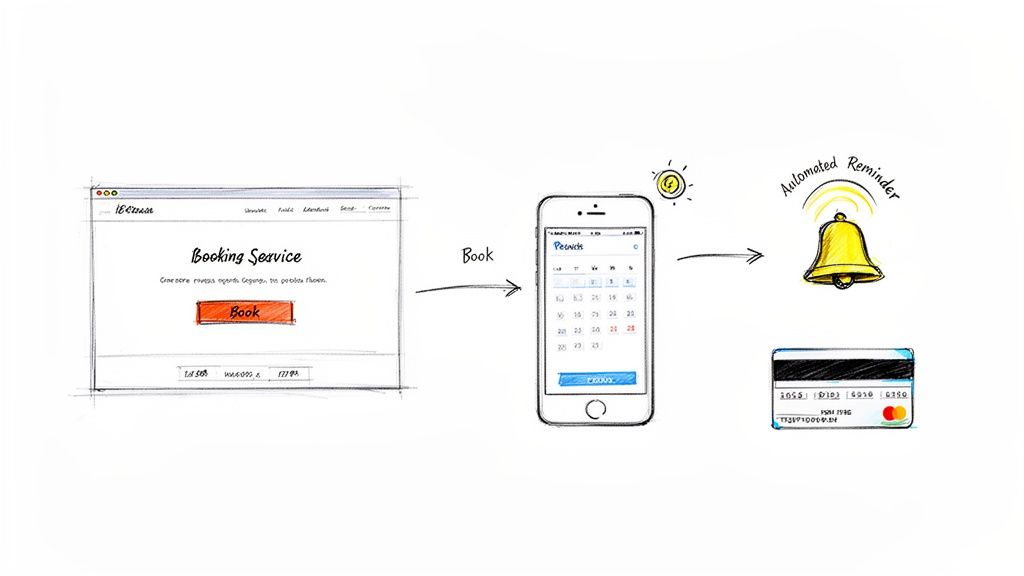
Tools like Kejoola are built for this exact purpose. A client can visit your site, see your real-time availability, and book themselves in. This isn't just a convenience; it's what modern customers expect. It also frees you up to do what you do best: deliver your service.
This kind of booking-first design puts the call-to-action front and center, removing any friction for someone ready to buy. The system can handle everything from the initial booking and payment to sending automated reminders that dramatically cut down on no-shows. As you get this set up, it's worth spending some time optimizing your booking flow—small tweaks here can have a surprisingly big impact on your bottom line.
Designing a Simple Client Intake Process
Your booking system is also the perfect starting point for your client intake. When someone books a service, you have a golden opportunity to collect the critical information you need to hit the ground running.
The key is to keep it brief. Don't greet a new client with a 20-question survey. Just ask for the absolute essentials.
Think about what you truly need to know before you can start:
- The Basics: Name, email, and phone number are must-haves.
- The Service: Which specific package are they interested in?
- The Context: Add one or two open-ended questions. Something like, "What's the main goal you're hoping to achieve?" or "Is there anything specific I should know before our call?" works wonders.
Gathering this information upfront not only saves time but also shows your new client that you're organized and ready to get to work. If you want to see how this all fits together technically, our guide on how to create a booking website walks through the entire setup process.
Acquiring Your First Clients with Smart Marketing
Alright, your website is live and your booking system is humming. Now for the moment of truth: getting people to actually pay you. Let’s be honest, this is where most new service businesses get stuck. They think they need a huge ad budget, but the reality is much simpler. Early on, it’s all about smart, foundational moves that build trust and get the ball rolling.
That first client is always the toughest catch. They’re taking a leap of faith on someone new. This is exactly why your initial marketing needs to be less about broad advertising and more about laser-focusing on credibility and tapping into the connections you already have.
Dominate Local Search with Google Business Profile
If you’re a local service provider, your clients are right around the corner. And your single most powerful free marketing tool is your Google Business Profile (GBP). This is your ticket to showing up in the "map pack" when someone nearby searches for "landscaper near me" or "best wedding photographer in Austin."
Getting your GBP right isn't just a good idea; it's non-negotiable. It’s how you signal to Google that you're a real, active business ready to serve the local community.
Dive in and fill out every single section. Don't cut corners here.
- Be Consistent: Your business name, address, phone number, and website need to be identical everywhere they appear online.
- Define Your Turf: Clearly list the specific neighborhoods, cities, or counties you serve.
- Detail Your Services: Don’t just say "Plumbing." List every service—drain cleaning, water heater installation, leak repair—with short, clear descriptions.
- Show, Don't Tell: Upload high-quality photos of your work in progress, finished projects, your van, and even a friendly shot of yourself. Visuals build instant trust.
The secret to winning with GBP is keeping it active. Post regular updates, share photos of recent jobs, and answer questions that pop up. For a much deeper dive, our guide on how to improve local SEO has some more advanced strategies you can use.
Generate Trust with Online Reviews
Think of positive online reviews as today's word-of-mouth. They are often the deciding factor for someone choosing between you and a competitor, especially when you’re just starting out.
Your number one goal after completing your first few jobs is to get reviews on your Google Business Profile. Don't feel awkward about asking for them. Make it a natural part of how you wrap up every project.
Create a simple, repeatable system for requesting reviews. After a successful project, send a follow-up email thanking the client for their business and include a direct link to your GBP review page. This makes it incredibly easy for them and dramatically boosts your chances of getting that 5-star rating.
Proven Channels for Early Client Wins
Beyond Google, a few other low-cost channels are goldmines for new service businesses. The trick is to pick the one where your ideal client spends their time.
- Become a Fixture in Online Communities: Find the Facebook groups, local subreddits, or LinkedIn forums where your potential clients are. Don’t just spam your link—genuinely answer questions and offer helpful advice. You’ll quickly become the go-to expert.
- Tap Your Personal Network: Never underestimate the people who already know and trust you. Post a thoughtful announcement about your new venture on your personal social media. Your first referral is very likely to come from a friend, former colleague, or family member.
- Just Document Your Work: You don’t need a fancy content strategy. Simply taking before-and-after photos for Instagram or writing a quick case study on your blog can be incredibly effective. It shows what you can do and attracts people looking for those exact results.
The timing couldn’t be better. Service businesses are experiencing a major upswing, driven by big shifts in technology and demographics. In fact, sectors like healthcare alone are projected to add 2.2 million new jobs by 2033. This wave of growth creates a powerful tailwind for anyone launching now. You can read the full analysis on small business trends on Paychex.com. By nailing these foundational marketing tasks, you’re setting yourself up to ride that wave from day one.
Delivering Exceptional Service and Scaling Your Operations
Getting your first client is a huge win, but the real challenge is keeping them. The journey from being a solo freelancer chasing that first gig to running a truly scalable operation is where lasting businesses are made. This is all about building a reputation for excellence, one project at a time.
At this stage, your focus shifts from aggressive marketing to methodical, high-quality execution. The main goal? Turn one-off projects into long-term partnerships. Repeat business is the backbone of any service company—it’s infinitely easier and more profitable to keep a happy client than to constantly be on the hunt for new ones. And it all starts with phenomenal communication.
Turning Clients into Advocates
A killer final product is only half the battle. Exceptional service is defined by the entire client experience, from the moment they sign on to the final handover. Every single interaction shapes their perception of your value and professionalism.
This is why setting crystal-clear expectations from the get-go is non-negotiable. Your proposal and contract should leave no room for doubt, spelling out the exact scope of work, key deadlines, and how you'll communicate. This single document is your best defense against scope creep and misunderstandings.
A happy client becomes your most powerful marketing asset. Their testimonials and referrals carry more weight than any advertisement you could buy. The goal isn't just client satisfaction; it's creating genuine advocates for your brand.
To really nail this, check out our guide on client communication best practices for some strategies you can put to work right away.
Creating Repeatable Systems for Consistency
Once you start juggling multiple clients, you can't rely on memory to keep your quality high. The secret to delivering consistent, top-notch results lies in building repeatable systems for everything you do. This means documenting your process for onboarding, project execution, and even offboarding.
Think of it like creating a detailed recipe for your service. A simple checklist or a project template in your favorite tool ensures no step gets missed, no matter how chaotic your day gets. This is the bedrock of a service business that can actually grow beyond just your own efforts.
Here are a few essential systems to document from day one:
- Client Onboarding Checklist: The exact steps you follow the moment a contract is signed.
- Project Kickoff Template: A standard agenda for that critical first meeting.
- Weekly Update Email: A pre-written template to keep clients informed and confident.
- Project Offboarding Process: How you wrap things up, gather feedback, and ask for that all-important testimonial.
Knowing When and How to Scale
As your business grows, you'll hit a crossroads: work more hours or work smarter. Scaling isn't always about hiring a full-time team right away. It’s about strategically adding resources to meet demand without letting your quality slip.
Your first move might be to bring in a specialized contractor to handle a specific part of your workflow. Or maybe you invest in software to automate tedious tasks like scheduling and invoicing. The objective is to free up your own time so you can focus on the high-value work that only you can do.
By constantly refining your systems and strategically expanding your capacity, you’re not just getting busier—you’re building a business that’s truly built to last.
Common Questions About Starting a Service Business
When you're first starting out, it feels like you're facing a mountain of questions. Let's cut through the noise and tackle some of the most common ones I hear from new service business owners. Getting these right from the beginning will save you a ton of headaches down the road.
What Are the Most Profitable Service Business Niches Today?
Everyone wants to know where the money is. While profitability can shift with the market, a few areas consistently deliver strong returns because they solve an urgent, high-value problem. It's all about specialization.
You’ll find some of the best opportunities in these spaces:
- Professional B2B Services: This is a big one. Think about services that directly make or save other businesses money. Copywriting for SaaS companies, fractional CMO services for startups, or specialized bookkeeping for e-commerce brands are all great examples. Businesses happily pay a premium for expertise that impacts their bottom line.
- Skilled Home Services: This goes way beyond general handyman work. We're talking about specialized skills homeowners can't easily do themselves, like smart home installations, custom closet design and organization, or high-end landscape lighting.
- Personal and Wellness Coaching: The demand for focused coaching keeps climbing. Whether it’s executive leadership training, career transition guidance, or a specific fitness methodology, people are willing to invest in targeted personal growth.
The key takeaway? A general "consultant" struggles to stand out. An "email marketing consultant for DTC beauty brands" can build a thriving business. Niche down.
How Much Does It Really Cost to Start a Service Business?
This is one of the best parts of starting a service business: the barrier to entry is incredibly low. You're selling your skills, not a warehouse full of products. For most people, you can get a legitimate business off the ground for well under $1,000.
Your main startup costs will likely be:
- Business Registration: Setting up an LLC might cost a few hundred dollars, depending on your state. A sole proprietorship can be almost free to start.
- Website and Booking System: A professional online presence isn't optional. But you don't need a custom-coded site. Platforms like Kejoola bundle everything you need—website, hosting, booking—into a low monthly fee, avoiding that huge upfront cost.
- Essential Software: Think about what you absolutely need to operate. This could be accounting software like QuickBooks, a project management tool, or software specific to your industry.
- Basic Insurance: General liability insurance is a non-negotiable. It’s typically an affordable monthly expense that protects you from potential disasters.
Forget the fancy office and expensive gear for now. Start lean, get some cash flow, and then reinvest your profits into upgrading your tools and systems.
What Is the Best Way to Get Your First Paying Client?
Getting that first client can feel like a chicken-and-egg problem. You have no portfolio and no testimonials. This is where your personal network becomes your greatest asset. Forget cold emails and ads for now.
The most effective strategy for getting your first client is to tap into your existing network. The people who already know you—former colleagues, friends, and family—are the most likely to trust you enough to take a chance on your new venture.
Don’t just blast out a generic announcement on social media. Send a personal, direct message or email. Explain what you’re doing now and, more importantly, the specific problem you solve for people. Ask if they know anyone who might need your help. A warm introduction is the fastest way to land that critical first project.
Should I Choose a Sole Proprietorship or an LLC?
This is a decision you need to make early on, and it has real consequences.
A sole proprietorship is the default structure. If you just start doing business, you're a sole proprietor. It's simple and free, but it offers zero liability protection. That means if your business gets sued, your personal assets—your house, your car, your savings—are on the line.
An LLC (Limited Liability Company), on the other hand, creates a legal wall between you and your business. This "corporate veil" is designed to protect your personal assets from business debts and lawsuits. Yes, it involves a filing fee and a little bit of annual paperwork, but that protection is priceless. For any serious service provider, the peace of mind an LLC provides makes it the clear choice from day one.
Ready to build a professional online presence that wins clients? With Kejoola, you can launch a stunning, booking-ready website in minutes—no technical skills required. Our AI-powered platform gives you everything you need to manage schedules, communicate with clients, and grow your business, all in one place. Start your 14-day free trial today!