HVAC Contract: 7 Free Templates for Installs and Repairs
An HVAC contract names the contractor and the customer, lists the equipment and the work, sets the price and payment schedule, and carries both signatures. Seven templates to copy: system replacement, equipment schedule, repair, ductwork, change order, subcontract and startup sign-off.
Josh · Nov 17, 2026 · 16 min read
- hvac contract
- hvac contract template
- hvac installation contract
- hvac repair contract
- hvac change order
- hvac business
An HVAC contract is a written agreement between a heating and cooling contractor and a customer that lists the equipment, the work, the price and the payment schedule, and it carries both signatures. The seven templates below cover a system replacement, an equipment and installation schedule, a diagnostic and repair job, ductwork, a change order, a subcontract with a builder and a startup sign-off. Copy the one you need, replace the brackets with your details, and have an attorney in your state read it once before you rely on it. Maintenance plans have their own forms in the HVAC service agreement templates.
What an HVAC contract has to cover
eForms says an HVAC contract may be used for installation, maintenance, service, repair, or all of these. It lists six parts that belong in one: scope of work, schedule, payment, utility charges, warranty and termination. Jotform's installation contract adds agreement modifications and jurisdiction. PandaDoc's version adds a clause on access to the property on the scheduled day.
| Part | What to write | Example line |
|---|---|---|
| Parties | Your business name, address and license number, plus the customer's name and service address | "Service address: 2210 Alder Ct, attic unit" |
| Scope | Equipment in and out, related tasks, and what is not included | "Remove 3-ton split system. Drywall repair not included." |
| Equipment | Brand, model numbers, capacity and refrigerant | "Outdoor unit model [number], indoor coil model [number]" |
| Schedule | Start date, expected finish, and what moves the dates | "Start Jan 12, finish in 2 working days" |
| Price and payment | Total or rate, deposit, progress and final payments | "Final payment after startup and inspection" |
| Utilities | Who pays for power and gas used during the work | "Owner supplies electricity and gas at no charge" |
| Changes | How added work gets priced and approved | "No extra work without a signed change order" |
| Warranty | Labor coverage and how manufacturer warranties apply | "Labor warranted [number] months" |
| Signatures | Both parties, with dates | "Signed and dated by both" |
eForms draws a line between repair and installation scopes. A repair contract typically names the make and model of the unit, the date it was installed, and what needs to be fixed. If the cause is unknown, the contract should say that finding the problem is part of the technician's job. An installation contract names the type of unit and the related tasks, such as drywall patching and wiring.
The utility clause is specific to this trade. eForms notes that HVAC contracts usually say the contractor is not responsible for utility costs tied to the service, installation or repair.
Rules to check before you send one
Each rule below comes from a government page. State and local rules can add to them, so confirm the details where you work.
Refrigerant work needs a certified technician. The EPA says technicians who maintain, service, repair or dispose of equipment that could release refrigerants must hold Section 608 certification. Apprentices are exempt when a certified technician supervises them closely and continually. If your contract covers recovery from an old system, the person doing it needs that credential.
New systems have a refrigerant limit. The EPA's restrictions table sets a global warming potential limit of 700 for new residential and light commercial air conditioning and heat pump systems, starting January 1, 2025. The table notes there is no installation compliance date where all specified components were made or imported before that date. Write the refrigerant into the equipment schedule so the customer knows what the system uses.
States set their own contract rules. In California, the Contractors State License Board says a written contract is required for all home improvement projects over $500. It needs a detailed payment schedule, a completion date and written direction on who gets the permits. A change to price or scope must be a written change order signed before the change. The down payment cannot be more than $1,000 or 10 percent of the contract price, whichever is less.
A sale made in the home may carry a right to cancel. The FTC's Cooling-Off Rule gives a buyer three days to cancel certain sales made at home, and it does not cover home sales under $25. The seller must hand over a dated contract or receipt and two copies of a cancellation form. The rule leaves out a sale needed to meet an emergency. It also leaves out a sale made because the customer asked you to come and repair something, although things bought beyond that request are covered. A replacement system sold during a repair call can land on either side of that line, so ask your attorney how your sales process should handle it.
Template 1: System replacement contract
Use this for a planned changeout: a furnace and coil, a split air conditioner, a heat pump or a ductless system. Template 2 attaches to it as Exhibit A.
HVAC SYSTEM REPLACEMENT CONTRACT

Date: [date]
Contractor: [company name], [address], [phone], [email]
License no.: [number]   Insurance: [carrier, policy no.], certificate attached
Owner: [name], [property address], [phone], [email]

1. SCOPE OF WORK
Remove and dispose of the existing [system type, brand, location].
Furnish and install the equipment listed in Exhibit A.
Related work included: [e.g., "new condenser pad, new line set,
condensate drain to exterior, thermostat, electrical whip and disconnect"]
Not included: [drywall repair, painting, duct replacement, electrical
panel upgrades, asbestos or mold remediation]

2. PERMITS AND INSPECTIONS
[Contractor / Owner] will obtain the mechanical permit. Fees are
[included / billed at cost]. Work is scheduled around required inspections.

3. SCHEDULE
Start: [date]. Estimated completion: [number] working days after start.
Heating or cooling will be off during [hours or days]. Delays caused by
weather, inspections, equipment backorders or hidden conditions extend
these dates.

4. PRICE AND PAYMENT
Contract price: $[total].
Deposit on signing: $[amount] (check your state's deposit limit)
Progress payment: $[amount] when [equipment is set in place]
Final payment: $[amount] after startup and final inspection.
Financing, if any: [lender, terms, or "none"].

5. UTILITIES
Owner supplies electricity, gas and water needed for the work at no
charge. The contractor is not responsible for utility costs during
installation or testing.

6. OWNER RESPONSIBILITIES
Provide access to the attic, crawl space, yard and electrical panel.
Clear the work areas. Tell the contractor about pets and alarm systems.

7. CONTRACTOR RESPONSIBILITIES
Supply labor, tools and materials named above. Recover refrigerant from
the old system using a certified technician. Protect floors along the
work path. Remove old equipment and debris at completion.

8. HIDDEN CONDITIONS
If the work reveals conditions not visible at the estimate, such as
damaged ductwork, undersized wiring or a failed flue, the contractor
will stop that part of the work and notify the owner. Added work is
priced by written change order before it continues.

9. WARRANTY
As stated in the startup and warranty sign-off (Template 7).

10. CHANGES
Any change to equipment, scope, price or schedule must be written and
signed by both parties before the changed work is done.

11. CANCELLATION AND TERMINATION
Owner's right to cancel: [notice required by law, with cancellation
form attached if it applies]. Either party may end this contract for an
uncured breach after [number] days' written notice. Completed work and
delivered equipment are paid at the contract rate.

12. DISPUTES
The parties will try to resolve disputes by [discussion, then mediation].
Governing law: [state].

Signed: ____________________ Contractor    Date: ________
Signed: ____________________ Owner         Date: ________
Tie the final payment to startup and inspection, not to the day the equipment arrives. The customer then pays the balance for a system they have felt running.
Template 2: Equipment and installation schedule
This exhibit turns "new 3-ton system" into model numbers and steps. ENERGY STAR's bid comparison checklist says more than half of new systems in U.S. homes do not perform to their rated efficiency because of improper installation. It adds that improper installation can reduce performance by as much as 30 percent. The lines below follow the questions on that checklist.
EXHIBIT A: EQUIPMENT AND INSTALLATION SCHEDULE

Contract date: [date]
Owner: [name], [property address]

1. EQUIPMENT
Outdoor unit: [brand, model no., capacity, efficiency rating]
Indoor unit or coil: [brand, model no.]
Furnace or air handler: [brand, model no., input or capacity]
Thermostat: [brand, model]
Refrigerant: [type]
Accessories: [filter cabinet, condensate pump, surge protector, other]

2. SIZING
Equipment size is based on a load calculation for this home using
[ACCA Manual J / equivalent method], dated [date]. A copy is
[attached / provided at completion].

3. MATCHED SYSTEM
The indoor and outdoor units are a matched combination.
AHRI certificate no.: [number], [attached / provided at completion].

4. REFRIGERANT LINES
[New line set installed / Existing line set reused after
[flushing and pressure test]].

5. DUCTWORK
Existing ducts will be [inspected for damage / sealed at accessible
seams / tested for leakage / not altered]. Duct repairs beyond this
are priced by change order.

6. STARTUP CHECKS
Refrigerant charge and airflow across the coil will be measured and
recorded at startup. Readings are listed on the sign-off (Template 7).

7. DOCUMENTS LEFT WITH OWNER
Owner's manuals, warranty papers, the load calculation, the AHRI
certificate and startup readings.

Initials: ______ Contractor    ______ Owner
The checklist's notes explain two of these lines. The contractor should calculate the home's heating and cooling loads using ACCA Manual J or an equivalent. An AHRI certificate documents that the indoor and outdoor units were properly matched.
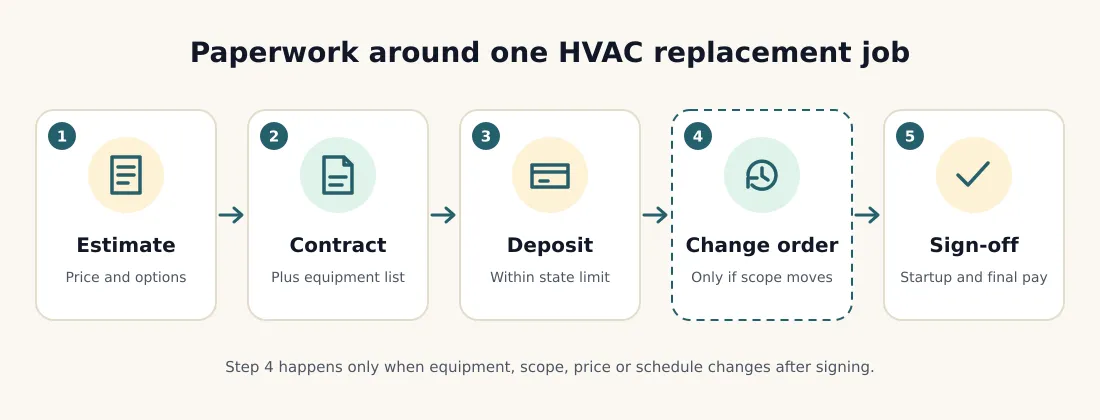
How the templates fit around one replacement job. Diagram only.
Template 3: Diagnostic and repair contract
Use this for a single call: no heat, a frozen coil, a failed capacitor, a noisy inducer motor. It follows the repair details eForms lists, and it is short enough to sign on a tablet at the door.
HVAC DIAGNOSTIC AND REPAIR CONTRACT

Date: [date]
Contractor: [company name], [address], [phone], [license no.]
Customer: [name], [service address], [phone], [email]

1. EQUIPMENT
[Brand, model no., serial no.]   Installed: [year, if known]
Location: [attic / closet / garage / roof / side yard]

2. PROBLEM REPORTED
[Customer's description, e.g., "outdoor unit runs, air not cold"]

3. DIAGNOSIS
The technician will inspect and test the system to find the cause.
Diagnostic fee: $[amount], [credited to the repair / not credited].

4. REPAIR AUTHORIZED
[e.g., "Replace dual run capacitor and contactor at outdoor unit"]
Work beyond this description needs the customer's approval first.

5. PRICE
Labor: [flat price $[amount] / $[rate] per hour]
Parts: [itemized on the invoice]. Parts are [new / OEM / equivalent].
Refrigerant, if needed: $[amount] per pound, billed separately.

6. PAYMENT
Due on completion. Accepted: [cash, check, card, other].

7. EXISTING WARRANTIES
The customer confirms whether the equipment is under a manufacturer
or third-party warranty: [yes, with (provider) / no / unknown].
The contractor is not responsible for the terms of a warranty it was
not told about.

8. REPAIR WARRANTY
Labor on this repair is warranted for [number] days.
Parts carry the manufacturer's warranty.

Signed: ____________________ Customer      Date: ________
Signed: ____________________ Contractor    Date: ________
The existing-warranty line comes from a risk eForms describes. If a manufacturer's policy is already in effect and the customer hires an outside contractor without saying so, the work could violate the warranty terms. Asking the question in writing puts the answer on record before you open the cabinet.
Template 4: Ductwork contract
Duct jobs go wrong on scope more often than on price. This form makes you name the runs, the materials and the test before work starts.
DUCTWORK CONTRACT

Date: [date]
Contractor: [company name], [address], [phone], [license no.]
Owner: [name], [property address], [phone], [email]

1. SCOPE OF WORK
[Replace / Repair / Seal / Insulate] the ductwork described below.
Supply runs: [number and rooms served]
Return runs: [number and locations]
Trunk or plenum: [replace / modify / leave in place]
Registers and grilles: [replace / reuse], [number]

2. MATERIALS
Duct type: [sheet metal / flex / duct board], insulation [R-value]
Sealing method: [mastic / foil tape] on all [new / accessible] seams

3. ACCESS
Work area: [attic / crawl space / basement]. Owner will clear stored
items from the access path before the start date.

4. TESTING
[Duct leakage will be tested after the work and the result recorded /
No leakage test is included].

5. NOT INCLUDED
[Asbestos-wrapped duct, mold remediation, framing changes, drywall
and paint, equipment replacement]

6. PRICE AND PAYMENT
Contract price: $[total]. Deposit: $[amount]. Balance on completion.

7. CHANGES
Added runs or repairs found after work begins are priced by written
change order before they are done.

Signed: ____________________ Contractor    Date: ________
Signed: ____________________ Owner         Date: ________
Seal first if you plan to insulate. ENERGY STAR's checklist asks contractors to seal all duct seams before insulating, and its notes say total duct leakage should be no more than 20 percent in most cases.
Template 5: Change order
Use a change order whenever the equipment, scope, price or schedule moves after signing. The old flue fails inspection. The customer decides to add a ductless head in the garage while you are there.
CHANGE ORDER NO. [number]

Original contract date: [date]
Contractor: [company name], [license no.]
Owner: [name], [property address]

1. CHANGE DESCRIBED
[e.g., "Replace 12 feet of rusted flue pipe from furnace to chase."]

2. REASON
[Hidden condition / Owner request / Code or inspection requirement /
Equipment substitution]

3. EQUIPMENT CHANGE, IF ANY
Replaces: [brand, model no.]   With: [brand, model no.]

4. PRICE CHANGE
Added: $[amount]   Credit: $[amount]
Original contract price: $[amount]
Prior change orders: $[amount]
New contract price: $[amount]

5. SCHEDULE CHANGE
[None / Completion moves by [number] working days]

This change order becomes part of the original contract.
No changed work starts until both parties sign.

Signed: ____________________ Contractor    Date: ________
Signed: ____________________ Owner         Date: ________
The equipment line matters when a model is backordered and you offer a substitute. A signed swap, with both model numbers on it, keeps the equipment schedule and the installed system in agreement.
Template 6: HVAC subcontract agreement
Use this when a builder or general contractor hires you for a new home, an addition or a tenant build-out. Your customer here is a business, so the terms deal with drawings, phases and site rules.
HVAC SUBCONTRACT AGREEMENT

Date: [date]
General contractor: [company name], [address], [license no.]
Subcontractor: [company name], [address], [license no.]
Project: [name and address]

1. SCOPE OF WORK
Furnish and install the HVAC system shown on [drawings, sheet numbers,
dated] and described in [specification section or attached scope].
Includes: [equipment, ductwork, refrigerant piping, condensate drains,
flues, thermostats, startup]
Excludes: [line-voltage wiring, gas piping to the unit, roof curbs,
cutting and patching, temporary heat]

2. PHASES
Rough-in: begins within [number] days of notice that framing is ready.
Trim and startup: begins within [number] days of notice that
[paint and power] are complete.

3. PRICE AND PAYMENT
Subcontract price: $[total].
Rough-in complete and inspected: $[amount]
Equipment set: $[amount]
Startup complete and final inspection passed: $[amount]
Payment is due [number] days after each invoice.
Retainage: [percent, released on (event) / none].

4. PERMITS AND INSPECTIONS
[Subcontractor / General contractor] obtains the mechanical permit and
schedules mechanical inspections.

5. CHANGES
Work outside the drawings needs a written change order signed by the
general contractor before it is done.

6. INSURANCE
Subcontractor carries general liability of $[amount] and workers'
compensation as required by law. Certificates attached.

7. SITE CONDITIONS
General contractor provides access, temporary power and a secure place
to store equipment. Equipment damaged or stolen after delivery to the
site is the responsibility of [party].

8. WARRANTY
Labor is warranted for [number] months from [substantial completion /
certificate of occupancy]. Manufacturer warranties pass to the owner.

9. TERMINATION
Either party may end this agreement for an uncured breach after
[number] days' written notice. Work in place and stored equipment are
paid at the subcontract rate.

Signed: ____________________ General contractor    Date: ________
Signed: ____________________ Subcontractor         Date: ________
Write the exclusions as carefully as the inclusions. On a job with three other trades, "who runs the gas line to the furnace" should have an answer on paper before rough-in starts.
Template 7: Startup and warranty sign-off
Use this on the last day. It records what you measured, hands over the documents and starts the clock on the warranty and the final payment.
STARTUP AND WARRANTY SIGN-OFF

Contract date: [date]   Completion date: [date]
Contractor: [company name], [license no.]
Owner: [name], [property address]

1. WORK COMPLETED
All work in the contract dated [date] and change orders [numbers]
is complete. Final inspection: [passed on date / not required].

2. EQUIPMENT INSTALLED
Outdoor unit: [brand, model no., serial no.]
Indoor unit: [brand, model no., serial no.]
Refrigerant: [type]

3. STARTUP READINGS
Technician: [name]
Refrigerant charge check: [method and readings]
Airflow across the coil: [reading]
Supply and return air temperatures: [readings]
Gas pressure and combustion check, if a furnace: [readings]
Thermostat set up and tested in [heat / cool / both].

4. OWNER WALKTHROUGH
The owner was shown how to change the filter, use the thermostat and
shut the system off.

5. DOCUMENTS HANDED OVER
[Manuals, warranty papers, load calculation, AHRI certificate,
permit card, startup readings]

6. LABOR WARRANTY
The contractor warrants its workmanship for [number] months/years from
the completion date. The warranty does not cover damage from lack of
maintenance, dirty filters, power surges, or alterations by others.

7. MANUFACTURER WARRANTIES
[Brand, component]: [term], registered [by contractor on date /
by owner]. Registration deadline, if any: [date].

8. FINAL PAYMENT
Balance due: $[amount], due [on signing / within [number] days].

Owner confirms the work above is complete.

Signed: ____________________ Owner         Date: ________
Signed: ____________________ Contractor    Date: ________
ENERGY STAR's checklist asks whether the contractor will confirm refrigerant levels and airflow across the coil, show the owner how to replace the filter, and leave the manuals and installation records. This form gives each of those a line and a signature.
Questions HVAC owners ask about contracts
Is an HVAC contract the same as an HVAC service agreement?
Not always. eForms says an HVAC contract may cover installation, maintenance, service or repair. ContractsCounsel treats the terms as interchangeable, describing an HVAC contract as also known as an HVAC service contract or service agreement. In daily use, most contractors keep a job contract for installs and repairs and a separate plan document for scheduled maintenance.
Does an HVAC contract have to be in writing?
In some states, yes, above a set price. California requires a written contract for all home improvement projects over $500. Even where no rule applies, a written contract gives you a record if the customer later disputes the equipment, the price or the scope.
How much deposit can an HVAC contractor take?
It depends on your state. California caps the down payment at $1,000 or 10 percent of the contract price, whichever is less, with no exception for special-order materials. Check your own licensing board before you set a deposit on an equipment order.
Should the contract list model numbers?
Yes. California's board says a contract should describe the products in detail, including the manufacturer model number. ENERGY STAR's checklist also asks contractors to provide an AHRI certificate, which documents that the system was properly matched. Model numbers on the contract let the customer check what was installed against what was sold.
Can a customer sign an HVAC contract electronically?
Generally yes. Knockio's template guide says a contract cannot be denied legal effect under the federal ESIGN Act just because it was signed electronically. It also says a customer who wants paper can still get paper, and it advises a paper copy of any safety red-tag notice.
Give customers a place to request the job
A replacement job usually starts with a homeowner looking for someone to call when the old system quits. Kejoola gives an HVAC business a four-page website with Home, Services, Blog and Contact pages and an online booking form. The form asks for a name, email, phone number and a notes box, so a homeowner can say what the system is doing before you call back. List installs, repairs and ductwork on the Services page, then send the right contract from the list above once you have seen the job. The HVAC website design guide shows what to put on each page.
Sources
- eForms: HVAC Contract Template
- ContractsCounsel: HVAC Contract
- PandaDoc: HVAC Contract Template
- Jotform: HVAC Installation Contract Template
- Knockio: Free HVAC Service Contract Templates
- ENERGY STAR: Installation Bid Comparison Checklist
- EPA: Section 608 Technician Certification Requirements
- EPA: Technology Transitions HFC Restrictions by Sector
- CSLB: What Is a Contract?
- FTC: Buyer's Remorse, the Cooling-Off Rule