HVAC Inspection Checklist: 8 Templates for Service Techs
An HVAC inspection checklist lists every part of a heating and cooling system you check, in a fixed order, with a place to record its condition. Eight copy-ready templates for techs: customer interview, thermostat, outdoor unit, indoor unit, gas furnace safety, ducts, a light commercial air handler, and a ranked findings report.
Josh · Nov 16, 2026 · 17 min read
- hvac inspection checklist
- hvac inspection
- furnace inspection checklist
- ac inspection checklist
- hvac inspection report
- hvac business
An HVAC inspection checklist is a written list of every part of a heating and cooling system you check on a visit, in a fixed order, with a place to record the condition of each one. A workable list runs from the thermostat to the outdoor unit, the indoor unit, the burners and vent, and the ducts, and it ends with ranked findings. The eight templates below cover the customer interview, the thermostat, the outdoor unit, the indoor unit, gas furnace safety, ductwork, a light commercial air handler, and the findings report. Copy each one, replace the brackets, and cut any line outside the scope you agreed.
What an HVAC inspection checklist has to cover
An inspection answers a different question than a tune-up. A tune-up asks what to clean and adjust today. An inspection asks what condition the system is in, and what the owner should do about it. You write down what you saw and measured, and the cleaning and repairs get priced afterward.
Three different jobs share the name, and your checklist should say which one you are doing.
| Kind of inspection | Who does it | What the list is built around |
|---|---|---|
| Home inspection | A home inspector, usually for a sale | Whether the system runs from its normal controls |
| Condition inspection | An HVAC technician | The state of each component, with readings |
| Building walkthrough | A facility manager or contractor | Air handlers, outside air and drains, unit by unit |
The InterNACHI home inspection standard shows how narrow the first kind is. The inspector operates the heating and cooling systems using normal operating controls. The report describes the thermostat location, the energy source and the heating and cooling method. The standard does not require the inspector to evaluate heat exchangers, flue interiors or combustion air. It also does not require examining electrical current, coolant fluids or gases, or coolant leakage.
That gap is the work a buyer, a seller or a landlord pays you for. The templates here are for the second kind, with one sheet for the third. Each has the same four parts.
| Part | What to write | Example line |
|---|---|---|
| Job header | Customer, address, date, tech, equipment data | "Split system, gas furnace in basement, 2009" |
| Scope | What you will open, measure and leave alone | "Furnace cabinet opened. No attic entry." |
| Check lines | One verb and one object per line, in walking order | "Check condensate trap and drain for flow" |
| Result | A mark and a reading or note for each line | "Needs attention: pan rusted at the outlet" |
Pick one marking system and use it on every sheet. Public checklists agree on the idea. New Hampshire's state HVAC inspection form uses two columns, "OK" and "Needs Attn.", with a comment beside each item. The EPA's long-form HVAC checklist adds a third, "Not Applicable". The templates below use OK, Attn for needs attention, and N/A.
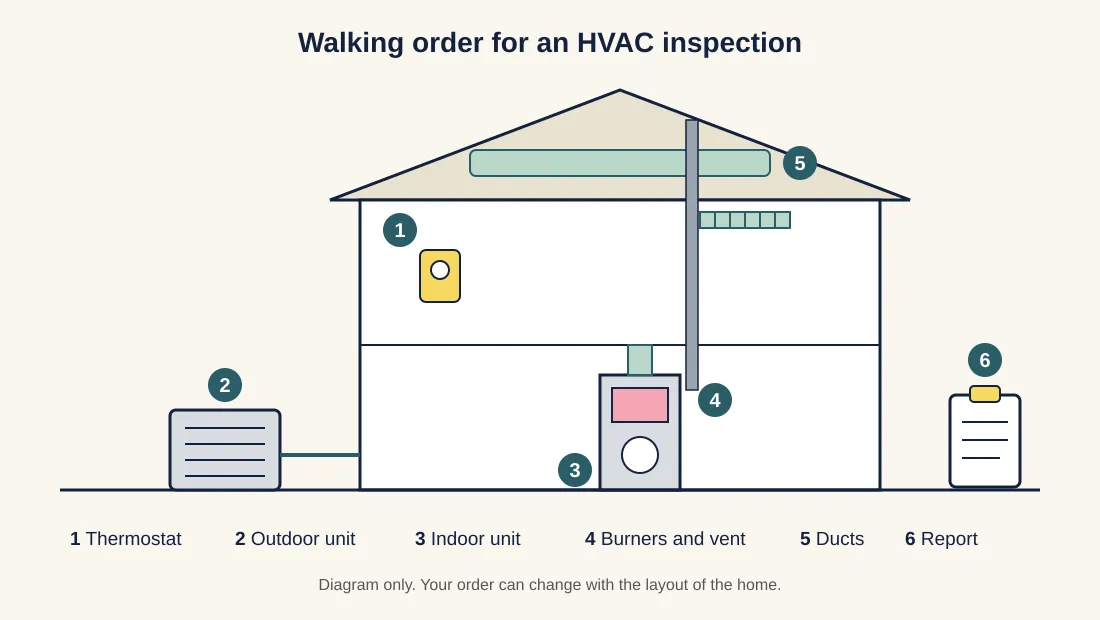
The order the templates follow. Diagram only.
Template 1: Job header and customer interview
Start with the person who lives with the system. They know which room never cools and which month the bill jumped. ENERGY STAR lists the signs of poorly performing ducts, including high summer and winter utility bills, rooms that are difficult to heat and cool, and stuffy rooms. Ask about each one before you open a panel.
HVAC INSPECTION: [Customer name]
Address: [Street, city]            Date: [Date]
Technician: [Name]                 License: [Number]
Reason for visit: [Sale / new owner / landlord / concern]

System type: [Split AC + furnace / heat pump / package]
Fuel: [Gas / propane / oil / electric]
Outdoor unit: [Make, model, serial, year]
Indoor unit: [Make, model, serial, year]
Filter size: [Size]                Location: [Where]

Ask the customer:
[ ] Any rooms that are hard to heat or cool? Which?
[ ] Any rooms that feel stuffy?
[ ] Utility bills higher than last year?
[ ] Any water near the indoor unit?
[ ] Any odors, soot or unusual noises? When?
[ ] Has a CO alarm ever sounded?
[ ] When was the filter last changed?
[ ] Last service visit: [Date, company, work done]

Scope agreed: [What will be opened and measured]
Not included: [Attic / crawl space / roof / chimney]
Customer initials: ____
Write the scope before you touch the equipment. A buyer who expects a full report will be disappointed by a visual check, so name the areas you are not entering and have the customer initial the line.
Template 2: Thermostat and controls
The thermostat is the first stop, because it tells you how the system behaves before you influence it. ENERGY STAR's check-up list includes the starting cycle of the equipment, to assure the system starts, operates and shuts off properly. Watch one full cycle in each mode the weather allows.
THERMOSTAT AND CONTROLS: [Address]   [Date]
Thermostat: [Make / type]    Location: [Room, wall]
Outdoor temperature: [°F]    Indoor temperature: [°F]

[ ] Thermostat level and secure on the wall     OK / Attn
[ ] Display readable, batteries good            OK / Attn
[ ] Away from supply registers, sun and lamps   OK / Attn
[ ] Schedule or setpoints recorded: [Settings]
[ ] Call for cooling: system starts             OK / Attn / N/A
[ ] Call for heat: system starts                OK / Attn / N/A
[ ] Fan runs in "On" and stops in "Auto"        OK / Attn
[ ] System shuts off when setpoint is reached   OK / Attn
[ ] Emergency or auxiliary heat responds        OK / Attn / N/A
[ ] Service switch at the indoor unit labeled   OK / Attn
[ ] Outdoor disconnect present and operable     OK / Attn

Mode not tested: [Cooling / heating]  Why: __________
Notes: _____________________________________________
Fill in the "mode not tested" line every time it applies. The InterNACHI standard does not require a home inspector to operate cooling equipment when the exterior temperature is below 65° Fahrenheit, or when conditions may damage the equipment. Follow the manufacturer's limits for the unit in front of you, and tell the reader of your report which half of the system you could not run.
Template 3: Outdoor unit
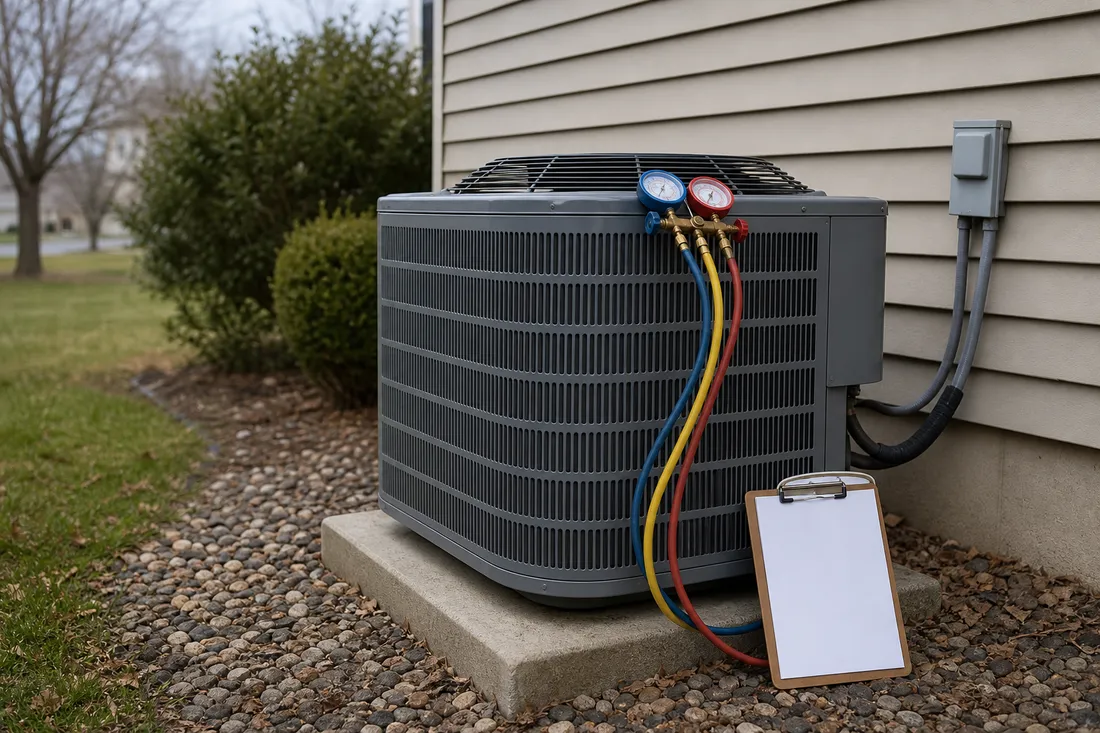
Walk outside while the system is running. Look first, then measure. Record the nameplate before anything else, because the model and serial numbers are what a later reader will check against the listing or the warranty.
OUTDOOR UNIT: [Address]              [Date]
Type: [AC condenser / heat pump]
Nameplate: [Make, model, serial]     Refrigerant: [Type]

Visual:
[ ] Unit level on a sound pad                   OK / Attn
[ ] Clearance around the coil: [Inches]         OK / Attn
[ ] Coil fins clean, not flattened              OK / Attn
[ ] Cabinet panels and fan guard in place       OK / Attn
[ ] Fan blade intact, turns freely              OK / Attn
[ ] Line set insulation intact                  OK / Attn
[ ] No oil stains at fittings or service valves OK / Attn
[ ] Wiring whip and conduit secure              OK / Attn
[ ] Disconnect within sight, cover closes       OK / Attn

Electrical (panel off, then running):
[ ] Contactor points: [Condition]               OK / Attn
[ ] Capacitor reading: [Rated] / [Measured]     OK / Attn
[ ] Connections tight, no heat marks            OK / Attn
[ ] Compressor amps: [Rated] / [Measured]
[ ] Fan motor amps: [Rated] / [Measured]

Refrigerant circuit (certified technician only):
[ ] Suction pressure: [psig]   Line temp: [°F]
[ ] Liquid pressure: [psig]    Line temp: [°F]
[ ] Superheat: [°F]            Subcooling: [°F]

Findings: __________________________________________
The last block has a legal limit on who fills it in. EPA rules under Section 608 of the Clean Air Act require certification for technicians who maintain, service, repair or dispose of equipment that could release refrigerants. The EPA's definition of a technician includes anyone attaching hoses and gauges to an appliance to measure pressure. Apprentices are exempt only when a certified technician supervises them closely and continually. If a helper runs this sheet alone, the helper stops at the electrical block.
Record the charge readings and leave the judgment for the report. ENERGY STAR notes that too much or too little refrigerant makes a system less efficient and shortens the life of the equipment. A reading outside the manufacturer's target is a finding with a cause to find, and adding refrigerant is a repair you quote separately.
Template 4: Indoor unit, coil and condensate
Go to the air handler or furnace cabinet next. This sheet covers the parts every system has, whatever the fuel. The burner checks come in Template 5.
INDOOR UNIT: [Address]               [Date]
Location: [Basement / closet / attic / garage]
Nameplate: [Make, model, serial]

Filter and airflow:
[ ] Filter in place, correct size               OK / Attn
[ ] Filter condition: [Clean / loaded / missing]
[ ] No gaps where air bypasses the filter       OK / Attn
[ ] Blower wheel clean                          OK / Attn
[ ] Blower motor amps: [Rated] / [Measured]
[ ] Belt condition and tension                  OK / Attn / N/A

Evaporator coil:
[ ] Coil face visible: [Yes / No, why]
[ ] Coil clean, fins straight                   OK / Attn
[ ] No frost, oil or corrosion on the coil      OK / Attn

Condensate:
[ ] Drain pan free of rust and standing water   OK / Attn
[ ] Trap present and primed                     OK / Attn
[ ] Drain line flows when water is poured in    OK / Attn
[ ] Secondary pan and float switch tested       OK / Attn / N/A
[ ] No water stains under or around the unit    OK / Attn

Electrical:
[ ] Connections tight, no heat marks            OK / Attn
[ ] Control board: no burn marks, fault code: [Code]

Temperatures (after the system has run steadily):
Return air: [°F]   Supply air: [°F]   Difference: [°F]

Findings: __________________________________________
Three of these lines carry numbers a customer can understand. ENERGY STAR says airflow problems can reduce a system's efficiency by up to 15 percent, which is why the filter, blower and coil lines come first. It also says a plugged condensate drain can cause water damage in the house and affect indoor humidity levels. A water stain on the platform is evidence, so photograph it.
Be honest on the "coil face visible" line. A cased coil with no access panel cannot be inspected without cutting in, and your report should say you did not see it.
Template 5: Gas furnace safety and combustion
This sheet is where a technician's inspection differs most from a home inspection, and where the risk is highest. The U.S. Consumer Product Safety Commission (CPSC) says more than 200 people die each year from unintentional non-fire carbon monoxide poisoning associated with consumer products. It names heating equipment among the top contributors. The CPSC urges a yearly professional inspection of all fuel-burning home heating systems. Its list covers furnaces, boilers, fireplaces, wood stoves, water heaters, chimneys, flues and vents.
GAS FURNACE: [Address]               [Date]
Nameplate: [Make, model, serial]     Input: [BTU/h]
Vent type: [Metal flue / PVC / chimney liner]

Before firing:
[ ] No gas odor at the appliance                OK / Attn
[ ] Gas shutoff within reach, operates          OK / Attn
[ ] Flexible connector and drip leg in place    OK / Attn
[ ] Leak check at joints: [Method]              OK / Attn
[ ] Combustion air openings clear               OK / Attn
[ ] Nothing flammable stored near the furnace   OK / Attn

Burners and heat exchanger:
[ ] Burners clean, aligned, no rust flakes      OK / Attn
[ ] Ignition smooth, no delay or rollout        OK / Attn
[ ] Flame steady when the blower starts         OK / Attn
[ ] Flame sensor reading: [Microamps]
[ ] Heat exchanger: [Visual / camera / not accessible]
[ ] No cracks, holes or soot tracks seen        OK / Attn

Venting:
[ ] Vent connector sloped, supported, no rust   OK / Attn
[ ] Joints secure, no gaps or tape repairs      OK / Attn
[ ] Draft or inducer pressure switch operates   OK / Attn
[ ] Termination clear outdoors                  OK / Attn
[ ] Condensate from a condensing furnace drains OK / Attn / N/A

Safeties and readings:
[ ] High limit and rollout switches in circuit  OK / Attn
[ ] Gas pressure: [Inlet] / [Manifold]
[ ] Temperature rise: [°F]   Nameplate range: [°F]
[ ] Combustion analysis: O2 [%]  CO [ppm]  Stack [°F]
[ ] CO in the supply air and room: [ppm]

CO alarms in the home: [Where]   None on: [Levels]
Findings: __________________________________________
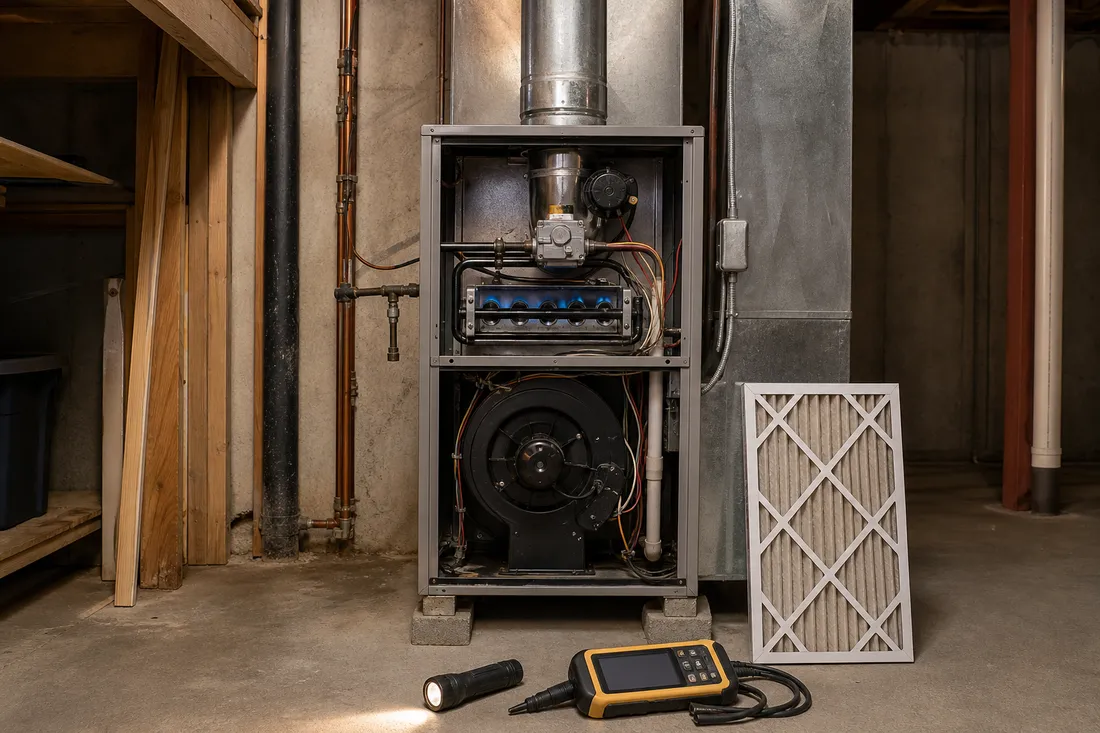
ENERGY STAR's heating check-up names the same core: gas or oil connections, gas pressure, burner combustion and the heat exchanger. It warns that improperly operating gas connections are a fire hazard. It adds that a dirty burner or cracked heat exchanger causes improper burner operation.
Write down how you examined the heat exchanger. "Visual through the burner openings" and "camera, all cells" are different levels of confidence, and the reader deserves to know which one stands behind your OK. Compare every reading to the nameplate and the manufacturer's instructions, and write both numbers on the sheet.
The alarm line is a courtesy that takes one minute. The CPSC advises CO alarms on every level of the home and outside sleeping areas. If a level has none, say so in the report.
Template 6: Ductwork and airflow
Ducts fail quietly. ENERGY STAR estimates that in a typical house about 20 to 30 percent of the air moving through the duct system is lost to leaks, holes and poorly connected ducts. Agree with the customer on which spaces you will enter, since an attic or crawl space adds time.
DUCTWORK: [Address]                  [Date]
Areas entered: [Basement / attic / crawl / garage]
Duct type: [Sheet metal / flex / duct board]

[ ] Supply plenum sealed at the unit            OK / Attn
[ ] Return plenum sealed at the unit            OK / Attn
[ ] Joints sealed with mastic or metal tape     OK / Attn
[ ] No cloth duct tape used as a seal           OK / Attn
[ ] No disconnected or crushed runs             OK / Attn
[ ] Flex duct supported, not kinked or tangled  OK / Attn
[ ] Duct insulation intact in unconditioned space OK / Attn
[ ] No moisture stains or visible growth        OK / Attn
[ ] Dampers found and positions noted: [Where]

Room by room:
[Room]  Supply registers: [#]  Airflow: [Strong / weak / none]
[Room]  Supply registers: [#]  Airflow: [Strong / weak / none]
[ ] Registers open, not blocked by furniture    OK / Attn
[ ] Register boots sealed to floor, wall or ceiling OK / Attn
[ ] Return grilles clear and clean              OK / Attn

Static pressure, if in scope: Supply [in. w.c.]  Return [in. w.c.]
Findings: __________________________________________
The tape line comes straight from ENERGY STAR, which says to seal leaks with mastic sealant or metal tape and never to use duct tape, because it is not long-lasting. It also points to the connections at vents and registers as common places to find leaks and disconnected ductwork. Lift a few registers and look at the boot.
Match the weak rooms on this sheet to the complaints from Template 1. A customer who hears "the back bedroom run is kinked behind the knee wall" will believe the rest of your report.
Template 7: Light commercial air handler or rooftop unit
A shop, office or school adds parts a house does not have: an outside air intake, dampers and often a belt-driven fan. Print one sheet per unit and write the area it serves at the top, the way New Hampshire's state form does.
COMMERCIAL UNIT: [Business name]     [Date]
Unit: [Tag or number]    Area served: [Rooms]
Location: [Roof / mechanical room]   Contact: [Name]

Outside air intake:
[ ] Intake unobstructed                         OK / Attn
[ ] Bird screen in place and clear              OK / Attn
[ ] No standing water or droppings nearby       OK / Attn
[ ] No exhaust outlet within 25 feet            OK / Attn
[ ] No cooling tower or trash compactor within 25 feet OK / Attn
[ ] Not next to parking, a busy road or a loading dock OK / Attn
[ ] Outside air damper operates, setting noted  OK / Attn

Fans:
[ ] Motor operating, no unusual noise           OK / Attn
[ ] Belts in good condition and adjusted        OK / Attn

Filters and coils:
[ ] Filters in place, complete coverage         OK / Attn
[ ] Pressure drop within the maker's range      OK / Attn
[ ] Coils free of corrosion and leaks           OK / Attn
[ ] Coils clean, no dust or debris              OK / Attn

Condensate:
[ ] Drain pan free of corrosion                 OK / Attn
[ ] Draining properly, trap working             OK / Attn
[ ] No visible slime or growth, no odor         OK / Attn

Ducts and controls:
[ ] Duct lining and insulation intact           OK / Attn
[ ] Ducts free of obstructions                  OK / Attn
[ ] Thermostats and sensors respond             OK / Attn

Items for the owner: _______________________________
Items for a quote: _________________________________
Every line here appears on a public form. The intake lines follow the EPA's long-form HVAC checklist, which asks whether a cooling tower, an exhaust outlet or a trash compactor sits within 25 feet of the outside air intake. It also asks whether the intake is near a parking facility, busy road or loading dock. The fan, coil, filter and drain pan lines match the New Hampshire form, which checks for belts "in good condition and adjusted" and a pan "free of visible biofilm."
Split what you find into two lists. A blocked intake screen is something the owner's staff can clear the same day. A seized damper actuator is a repair, and it belongs in an HVAC estimate.
Template 8: Findings report and sign-off
The report is what the customer pays for. Rank every finding, so a buyer reading it the night before closing knows what cannot wait.
FINDINGS REPORT: [Customer name]     [Date]
Address: [Street, city]
Technician: [Name]                   License: [Number]
Equipment: [Outdoor unit] / [Indoor unit], [Years]
Inspected: [Controls / outdoor / indoor / furnace / ducts]
Not inspected: [Areas or modes, and why]

PRIORITY 1: Fix now (safety)
1. [What] at [Where]. Reading: [Value]. Photo: [Number]

PRIORITY 2: Fix soon (defect, system still safe to run)
1. [What] at [Where]. Photo: [Number]

PRIORITY 3: Maintenance or upgrade to consider
1. [What] at [Where]

Readings attached: [Sheets 2 to 6]
Made safe during the visit: [What you did, or "Nothing"]
Equipment left off: [Which, and why]

This report describes conditions seen and measured on
the date above in the areas listed as inspected. It is
not a warranty of future performance.

Technician signature: ____________   Date: ________
Customer signature: ______________   Date: ________
Keep the report and the price on separate pages. Send the findings first, then price each priority group as its own line, so the customer can approve the safety work without committing to the upgrades. Cleaning and adjustment items from Priority 3 fit a tune-up visit, and the HVAC maintenance checklist covers what that visit includes. A customer who wants those visits every spring and fall is a candidate for an HVAC service agreement.
Questions HVAC techs ask about inspection checklists
What does an HVAC inspection include?
It includes the controls, the outdoor unit, the indoor unit, the burners and vent on fuel-burning equipment, and the ducts, followed by a written report. ENERGY STAR's check-up list names the same parts: thermostat settings, electrical connections, the condensate drain, system controls, coils, refrigerant level, blower components, gas connections and the heat exchanger.
How often should an HVAC system be inspected?
Once a year for each half of the system. ENERGY STAR recommends annual pre-season check-ups, with the cooling system checked in the spring and the heating system in the fall. The CPSC urges a yearly professional inspection of all fuel-burning home heating systems.
Is an HVAC inspection the same as a home inspection?
No. The InterNACHI standard has a home inspector operate the system from its normal controls and report whether it ran. The standard does not require evaluating heat exchangers, measuring airflow or examining refrigerant. A technician's inspection opens the equipment and records readings.
Who is allowed to check the refrigerant charge?
A technician with EPA Section 608 certification, or an apprentice working under one. The EPA counts attaching hoses and gauges to measure pressure as technician work, so the certification applies to the reading as well as to adding refrigerant. The credential does not expire.
What should a homeowner check between inspections?
The filter. ENERGY STAR says to inspect, clean or change air filters once a month in a central air conditioner, furnace or heat pump. Show the customer where the filter is and write its size on the report, so they buy the right one.
Let customers request an inspection online
A buyer with a closing date, or a landlord between tenants, often looks for an HVAC company in the evening, after your phones are off. Kejoola gives an HVAC business a four-page website with Home, Services, Blog and Contact pages and an online booking form. The form asks for a name, email, phone number and a notes box, so the customer can describe the system, its age and the reason for the inspection. You read the request the next morning, call back, and bring Template 1 to the visit.
Sources
- ENERGY STAR: Maintenance Checklist
- ENERGY STAR: Duct Sealing
- EPA: Section 608 Technician Certification Requirements
- EPA: HVAC Checklist, Long Form
- CPSC: Home Heating Equipment
- CPSC: Carbon Monoxide Information Center
- InterNACHI: Home Inspection Standards of Practice
- New Hampshire Department of Administrative Services: HVAC Inspection Checklist