HVAC Estimate: What Drives the Price and How to Write One
An HVAC estimate is a written, itemized price for heating or cooling work, built from labor, equipment at a set markup, and overhead. The price moves most with system type, size, efficiency, ductwork and access.
Josh · Nov 12, 2026 · 12 min read
- hvac estimate
- hvac estimate template
- hvac pricing
- hvac quote
- hvac business
An HVAC estimate is a written, itemized price for heating or cooling work, given before the job starts. You build it from labor, equipment and parts at a set markup, and your overhead, then add scope, exclusions, terms and a valid-until date. The number moves most with the system type, its size and efficiency, the condition of the ductwork, and how hard the install is to reach. Below are the cost drivers, the pricing math, the line items every estimate needs, and a layout you can copy.
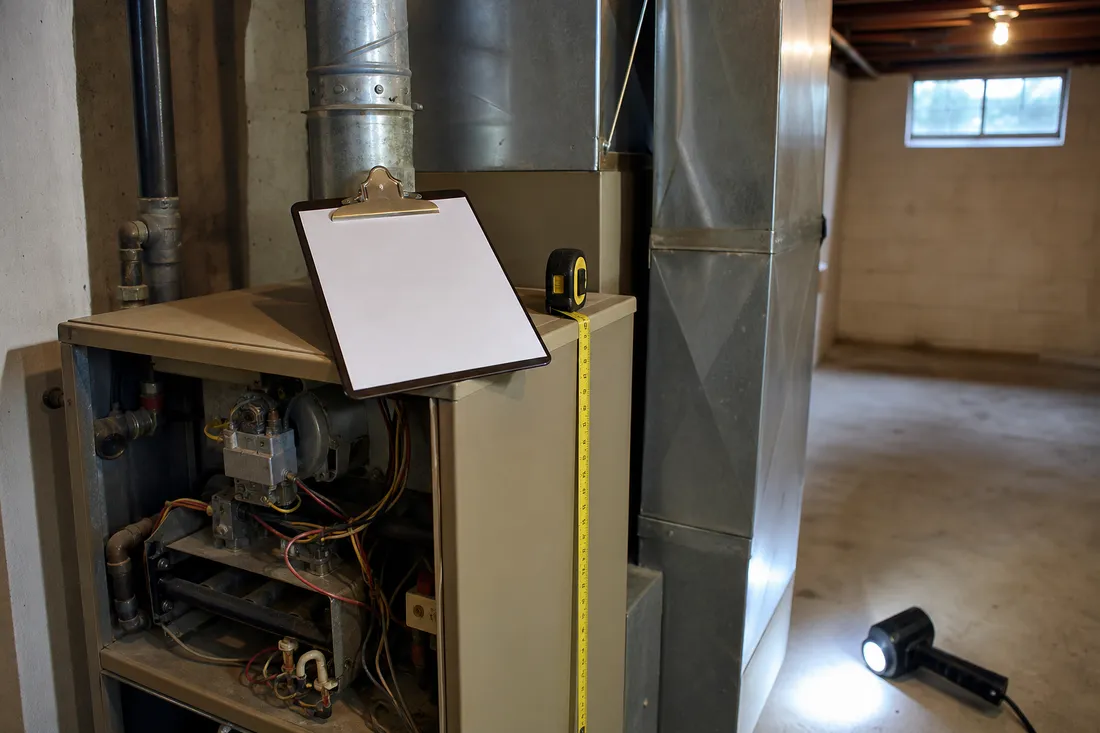
Estimate, quote or proposal
Customers use these words as if they mean the same thing. You should not, because each one carries a different risk for you.
Jobber describes an estimate as a rough but educated guess at the time, work and materials a job will take. It leaves you room if something unexpected turns up behind a panel or in a crawl space. A quote tells the customer exactly what they will pay. If you come in under budget, you keep the difference. If the job runs long, you absorb it.
A proposal is larger. Jobber notes that proposals can include project timelines and company background, and that commercial clients ask for them more often than homeowners do.
Write the document type in its title. A replacement with a known model and a clear install path can go out as a quote. A no-cool call in an older house with buried duct runs should go out as an estimate, with a line saying what could change the price.
What the customer is comparing your number to
Most homeowners have looked up a price before you arrive. Knowing the ranges they have seen helps you explain why your number is different.
Carrier puts a typical HVAC replacement at about $3,000 to more than $15,000, depending on equipment type, efficiency, size and installation complexity. Its ranges by system type, including equipment and standard installation, are:
- Gas furnace: $3,800 to $12,000
- Ductless mini split: $2,000 to $10,500
- Oil furnace: $2,500 to $10,000
- Central air conditioner: $3,000 to $15,000
- Heat pump: $6,000 to $25,000
- Geothermal heat pump: $12,000 to $45,000
Thumbtack reports a national average HVAC system cost of $11,862, with a typical range of $3,725 to $20,449, based on its own platform data.
These ranges are wide because the house matters as much as the equipment. Carrier makes the same point: two homes replacing similar equipment can receive very different estimates. Your job on the estimate is to show which of the drivers below applied to this house.
The cost drivers behind an HVAC estimate
Carrier groups replacement cost into three parts: the equipment, the installation, and the requirements of the specific home. Each part has a few drivers you should check on every site visit.
System type
The equipment itself sets the floor. A straight air conditioner swap costs less than replacing a full dual-fuel system, Carrier notes, and a geothermal heat pump sits at the top of every range. If the house has no ducts, a ductless mini split may replace a ducted system and its duct installation entirely.
Size and the load calculation
A unit that is too large cycles on and off and wastes energy. One that is too small never keeps the house comfortable. Size it from a load calculation, not from the tonnage on the old data plate.
ACCA's Manual J is the ANSI-recognized national standard for residential load calculations. ACCA states that a proper load calculation is required by national building codes and by most state and local jurisdictions. Put the calculated load on the estimate. It explains why you quoted a smaller unit than the one on the old data plate.
Efficiency rating and staging
Higher SEER2, HSPF2, EER2 and AFUE ratings raise the equipment price, though they can lower the customer's running costs. An Indianapolis dealer quoted by Carrier lists efficiency, single-stage versus variable-speed staging, warranties and indoor air quality accessories as the items that move the price most.
Federal efficiency minimums for central air conditioners also differ by region. Carrier notes that different standards apply in the North, the Southeast and the Southwest. Confirm that the model you quote is allowed where it will be installed.
Ductwork
Leaky or undersized ducts may need repair or replacement before a new system can move air properly. Carrier says duct modifications can add significantly to the cost. One Chicago contractor, Chicago Comfort, puts duct replacement at $2,000 to $5,000 on top of the equipment in its market. Your local figure will differ, so price it from your own labor and material.
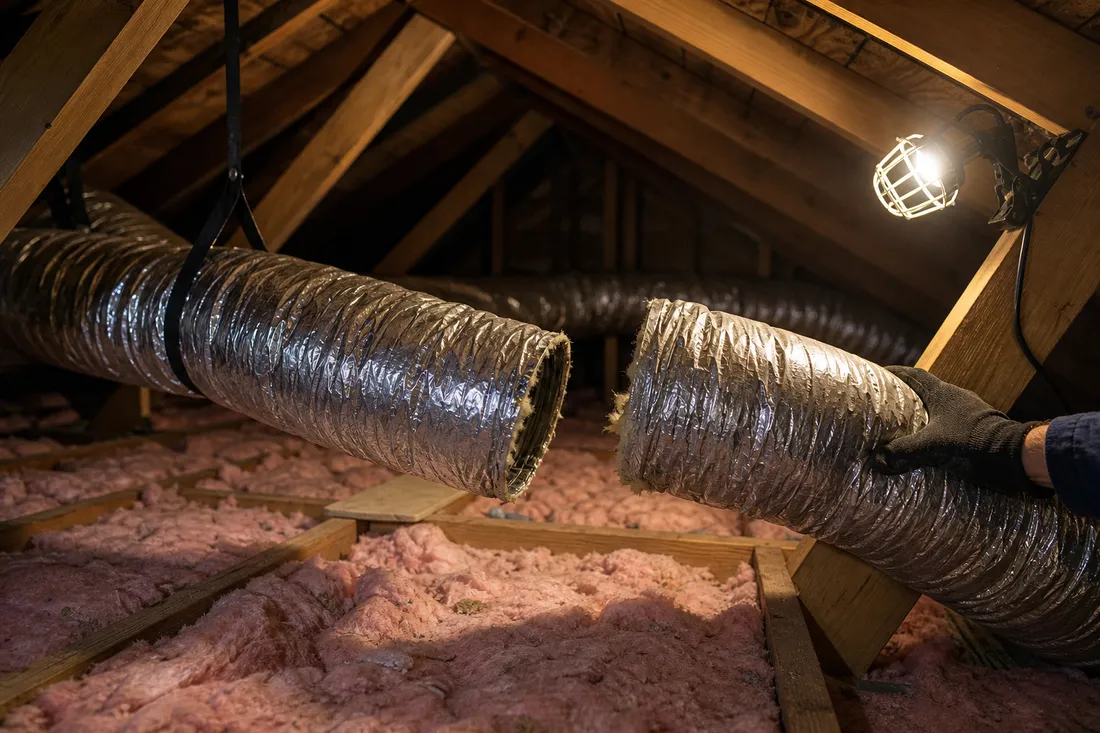
A separated duct joint like this one belongs on the estimate as its own line, with a photo, so the customer can see why it is there.
Labor, access and electrical work
Tight crawl spaces, hot attics and electrical upgrades take more time and sometimes a larger crew, Carrier notes. A furnace in an open basement is a different job from an air handler in a hot attic reached through a closet hatch. Write the access conditions on the estimate so the labor hours make sense.
Refrigerant
Refrigerant rules changed again in 2026, and they affect which equipment you can quote. NAHB reports that the EPA published a final rule on May 26, 2026, effective July 27, 2026. It lets contractors keep installing R-410A units made or imported before January 1, 2025, until existing supplies run out.
No new complete R-410A systems are being made, so that supply will shrink. NAHB also notes that New York passed a state law keeping the original January 1, 2026 deadline, so no R-410A systems can be installed there. Check your state's rules before you put an older unit on an estimate.
Location, season and permits
Demand and local conditions move the price. Carrier says spring and fall installs may offer more scheduling flexibility than peak summer or winter, and it lists shoulder seasons as the usual time for lower prices.
Permits are a separate line. In Chicago, Chicago Comfort puts HVAC permit costs at $50 to $200 depending on scope. Look up your own city's fee schedule and list the permit at cost.
How to price the job
Customers see the drivers. You also need the arithmetic underneath them, or the estimate looks right and still loses money.
Labor at its true cost
Start with what an hour of labor costs your business, not what a tech earns. The Bureau of Labor Statistics puts the median wage for heating, air conditioning and refrigeration mechanics and installers at $29.33 an hour, or $61,010 a year, as of May 2025.
Payroll taxes, workers' compensation and benefits sit on top of that wage. Jobber's example adds 20% to a $28 hourly wage for a labor cost of $33.60 an hour. Multiply that cost by the hours on the job and the number of techs. Jobber's example is 3 hours times 2 techs, or 6 labor hours.
Your past timesheets are the best guide to hours. A changeout your crew has done many times has a known time. A first-time install does not, so add a margin for it.
Overhead per labor hour
Overhead is everything that keeps the business running but does not belong to one job. That means vehicles, licensing, insurance, office costs and software. Jobber turns it into an hourly figure by dividing overhead by labor hours. Its example divides $8,000 of monthly overhead by 400 labor hours, which means every labor hour needs to carry $20 of overhead.
Equipment and parts at a set markup
List every part and piece of equipment, add its cost, then add your markup. Jobber puts the average markup on HVAC equipment at 25% to 50%, and 100% or more on spare parts and materials.
Markup and margin are different numbers. Jobber's chart shows that a 25% markup gives a 20% profit margin, and a 40% markup gives about 29%. If you set prices by markup but track profit by margin, you will think you are earning more than you are.
Flat rate, time and materials, or both
Jobber describes three ways to turn those costs into a price, with worked examples:
- Flat rate for predictable work. An A/C tune-up at one hour and $80 an hour, with $20 of materials at a 25% markup, comes to $105.
- Time and materials for work with unknowns. Custom ductwork at two hours and $80 an hour, with $600 of materials at a 25% markup, comes to $910.
- Hybrid for a job that has both. The tune-up and the ductwork together come to $1,015.
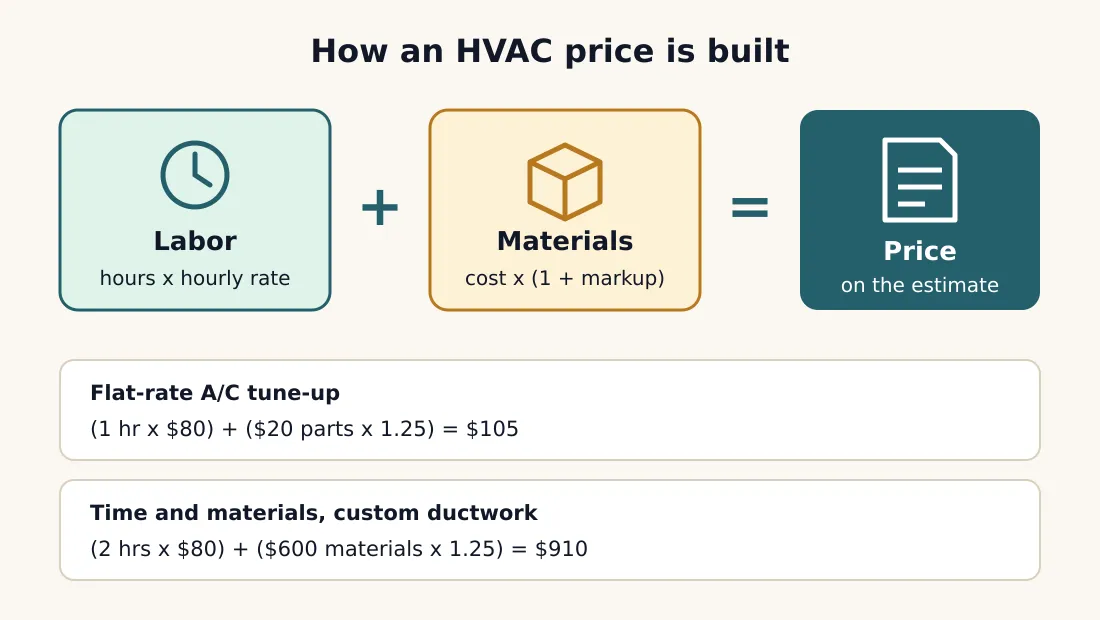
Flat rates suit tune-ups, common repairs and standard replacements. Time and materials suits diagnostic work, retrofits in old houses and emergency calls. Jobber suggests reviewing your job history each quarter: tasks that keep running long move to time and materials, and tasks that stay on time can become flat rates.
Jobber's guide also puts a typical markup target at 20% or higher once all costs are counted. Treat that as a floor to check against, not a rule.
What goes on the estimate
Jobber lists the items every HVAC estimate should carry. Use them as your checklist:
- Your business name, logo and contact details
- The customer's name, address, phone and email
- An estimate number for your records
- A description of the work, broken into tasks
- Itemized costs: labor, materials, quantities, parts markup, discounts and sales tax
- Optional line items for add-on work
- What is not included
- How long the estimate is valid
- Terms such as deposit, payment terms and warranty
Here is a layout that puts those items in order. Copy it into your own document and replace the bracketed text.
HVAC ESTIMATE                         Estimate no. [1047]
[Business name] | [License no.] | [Phone] | [Email]
Date: [MM/DD/YYYY]          Valid until: [MM/DD/YYYY]

Customer: [Name], [Service address], [Phone], [Email]

Existing equipment: [Type, age, tonnage or BTU]
Site notes: [Access, duct condition, electrical, photos attached]
Load calculation: [Result and method]

SCOPE OF WORK
1. Remove and dispose of existing [equipment]       $[  ]
2. Supply and install [model], [efficiency rating]  $[  ]
3. [Line set / pad / disconnect / thermostat]       $[  ]
4. Duct repairs: [location and extent]              $[  ]
5. Permit and inspection                            $[  ]
6. Start-up, testing and walkthrough                $[  ]

OPTIONAL ADD-ONS
A. [Air cleaner / humidifier / smart thermostat]    $[  ]

Subtotal $[  ]   Tax $[  ]   Total $[  ]
Deposit due on acceptance: $[  ]

NOT INCLUDED: [Drywall repair, asbestos abatement, electrical
panel upgrade, any work not listed above]

PRICE MAY CHANGE IF: [Hidden duct damage, code corrections
required by the inspector, equipment price changes after the
valid-until date]

WARRANTY: [Equipment and labor terms]

Accepted by: ____________________   Date: __________
Give each driver from the site visit its own line. A customer who sees "duct repairs, attic, two separated joints" with a photo accepts the cost more readily than one who sees a single total.
When the job is done, the same lines carry over to the bill. An HVAC invoice template with matching sections makes the two documents easy to compare. If the customer wants ongoing care, an HVAC service agreement covers the recurring visits.
Free estimates and paid diagnostic visits
Whether you charge for the visit depends on the work. Chicago Comfort reports that many HVAC companies give free estimates for straightforward installations. Detailed diagnostics or load calculations are often a paid service call, which runs $100 to $250 in Chicago, and contractors often credit that fee toward the install.
A common split is a free replacement estimate and a paid repair diagnostic. State it on your website and on the phone before you go out, so nobody is surprised at the door.
Repair or replace, and incentives
Customers often ask you to settle the repair-or-replace question on the estimate. Carrier describes the "$5,000 rule": multiply the age of the equipment by the repair cost. If the result is more than $5,000, replacement is usually the better choice. A 10-year-old unit with a $600 repair comes to $6,000, which points toward replacement. Carrier also puts typical system life at 15 to 20 years.
Show both options on the same estimate when the numbers are close. Carrier also advises against replacing only the outdoor unit and keeping an old indoor coil, because mismatched components can reduce efficiency and affect warranty coverage.
Be careful with incentives. The IRS energy efficient home improvement credit covered qualifying property placed in service through December 31, 2025, so do not promise it on a job installed now. Carrier recommends checking current IRS guidance and state and utility programs before assuming any credit applies. Point customers to their utility's rebate page rather than printing a figure you have not confirmed.
Frequently asked questions
How do you estimate an HVAC job?
Price it from your costs. Add labor hours times your true hourly labor cost, overhead per labor hour, and equipment and parts at your markup. Then check the result against the drivers you found on site: system type, load calculation, efficiency, ductwork, access, refrigerant and permits.
Should an HVAC estimate be free?
Usually for replacements, often not for diagnostics. Chicago Comfort reports that many companies give free estimates for straightforward installs and charge a service fee for detailed diagnostics, often credited toward the job. Say which applies before you book the visit.
How long should an HVAC estimate stay valid?
Set a specific date and print it on the estimate. Jobber lists the validity period as a required item. Refrigerant rules changed during 2026, so a short window protects you from quoting a unit you can no longer buy at that price.
Why do two HVAC estimates for the same house differ so much?
Because they quote different equipment or scope. Carrier notes that efficiency, staging, warranties, ductwork, electrical work and accessories can swing the price by thousands of dollars. Itemizing each driver lets the customer compare line by line.
What is the difference between an HVAC estimate and an invoice?
The estimate comes before the work and the invoice comes after. Jobber describes the estimate as the expected cost and scope the customer signs off on, and the invoice as the final itemized bill, which can differ if the work changed.
Get more estimate requests
An estimate only matters if the customer asks for one. Kejoola gives an HVAC business a four-page website (Home, Services, Blog and Contact) with online booking. The booking form collects name, email, phone and a notes box, where a customer can describe the system's age or the problem before you arrive. See what an HVAC website needs, or keep the HVAC maintenance checklist for the visits that follow an install.
Sources
- Free HVAC Estimate Template, Jobber
- How to Price HVAC Jobs, Jobber
- HVAC Parts Markup Chart, Jobber
- How Much Does HVAC Replacement Cost?, Carrier
- How Much Does an HVAC System Cost?, Thumbtack
- How Much Is an HVAC Estimate?, Chicago Comfort
- Manual J Residential Load Calculation, ACCA
- EPA Finalizes Refrigerant Rule Update to Allow Older HVAC Unit Installation, NAHB
- Energy Efficient Home Improvement Credit, IRS
- Heating, Air Conditioning, and Refrigeration Mechanics and Installers, Bureau of Labor Statistics