Landscape Maintenance Contract: 7 Free Templates to Copy
A landscape maintenance contract names the property, lists the work area by area, sets a visit schedule, a monthly price and a term, and says how extra work and renewal are handled. Seven forms to copy: agreement, scope exhibit, frequency schedule, optional services, extra work, commercial addendum and renewal notice.
Josh · Nov 17, 2026 · 17 min read
- landscape maintenance contract
- landscape maintenance agreement
- commercial landscape maintenance contract
- landscape maintenance scope of work
- grounds maintenance contract
- landscaping business
A landscape maintenance contract is a written agreement to care for a property's turf, beds, shrubs, trees and irrigation on a schedule, for a set monthly price and term. It names both parties and the property, attaches a scope of work and a visit schedule, and says how extra work, late payment and renewal are handled. The seven templates below cover the agreement, a scope exhibit, a frequency schedule, an optional services sheet, an extra work form, a commercial addendum and a renewal notice. Copy one, replace the brackets, and have a local attorney read it once before you rely on it.
What a landscape maintenance contract has to cover
A maintenance contract is different from a mowing agreement. It covers the whole property for a year, so the scope has more parts and the seasons change the work. BrightView, a commercial landscaping company, tells property managers to check a contract against five questions: who does the work, what is included, when it happens, where on the site, and why each service is there.
The "what" does the most work. BrightView lists mowing with edging and blowing, lawn care such as fertilizer and aeration, bed maintenance, and irrigation as the core. Tree care, pest and disease treatment, and enhancements such as seasonal color are items a contract may add. It also advises spelling out areas you will not touch, such as a wetland or a garden the staff keeps.
The California Landscape Contractors Association publishes a maintenance agreement that shows how the paper is organized. A short front page holds the parties, the property, the term, the monthly price and the signatures. The detail sits in an attached Exhibit A and a page of terms and conditions. That layout is worth copying, because you can reuse the front page and rewrite only the exhibit for each property.
| Part | What it settles | Where it goes |
|---|---|---|
| Parties and property | Who signs, and whether the signer owns the site or acts for the owner | Template 1 |
| Scope by area | Turf, beds, shrubs and trees, irrigation, hard surfaces, exclusions | Template 2 |
| Frequency | How many visits or services each month | Template 3 |
| Optional services | Fertilizer, pest and weed control, renovation, mulch, color | Template 4 |
| Extra work | How a change is priced and approved | Template 5 |
| Term, price, payment | Length, monthly amount, due date, late charge | Template 1 |
| Insurance and site rules | Certificates, standards, time to correct a problem | Template 6 |
| Renewal | Notice period and any price change | Template 7 |
Check these three things before you send one
A maintenance contract is not a construction contract. The CLCA form says so on its first page: it is a maintenance agreement only. Under California's Contractors' License Law, construction work needs a separate agreement and a state contractor's license. The same form carries a note that with a homeowner, no more than $1,000 can be charged in a single term before a full home improvement contract is required. That limit is on a California form, so ask your own state's licensing board where the line sits for you.
Spraying is licensed separately from mowing. The EPA says federal law requires anyone who applies or supervises restricted use pesticides to be certified, and that states, territories and tribes do the certifying. It adds that many states require all commercial applicators to be certified, not only those using restricted products. If your contract includes weed or pest control, confirm your state certification first, or name the licensed subcontractor who will do it.
Insurance wording should match your policy. Randall Landscaping, a commercial contractor serving the Merrimack Valley, says a contractor on a commercial site should carry general liability of at least $1 million per occurrence and $3 million aggregate, plus workers' compensation. It also notes that commercial clients ask to be named as an additional insured. Write down only the limits your certificate actually shows.
Template 1: Landscape maintenance agreement
This is the front page for any property. It follows the CLCA layout, with the detail pushed into the exhibits that come next.
LANDSCAPE MAINTENANCE AGREEMENT          No. [number]

Date: [date]
Provider: [business name], [address], [phone], [email]
License / certification no.: [number, if any]
Client: [name or company], [mailing address], [phone]
The Client is [ ] the owner  [ ] the owner's agent.
Property: [street address and short description]

1. WORK
The Provider will furnish the labor, equipment and
supervision to maintain the landscaped areas of the
Property as described in Exhibit A (Scope of Work) and
Exhibit B (Frequency Schedule). This is a maintenance
agreement only. Construction, installation and repair
work require a separate written agreement.

2. TERM
This Agreement runs [12] months from [start date]. It
renews for another equal term unless either party gives
written notice at least [30] days before the term ends.

3. PRICE AND PAYMENT
The Client will pay $[amount] per month, plus tax where
it applies. Invoices are sent on the [day] of each month
and are due within [number] days.

4. LATE PAYMENT
A balance not paid by the due date bears a late charge
of [rate]% per month. If a balance is more than [number]
days past due, the Provider may suspend work until the
account is current.

5. EXTRA WORK
Work outside Exhibits A and B is done only after both
parties sign an Additional Work Authorization.

6. CLIENT RESPONSIBILITIES
The Client will provide water and electricity at the
site, give the Provider access on service days, point
out the property lines, and remove or protect furniture,
toys, lighting and other personal property.

7. WEATHER AND DELAYS
The monthly price is due in full when a visit is delayed
or reduced by weather or another cause outside the
Provider's control. Missed work is rescheduled when
conditions allow.

8. WARRANTY AND LIMITS
The Provider will perform the work in a good and
workmanlike manner. The Provider does not guarantee the
life or growth of plants, and is not responsible for
damage from weather, drainage, pests, disease, or
watering the Provider does not control.

9. INSURANCE AND STATUS
The Provider carries general liability insurance and
workers' compensation as required by [state], and is an
independent contractor.

Provider signature: ____________________  Date: ________
Client signature: ______________________  Date: ________
The numbers in brackets have real precedents you can weigh. The CLCA form renews automatically unless the client gives notice 30 days before the term ends. It treats a payment as past due after five days and charges 1.5% a month on late balances. JP Landscape Services, a Washington contractor, publishes a 12-month contract with invoices sent on the 25th, net 10 terms and a 2% monthly late charge. Randall Landscaping describes net 10 to net 30 and 1.5% to 2% a month as the usual range. Ask your attorney what late charge your state allows before you fill in a rate.
Section 7 comes from the CLCA terms, which give the provider the full monthly payment when work is cut short for reasons beyond its control, including weather. Section 8 follows the same form, which excludes any guarantee of plant life beyond initial planting shock.
Template 2: Scope of work exhibit
This exhibit lists the work area by area. Write a separate one for each property, and walk the site with the client before you fill it in.
EXHIBIT A: SCOPE OF WORK
Property: [address]            Agreement no.: [number]

1. TURF
Mow all turf areas to a height of [height] inches.
Trim areas mowers cannot reach at each mowing visit.
Edge along [walks, curbs, drives, beds] with a bladed
edger. Blow clippings from walks, drives and patios.
Parking lots are [included / not included].

2. BEDS AND GROUND COVER
Keep beds free of weeds, leaves and debris. Trim ground
cover back from walks, trees and bed edges. Rake beds
as needed to keep a clean appearance.

3. SHRUBS, TREES AND VINES
Prune and shape shrubs to keep a neat appearance and
healthy growth. Remove suckers, crossing branches and
dead wood. Prune trees up to [height] feet from the
ground. Taller trees are referred to an arborist.

4. IRRIGATION
Inspect the system [each visit / monthly] and adjust the
controller for season and rainfall. Report broken or
faulty parts to the Client. Repairs, parts and
winterization are extra work.

5. HARD SURFACES
Remove litter and debris from walks, entries and
[other areas] at each visit. Cleaning of [garages,
parking areas, driveways] is not included.

6. AREAS NOT SERVICED
[wetland, staff garden, pond, fenced yard, other]

7. NOT INCLUDED
Plant replacement, storm cleanup, hand watering, and
any item not listed above.
The wording tracks two published scopes. The CLCA exhibit has the same five headings for irrigation, trees and shrubs, ground cover and beds, lawns, and hardscape, and it treats unusual debris as additional work. JP Landscape's contract excludes pruning trees over 15 feet high and watering where no irrigation system exists, and it bills irrigation repairs and winterization separately.
Mowing height is a regional choice. JP Landscape cuts at about 2 inches in Washington and leaves the turf longer in summer. A sample contract from Plant NOVA Natives in Northern Virginia sets 3 to 4 inches, mowed every 7 to 11 days in the growing season, with no more than a third of the blade removed at one time. Use the height your local extension office recommends for the grass on the site.
Template 3: Monthly frequency schedule
This exhibit turns the scope into a count. Fill it in after the site visit, and write "as needed" only for the tasks you truly cannot count.
EXHIBIT B: FREQUENCY SCHEDULE
(number of services per month; AN = as needed)

Task            J  F  M  A  M  J  J  A  S  O  N  D  Total
Mowing         [ ][ ][ ][ ][ ][ ][ ][ ][ ][ ][ ][ ] [   ]
Edging         [ ][ ][ ][ ][ ][ ][ ][ ][ ][ ][ ][ ] [   ]
Bed weeding    [ ][ ][ ][ ][ ][ ][ ][ ][ ][ ][ ][ ] [   ]
Shrub pruning  [ ][ ][ ][ ][ ][ ][ ][ ][ ][ ][ ][ ] [   ]
Tree pruning   [ ][ ][ ][ ][ ][ ][ ][ ][ ][ ][ ][ ] [   ]
Leaf removal   [ ][ ][ ][ ][ ][ ][ ][ ][ ][ ][ ][ ] [   ]
Blowing        [ ][ ][ ][ ][ ][ ][ ][ ][ ][ ][ ][ ] [   ]
Irrigation     [ ][ ][ ][ ][ ][ ][ ][ ][ ][ ][ ][ ] [   ]
Fertilizing    [ ][ ][ ][ ][ ][ ][ ][ ][ ][ ][ ][ ] [   ]
[other]        [ ][ ][ ][ ][ ][ ][ ][ ][ ][ ][ ][ ] [   ]

Service day(s): [day or days]
Minimum visits in dormant months: [number] per month
JP Landscape attaches a grid like this one, with a row for each task, a column for each month and a total, and marks shrub pruning "as needed" across the year. BrightView gives the reason for a seasonal grid: a property needs more service in the growing season than in the colder months. It suggests dormant pruning in winter, seasonal color and fertilizer in spring, and leaf removal and cutting back perennials in fall.
There are two ways to write the promise. Randall Landscaping says commercial contracts have largely moved from hour-based to performance-based terms, such as turf kept between 2.5 and 3 inches in place of a weekly mowing count. BrightView agrees that these contracts are generally performance-based and not tied to a set number of labor hours. A count is easier for a small crew to price, and a standard is easier to defend in a wet spring. You can use both: counts in Exhibit B and one or two standards in the commercial addendum.
Template 4: Optional services sheet
This sheet holds the services that cost extra or need a license. Each one is in the contract only if both sides initial it.
EXHIBIT C: OPTIONAL SERVICES
A service below is part of this Agreement only if both
parties initial it.

                                   Provider   Client
a. FERTILIZATION                    [____]    [____]
   Turf and planted areas, [number] times per year in
   [months]. Cost is [ ] included in the monthly price
   [ ] billed at $[amount] per application.

b. WEED AND PEST CONTROL            [____]    [____]
   Targets: [weeds, insects or diseases]. Products:
   [conventional / organic / as agreed]. Applied by a
   certified applicator, certification no. [number].
   Cost is [ ] included  [ ] billed at $[amount].

c. LAWN RENOVATION                  [____]    [____]
   Aerate, dethatch, overseed and top-dress in [month].
   Cost is [ ] included  [ ] billed at $[amount].

d. MULCH                            [____]    [____]
   [depth] inches of [material] in all beds in [month].
   Cost is [ ] included  [ ] billed at $[amount].

e. SEASONAL COLOR                   [____]    [____]
   [number] rotations per year in [locations]. Budget
   per rotation: $[amount].

f. IRRIGATION WINTERIZATION         [____]    [____]
   Shut down in [month], start up in [month].
   Cost is [ ] included  [ ] billed at $[amount].
The initial-to-include method comes from the CLCA exhibit. It lists fertilization, pest and weed control, and lawn renovation as work done only if both parties initial. Each has a box for whether the cost is in the monthly price. The same form warns that some weeds, naming Bermuda, oxalis and kikuyu grass, may not respond to chemical or manual control. A line like that keeps a weed-control promise honest.
BrightView advises that a contract with ongoing treatments name the pests or diseases being targeted, and record any preference such as organic products. For seasonal color and other enhancements it wants the timeline, budget and materials written down. La Hacienda Nursery and Landscape's standard agreement shows a counted version: lawns fertilized two times a year, with any further application charged as extra.
Template 5: Additional work authorization
Use this form for any request outside the exhibits, such as a storm cleanup, a dead shrub or a broken valve.
ADDITIONAL WORK AUTHORIZATION          No. [number]
Agreement no.: [number]        Date: [date]
Property: [address]

Requested by: [name and role]
Work to be done: [description and location on site]
Materials: [list]
Price: [ ] fixed at $[amount]
       [ ] cost of labor, equipment and materials
           plus [__]% overhead and [__]% profit
Planned date: [date or week]
Billing: added to the next monthly invoice.
Purchase order no. (commercial): [number]

Provider signature: ____________________  Date: ________
Client signature: ______________________  Date: ________
The CLCA agreement requires a signed Additional Work Authorization before any modification. It also sets a fallback price when the two sides cannot agree: actual cost plus stated percentages for overhead and profit. Its terms bill extra work with the next monthly payment. La Hacienda uses a signed change order for homes and a purchase order number for commercial accounts. Randall Landscaping recommends the same cost-plus approach and says electronic signatures speed up approvals.
Template 6: Commercial and HOA addendum
Add this page for an office park, a retail center or a homeowners association. It covers what a property manager asks for before signing.
COMMERCIAL ADDENDUM            Agreement no.: [number]

1. INSURANCE
The Provider will keep in force general liability of
$[amount] per occurrence and $[amount] aggregate, auto
liability of $[amount], and workers' compensation as
required by [state]. A certificate naming the Client as
additional insured is provided before the start date.

2. SITE CONTACTS AND REPORTING
Client contact: [name, phone, email]
Provider contact: [name, phone, email]
The Provider will send a short service report by email
[after each visit / monthly] and flag dead plants,
irrigation faults and hazards within [number] days.

3. SITE RULES
Work hours: [hours and days]. Blowers and mowers are
not used before [time]. Crews park at [location].
Gate and key instructions: [details].

4. SERVICE STANDARDS
Turf is kept between [low] and [high] inches in the
growing season. Beds are kept free of visible weeds.
Walks and entries are free of clippings after each visit.

5. RIGHT TO CORRECT
If the Client reports work that does not meet Section 4,
the Provider has [30] days from written notice to
correct it before the Client may end the Agreement
for cause.

6. SUBCONTRACTORS
The following work is done by licensed subcontractors:
[tree work, pesticide application, irrigation repair].
Randall Landscaping describes the right-to-correct clause as a window, usually 30 days, to fix a service issue before the client can terminate. It lists $1 million auto liability as the typical floor for crews that arrive with vehicles. BrightView tells clients to ask about insurance, state applicator licenses, certifications and references. It also tells them to confirm whether services will be subcontracted. Putting those answers in the addendum saves a round of emails. The CLCA exhibit adds a clause to consider where blower rules are tightening: the provider may cancel on 30 days' notice if a gas-powered blower can no longer be used.
Template 7: Renewal and price adjustment notice
Send this before the notice deadline in Section 2, so the client has time to accept the new price or decline.
RENEWAL NOTICE                 Agreement no.: [number]
Date: [date]
To: [client name]              Property: [address]

Your landscape maintenance agreement ends on [date].
Under Section 2 it renews for [12] months on [date]
unless either party gives written notice by [date].

Price for the new term: $[amount] per month
(current price: $[amount]).
Changes to Exhibits A, B or C: [none / list].

[ ] Renew on the terms above.
[ ] Renew with these changes: [changes]
[ ] Do not renew. The last service date is [date].

Client signature: ______________________  Date: ________
Provider signature: ____________________  Date: ________
Randall Landscaping says most commercial contracts run 12 months with automatic renewal to prevent gaps in service. JP Landscape's contract commits the client to 12 months, then lets either side cancel with 30 days' written notice. La Hacienda asks for written cancellation at least 30 days before the contract ends. Ask your attorney whether your state has its own rules for automatic renewal before you use the clause with a homeowner.
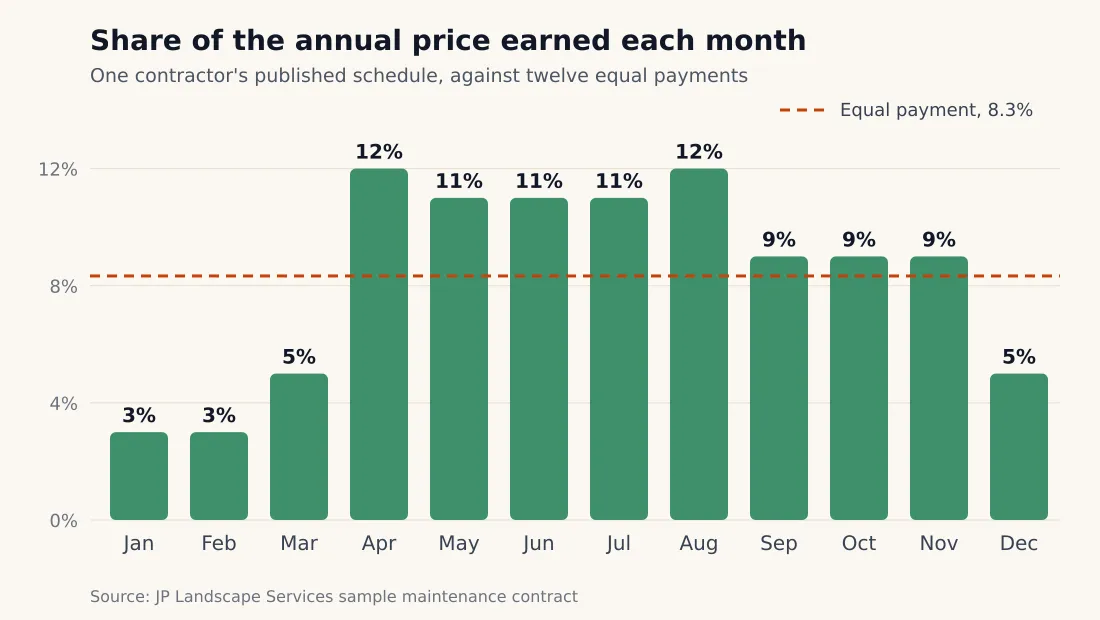
Early cancellation is the reason to think about how a level payment is earned. JP Landscape's contract includes a table of the share of the annual price earned each month, from 3% in January to 12% in April and August. If either side ends the contract early, a final bill settles the gap between payments made and revenue earned, in either direction.
Questions landscapers ask about maintenance contracts
How long should a landscape maintenance contract run?
Twelve months is the usual term. Randall Landscaping says most commercial contracts run 12 months with automatic renewal, and JP Landscape and the CLCA form are both built around a term that renews. A full year lets one level monthly price cover the busy and quiet months.
Should the contract promise visits or results?
Use counts for a small account and standards for a commercial one. Randall Landscaping and BrightView both describe commercial contracts as performance-based, tied to outcomes such as turf height and not to labor hours. A frequency schedule is simpler to price and to prove, so many contractors attach both.
Can you include weed and pest control in the contract?
Yes, if a certified applicator does the work. The EPA says restricted use pesticides require certification under federal law and that many states certify all commercial applicators. List the service on the optional sheet with the targets and the certification number, or name the subcontractor.
What happens to the monthly payment when weather stops work?
The payment stays the same if the contract says so. The CLCA terms give the provider the full monthly payment when work is not fully performed for reasons beyond its control, including storms. Put that sentence in the agreement, and reschedule missed work when conditions allow.
Is a maintenance contract enough for planting or installing a patio?
No, installation needs its own contract. The CLCA form states it is for routine maintenance only and is not to be used for construction. Use a landscaping contract for installs and a lawn care contract for mowing-only accounts.
Get maintenance requests online
A contract starts with a property manager or homeowner asking for a site walk, and that request often arrives while your crew is on a job. Kejoola gives a landscaping business a four-page website with Home, Services, Blog and Contact pages and an online booking form. The form asks for a name, email, phone number and a notes box, so a client can describe the property before you call back. The landscaping website guide shows what to put on each page. For pricing the work before the contract, see the landscaping estimate template.
Sources
- California Landscape Contractors Association: Landscape Maintenance Agreement
- BrightView: Landscape Maintenance Contracts 101
- JP Landscape Services: Landscape Maintenance Contract for Services
- Randall Landscaping: Commercial Landscape Maintenance Contracts Explained
- Plant NOVA Natives: Sample Maintenance Contract
- La Hacienda Nursery and Landscape: Standard Landscape Maintenance Agreement
- EPA: How to Get Certified as a Pesticide Applicator