Landscaping Website: What a Booking-Ready Site Needs
A landscaping website that wins yard work is booking-ready: weekly mow, mulch, seasonal cleanup, and shrub-trim nouns, property address plus gate and dog notes, and Google Website + Booking links that finish the appointment.
Landscaping Website: What a Booking-Ready Site Needs
When a homeowner types “landscaping near me,” they want a crew that can do a weekly mow, mulch refresh, spring or fall cleanup, shrub trim, or sod-install consult — and leave a property address, gate notes, and a time without another “are you free Saturday?” text.
This guide is for US landscapers and landscape maintenance crews building a short, booking-ready landscaping website. It is the shopfront checklist — not a grow-without-phone playbook like Grow your landscaping business without answering the phone, and not a clone of handyman website, cleaning business website, or the broader home service website frame. Pest, moving, and remodel-agency angles stay out.
What booking-ready landscaping website means
For house-call landscaping crews, design is less about hero animations and more about whether the site can finish a yard booking. A booking-ready landscaper website should:
- Look like a real local landscaping business (name, phone, service area), not a chat thread.
- List services a homeowner would actually search — weekly mow, mulch refresh, spring/fall cleanup, shrub trim, leaf removal, sod install consult — not only “landscaping services” or “free estimate.”
- Capture the property address plus access notes (gate, dogs, parking, lot size or yard notes), because the crew has to find the right driveway and know what they are walking into.
- Be honest about visit length and scope so a weekly mow is not scheduled like a full seasonal cleanup.
- Expose the same bookable URL on Google Business Profile as Website and Booking — not Messenger, Instagram, or a shortener.
Without a bookable page, “landscaping website” collapses into a contact form that still ends in phone tag. If your Maps listing still points at Facebook or has no site, see Turn your Google Business listing into a bookable website.
The short site shape that works for landscapers
You do not need a twenty-page brochure to take lawn and yard work. Soft product shape: Kejoola publishes a fixed 4-page site — Home, Services, Blog, and Contact — with online booking for landscaping and other home services. Themes include schema aimed at “your service + your city” visibility.
Use that shape as a checklist of what has to exist, regardless of which tool you use:
| Site piece | Job for the homeowner | Job for the crew |
|---|---|---|
| Home | Prove you are a real local landscaping company | Match name/phone/area to your Google listing |
| Services | Pick weekly mow, mulch, cleanup, shrub trim, sod consult | Map each job to duration and what’s included |
| Blog | Optional trust and “service + city” support | Not required to finish a booking |
| Contact | Phone, crew notes, after-hours path | Backup when booking is closed |
| Booking flow | Pick service + time + leave address and access notes | Calendar, buffers, confirmations |
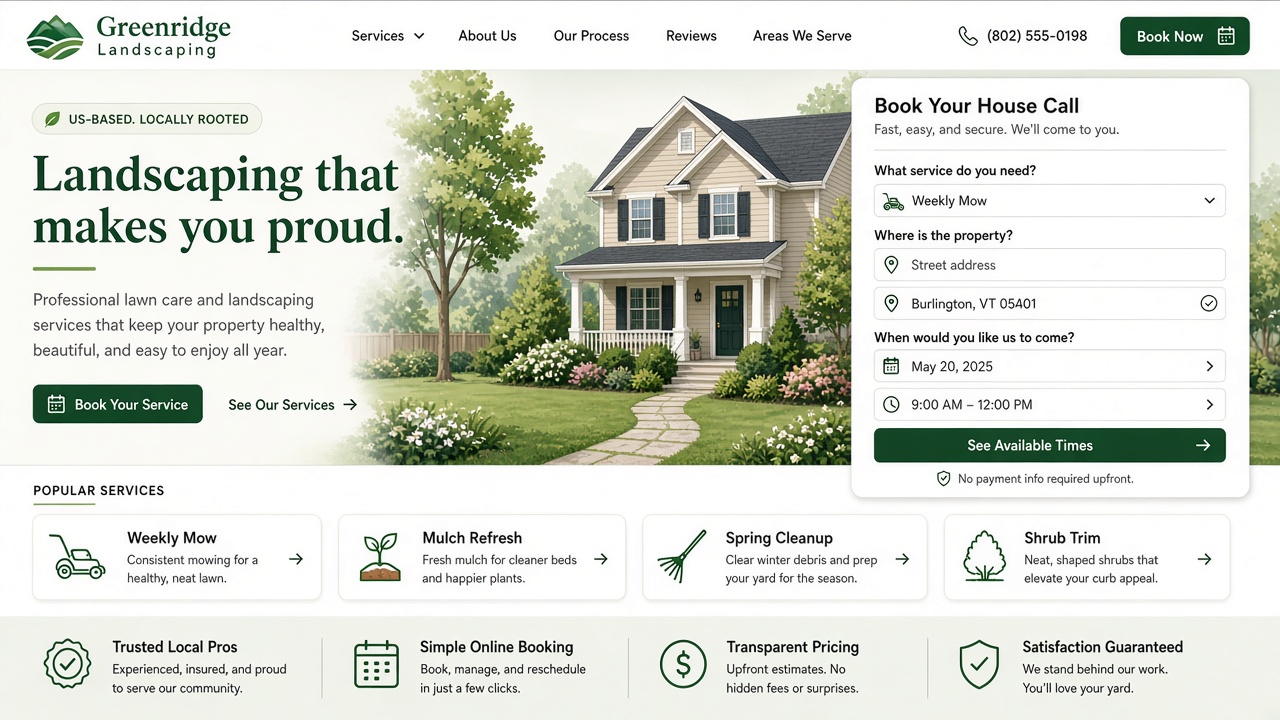
Sample bookable landscaping shopfront (fictional Greenridge Landscaping — illustrative mock, not a live booking site).
Services page: landscaping nouns, not vague “projects”
List jobs the way people search and text: “weekly lawn mow,” “mulch refresh,” “spring cleanup,” “fall cleanup,” “shrub trim,” “leaf removal,” “sod install consult.” Avoid only “landscaping” or “call for quote” as the sole bookable option. Lawn care nouns belong on Services as bookable work — this post does not invent a separate lawn-care URL.
Each service should answer:
- What it is (one plain sentence a homeowner understands — weekly mow vs seasonal cleanup vs consult).
- Rough visit length (a standard mow is not a full leaf-removal day or a sod consult walkthrough).
- Whether it is house-call / on-site only (almost always for mobile landscaping crews).
- What you need before arrival (gate code, dog notes, parking for a trailer, property size or yard notes, whether debris haul-away is in scope).
Clarify frequency early. Recurring weekly or biweekly mows need calendar rules and reminders; one-time mulch refreshes, cleanups, and sod consults need clearer scope and longer slots. See Handyman website and Cleaning business website for the same booking pattern with different nouns. This article stays on landscaping jobs.
House-call booking: property address, gate, dogs, parking, and yard notes
Landscaping is not a Zoom consult. The booking page must collect the service address — street, city, ZIP — plus access and property notes before the slot is confirmed. Phone and name alone cannot route a trailer to the right gate or HOA lot.
Build the flow so the homeowner:
- Chooses the landscaping service (weekly mow, mulch refresh, spring/fall cleanup, shrub trim, leaf removal, sod install consult).
- Sees open times that already include your drive buffers between properties.
- Enters the job address, gate/access notes, dog notes, parking notes, and property size or yard notes.
- Gets a confirmation they can forward to a spouse, landlord, property manager, or HOA contact.
Access honesty, without invented prices: Design Services and booking copy so arrival expectations are clear — locked side gates, dogs that need to be indoors or leashed, tight trailer parking, and “front yard only vs full lot” should not surprise anyone at the curb.
Soft product behavior to aim for: online booking with confirmations and reminders, plus cancel/reschedule that notifies the client — the behavior your stack should deliver, not a ranking claim. For the multi-trade booking frame (not this landscaping deep dive), see Booking website for home services.
Google Website + Booking links
Google says a Business Profile can include links that help customers learn more, and action links that help them book an appointment from Search or Maps.
- Website — your shopfront (homepage that represents this landscaping business).
- Booking — a dedicated URL where they finish the appointment.
Add the Booking URL (Search and Maps)
From Google’s Help (Manage your local business links): on Search, open your Business Profile → Booking → Add link → paste the bookable URL → Save. On Maps, open the profile → Edit profile → transaction type Booking → Add link → paste → Save.
You can set a preferred link when more than one booking link is present. Local business links are not available via the Business Profile API or spreadsheet upload. Follow the link limits your profile UI allows (Google documents up to 10 per category on the manage-links page and up to 20 per transaction type on the policies page).
Rules that block Messenger and shorteners
Google requires a dedicated landing page for the business and a link that completes the designated action. Local business links cannot be social media sites, messaging links, app store links, or link shorteners. The profile must be verified. Google may remove non-compliant or uncrawlable links. (Business links policies & guidelines)
That is why Messenger, Facebook/Instagram profiles, link shorteners, and a homepage with no way to finish a booking fail even when the tap “works” on your phone.
For deeper Website vs Booking fields, see How to add a booking link to Google Business Profile. Make the destination landscaping-ready before you paste it.
Name, categories, and service-area honesty
Google’s representation guidelines ask you to use your real-world business name as customers know it — the same name on trailers, uniforms, and your site — and to choose the fewest categories that describe your core business. Stuffing city names, taglines, or “#1 landscaping” keywords into the Business Profile name is not allowed and can put the listing at risk. (Guidelines for representing your business on Google)
Many landscaping crews visit customers and do not serve walk-ins at a storefront. Google’s Help defines a service-area business as one that visits or delivers to customers directly but does not serve customers at the business address — and lists cleaning services (alongside plumbers) as examples. Landscapers who work the same way fit that pattern. You can set up to 20 service areas by city, postal code, or other area types; you cannot set a radius distance. (Manage your service areas)
If you do not serve customers at your business address, remove the address and keep service areas. Overall boundaries should not exceed about two hours of driving from where the business is based. See Hide your address on Google Business Profile for service-area businesses and Home services marketing.
Soft product path: when a 4-page bookable site fits
If you want a booking-first landscaping website instead of assembling a general site only to host a calendar, start at kejoola.com for a 14-day free trial with no credit card. Soft list prices (monthly USD; annual also available): Lite $24 website-only, Starter $39, Professional $89, Business $159. Import from the listing you already have at kejoola.com/start/google-business — paste your Google Maps or Business Profile link (Share → Copy link) — or go straight to sign-up. This is one option in the category, not a ranked roundup and not a Google partner claim.
Owner checklist
- Home shows a real landscaping company name, phone, and service cities.
- Services lists weekly mow, mulch refresh, spring/fall cleanup, shrub trim, leaf removal, sod install consult — with visit-length and scope notes.
- Booking collects address plus gate, dogs, parking, and property size or yard notes.
- Recurring mows vs one-time cleanups and consults are clear; calendars leave drive buffers between properties.
- Google name/categories match the real-world brand; service areas are honest (house-call landscaping fits the SAB pattern).
- Website and Booking URLs finish the landscaping booking — never Messenger or a shortener.
Put it together
A landscaping website that works in 2026 is booking-ready: landscaping nouns on Services, house-call address and access capture, honest visit length and scope, service-area honesty on Google, and Website + Booking URLs that finish the job — never Messenger. Build the destination first, then wire Search and Maps.