Landscaping Invoice Template: 7 Free Formats to Copy
A landscaping invoice names the property, lists each service and material on its own line, adds tax if your state requires it, and shows a due date. Seven copy-paste formats, plus the email and a past-due reminder.
Josh · Nov 6, 2026 · 14 min read
- landscaping invoice template
- lawn care invoice
- landscaping invoice
- landscaping business
- landscaper billing
A landscaping invoice template is the bill you send after a visit or a job. It names the property, lists each service and material on its own line, adds tax if your state requires it, and shows the balance and due date. The seven templates below cover a per-visit mowing invoice, a monthly maintenance invoice, a seasonal cleanup with haul-away, a planting and mulch job, a final invoice after a deposit, the email that carries it, and a past-due reminder. Copy the one that matches the job and fill in the brackets.
What every landscaping invoice needs
An invoice is the customer's record of the work and your record of the sale. The IRS lists invoices among the supporting documents for your gross receipts, alongside deposit slips and sales slips. Write each one for two readers: the homeowner who pays it, and you at tax time.
| Part | What to write | Example line |
|---|---|---|
| Header | Business name, phone, email, invoice number, date | "INV-1187 · Nov 6" |
| Bill to and property | Customer name, billing address, and the address you worked at | "Property: 22 Alder Ln, back gate" |
| Service lines | Each service with a price or rate, one line each | "Mow, trim and edge, front and back" |
| Materials and haul-away | Plants, mulch, stone, and disposal, with quantity and price | "Hardwood mulch, 4 cu. yd." |
| Totals | Subtotal, tax if due, deposit credit, balance | "Deposit received: [Amount]" |
| Terms | Due date, how to pay, who to call with questions | "Due in 14 days" |
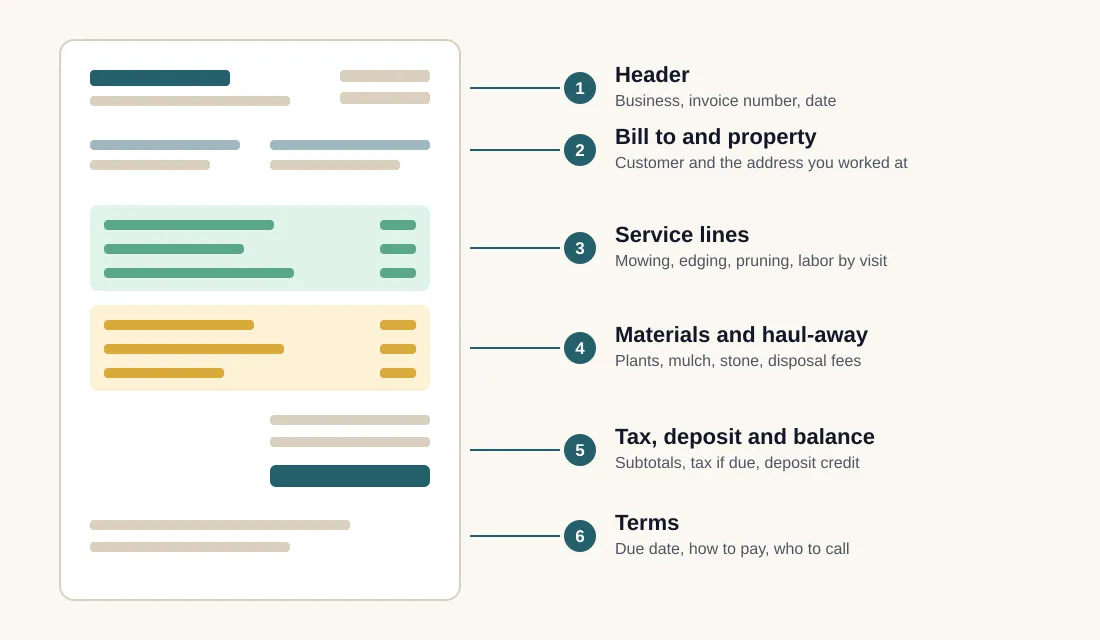
The six parts that belong on every landscaping invoice before it goes out. Diagram only.
Number invoices in order and never reuse a number. "INV-" plus a running count is enough. When a customer asks about a charge in April, the number takes you straight to the visit.
Keep service lines and material lines in separate blocks, as the diagram shows. It reads cleaner for the customer, and in some states it decides which part of the bill is taxed.
Taxes, materials, and how to split the bill
Whether landscaping is taxable depends on your state, and the rules are not intuitive. Texas is a useful example because the state publishes clear guidance. The Texas Comptroller says landscaping and lawn care services are taxable on the total charge. That covers planting, mowing, trimming, edging, pruning, fertilizing, and watering. Landscape design and consulting by a designer are not taxable, but the state tells you to state those charges separately. If you do not, the whole bill is presumed taxable when the taxable portion is more than 5 percent.
The same page draws a line around construction. Decks, retaining walls, fences, pools, and underground sprinkler systems are not landscaping for tax purposes, so the state asks you to keep those charges apart from lawn and plant work. For residential construction, the type of contract matters. Under a lump-sum contract, one price covers labor and materials, and you pay tax on materials when you buy them. Under a separated contract, you charge labor and materials separately and collect tax on materials only.
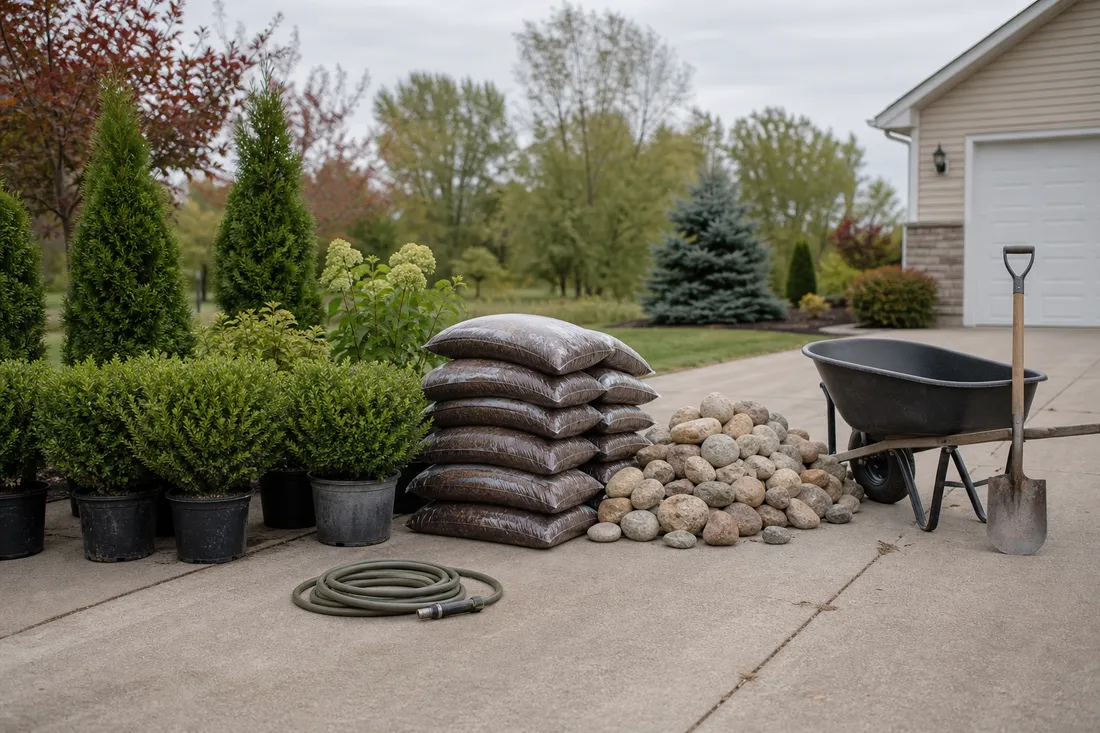
Plants, mulch, and stone are the lines customers question most, so name each one on the invoice.
Two more points from the same page. If you hire a subcontractor for part of the work, you collect tax from your customer on the total charge, including the subcontractor's share. The page also says your invoices or contracts should clearly identify the services you perform, so name each service rather than writing one lump line.
Other states handle this differently. Ask your state revenue department how to set up your lines before you build a template you reuse all season.
Whatever you decide, match the invoice to the estimate. If you quoted a flat price for a cleanup, do not switch to hourly because the job ran long. If the scope grew, write the change and the time the customer approved it. Your landscaping estimate template and the invoice should read like the same document.
When to send each invoice
| Situation | Send when | Channel |
|---|---|---|
| One-time mowing or trim visit | Before you leave, or that evening | Email or printed copy |
| Monthly maintenance | The last day of the month, or the first of the next | |
| Seasonal cleanup | The day the haul-away is done | |
| Planting or mulch job | When the crew finishes and the customer has walked the site | |
| Job with a deposit | Deposit invoice at booking, final invoice at completion | |
| Past due | The day after the due date, then 7 days later | Email first, then a call |
A crisp edge is the proof of work. The invoice should say what produced it.
1. Per-visit lawn maintenance invoice
This is the bill for a single mowing or trim visit, billed by the visit. Fill in the crew times and one line per service, and the customer can see what the price covered.
INVOICE
[Business name] · [Phone] · [Email]
Invoice #: INV-[Number]    Date: [Date]
Due date: [Date or "Due on receipt"]

BILL TO
[Customer name]
[Billing address]

PROPERTY SERVICED
[Address, gate or access notes]

Service date: [Date]
Crew arrived: [Time]   Finished: [Time]

SERVICES
Qty  Description                          Rate     Amount
1    Mow, trim and edge: front and back   [Rate]   [Amount]
1    Blow off walks, drive and patio      [Rate]   [Amount]
1    [Extra, e.g. "Weed front beds"]      [Rate]   [Amount]

NOTES FROM THE VISIT
[e.g. "Gate latch is loose. Brown patch near the
oak, will check again next week."]

Subtotal:                                 [Amount]
Sales tax (if required):                  [Amount]
TOTAL DUE:                                [Amount]

PAYMENT
Accepted: [Cash / check / card / bank transfer]
Checks payable to: [Business name]

Thank you for choosing [Business name].
Three changes make this one work harder:
- Write the clock times. Customers question the price far less when the arrival and finish times are printed on it.
- Use the notes box for one useful observation. A loose gate latch or a dry patch shows you were paying attention.
- List extras as their own lines. "Weed front beds" at its own price is easy to approve again next visit.
2. Monthly maintenance invoice
A recurring client should get one invoice a month that lists every visit. List the dates, so a customer who was out of town can see that the crew came.
INVOICE: MONTHLY MAINTENANCE
[Business name] · [Phone] · [Email]
Invoice #: INV-[Number]    Date: [Date]
Billing period: [Start date] to [End date]
Due date: [Date]

BILL TO
[Customer name]
[Billing address]

PROPERTY SERVICED
[Address]

VISITS THIS PERIOD
[Date]  Mow, trim, edge, blow off
[Date]  Mow, trim, edge, blow off
[Date]  Mow, trim, edge, blow off
[Date]  Mow, trim, edge, blow off

PLAN
[Plan name, e.g. "Weekly mowing, April to October"]
Monthly price per the service agreement:   [Amount]

ADDED THIS PERIOD
[Date]  [Extra work, e.g. "Spring bed weeding"]   [Amount]

Previous balance:                          [Amount]
Subtotal:                                  [Amount]
Sales tax (if required):                   [Amount]
TOTAL DUE:                                 [Amount]

Service agreement dated [Date]. Questions: [Phone].
A few notes on this format:
- Show the plan price and the extras apart. If a customer disputes the bill, it is almost always the extras.
- Include the previous balance even when it is zero. A visible "$0.00" tells a good client they are in good standing.
- Skipped visits for rain should appear as a line with no charge, so the visit count matches the plan.
3. Seasonal cleanup and haul-away invoice
Spring and fall cleanups are priced by the job, with disposal as a separate line. Name what you removed, and mention where it went.
INVOICE: SEASONAL CLEANUP
[Business name] · [Phone] · [Email]
Invoice #: INV-[Number]    Date: [Date]
Due date: [Date]

BILL TO
[Customer name]
[Billing address]

PROPERTY SERVICED
[Address]

Work date: [Date]    Crew size: [Number]    Hours on site: [Hours]

WORK COMPLETED
Qty  Description                          Amount
1    Leaf and debris removal, lawn        [Amount]
1    Bed cleanup and cutting back         [Amount]
1    Prune [shrubs, e.g. "foundation shrubs"]  [Amount]
1    Haul-away and disposal               [Amount]

NOTES
[e.g. "Removed 14 bags of leaves and one dead shrub
by the garage. Hauled to [disposal site]."]

Subtotal:                                  [Amount]
Sales tax (if required):                   [Amount]
TOTAL DUE:                                 [Amount]

Quoted price per estimate #[Number]: [Amount]
Thank you for choosing [Business name].
Make these edits to fit your jobs:
- Put the quoted price at the bottom so the customer can compare it to the total at a glance.
- Count what you hauled in bags, loads, or cubic yards. A number is easier to trust than "debris."
- If your disposal site charges you a fee, you can bill it as a line, as long as the estimate said you would.
4. Planting and mulch installation invoice
Installation jobs mix labor with plants, mulch, and stone. List each plant by name and container size, and each bulk material by quantity.
INVOICE: PLANTING AND MULCH
[Business name] · [Phone] · [Email]
Invoice #: INV-[Number]    Date: [Date]
Due date: [Date]

BILL TO
[Customer name]
[Billing address]

PROPERTY SERVICED
[Address, area worked, e.g. "front foundation bed"]

LABOR
Qty  Description                          Rate     Amount
[X]  Crew hours: bed prep and planting    [Rate]   [Amount]
[X]  Crew hours: mulch and edging         [Rate]   [Amount]

PLANTS
Qty  Description                          Price    Amount
[X]  [Plant name], [container size]       [Price]  [Amount]
[X]  [Plant name], [container size]       [Price]  [Amount]

MATERIALS
Qty  Description                          Price    Amount
[X]  [Mulch type], cubic yards            [Price]  [Amount]
[X]  [Stone or soil], [unit]              [Price]  [Amount]

Subtotal:                                  [Amount]
Sales tax (if required):                   [Amount]
Deposit received on [Date]:               -[Amount]
BALANCE DUE:                               [Amount]

CARE AND REPLACEMENT
[Watering instructions. Replacement terms exactly as
written on the signed estimate.]
Use these tips with it:
- Name each plant with its container size, such as "3 gal." The size explains the price better than a long sentence.
- Keep the care note on the invoice. A customer who knows the watering schedule is less likely to call about a wilting shrub.
- Copy replacement terms word for word from the signed estimate. Do not promise anything new on the invoice.
- If your state taxes materials and labor differently, keep the three blocks apart as shown.
5. Final invoice with a deposit credit
Larger installs, such as a patio, a retaining wall, or a full yard redo, usually start with a deposit. The final invoice credits that deposit and any approved changes.
FINAL INVOICE
[Business name] · [Phone] · [Email]
Invoice #: INV-[Number]    Date: [Date]
Due date: [Date]

BILL TO
[Customer name]
[Billing address]

PROJECT
[Project name and address, e.g. "Back patio and planting"]
Estimate #[Number] signed [Date]

CONTRACT PRICE
Original agreed price:                      [Amount]

APPROVED CHANGES
[Date]  [Change, e.g. "Added second garden bed"]   [Amount]
[Date]  [Change, e.g. "Swapped gravel for pavers"] [Amount]

Revised total:                              [Amount]
Sales tax (if required, per contract type): [Amount]
Deposit received on [Date]:                -[Amount]
Progress payments received:                -[Amount]
BALANCE DUE:                                [Amount]

COMPLETION
Work finished: [Date]    Walkthrough with customer: [Date]

PAYMENT
Accepted: [Check / card / bank transfer]
Some practical points for this format:
- List every change with the date the customer approved it. This is the section that protects you in a dispute.
- Show the walkthrough date. A customer who has walked the site and signed off is paying for a finished job.
- Construction work such as walls and patios can fall under different tax rules from lawn care. Ask your state revenue department how to label that work before you reuse this format.
6. Invoice email to the customer
The email should be short and ready to open on a phone. Put the amount and the due date in the first two lines, and attach the invoice as a PDF.
Subject: Invoice [Number] from [Business name]: [Amount] due [Date]

Hi [First name],

Thanks for having us out at [Address] on [Date]. Your
invoice is attached.

Amount due: [Amount]
Due date: [Date]
Pay by: [Check / card / bank transfer, with details]

The invoice lists each service from the visit. If anything
looks different from what you expected, reply to this email
or call [Phone] and I will sort it out.

Thank you,
[Name]
[Business name]
Two edits are worth making before you send it:
- Mention one detail from the visit, such as "the front bed looks great with the new mulch." It sounds like a person wrote it.
- Keep the subject line the same every time. Customers search their inbox for "invoice" and the business name.
7. Past-due landscaping invoice reminder
Send the first reminder the day after the due date. Stay polite. Most late invoices are forgotten, not disputed.
Subject: Reminder: invoice [Number] was due [Date]

Hi [First name],

A quick reminder that invoice [Number] for [Amount],
for the [service, e.g. "spring cleanup"] at [Address],
was due on [Date].

You can pay by [method and details]. If you already sent
payment, thank you, and please disregard this note.

If something on the invoice looks off, tell me what and
I will fix it right away.

Thanks,
[Name]
[Business name] · [Phone]
Keep these rules in mind with every reminder:
- Mention a late fee only if it was written on the estimate or agreement the customer signed.
- Invite the customer to raise a problem with the work. A slow payer is sometimes a customer with a complaint they have not voiced.
- Keep threats out of writing. Lien and collection rules differ by state, so check yours before you take the next step.
- Send the second reminder a week later, then pick up the phone.
Which invoice to send
| Template | Send when | Channel |
|---|---|---|
| 1. Per-visit maintenance | Same day as the visit | Email or printed |
| 2. Monthly maintenance | End of the billing month | |
| 3. Seasonal cleanup | The day the haul-away is done | |
| 4. Planting and mulch | After the customer walks the site | |
| 5. Final invoice with deposit | At completion, with approved changes | |
| 6. Invoice email | With every emailed invoice | |
| 7. Past-due reminder | Day after due date, then 7 days later | Email, then a call |
Mistakes that slow down landscaping payments
- A total with no service lines. "Lawn care: [Amount]" invites a call. A short list of what the crew did answers the question first.
- Materials with no names. "Plants and mulch" looks padded. "6 boxwoods, 3 gal." and "hardwood mulch, 4 cu. yd." look honest.
- Changing the pricing method mid-job. If you quoted a flat price, invoice a flat price, and write extra work as its own approved line.
- No due date. "Due on receipt" is easy to put off. A real date gets paid.
- Losing the paper trail. The IRS says to keep records for 3 years in most cases, and longer in some situations. Save every invoice, photo, and payment record in one folder per year.
If you are still choosing how to run the office side, look at lawn care software options that handle scheduling and billing. If you are just starting out, how to start a landscaping business covers licenses and insurance first. And once a job is paid and the customer is happy, that is the right moment to ask for a Google review.
Questions landscapers ask about invoices
What should a landscaping invoice include?
Your business name and contact details, an invoice number and date, the customer's name and billing address, and the address you worked at. Then each service on its own line, plants and materials with quantities and prices, tax if your state requires it, any deposit received, the balance due, the due date, and how to pay.
Do landscapers charge sales tax on invoices?
It depends on your state. Texas taxes landscaping and lawn care services on the total charge, but not the labor to repair, remodel, or build residential structures. Other states have their own rules. Confirm with your state revenue department, and keep taxable and nontaxable lines apart on the invoice.
Should I list materials separately on a landscaping invoice?
Yes, in most cases. Customers trust a bill they can check, and separate lines head off "why so much" calls. It can also affect sales tax. In Texas, a separated residential construction bill means tax is collected on materials only. Check your state's rules before you choose a format.
How often should I invoice lawn maintenance clients?
Monthly works for recurring service, and per visit works for one-time jobs. A monthly invoice that lists every visit date keeps your paperwork light and gives the customer a clear record. Seasonal cleanups and installs should be invoiced the day the work is finished.
How long should I keep landscaping invoices?
Keep them for at least 3 years in most cases. The IRS lists longer periods in some situations, such as when you claim a bad debt deduction. Store each invoice with its payment record, organized by year.
Get the next lawn booked
A clear invoice closes out one job. The next step is making the following one easy to book. Kejoola is not an invoicing tool. It gives you a four-page website, with Home, Services, Blog, and Contact pages, and online booking. Get a booking site for your landscaping business with Kejoola. Customers enter their name, email, and phone, and use the notes box to describe the yard, the gate code, or the job they have in mind. For what that site should cover, see what a landscaping website needs.