Lawn Care Estimate: How to Price and Write One in 5 Steps
A lawn care estimate is the price you give a homeowner before work starts, built from the lawn's size, your hourly cost and a profit margin. Five steps: measure the lawn, find your cost per hour, price each service, add profit, and write it up.
Josh · Nov 22, 2026 · 11 min read
- lawn care estimate
- lawn mowing estimate
- how to estimate lawn care jobs
- lawn care pricing
- lawn care quote
- lawn care business
A lawn care estimate is the price you give a homeowner before any work starts, based on the size of the lawn, the hours the job takes, your costs and your profit. To build one, measure the lawn, work out what an hour of your crew costs, price each service, add a margin, and put it in writing. The five steps below follow that order and use one example yard from start to finish, a 7,500 square foot lawn mowed every week. Swap in your own wages, overhead and local prices as you go, because the method matters more than the example figures.
What a lawn care estimate is
An estimate and a quote are close, and homeowners use the words as if they were the same. Jobber's estimate guide draws the line at flexibility. An estimate is a rough but educated guess at the time, work and materials a job needs, which leaves you room if something unexpected turns up. A quote states the total the client will pay.
That difference shapes how you write the document. An estimate should say what it is based on, such as the measured area and the visit schedule, and what would change the price. Jobber's guide to quoting lawn mowing treats the estimate as the first pass you give after a phone call or a walkthrough. The quote comes after the client approves it, with taxes, fees and discounts filled in.
For weekly mowing the two often end up as one page. For a cleanup on an overgrown lot, keep them apart and say plainly that the number is an estimate.
Step 1: Measure the lawn
Every price in the estimate depends on area, so measure before you think about money. Jobber's guide says exact square footage matters most on fertilization and weed control jobs, because the area decides how much product you buy.
You have two ways to measure. For most residential mowing, Jobber says a satellite map is enough, and its free calculator works that way: you trace the lawn on an aerial image and draw the edging lines. Jobber also says those measurements are good for a ballpark and that you should confirm them in person before a final price. For large sites, odd layouts or heavy obstacles, it recommends walking the property.
When you walk it, break the lawn into simple shapes. Clemson Cooperative Extension's factsheet on measuring a home lawn gives the formulas:
- Rectangle: length times width.
- Triangle: half the base times the height.
- Circle: 3.14 times the radius squared.
- Oval: length times width times 0.8.
Add the shapes together. Clemson also suggests sketching each area and writing the square footage on the sketch, because the numbers are easy to forget a few months later.
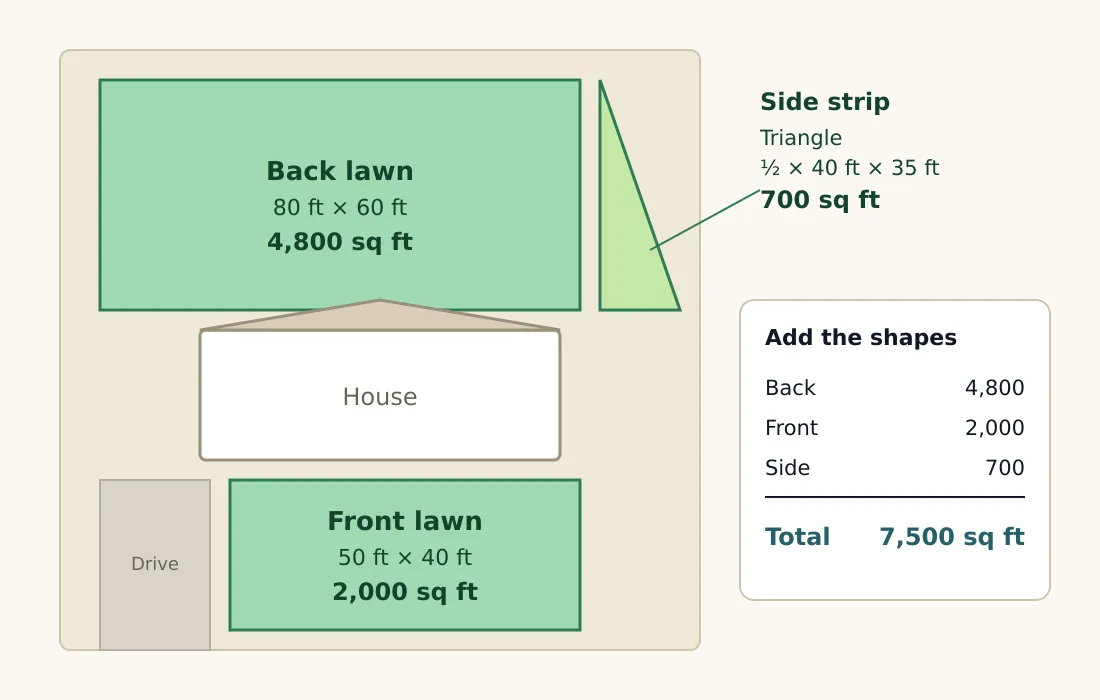
The example yard has three pieces. The back lawn is a rectangle of 80 by 60 feet, which is 4,800 square feet. The front lawn is 50 by 40 feet, or 2,000 square feet. A side strip is a triangle with a 40 foot base and a 35 foot height, which comes to 700 square feet. The total is 7,500 square feet.
While you are on site, note what slows a crew down. Connecteam's estimating advice lists slopes, fences, tight spaces around trees and uneven ground. Jobber adds a tip worth keeping: photograph any area that needs extra work and attach the photo to the estimate, so the client can see why a line is there.
Step 2: Find what an hour of work costs you
An estimate built only on what competitors charge can lose money on every visit. Start with your own cost per hour, which has two parts: labor and overhead.
Jobber gives this formula for labor: job hours times the number of workers, times the hourly wage with an allowance for employee costs such as payroll taxes and workers' compensation. Its example pays $18 an hour and adds 20 percent, which makes each labor hour cost $21.60.
If you have no wage history yet, the Bureau of Labor Statistics is a reasonable anchor. It reports a median hourly wage of $19.27 for grounds maintenance workers in May 2025. The lowest tenth earned less than $15.01 and the highest tenth more than $28.10. With Jobber's 20 percent allowance, a $19.27 wage costs you about $23.12 an hour.
The example yard takes two people 36 minutes. That is 1.2 labor hours, and at $23.12 the labor cost is $27.75 a visit. Use your own timed jobs for the hours. Connecteam recommends tracking actual time on similar lawns, because your records are more accurate than any rule of thumb.
Overhead is everything you pay whether or not a mower runs. Jobber lists vehicle and fuel costs, insurance, taxes, office rent and utilities. Its formula is total monthly overhead divided by billable hours per month. Suppose your overhead is $1,800 a month and your crew bills 150 hours. Each hour carries $12 of overhead, so the 1.2 hour visit carries $14.40.
Add the two parts. The visit costs you $42.15 before any profit. Owner-operators should run the same math with a wage for themselves, or the estimate treats their own time as free.
Travel is the cost most often left out. Jobber advises charging more when you drive farther or haul a riding mower on a trailer. The IRS business mileage rate, 76 cents a mile for July through December 2026, is a useful yardstick for what a vehicle costs to run. A lawn that adds 6 miles to the route adds about $4.56 a visit by that measure.
Step 3: Price each service on the estimate
With a cost per visit in hand, decide how each service is priced on the page. Jobber recommends keeping a pricing chart, a single list of your services with a flat rate and a square foot rate for each. With a chart you are not inventing prices at every property.
The three ways to price a line each fit different work:
- A flat rate per visit suits routine mowing on ordinary lots. The client sees one number and you can quote it over the phone.
- A square foot rate suits work where product scales with area, such as fertilizer, weed control, seeding and aeration.
- An hourly rate suits work you cannot see the end of, such as a first cut on a neglected yard or storm cleanup.
To turn a flat rate into a square foot rate, Jobber's calculator instructions say to divide your rate by the average square footage of the lawns you service. If your usual visit is priced at $53 and your usual lawn is 7,500 square feet, your rate is about $7.07 per 1,000 square feet.
List extra work as separate lines instead of folding it into the mowing price. Jobber's guide names hauling leaves, clearing brush and debris, and client requests for specific products as common extras. It also recommends adding optional lines for services the yard would benefit from, such as preventive weed control. An optional line costs you nothing to write, and the client can accept it later without a second visit.
Frequency changes the price too. Connecteam advises a small discount for recurring service, because regular visits keep growth down and give you steady income. LawnBeast's pricing calculator shows the idea in its default display, with 25 percent off a one-time mowing price for weekly service and 10 percent off for visits every other week.
Step 4: Add profit and check it against local prices
Cost is the floor of the estimate. Jobber calls an operating profit margin of 15 to 20 percent a good goal for a small lawn care business. Connecteam describes a 15 to 20 percent markup for residential work and 10 to 15 percent for commercial.
Margin and markup are different numbers, and mixing them up shrinks your profit. Jobber's example shows the gap. A job that costs $120 and sells for $150 earns $30. That $30 is a 25 percent markup on cost and a 20 percent margin on the price.
To reach a 20 percent margin, divide your cost by 0.8. The example visit costs $42.15, so the price is $52.69, which rounds to $53. Weekly service is four visits in a typical month, so the estimate shows $212 a month.
Now compare that with what homeowners near you already pay. Landscaping Cost Calculator's 2026 averages put a mowing visit at these ranges:
| Lawn size | Mowing price per visit |
|---|---|
| Small, under 3,000 sq ft | $30 to $45 |
| Medium, 5,000 to 8,000 sq ft | $45 to $70 |
| Large, 10,000 to 15,000 sq ft | $75 to $130 |
The $53 example sits inside the medium range. If your number lands above the local range, check your hours and overhead before you cut the margin. If it lands well below, you have room to raise it.
Published prices for extras give you a second check. Lawn Love's pricing page lists leaf removal at $60 to $175 and fertilization at $64 to $175 per application. Jobber's advice is the same for every service: research other lawn care businesses in your area before you set final prices.
Keep overhead and markup out of sight. Jobber says to build both into your service prices instead of showing them as their own lines. The client needs to see what they get and what it costs, not how you arrived at it.
Step 5: Write the estimate and send it
A written estimate turns your math into something a homeowner can say yes to. Jobber's lawn care estimate template lists what the page should carry:
- Your business name, logo and contact details.
- The client's name, address, phone number and email.
- An estimate number for your records.
- Each service with a description and a price.
- Optional lines for added services.
- Anything that is specifically not included.
- How long the estimate is valid.
- Terms, such as a deposit and when payment is due.
- Sales tax and any discount, then the total.
The exclusions line prevents the most arguments. Landscaping Cost Calculator notes that a standard weekly mowing agreement usually covers mowing, edging, line trimming and blowing clippings off paved surfaces. It usually leaves out fertilization, weed control, aeration and leaf removal. Say so on the estimate.
Here is the example yard written up. Copy it and replace the details with your own.
LAWN CARE ESTIMATE                         Estimate no. 1042
[Your business name]                       Date: [date]
[phone]  [email]                           Valid until: [date]

Prepared for: [client name]
Service address: [street, city, state, ZIP]
Measured lawn area: 7,500 sq ft (front, back and side strip)

WEEKLY SERVICE
Mowing, front and back lawn                     per visit
String trimming around beds, fences and trees   included
Edging along walks and driveway                 included
Blowing clippings off paved surfaces            included
Price per visit                                 $53.00
Estimated monthly total (4 visits)              $212.00

OPTIONAL
Fall leaf removal, one visit                    $160.00

NOT INCLUDED
Fertilization, weed control, aeration, bed weeding, haul-away
of branches or debris. Each can be priced on request.

This estimate is based on the measured area and weekly visits
during the growing season. A first cut on grass taller than
[height] is billed at [rate].

Sales tax: [rate, if it applies in your state]
Payment: due [terms]
Accepted by: ______________________  Date: ________
The signature line matters. Jobber points out that a signed quote can serve as the agreement that lets you start the approved work. For recurring clients you may still want the longer form in the lawn care contract template.
Send the estimate the same day you measure, while the homeowner still remembers the conversation. If you hear nothing within a few days, Jobber recommends following up to ask whether the client has questions. When the work is done, the invoice should match the approved price or sit very close to it. The lawn care invoice template covers that step.
Questions about lawn care estimates
How much should I charge to mow a lawn?
Charge your cost per visit plus a margin, then check the result against local prices. Landscaping Cost Calculator's 2026 averages run $30 to $45 for a small lawn, $45 to $70 for a medium lawn and $75 to $130 for a large one. Your own labor, overhead and drive time decide where you should sit inside that range.
Can I give an estimate without visiting the property?
Yes, for most residential mowing. Jobber says a satellite measurement is accurate enough for a ballpark, and that a walkthrough is the better choice for large sites, unusual layouts and jobs with heavy obstacles. Label a remote number as an estimate and confirm it on the first visit.
How much profit should a lawn care estimate include?
Aim for a margin of 15 to 20 percent, which Jobber calls a good goal for a small lawn care business. Add it after labor, materials and overhead, and remember that a 25 percent markup on cost produces a 20 percent margin on the price. Check past jobs with Jobber's formula: revenue minus cost, divided by revenue.
Should the estimate show a price per visit or per month?
Show both when the service repeats. The per-visit price lets the client compare you with other companies, and the monthly total tells them what to expect on the bill. Jobber's method multiplies a weekly visit by four to get the monthly figure.
Get estimate requests from your website
Most estimates start with a homeowner asking for a price while you are on a mower. Kejoola gives a lawn care business a four-page website with Home, Services, Blog and Contact pages and online booking. The booking form asks for a name, email, phone number and a notes box, so a homeowner can describe the yard and the service they want before you call back. You still measure, price and send the estimate yourself with the steps above. The lawn care website guide shows what to put on each page, and the landscaping estimate template has copy-ready forms for larger jobs.
Sources
- Jobber: How to Quote Lawn Mowing
- Jobber: Lawn Care Cost Calculator
- Jobber: Lawn Care Estimate Template
- Connecteam: Lawn Care Cost Calculator
- Clemson Cooperative Extension: Measuring the Area of a Home Lawn
- Bureau of Labor Statistics: Grounds Maintenance Workers
- IRS: Standard Mileage Rates
- Landscaping Cost Calculator: Lawn Care Cost
- Lawn Love: Lawn Care Services and Pricing
- LawnBeast: How Much to Charge Calculator