Lawn Care Invoice Template: 7 Free Formats for Mowing Routes
A lawn care invoice lists the property, every visit date, each service on its own line, tax if your state charges it, and a due date. Seven copy-paste formats cover single cuts, monthly routes, prepaid seasons, treatments, credits, and late notices.
Josh · Nov 19, 2026 · 14 min read
- lawn care invoice template
- lawn care invoice
- lawn mowing invoice
- lawn care business
- lawn service billing
A lawn care invoice template is a reusable bill for mowing and turf work. It names the property, lists every visit date and each service on its own line, adds sales tax where your state charges it, and shows the balance and due date. The seven templates below cover a single cut, a monthly route invoice, a prepaid season plan, a fertilizer and weed treatment, an aeration and overseeding job, a credit for a skipped visit, and a past-due notice. Copy the one that matches how you bill and fill in the brackets.
What a lawn care invoice has to show
Lawn care billing differs from most trade billing in one way: the same small job repeats all season. A plumber bills one repair. You bill the same yard visit after visit. So the invoice has to answer one question quickly: which days were you there, and what did you do each time?
It also has to work as a record. The IRS lists invoices among the documents that support your gross receipts, next to deposit information and receipt books. A stack of numbered invoices is how you show a season's income.
| Part | What to write | Example line |
|---|---|---|
| Header | Business name, phone, email, invoice number, invoice date | "INV-0412 · Jun 30" |
| Customer and property | Who pays, and the yard you serviced | "Property: 118 Birch Ct, corner lot" |
| Visit dates | Every date you serviced the property in the period | "Jun 3, 10, 17, 24" |
| Service lines | One line per service, with the per-visit or flat price | "Mow, trim, edge and blow" |
| Adjustments | Skipped visits, rain delays, extras approved by the customer | "Jun 17 skipped, gate locked" |
| Totals and terms | Subtotal, tax if due, balance, due date, how to pay | "Due in 10 days" |
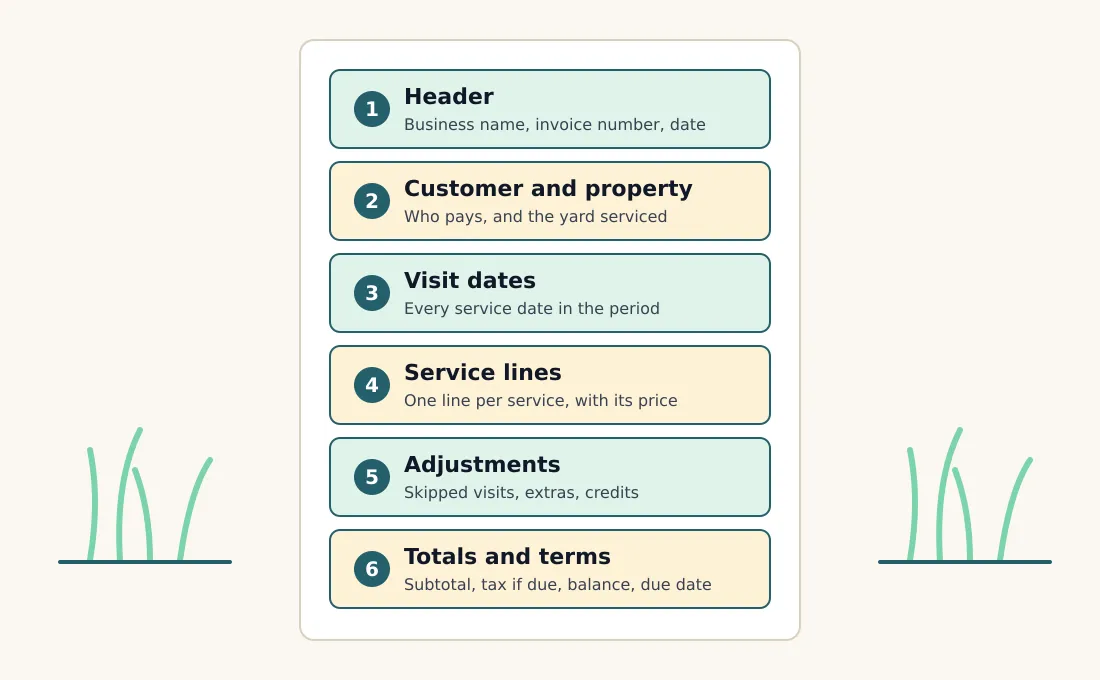
The six blocks of a lawn care invoice. Diagram only.
Two habits keep the season tidy. Number invoices in order and never reuse a number. And write the property address even when it matches the billing address, because rental owners and property managers often pay for a yard they do not live at.
Sales tax on mowing depends on your state
There is no national rule for taxing lawn care. Each state decides, and two large states show how different the answers can be.
Texas treats lawn care as a taxable service. The Texas Comptroller says to collect state and local tax on the total charge for work such as mowing, trimming, and edging grass, and fertilizing or spraying plants. The same page carves out an exception that matters to one-person outfits. Lawn care is not taxable when a self-employed person does the work personally, has no employees or partners providing the service, and had gross receipts of $5,000 or less from it over the most recent four calendar quarters. Once you pass $5,000, you start collecting on the first day of the next quarter.
New York sorts the work by type. Its tax department lists mowing lawns, trimming hedges, and reseeding bare spots as taxable maintenance, and says tax applies to both materials and labor on that kind of job. Planting or installing a new lawn is treated as a capital improvement, and the customer is not charged tax when they give you a completed capital improvement certificate.
So the same invoice could be fully taxed, partly taxed, or untaxed depending on where the yard is. Three practical steps follow from those two pages:
- Ask your state revenue department how it treats mowing, treatments, and new lawn installs before the season starts.
- Keep maintenance lines and installation lines in separate blocks, so each can carry its own tax treatment.
- Name each service. Texas says your invoices or contracts should clearly identify the services you perform.
Every template below has a "Sales tax (if required)" line. Delete it if your state does not tax the service, and keep it if it does.
How often to bill a mowing route
| Billing style | Works best for | Invoice to use |
|---|---|---|
| Per cut | One-time cuts, new customers, vacation coverage | Template 1 |
| Monthly, after service | Weekly or biweekly route customers | Template 2 |
| Prepaid season | Customers who want one price and no monthly bill | Template 3 |
| Per application | Fertilizer and weed control rounds | Template 4 |
| One-time job | Aeration, overseeding, dethatching | Template 5 |
Whichever style you choose, write it into your service agreement so the invoice never surprises anyone. Your lawn care contract should state the visit frequency, the price per visit or per month, and what happens on a rain day. The invoice then repeats those terms instead of inventing them.
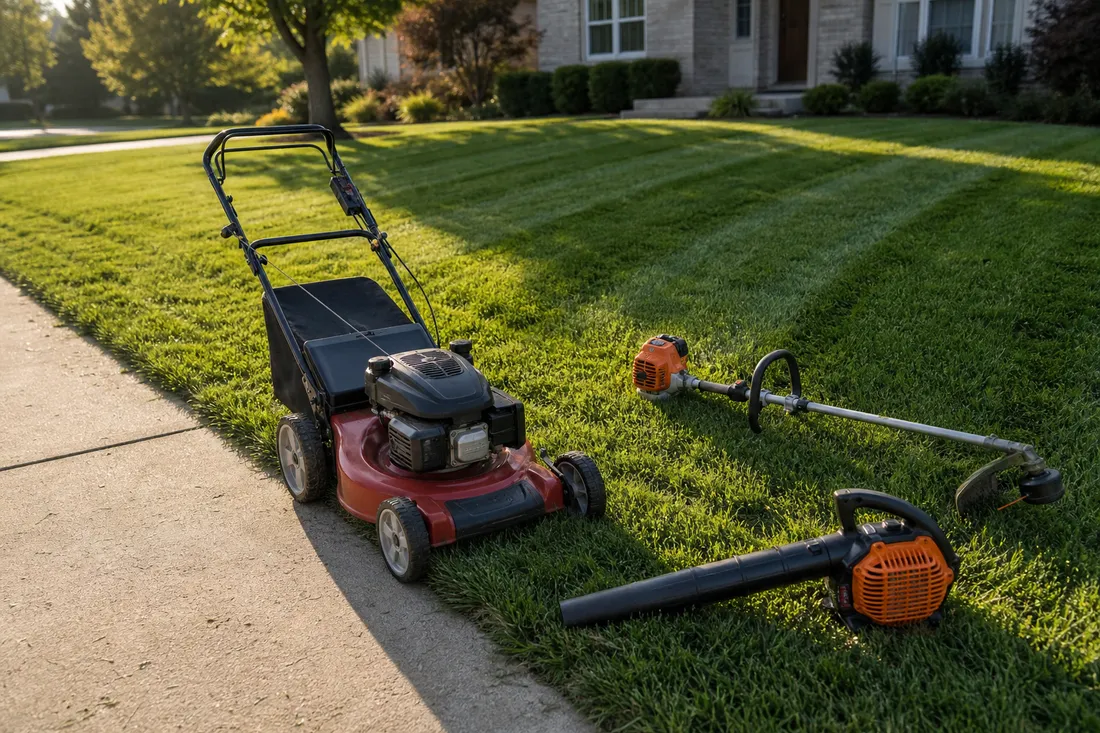
Mow, trim, edge, and blow are four tasks. One invoice line can cover them if it names all four.
1. Single-cut invoice
Use this for a one-time mow, a first visit to an overgrown yard, or a customer you are covering for two weeks. It is short on purpose, so you can finish it at the truck.
INVOICE
[Business name] · [Phone] · [Email]
Invoice #: INV-[Number]        Date: [Date]
Due: [On receipt / Date]

BILL TO                        PROPERTY SERVICED
[Customer name]                [Service address]
[Billing address]              [Gate code or access note]

Service date: [Date]
Lawn condition on arrival: [Normal / Overgrown, about [Height]]

Description                                  Amount
Mow front and back lawn                      [Amount]
String trim fence lines and obstacles        [Included / Amount]
Edge walks and driveway                      [Included / Amount]
Blow clippings off hard surfaces             [Included / Amount]
[Overgrowth charge, double cut and bagging]  [Amount]

Subtotal:                                    [Amount]
Sales tax (if required):                     [Amount]
TOTAL DUE:                                   [Amount]

Pay by: [Cash / check / card / bank transfer]
Questions about this invoice: [Phone]
The overgrowth line is the one to get right. If the grass was knee high and you quoted a normal cut, tell the customer the new price before you start, then show it as its own line. A surcharge they approved in the driveway is easy to pay. One they first see on the invoice is not.
2. Monthly route invoice
This is the main invoice for a mowing business. It bills every visit in the month on one page and lists the dates, so the customer can match it against what they saw from the window.
INVOICE
[Business name] · [Phone] · [Email]
Invoice #: INV-[Number]        Date: [Last day of month]
Billing period: [Month, Year]  Due: [Date]

BILL TO                        PROPERTY SERVICED
[Customer name]                [Service address]
[Billing address]

Service plan: [Weekly / Every other week] mowing
Price per visit: [Amount]

VISITS THIS PERIOD
Date        Service                         Amount
[Date]      Mow, trim, edge, blow           [Amount]
[Date]      Mow, trim, edge, blow           [Amount]
[Date]      Skipped: [Rain / Gate locked]   0.00
[Date]      Mow, trim, edge, blow           [Amount]
[Date]      Mow, trim, edge, blow           [Amount]

EXTRAS APPROVED BY CUSTOMER
[Date]      [e.g. "Trim front hedges"]      [Amount]

Visits completed: [Number]
Subtotal:                                   [Amount]
Sales tax (if required):                    [Amount]
TOTAL DUE:                                  [Amount]

Pay by: [Check / card / bank transfer]
Next billing date: [Date]
Three details do most of the work here:
- Show skipped visits as a zero line. The customer sees you noticed, and nobody has to call about a week you did not come.
- Keep extras in their own block with the date. A hedge trim buried inside the mowing total reads like a price increase.
- Print the next billing date. It tells the customer when to expect the next bill.
Some months have five mowing days and some have four. If you bill per visit, the total moves with the calendar, and listing the dates explains why.
3. Prepaid season plan invoice
Some customers would rather pay one flat amount for the season, or equal installments, than open a bill every month. This invoice sets out what the plan covers and when each payment is due.
INVOICE: SEASON PLAN
[Business name] · [Phone] · [Email]
Invoice #: INV-[Number]        Date: [Date]

BILL TO                        PROPERTY SERVICED
[Customer name]                [Service address]
[Billing address]

Season: [Start date] to [End date]
Planned visits: [Number], [weekly / every other week]

WHAT THE PLAN COVERS
Mow, trim, edge and blow each visit
[Number] fertilizer or weed control rounds   [Included / Not included]
Spring cleanup                               [Included / Not included]
Fall leaf cleanup                            [Included / Not included]

Season price:                                [Amount]
Prepay discount:                             -[Amount]
Sales tax (if required):                     [Amount]
TOTAL FOR SEASON:                            [Amount]

PAYMENT SCHEDULE
[ ] Paid in full by [Date]:                  [Amount]
[ ] Or [Number] installments of [Amount], due on the
    [Day] of each month from [Month] to [Month]

IF THE SEASON RUNS SHORT
Visits missed for weather are made up within [Number]
days. Visits we cannot make up are credited at
[Amount] per visit on the final statement.
The last block protects both sides. A dry August or an early frost can cut the number of visits, and a customer who prepaid will ask what happens to those weeks. Answer on the invoice, before the season starts.
If you offer installments, keep them equal and tie them to a calendar day. Equal amounts are easier for the customer to set up as a recurring payment through their bank.
4. Fertilizer and weed control invoice
Treatment rounds need more detail than a mow, because the customer cannot see what you applied. Name the product, the area treated, and what the household should do afterward.
INVOICE: LAWN TREATMENT
[Business name] · [Phone] · [Email]
Applicator license #: [Number, if your state issues one]
Invoice #: INV-[Number]        Date: [Date]
Due: [Date]

BILL TO                        PROPERTY SERVICED
[Customer name]                [Service address]
[Billing address]

Application date: [Date]       Time: [Time]
Round: [e.g. "2 of 5, late spring"]
Applied by: [Technician name]

Description                                  Amount
[Product name], [granular / liquid]
  Area treated: [Front / back / both],
  about [Number] sq. ft.                     [Amount]
Spot treatment: [Target weed, product]       [Amount]

AFTER THIS VISIT
Follow the product label for watering and re-entry:
[e.g. "Water in within 24 hours" or
"Keep off until dry"]

Subtotal:                                    [Amount]
Sales tax (if required):                     [Amount]
TOTAL DUE:                                   [Amount]

Next round: [Approximate date]
Check your licensing before you sell treatments at all. The EPA says federal law requires certification for anyone who applies restricted use pesticides, and that many states require all commercial applicators to be certified, not only those using restricted products. Your state agency sets the rules, including whether a license number belongs on customer paperwork. If it issues one, print it in the header.
Take the after-care wording from the product label rather than from memory. The label is the instruction the customer should follow, and copying it keeps your invoice consistent with it.
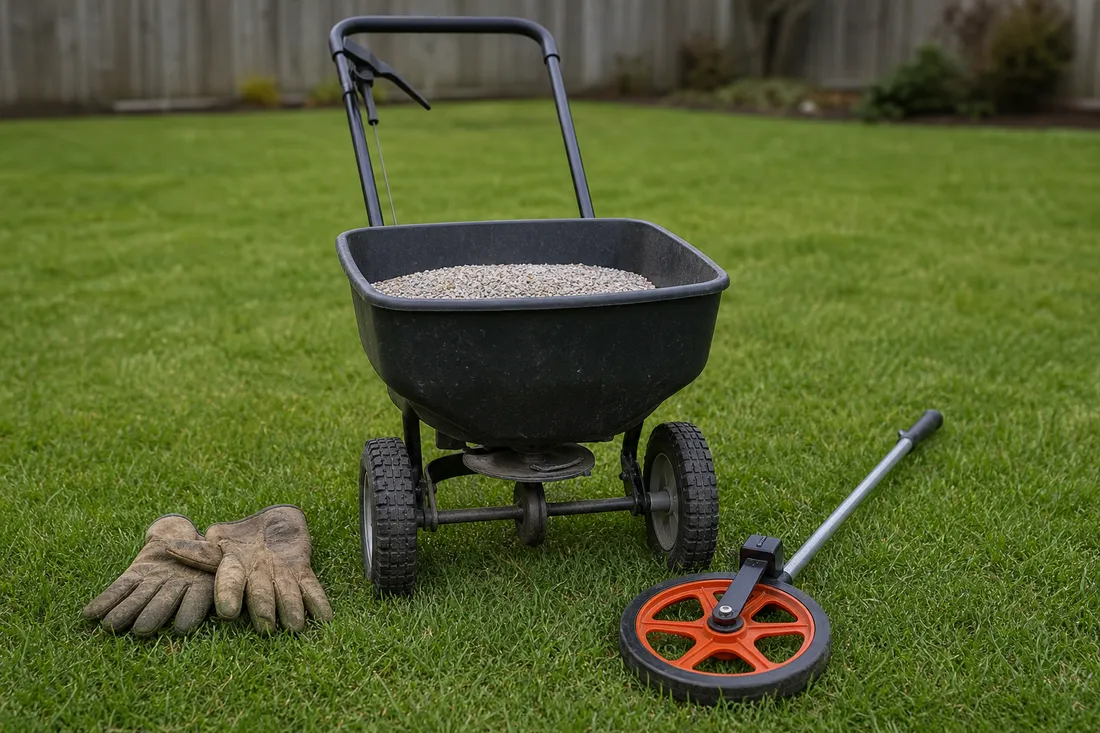
A treatment leaves little to see, so the invoice has to say what went down and where.
5. Aeration and overseeding invoice
Aeration, overseeding, and dethatching are one-time jobs with materials. Bill them apart from the mowing route so the customer does not mistake them for a higher monthly price.
INVOICE
[Business name] · [Phone] · [Email]
Invoice #: INV-[Number]        Date: [Date]
Due: [Date]

BILL TO                        PROPERTY SERVICED
[Customer name]                [Service address]
[Billing address]

Service date: [Date]
Estimate #: [Number, if you sent one]

SERVICES
Description                                  Amount
Core aeration, about [Number] sq. ft.        [Amount]
Overseeding labor                            [Amount]
[Dethatching / topdressing]                  [Amount]

MATERIALS
Qty      Description              Price      Amount
[Qty]    [Seed blend], [lb.]      [Price]    [Amount]
[Qty]    [Starter fertilizer]     [Price]    [Amount]

Subtotal:                                    [Amount]
Sales tax (if required):                     [Amount]
Deposit received:                            -[Amount]
BALANCE DUE:                                 [Amount]

WATERING NOTE
[e.g. "Keep seeded areas moist until the new grass
is established. We skip mowing on [Date]."]
Services and materials sit in separate blocks for a reason. In New York, reseeding bare spots is taxed as maintenance while installing a new lawn is a capital improvement, so how you describe the job can decide whether tax applies. Describe the work accurately and let your state's rule do the rest.
If you sent a quote first, carry the estimate number onto the invoice and keep the same line order. Your estimate and your invoice should read like two versions of one document.
6. Credit for a skipped or redone visit
Sooner or later a visit goes wrong. A gate is locked, a crew misses a strip, or a prepaid week gets rained out. A credit memo records the fix in writing and keeps your invoice numbers clean.
CREDIT MEMO
[Business name] · [Phone] · [Email]
Credit #: CR-[Number]          Date: [Date]
Applies to invoice #: INV-[Number]

CUSTOMER                       PROPERTY
[Customer name]                [Service address]

REASON FOR CREDIT
[e.g. "Visit on [Date] not completed, gate locked."
"Back lawn missed on [Date], returned [Date]."
"Prepaid visit not made up before season end."]

Description                                  Amount
Credit for [visit / partial visit] on [Date] -[Amount]
Sales tax adjustment (if tax was charged):   -[Amount]
TOTAL CREDIT:                                -[Amount]

HOW IT IS APPLIED
[ ] Taken off your next invoice
[ ] Refunded by [Method] on [Date]

New balance on invoice INV-[Number]:         [Amount]
Do not edit the original invoice to fix a mistake. Issue the credit against it and leave both on file. The IRS asks you to keep documents that support the entries in your books, and a paper trail of invoice plus credit explains itself years later.
Send the credit before the customer asks. A missed strip you report yourself costs one visit's price. One the customer has to chase costs more than that in goodwill.
7. Past-due notice
A late lawn payment is often an oversight, because the bills are small and frequent. This notice restates the balance and says what happens to service if it stays unpaid.
Subject: Past due: lawn service invoice INV-[Number]

Hi [Customer name],

Our records show invoice INV-[Number] for lawn
service at [Service address] is past due.

Invoice date:    [Date]
Billing period:  [Month]
Amount due:      [Amount]
Original due:    [Date]

You can pay by [check / card / bank transfer].
[Payment instructions]

If payment has already been sent, thank you, and
please ignore this note.

Under our service agreement, mowing is paused when
a balance is [Number] days past due. Your next
scheduled visit is [Date]. To keep it on the route,
please pay or reply to this email by [Date].

Thank you,
[Your name]
[Business name] · [Phone]
State the pause only if your agreement already includes it, and use the same number of days. A late fee works the same way: charge one only if the customer agreed to it in writing, and check that your state allows it.
Send the first notice by email the day after the due date. If a week passes, call. A short call settles an oversight faster than a third email.
Mistakes that slow down lawn care payments
- No visit dates. "June mowing" with a total invites a call. Four dated lines do not.
- Billing weeks late. Send the monthly invoice on the last service day of the month, while the customer still remembers the cuts.
- Hidden price changes. If the per-visit price goes up, tell the customer before the first visit at the new price, not through the invoice.
- Mowing and one-time jobs on one total. Aeration folded into a mowing bill looks like an error. Give it its own invoice or its own block.
- No property address. Managers with several yards cannot approve a bill that does not say which one.
- Reusing invoice numbers. Two invoices with one number is the fastest way to lose track of a payment.
Questions lawn care owners ask about invoices
What should a lawn care invoice include?
It should include your business details, an invoice number and date, the customer's name, and the property serviced. Add every visit date, each service on its own line, any extras or credits, sales tax if your state charges it, the balance due, the due date, and how to pay.
Should I bill lawn care per cut or monthly?
Monthly is the better fit for route customers, and per cut suits one-time work. A monthly invoice that lists each visit date means one bill instead of four or five, and the customer still sees every cut. Use a single-cut invoice for new customers until they join the route.
Do I charge sales tax on lawn mowing?
It depends on the state. Texas taxes mowing on the total charge, with an exception for a self-employed person working alone with $5,000 or less in receipts over four quarters. New York taxes mowing as maintenance. Ask your own state revenue department before you set up your template.
How do I show a rained-out visit on an invoice?
List it on its date with a zero amount and a short reason. If the customer prepaid for the season, either make the visit up or issue a credit memo against the original invoice. Do not delete the line, because the dates are the record of the season.
How long should I keep lawn care invoices?
Three years covers most situations. The IRS says to keep records for 3 years in the general case, and for 7 years if you claim a bad debt deduction. Store each invoice with its payment record, sorted by year.
Fill next season's route
Invoices close out the visits you have already made. New yards come from people who can find you and ask for a quote without a phone call. Kejoola does not create or send invoices. It gives you a four-page website, with Home, Services, Blog, and Contact pages, and online booking. Set up a booking site for your lawn care business with Kejoola. Customers enter their name, email, and phone, and use the notes box to describe the lot, the gate, or how often they want a cut. For what to put on those pages, see what a lawn care website needs.