How to Start a Lawn Care Business: Gear, Pricing, and First Clients
How to start a lawn care business: set up and insure it, pick a mower and trailer that fit your yards, price each visit by lot size and drive time, and fill one tight route.
Josh · Oct 13, 2026 · 12 min read
- how to start a lawn care business
- lawn care business
- mowing business
- lawn care pricing
- route density
- small business
To start a lawn care business, register and insure it first. Then buy a mower setup that fits the yards you will cut, price every visit by lot size and drive time, and fill one tight route with weekly regulars. A mowing business earns its money in the minutes between driveways, so where your yards sit matters as much as how well you cut them.
The steps fit a solo owner or a two-person crew running a U.S. mowing and maintenance route. If you plan to add installs, hardscape, or spraying, the landscaping startup guide covers those licenses in more depth.
Why route density matters for a lawn care business
A lawn care customer pays for a visit, not for your day. The mow, trim, edge, and blow all happen inside that visit. Everything around it is unpaid: loading the trailer, driving to the next stop, waiting at a light, and hunting for a side gate.
That makes the map your biggest pricing tool. Ten yards on four nearby streets leave most of the day for mowing. The same ten yards spread across a county turn into a day of windshield time, more fuel, and a later finish.
Grass also keeps its own schedule. The University of Maryland Extension advises removing no more than one-third of the grass blade at each mowing, and notes that weekly mowing might not keep up with tall fescue at the peak of spring growth. When rain pushes a route back two days, every lawn on it keeps growing. A tight route lets you catch up in one long afternoon. A scattered one leaves you behind for the rest of the week.
Step 1: Set up the business before the first paid cut
The setup is mostly online and takes a few evenings. Finish it before you hang a single door hanger.
Register the business and get a free EIN
A solo mowing business usually starts as a sole proprietorship or a single-member LLC. The SBA notes that a sole proprietor can be held personally liable for the business's debts, while an LLC protects personal assets like your vehicle, house, and savings in most instances. It also says registering usually costs less than $300, though fees vary by state and structure.
Pick a name a neighbor can repeat after one hearing. The landscaping business name ideas work for mowing outfits too. Then apply for an EIN on the IRS site. The IRS issues it for free and warns about websites that charge for one. Open a business bank account and run every payment, fuel stop, and blade order through it.
Insure the work and the rig
The SBA describes general liability insurance as protection against losses from bodily injury, property damage, and lawsuits. In lawn care, that means a rock from the trimmer through a patio door or a scraped car in the driveway. Ask a licensed agent three questions. Does the policy cover damage from thrown debris? Does your personal auto policy cover a truck towing a trailer for business? Does gear stored in your garage need a home-based business rider?
Keep mowing separate from spraying
Weed control and insect treatments fall under pesticide rules. The EPA says states certify applicators and that many states require all commercial applicators to be certified, not only those using restricted products. Start with mowing, edging, and cleanup. Add weed and feed only after your state agency tells you which license covers it.
Step 2: Choose a mower, trailer, and kit that fit your yards
Buy for the lawns you will cut this season, not for the crew you hope to run later. Walk a few target streets before you shop. Note the narrowest backyard gates, the steep front slopes, and how many lawns are small city lots versus open suburban yards.
Match the mower to gates and lot sizes
| Mower type | Best for | Trade-off |
|---|---|---|
| Commercial push mower | Small lots, tight side gates, fenced backyards | Slow on big lawns and hard on your legs over a full day |
| Mid-size walk-behind | Mixed suburban routes with some gated yards | Needs a trailer and a ramp, and some gates are still too narrow |
| Stand-on or zero-turn | Large open lawns and long straight runs | Highest cost, a heavy trailer load, and often too wide for backyard gates |
Start with one push mower and add a bigger machine once the open lawns justify it. If half your yards have fenced backyards, the push mower stays on the trailer even after you upgrade.
Decide on a trailer
A push mower, trimmer, and blower can ride in a pickup bed with a ramp. A walk-behind or stand-on mower needs a trailer. Before you buy one, check your vehicle's towing rating in the owner's manual and ask your state motor vehicle office how it registers trailers. Look for a rear gate that doubles as a ramp, lockable racks for the trimmer and blower, and room to strap the mower down.
Build the rest of the kit
Add a string trimmer, an edger, a backpack blower, rakes, a flat shovel, tarps, gas cans, and spare trimmer line. Buy a second blade for each mower. The University of Maryland Extension says a good rule of thumb is to sharpen mower blades after about 10 cumulative hours of use. A full route reaches that quickly, so swap blades midweek and sharpen the dull one at night. Safety glasses, hearing protection, gloves, and boots go on the list before the first cut.
Step 3: Price each visit by lot size and drive time
Quote by the visit, and build the price from time. A visit price has to cover the minutes on site, the drive from your last stop, and a share of fuel, blades, insurance, and the slow months.
Measure and time the lawn
Measure the turf area with an online map tool, then walk the property. Note slopes, beds to edge around, trees, play sets, and gates. Time your first two visits from the moment you park to the moment the trailer gate closes. Your weekly price comes from the second visit, because first cuts run long.
Set lot-size tiers
Tiers let you answer a price question on the phone without guessing. There are 43,560 square feet in an acre, so quarter-acre and half-acre lines are easy to convert.
| Lot tier | Approx. lawn area | What usually adds time | How to quote |
|---|---|---|---|
| Small city lot | Under 5,445 sq ft (1/8 acre) | Gated backyard, hand-trim fence lines | Flat weekly price with a minimum per stop |
| Standard suburban | 5,445 to 10,890 sq ft (1/8 to 1/4 acre) | Beds, trees, and long edging runs | Flat weekly price from your timed second visit |
| Large suburban | 10,890 to 21,780 sq ft (1/4 to 1/2 acre) | Slopes, ditches, and wider trim areas | Flat price, checked against your route's hourly target |
| Half acre and up | Over 21,780 sq ft | Bigger mower needed, more fuel per visit | Walk it first, then quote by timed visit |
Set a minimum price per stop. A tiny lawn still costs you the full drive, unload, and load.
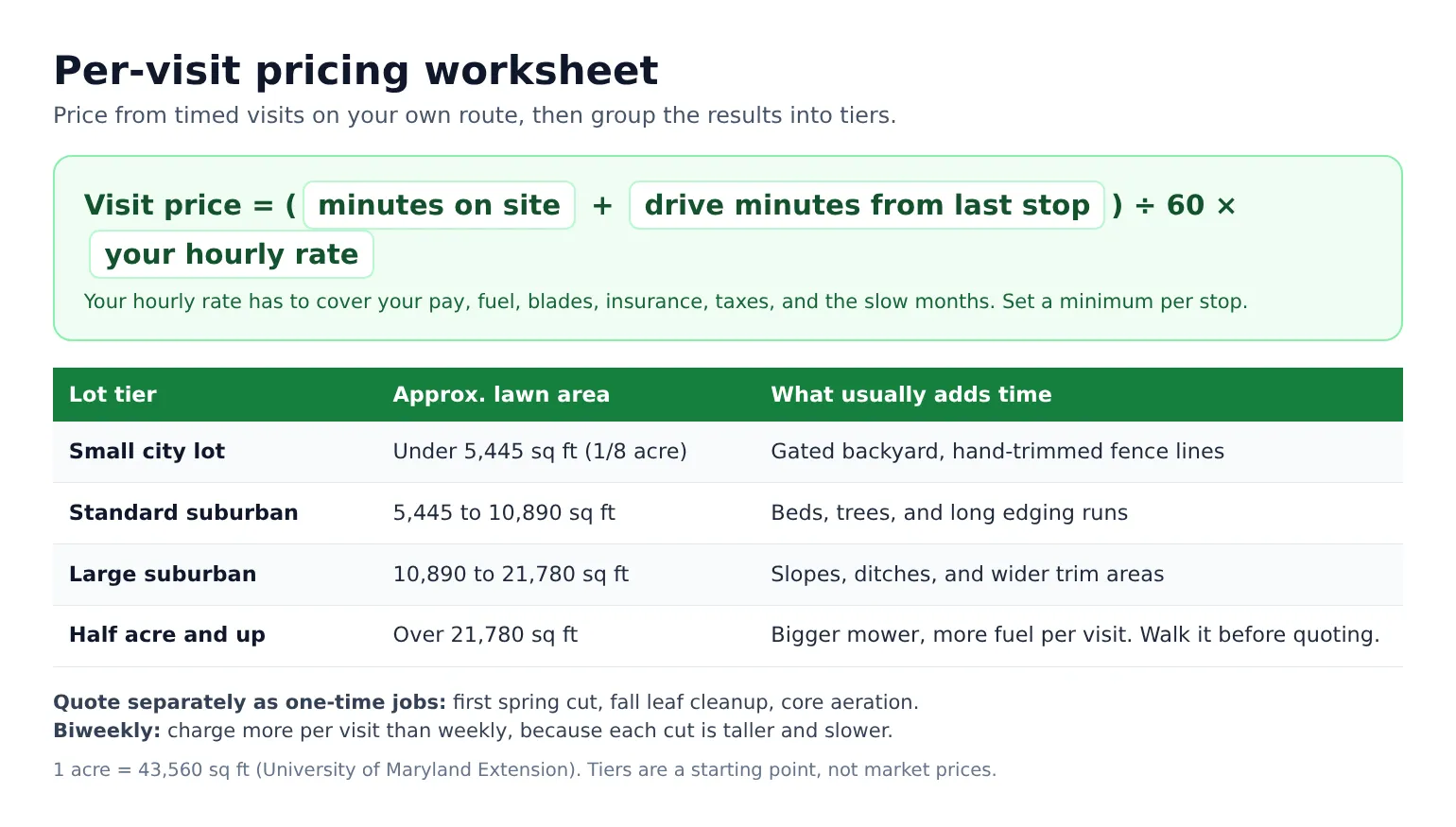
Build each tier from timed visits on your own route. Diagram only.
Price weekly and biweekly visits differently
Weekly service is the default for most lawns in spring. Grass cut every other week grows taller between visits, so each visit takes longer and the one-third rule gets harder to follow. The University of Maryland Extension notes that zoysia grows slower and might only need mowing every one and a half to two weeks. Offer biweekly service only for slow lawns, and charge more per biweekly visit than per weekly one.
Add seasonal extras to the same route
Add-ons raise the value of each stop without new driving. Leaf cleanup, a final fall cut, and core aeration fit lawn care well. The University of Maryland Extension advises aerating while the lawn is actively growing, never during dormancy. For cool-season lawns it suggests autumn, just before overseeding. Rent the aerator at first and book every aeration on one street for the same day. Price the first spring cut and fall leaf cleanups as one-time jobs, because neither looks like a regular weekly visit.
Step 4: Build a route and win your first 20 recurring clients
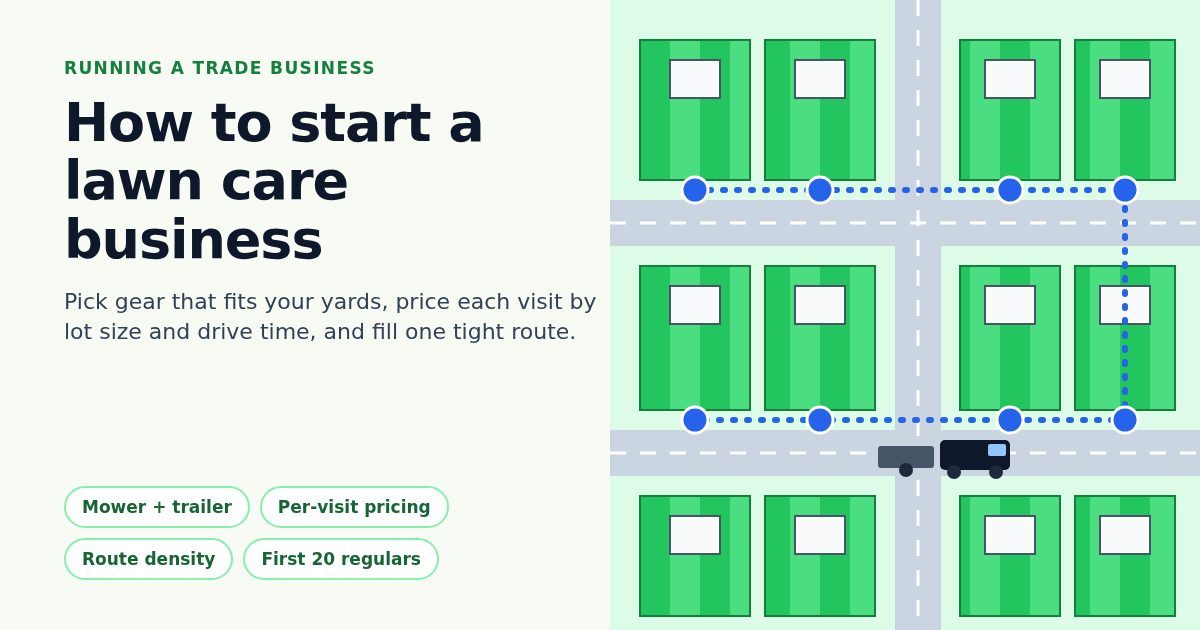
Twenty weekly regulars close together give you a working route. Pick a home zone of a few neighborhoods near where you park the trailer. Then decline or price higher anything outside it.
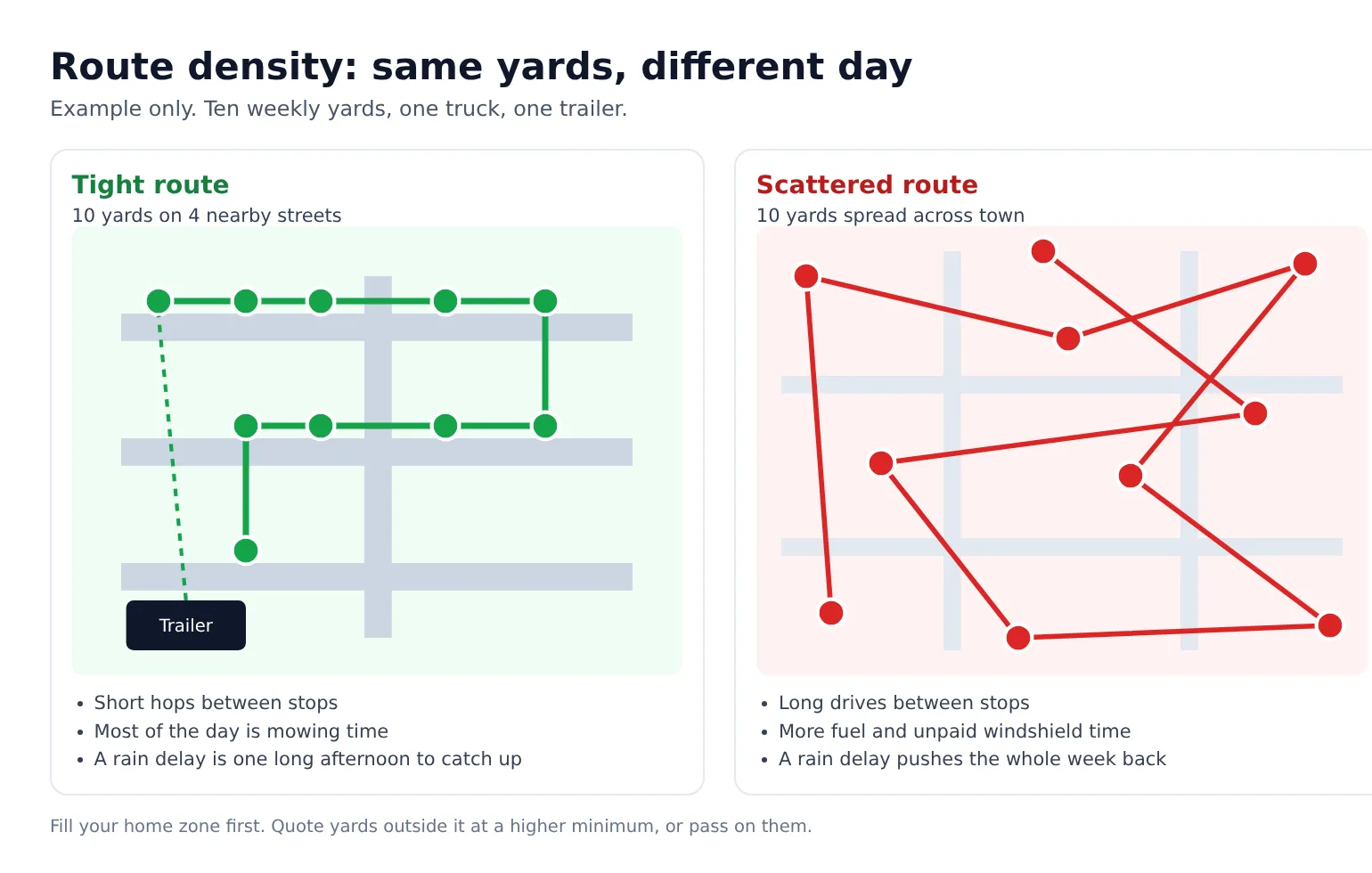
Same number of yards, very different day. Example route only. Diagram only.
Start with the streets you already know
Tell neighbors, friends, and coworkers which streets you cover and which day you will be there. After each first cut, leave a door hanger on the houses on both sides and across the street. Neighbors see the fresh stripes, and the yeses land on your existing route.
Mail one neighborhood at a time
USPS Every Door Direct Mail lets you map ZIP Codes and neighborhoods and send a postcard to every address on the routes you pick. USPS lists EDDM Retail at $0.26 per piece and requires at least 200 pieces per mailing. Pick the routes around your first yards, not the whole city.
Turn one-time cuts into standing slots
Many first calls are for a single overgrown cut. Do it well, then offer a set weekday that matches the route already on that street. Put the details in a one-page agreement: what each visit includes, how often you come, gate and dog notes, the rain policy, and how either side cancels.
Get reviews and a Google profile early
Set up a Google Business Profile as a service-area business with the towns you cover. Ask every new regular for a review after the second visit, once they have seen consistent work. The steps to get Google reviews from happy customers are quick once your review link is saved on your phone.
Once the client list outgrows a notebook, compare a few lawn care software options for routing and invoicing before next spring.
Step 5: Plan the winter before the first frost
Where winters turn cold, mowing stops for months. Plan the off-season while the route is still full.
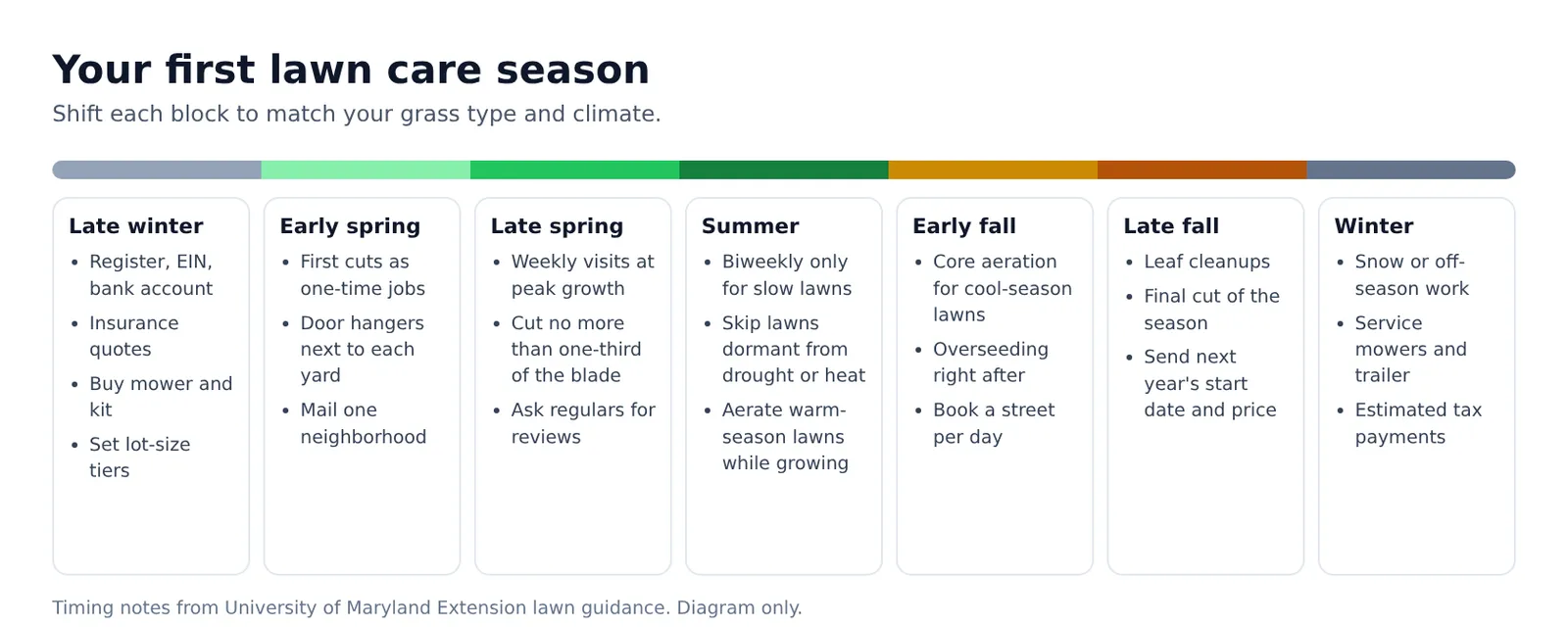
Timing shifts with your grass type and climate. Diagram only.
- Set aside money every summer week. Self-employed owners generally pay estimated tax during the year. The IRS says sole proprietors usually need estimated tax payments if they expect to owe $1,000 or more, and the year has four payment periods.
- Pick an off-season service or a second income. Snow removal, holiday lighting, and gutter cleanouts are common choices. Ask your insurance agent before you plow a single driveway.
- Service the equipment. Change oil, replace belts and blades, and fix the trailer lights while nobody is waiting on a cut.
- Renew the route early. Send every regular next year's start date and price in late winter, so your spring route is set before the first warm week.
Common problems and how to fix them
Rain pushed the whole route back
Shift every customer one day forward instead of squeezing two days into one. Call or message the affected customers that morning. Put the rain policy in your service agreement so nobody is surprised.
Biweekly lawns are too tall to cut cleanly
If a lawn grows past what the one-third rule allows between visits, it needs weekly service in its fast season. Move the customer to weekly in spring and back to biweekly in summer, or raise the biweekly price to cover the slower cut and the double pass.
Your stops are spread across town
Stop taking yards outside your zone, or quote them at a higher minimum. Group customers by weekday and neighborhood, and send new door hangers only to streets you already visit.
Customers ask you to spray weeds
Say no until you are certified, or refer them to a licensed applicator. Pull weeds by hand for now. Contact your state pesticide agency over the winter and ask which exam covers lawn work.
Where a bookable site fits
Once door hangers start working, new customers want a quick way to say yes when you can't pick up the phone. A Kejoola site, for example, is four pages (Home, Services, Blog, Contact) with online booking. New customers can book a first cut, an estimate walk, or a fall cleanup and type the address, gate code, and dog notes in the notes box. Each booking lands in your bookings. For what the site itself should show, read about a lawn care website customers can book from.
Questions owners ask about starting a lawn care business
How much does it cost to start a lawn care business?
It depends mostly on the gear you already own. The SBA says state registration costs less than $300 in most cases, and the IRS issues EINs for free. The rest is your mower, trimmer, blower, a trailer if you need one, insurance, fuel, and door hangers. Price each item with local dealers and agents before you commit.
Do you need a license to start a lawn care business?
Usually you need a local business license, and spraying needs more. Mowing, edging, and cleanup often need only a city or county license. Applying weed killer or fertilizer for pay usually needs state certification, and the EPA notes that many states certify all commercial applicators. Check with your city clerk and state pesticide agency first.
Should lawn customers be weekly or biweekly?
Weekly for most lawns in spring, biweekly only for slow growers. The University of Maryland Extension says weekly mowing may not keep up with tall fescue at peak spring growth, while zoysia might need mowing only every one and a half to two weeks. Price biweekly visits higher, since each cut is longer.
How many lawns can one person mow in a day?
It depends on lot size and route density more than mower speed. Time your first two weeks of visits, including drive time between stops. Divide your working hours by the average visit and drive time on your route. That tells you how many stops a day you can sell, and which streets to fill first.
What do lawn care businesses do in winter?
Many add snow removal, holiday lighting, or gutter work, or take a seasonal job. Use the slow months to service equipment, renew next season's agreements, and keep up with estimated tax payments. Plan the winter budget in summer, while the route still pays every week.
Give new lawn customers a way to book their first cut
If you want a site where customers can see your services and book a time, you can get a site customers can book from with Kejoola. Already have a Google Business listing? Paste your listing link to get a first draft of your site, then finish it with your own services, towns, and photos.
14-day free trial, no card needed. Online booking starts on the Starter plan.
Sources
- Launch your business: structure, registration, and insurance (U.S. Small Business Administration)
- Get an employer identification number (IRS)
- How to get certified as a pesticide applicator (U.S. EPA)
- Maintaining an established lawn (University of Maryland Extension)
- Every Door Direct Mail (USPS)
- Estimated taxes (IRS)