The Ultimate Local SEO Checklist for Service Businesses
A complete, actionable checklist for local service businesses to dominate local search results, from Google Business Profile optimization to advanced schema implementation.
Josh · Mar 24, 2026 · 19 min read

- local seo
- seo checklist
- google business profile
- service business
Why Your Service Business Isn't Showing Up on Google (and How to Fix It)
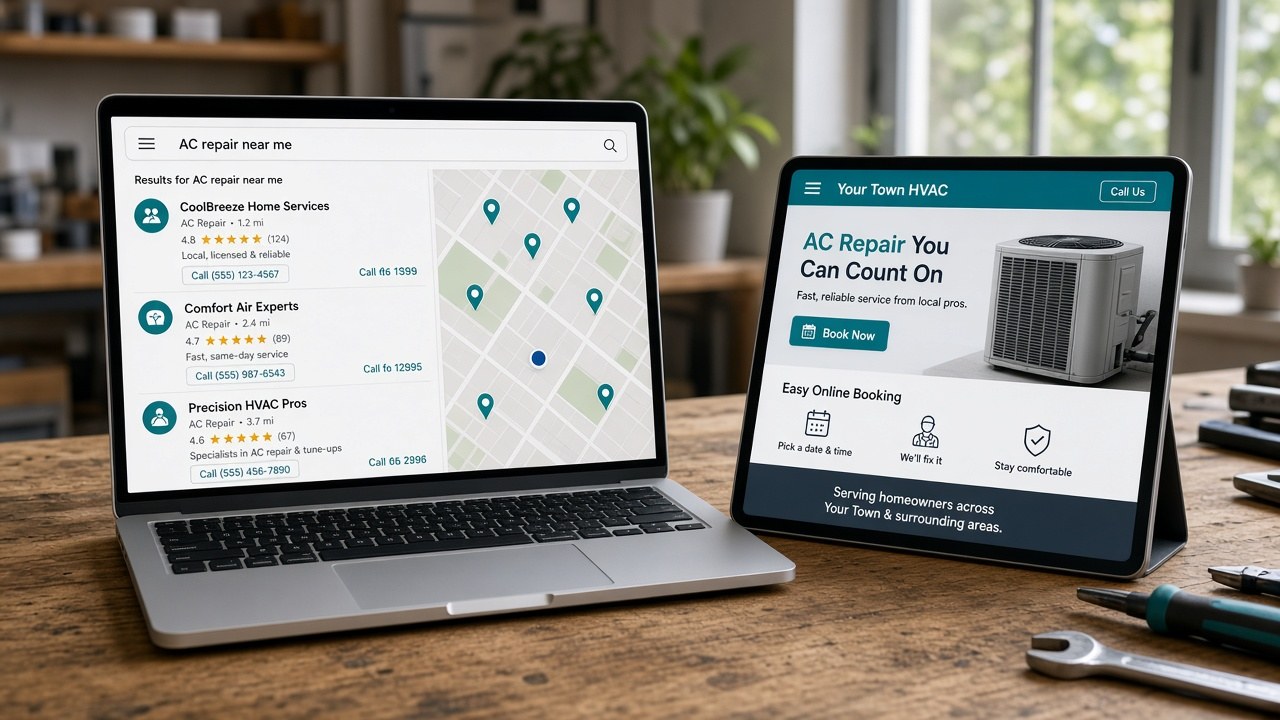
Potential customers aren't flipping through phone books; they are searching online for services "near me." For local service professionals, from pet groomers to home repair experts, being visible in these local search results is the difference between an empty schedule and a fully booked calendar.
Many businesses struggle to appear on Google Maps or in top search results, losing clients to competitors daily. The problem isn’t a lack of demand; it’s a gap in local search engine optimization (SEO). This definitive local SEO checklist is designed specifically for service-based businesses to close that gap.
We will provide an actionable, step-by-step framework to help you dominate your local market, attract more clients, and streamline your operations. To get a comprehensive understanding of what it takes to succeed, explore the 10 best local SEO strategies that can help your service business dominate local search.
Whether you're just starting or looking to improve your existing online presence, these eight steps will change how local customers find and book your services. For businesses using platforms like Kejoola, which are already built with SEO and booking in mind, this checklist will act as a supercharger. It will maximize the built-in advantages to help you achieve top rankings in your service area and keep your calendar full.
1. Optimize Google Business Profile (GBP) with Complete Business Information
Your Google Business Profile is the cornerstone of any effective local SEO checklist. It is often the very first interaction a potential customer has with your brand. Think of it as your digital storefront, prominently displayed in Google Search and on Google Maps. A fully optimized profile establishes immediate credibility and provides customers with the critical information they need to choose and book your services.

For appointment-based businesses, a complete GBP is not just an option; it's essential for visibility and converting searchers into clients. This free tool shows your business name, address, phone number (NAP), hours, and services directly in search results, reducing friction for potential customers. When every field is filled out accurately and thoughtfully, you signal to Google that your business is active, legitimate, and relevant to local queries.
Actionable Optimization Tips
To make your profile a customer-attraction machine, focus on consistency and engagement. A salon using Kejoola, for instance, can integrate its booking link directly into its GBP, allowing clients to schedule an appointment from the search results page.
- NAP Consistency: Ensure your Name, Address, and Phone number are identical across your GBP, your website, and all other online directories. Even a small variation like "St." vs. "Street" can cause confusion for search engines.
- Service Details: Be specific. Instead of just "Haircuts," list "Men's Precision Haircut," "Women's Long-Layer Cut," and "Children's Haircut." This targets more specific keywords.
- Photo Power: Add 5-10 high-quality photos every month. Showcase your workspace, your team in action, and before-and-after shots of your work.
- Review Management: Respond to every review, good or bad, within 24-48 hours. This shows you value customer feedback. Thank positive reviewers and offer to resolve issues for negative ones.
- Weekly Posts: Use the Google Posts feature weekly to announce special offers, highlight a new service, or share booking availability. These posts expire, so consistent activity is key.
2. Build Local Citations and Business Directory Listings
Beyond your Google Business Profile, local citations are crucial digital footprints that validate your business's existence and location. A citation is any online mention of your business's Name, Address, and Phone number (NAP). Search engines like Google crawl the web for these mentions on directories like Yelp, Apple Maps, and industry-specific sites to confirm that your business is legitimate and located where you say it is.

For service businesses, consistent and accurate citations act as trust signals that directly impact local search rankings. Think of each correct listing as a vote of confidence for your business. For example, a cleaning service listed with the same NAP on Thumbtack, Angi, and the local chamber of commerce website reinforces its credibility to Google, boosting its visibility in local search results. This part of your local SEO checklist is about building a strong, consistent online identity.
Actionable Optimization Tips
Building a robust citation profile requires a methodical approach focused on quality and consistency. A key goal is to drive both search engine trust and direct referral traffic from these platforms.
- Prioritize High-Authority Directories: Start with the foundational platforms. Secure and optimize your listings on Google Business Profile, Apple Maps, Yelp, and Bing Places before moving to others.
- Track Everything: Create a simple spreadsheet to monitor your citation efforts. Log the directory name, URL of your listing, login details, and the date you created or updated it. This is vital for maintaining NAP consistency.
- Leverage Industry-Specific Sites: Identify and get listed on directories relevant to your niche. A personal trainer should be on Mindbody and ClassPass, while a pet groomer would benefit from a presence on Rover and Care.com.
- Claim Existing Listings: Before creating new profiles, search for your business name on major directories. You might find auto-generated or old listings that need to be claimed and corrected.
- Maintain NAP Perfection: Ensure your NAP is identical everywhere. Use consistent formatting for your address ("Street" vs. "St.") and phone number. Include your Kejoola website URL in every profile to create valuable backlinks.
- Update Immediately: If your business moves or your phone number changes, updating your citations must be a top priority to avoid confusing search engines and customers.
3. Optimize On-Page Content with Local Keywords
While your Google Business Profile acts as your digital storefront, your website is your digital headquarters. On-page SEO involves strategically placing location-based keywords throughout your site’s content. This practice helps search engines understand your local relevance, connecting you with customers actively searching for your services in your specific area.
For a salon in Brooklyn, this means moving beyond general terms and targeting phrases like "balayage hair in Brooklyn" or "organic hair treatments near Park Slope." This level of specificity is a crucial part of any local SEO checklist because it directly answers a potential client's geographically-focused search query. By signaling to Google that you are the best local answer, you significantly improve your chances of appearing in top search results.
Actionable Optimization Tips
Integrating local keywords requires a natural, user-first approach. Forcing keywords will make your content unreadable and can hurt your rankings. A massage therapist in Denver could use their Kejoola site to create distinct service pages for "deep tissue massage near downtown Denver" and "sports massage in Cherry Creek," each with unique, relevant content.
- Title and Headers: Your page title and H1 header are prime real estate. Make them count by including your primary service and location, such as "Expert Dog Grooming in San Diego | Paws & Whiskers."
- Introduce with Location: Mention your service area within the first paragraph of your homepage and service pages. This immediately confirms your local relevance to both users and search engines.
- Descriptive Alt Text: Use local keywords in your image alt text. Instead of "haircut," write "women's salon haircut in downtown Chicago."
- Service Area Page: Create a dedicated "Service Areas" page on your Kejoola website. Detail the specific neighborhoods, suburbs, or cities you serve to cast a wider, yet targeted, net. For more guidance on keyword placement, you can explore how to add keywords to your website for maximum impact.
- Seasonal Content: Update your blog or service pages with seasonal offers that tie into local events. For example, "Prom Hair & Makeup Specials for Austin High School Students."
4. Create Location-Specific Landing Pages and Service Pages
If your business serves multiple neighborhoods or cities, you can't rely on a single homepage to rank everywhere. Creating dedicated landing pages for each location is a powerful tactic in any local SEO checklist. These pages act as highly-focused hubs that signal to Google your relevance in multiple service areas, moving beyond the physical address on your GBP.
For a service business, these geo-targeted pages are critical for attracting customers searching for your services within a specific town or neighborhood. A cleaning service, for example, can create separate pages for 'House Cleaning in Santa Monica' and 'Maid Service in Beverly Hills.' Each page provides location-relevant content, testimonials, and imagery, creating a better user experience and a much stronger signal for search engines. This strategy allows you to dominate search results across your entire territory, not just in the city where you are based.
Actionable Optimization Tips
The key to successful location pages is unique, valuable content. Avoid simply copying and pasting a template and swapping out the city name. Each page must stand on its own as a useful resource for someone in that specific area.
- Unique Content: Write original content for each page. Mention local landmarks, neighborhood characteristics, or common problems specific to that area (e.g., "post-construction cleaning for new developments in Irvine").
- Local Proof: Add customer testimonials, reviews, and portfolio photos from jobs completed in that specific city or neighborhood. This builds immense trust.
- Hyperlocal Keywords: Optimize each page for "[Service] + [Specific Neighborhood]" and "[Service] + [City]" keyword phrases. Think like a local searcher.
- Varying Hours: If you have different operating hours or team members for certain locations, be sure to include that specific information.
- Strategic Linking: Link from your main service pages to your location pages and vice-versa, but ensure your main navigation remains clean and doesn't overwhelm users with dozens of city links. For a deep dive into this topic, you can learn how to rank for service and city searches even if you're not an SEO expert.
5. Generate and Optimize Local Schema Markup
Schema markup is a form of structured data that acts as a translator between your website's content and search engines. It's code that tells Google, "This string of text is a business name," "this number is a price," and "this is our aggregate customer rating." This clarity helps search engines understand your information precisely, leading to rich, eye-catching search results known as rich snippets that can significantly boost your click-through rate.

For an appointment-based business, this is a game-changer. Imagine a potential client searching for "balayage coloring near me." With proper Service and AggregateOffer schema, your salon could appear with the service name, price, and a star rating directly in the search results. This immediate presentation of key information removes friction and encourages users to click your listing over a competitor's. For service pros using Kejoola, this is simplified, as the platform can automatically generate structured data for your services, pricing, and availability.
Actionable Optimization Tips
Implementing schema doesn't require you to be a coding expert. The key is to be accurate and comprehensive, ensuring the data in your code matches the visible content on your pages. This step is a critical part of a technical local seo checklist that directly impacts how you appear in search.
- Prioritize JSON-LD: Use the JSON-LD format for your schema markup. It's recommended by Google and is easier to implement and manage as it can be placed in the
<head>section of your HTML, separate from the body content. - Implement Key Schema Types: Start with
LocalBusinesson your homepage, including your full NAP and business hours. Then, for each service page, useServiceschema detailing the offering and its price. If you have reviews, addAggregateRating. - Test and Validate: Before publishing, always test your code using Google's Rich Results Test tool. This ensures your markup is error-free and eligible for rich snippet display.
- Synchronize Your Data: The information in your schema markup must exactly match the content visible to users on the page. Any discrepancy can lead to penalties.
- Include Images: Add an image URL within your schema types. This can help your listings appear with a thumbnail in certain search features, making them more visually appealing.
6. Build Local Citations Through Quality Backlinks and Local Partnerships
Beyond standard directory listings, earning backlinks from respected local websites is a powerful way to boost your authority and climb local search rankings. These links act as votes of confidence, telling search engines that your business is a legitimate and trusted part of the community. This step in your local SEO checklist moves beyond simple data entry and into genuine relationship-building.
For service businesses, these partnerships are a two-for-one win. They generate high-quality citations and backlinks that signal local relevance to Google, and they also drive direct referral traffic from people already engaged in the local community. A therapist sponsoring a local mental health awareness event, for instance, earns a valuable link from the event website while also connecting with their target audience.
Actionable Optimization Tips
Focus on creating real-world connections that translate into online authority. For a business using Kejoola, sharing news about a new partnership on your website's blog or news section amplifies the impact and keeps your site content fresh.
- Identify Local Allies: Make a list of chambers of commerce, community blogs, non-profits, and even complementary businesses (e.g., a dog groomer partnering with a local animal rescue).
- Offer Genuine Value: Don't just ask for a link. Offer to sponsor a local 5K race, provide a prize for a charity auction, or write a guest post for a community blog. This creates a reason for them to link to you.
- Join and Participate: Become a member of local business associations and industry groups. Your member profile often includes a link back to your website.
- Engage with Local Media: Offer expert commentary to local news outlets or community publications on topics related to your field. This establishes you as a go-to expert and can result in valuable media mentions.
- Create Link-Worthy Resources: Develop a useful guide, such as "The Best Dog-Friendly Parks in [Your City]," that other local websites will naturally want to share with their readers.
7. Ensure Mobile Optimization and Fast Page Load Speeds
The majority of your potential customers are searching for your services on their phones. With over 75% of local searches happening on mobile devices, having a fast, mobile-friendly website is no longer a bonus; it's a fundamental requirement. Google's mobile-first indexing algorithm means the mobile version of your site is the primary one used for ranking, making its performance critical to your visibility in a local SEO checklist.
A slow, clunky mobile experience creates friction and sends potential clients straight to your competitors. A salon, for example, whose Kejoola website loads in under two seconds on a mobile device and features a clear, one-tap booking button will naturally earn higher rankings and convert more visitors than a rival with a slow, desktop-centric site. The goal is to make it effortless for a customer to find you and book an appointment while on the go.
Actionable Optimization Tips
Speed and usability are the twin pillars of mobile success. Your website must not only look good on a small screen but also function flawlessly and load instantly. For service businesses, this directly translates to more bookings and fewer abandoned carts.
- Prioritize Page Speed: Use Google's PageSpeed Insights to test your site. Aim for your most important pages to load in under 3 seconds on a 4G connection.
- Simplify Navigation: Limit your main mobile menu to 3-4 essential items. Customers should be able to find what they need, like "Services" or "Book Now," without confusion.
- Click-to-Call Functionality: Make all phone numbers on your site clickable. This allows a user searching on their phone to call you with a single tap.
- Optimize Booking Forms: Keep mobile forms short. A cleaning service using a form that requires fewer than five fields can see a significant increase in mobile conversions.
- Large, Tappable Buttons: Ensure all calls-to-action (CTAs), especially your booking button, are large and easy to tap with a thumb.
- Monitor Core Web Vitals: Regularly check your LCP, FID, and CLS scores in Google Search Console. These metrics directly measure user experience and impact your rankings.
8. Generate Authentic Customer Reviews and Manage Reputation
Customer reviews are not just testimonials; they are a powerful local ranking signal and a primary driver of consumer trust. Studies show that a majority of consumers weigh online reviews as heavily as personal recommendations. For a service business, a steady stream of authentic, positive feedback on platforms like Google is a direct line to improved visibility in the local pack and higher booking conversion rates.

Think of a salon with 50 five-star reviews ranking first for "hair salon near me," while competitors with fewer reviews lag behind. This isn't a coincidence. Google's algorithm rewards businesses that demonstrate consistent customer satisfaction. Managing your reputation involves actively soliciting feedback, responding to all reviews professionally, and using that input to improve your services. This creates a positive feedback loop: better service leads to better reviews, which leads to better rankings and more customers.
Actionable Optimization Tips
Your strategy for reviews should be proactive, not passive. Integrating a review request into your post-service follow-up is a critical step in any local SEO checklist. A tutoring service, for instance, could request feedback immediately after a student reports a successful test score, capturing that positive moment to build social proof.
- Timing is Everything: The best time to ask for a review is immediately after the service is completed, when the positive experience is fresh in the client's mind. For a deeper dive into optimal timing, you can learn more about when to ask for reviews.
- Make It Easy: Include direct links to your Google, Yelp, or industry-specific review pages in your follow-up emails or text messages. The fewer clicks required, the higher the conversion rate.
- Respond to Everyone: Acknowledge every single review within 24-48 hours. Thank positive reviewers by name and mention the service they received. Address negative feedback by apologizing for their experience and offering to resolve the issue offline.
- Showcase Your Success: Use a Kejoola website to display your best reviews on your homepage. Incorporating powerful quotes into your service descriptions adds a layer of trust and credibility right where customers make decisions.
- Monitor for Insights: Regularly analyze your review trends. Are customers consistently praising a specific team member or service? Are there recurring complaints? Use this data to make meaningful business improvements.
Local SEO: 8-Point Checklist Comparison
| Strategy | Implementation Complexity 🔄 | Resource Requirements ⚡ | Expected Outcomes 📊 | Ideal Use Cases 💡 | Key Advantages ⭐ |
|---|---|---|---|---|---|
| Optimize Google Business Profile (GBP) with Complete Business Information | Low → initial setup & verification; routine updates | Low → time for photos, posts, review responses; free platform | High → prominent Map Pack placement, higher CTR and trust | Appointment-based local services seeking map visibility | Free, high visibility in Maps/Search, review integration |
| Build Local Citations and Business Directory Listings | Medium → claim and standardize multiple listings | Low–Medium → time to create/manage; some premium fees | Medium → improved local rankings and referral paths | Businesses needing broad directory presence and referral traffic | Builds citation authority; multiple discovery touchpoints |
| Optimize On-Page Content with Local Keywords | Medium → research and rewrite page content regularly | Medium → content creation, SEO tools and time | Medium–High → better local relevance and higher conversion rates | Single-location or niche services targeting local queries | Targets qualified local traffic; complements GBP optimization |
| Create Location-Specific Landing Pages and Service Pages | High → create unique, localized pages; avoid duplication | High → significant content and maintenance effort | High → dominates multi-location searches when done correctly | Multi-location or multi-neighborhood service providers | Captures long-tail local keywords; improves local relevance |
| Generate and Optimize Local Schema Markup | High → technical implementation (JSON-LD) and audits | Medium → developer time or automation tools; periodic audits | Medium–High → rich snippets, higher CTR, better SERP display | Businesses wanting enhanced SERP features (pricing, ratings, availability) | Enables rich results (ratings, pricing), aids search understanding |
| Build Local Citations Through Quality Backlinks & Partnerships | High → outreach and relationship building over time | Medium–High → time, possible sponsorship costs | High (long-term) → improved domain authority and referral traffic | Community-focused businesses building local authority | Earned backlinks, stronger local credibility, networking benefits |
| Ensure Mobile Optimization and Fast Page Load Speeds | Medium–High → responsive design, performance tuning, testing | Medium → developer resources, monitoring tools | High → improved rankings (mobile-first), lower bounce, higher conversions | Businesses with high mobile search/booking volume | Better Core Web Vitals, faster bookings, superior mobile UX |
| Generate Authentic Customer Reviews and Manage Reputation | Low–Medium → set up requests and response workflows | Low–Medium → automation tools and time to respond | High → strong influence on rankings and consumer decisions | Service providers relying on trust and word-of-mouth | Builds trust/social proof, directly boosts local rankings and conversions |
Putting It All Together: Your Path to Local Dominance
You have now worked through the essential components of a powerful local marketing strategy. This local SEO checklist is more than just a series of tasks; it's a repeatable framework for building a commanding presence in your service area. Think of each completed item not as a one-time fix, but as a gear in a larger machine designed to attract, engage, and convert local customers consistently.
From the foundational work of optimizing your Google Business Profile to the nuanced details of schema markup and review generation, every step reinforces the others. A well-managed GBP sends customers to your website, where location-specific content and fast load times create a positive experience, and authentic reviews build the trust needed to secure a booking. This interconnected system is what separates businesses that merely exist online from those that actively dominate their local market.
From Checklist to Consistent Action
The true power of this guide lies in its application over time. Local SEO is not a "set it and forget it" activity. It's a discipline. Your market, your competitors, and even Google's algorithms are in a constant state of flux. What makes you the top choice today requires maintenance to keep you there tomorrow.
To turn this initial effort into sustained growth, commit to a simple review cycle. Set a quarterly reminder to audit your progress against this checklist:
- Revisit Your GBP: Are your hours, services, and photos current? Have you responded to all new reviews and Q&As?
- Audit Your NAP: Run a quick check for any new, inconsistent citations that may have appeared.
- Update Your Content: Can you add a new project gallery, a case study, or a blog post about a recent job?
- Request New Reviews: Keep the flow of fresh, positive feedback coming by integrating review requests into your post-service follow-up.
This proactive approach ensures your digital storefront remains as polished and professional as the service you provide. Mastering these steps puts the control of your lead flow directly into your hands, creating a predictable pipeline of local appointments. For a comprehensive overview covering all the essential steps for local visibility, refer to this complete local SEO checklist which provides another great perspective on structuring your efforts.
The Real-World Impact of Local Mastery
Ultimately, every item on this local SEO checklist serves a single purpose: to make your business the obvious choice for customers in your area. When someone searches for "plumber near me" or "landscaping services in [Your Town]," your business should not only appear but also present itself as the most credible, professional, and trustworthy option.
This is achieved by sending clear, consistent signals to both search engines and potential clients. Your meticulous attention to detail in your business listings, the helpful content on your service pages, and the glowing reviews from past customers all work in concert to build that authority. For solo providers and small service businesses, this is the key to competing with larger companies, often without the need for a massive advertising budget. It's about being smarter, more focused, and more connected to your local community.
Ready to implement this checklist without the technical headaches? Kejoola builds booking-ready websites for service pros that automatically handle many of these critical SEO tasks. With built-in schema, blazing-fast speeds, and seamless booking integration, you can focus on your customers while your website works to attract them.