Handyman Invoice: 7 Free Templates for Repairs and Punch Lists
A handyman invoice lists each task in plain words, keeps labor, materials and the trip fee on separate lines, subtracts any deposit, and ends with a balance and a calendar due date. Seven templates to copy for a small repair, a punch list, hourly work, an install, a deposit job, a monthly statement and a past-due reminder.
Josh · Nov 14, 2026 · 16 min read
- handyman invoice
- handyman invoice template
- handyman billing
- punch list invoice
- handyman business
- repair invoice
A handyman invoice is a one-page bill that names each task you finished, lists labor, materials and any trip fee on separate lines, and ends with the balance due and a due date. The seven templates below cover a small repair call, a punch-list visit, hourly work, an install, a deposit job with a change order, a monthly statement for a repeat client, and the email and reminder that go with them. Copy one into a document or spreadsheet, replace the brackets with your own numbers, and send it.
Write it before you pull out of the driveway. The customer still remembers the sticking door and the dripping faucet, and so do you.
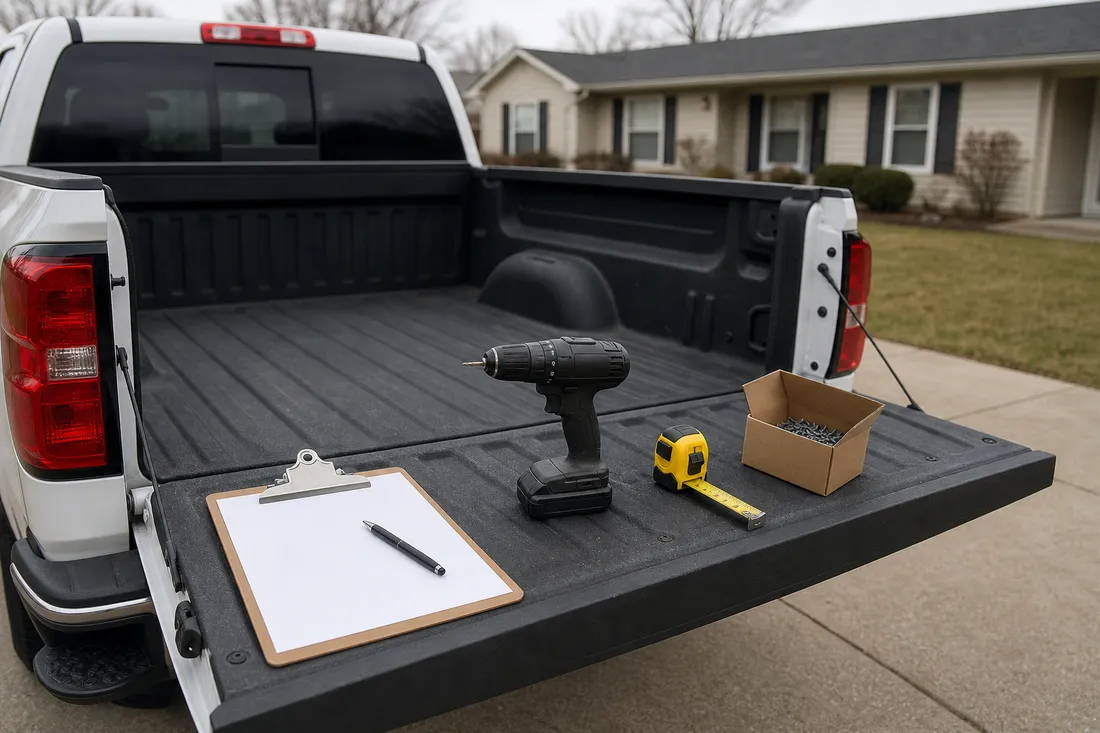
The tailgate is a fine desk. Write the invoice while the parts receipts are still in your pocket.
What every handyman invoice needs
An invoice is the customer's record of the visit and your record of the sale. The IRS lists invoices among the supporting documents that back up the entries in your books and on your tax return. Write each one for two readers: the customer who pays it and you at tax time.
eForms calls a handyman invoice both a formal record of work and a request for payment. Beyond contact details and a date, it asks for an inventory of the tasks completed with the time spent on each, an itemized cost for each task, and the due date with any late penalty. Legal Templates adds a unique invoice number, so you can pull the right bill when a customer calls with a question. Jobber's list goes further: the job site address when it differs from the billing address, payments already received, and your license or registration number if your state requires one.
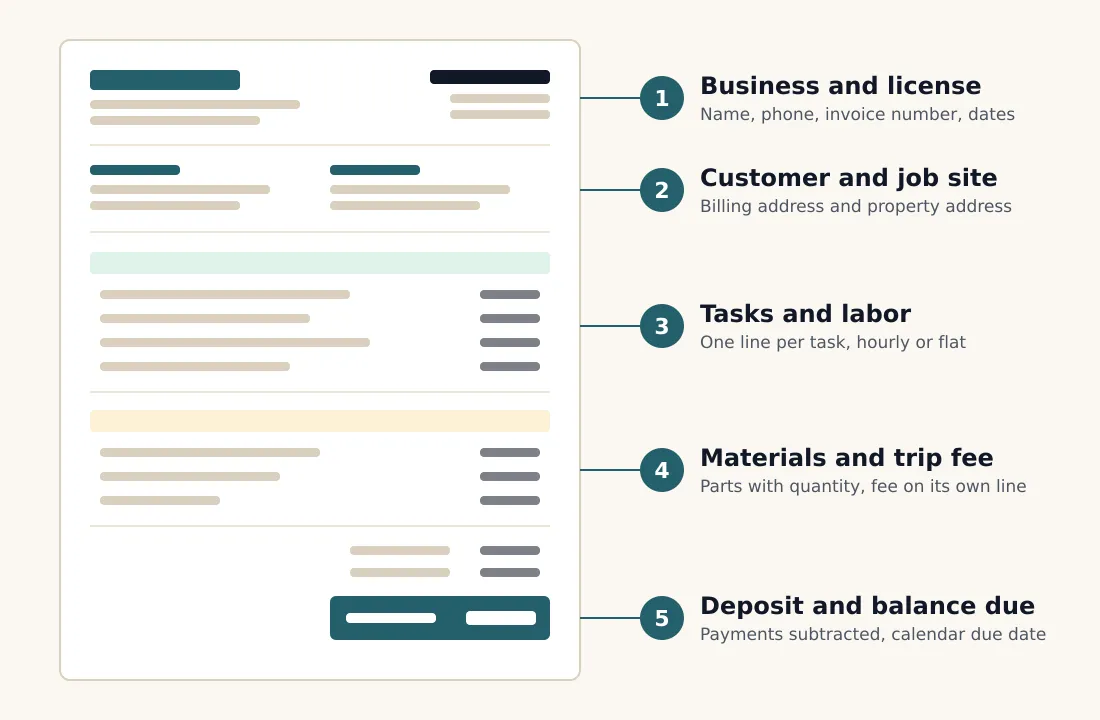
Put together, a complete handyman invoice has these parts:
- Your business. Name, phone, email, and your license or registration number if your state issues one.
- Invoice number and dates. A unique number, the date issued and a calendar due date.
- Customer and job site. Billing name and address, plus the property address if it differs.
- Tasks. One line per task, described the way the customer would describe it.
- Labor. Hours and rate for open-ended work, or a flat price for a set task.
- Materials. Each part with its quantity and price.
- Trip fee or minimum charge. On its own line, never buried in the labor.
- Payments. Any deposit or earlier payment subtracted before the balance due.
- Terms. Accepted payment methods, the due date, and any late fee.
Hourly, flat rate and trip fees: how to write the lines
Handyman work mixes pricing styles in a single visit. You might charge a flat price to swap a faucet, bill by the hour to chase down a ceiling stain, and add a trip fee on top. Jobber's advice is to put hourly work and flat-rate tasks on separate lines. Show the hours and your rate for the open-ended repair, and give the set-price task a line of its own.
Give the trip fee or minimum charge its own line too. Jobber's reasoning is that a separate line shows the customer what they are paying for your drive time and setup. A fee folded into the first task makes that task look overpriced.
List materials apart from labor. Jobber puts it this way: clients can see what they paid for parts and what they paid for your skill. Write each part with its quantity and unit cost. If you add a markup, apply it the same way on every invoice.
Describe each task in plain words. Jobber's example is "Patched hallway drywall hole" in place of "Drywall work." The first version tells the customer what you fixed and where. The second one starts a phone call.
Some jobs carry costs that are neither labor nor parts. ShiftFlow's handyman template has lines for service-call fees, travel and disposal. If you hauled away an old vanity or a broken door, bill the dump run on a line the customer can see.
License limits, sales tax and old paint: check your state
Four rules change by state or by the age of the house, and a template cannot settle them for you.
License limits. Your state may cap the size of job you can take without a contractor's license, and the invoice total is where that limit shows up. California is one example. Its contractor board says a law effective January 1, 2025 lets an unlicensed person complete projects up to $1,000 if they hire no workers and no building permit is needed. The board says the $1,000 includes labor, materials and all other costs on the project. If your state sets a limit like this, do not split one project across several invoices to stay under it. Check your own board's figure before you bill.
Sales tax. eForms notes that taxes vary with the jurisdiction and that standard practice is to account for them separately, even when you quote a flat rate. Texas is one example of how detailed the rules get. The Texas Comptroller says labor to repair, remodel or restore residential real property is not taxable, while the total charge on nonresidential repair or remodeling is taxable. It also separates lump-sum contracts, where you pay tax on your supplies when you buy them, from separated contracts, where you collect tax on the materials. Ask your state revenue department how to set yours up.
Old paint. The EPA's Renovation, Repair and Painting rule covers paid work that disturbs paint in housing and child-occupied facilities built before 1978. The agency says this includes all firms, even sole proprietorships. It exempts minor repair and maintenance that disturbs six square feet or less of paint per room inside, or 20 square feet or less outside. If your work on older homes goes past those limits and you hold a firm certification, put the number in the invoice header next to your license.
Deposits. Some states cap them. California's board says a down payment on a home improvement job cannot be more than $1,000 or 10 percent of the contract price, whichever is less. Check your own state's limit before you use template 5.
When to send each handyman invoice
| Situation | Send when | Channel |
|---|---|---|
| Small repair call | Before you leave the driveway | Email from your phone or a printed copy |
| Punch-list visit | Same day, one invoice for the whole visit | |
| Hourly work over several days | When the work is finished | |
| Project with a deposit | Deposit invoice at booking, final at completion | |
| Phased project | At the end of each phase | |
| Repeat client or property manager | End of the billing period | Email to whoever pays the bills |
| Past due | The day after the due date, then 7 days later | Email first, then a call |
Jobber's advice is to send the invoice within 48 hours, while the client still remembers the work. Legal Templates suggests handing it over in person when you can, so you can answer questions on the spot. If that is awkward in someone's kitchen, walk them through it on your phone and email it right away.
1. Small repair call invoice
Use this for a single flat-rate fix with a trip fee. It is the invoice you will send most often, so keep it short enough to fill in on your phone.
INVOICE
[Business name] · [Phone] · [Email]
License / registration #: [Number, if your state requires one]
Invoice #: [Number]    Date issued: [Date]
Due date: [Calendar date]

BILL TO
[Customer name]
[Billing address]

JOB SITE
[Property address, if different]
Completed: [Date]

WORK COMPLETED
Description                                   Amount
Trip fee                                      [Amount]
Replaced kitchen faucet cartridge, flat rate  [Amount]
Tested for leaks, cleaned work area           Included

MATERIALS
Qty  Item                         Unit     Amount
[1]  Faucet cartridge, [brand]    [Price]  [Amount]
[1]  Plumber's grease, O-rings    [Price]  [Amount]

Subtotal:                                  [Amount]
Sales tax (if required):                   [Amount]
TOTAL DUE:                                 [Amount]

PAYMENT
Accepted: [Check / bank transfer / card]
Payable to: [Business name]

Thank you for calling. If the drip comes back, call me.
The "Included" line costs you nothing, and customers notice that you tested the fix and wiped down the counter.
2. Punch-list invoice
A punch list is several small tasks in one visit. Jobber's advice is to combine them into one invoice with a line per task, so the client pays once for the whole visit. Charge the trip fee once at the top.
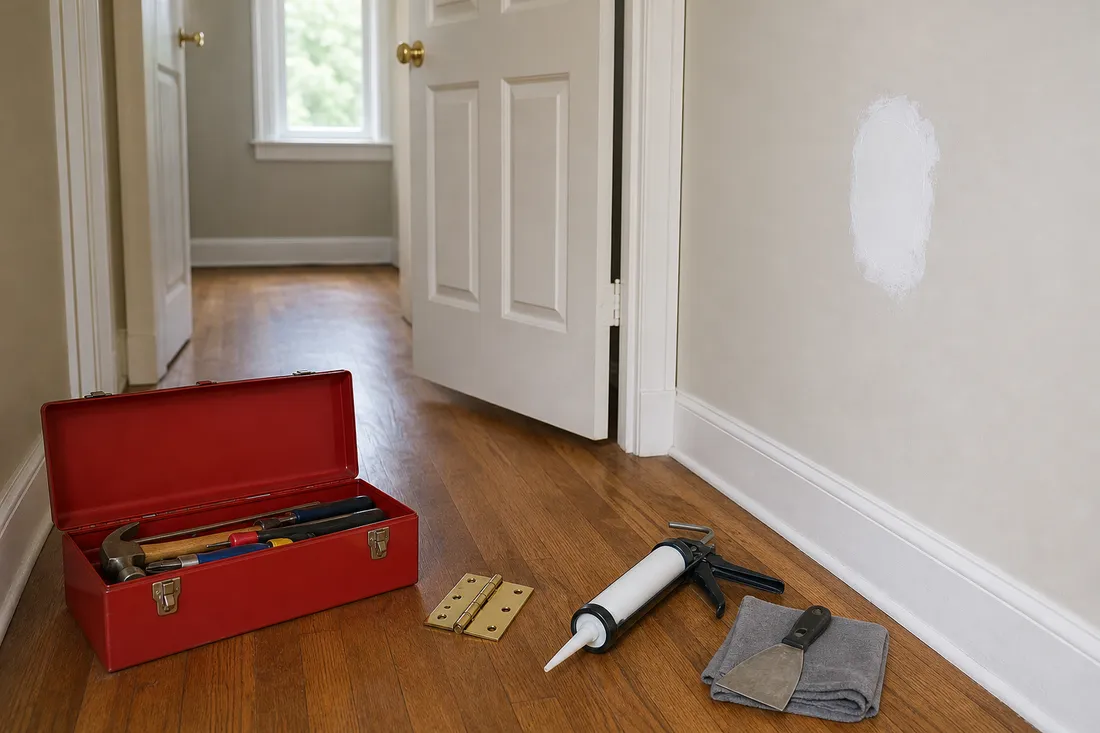
A hinge, a bead of caulk and a wall patch can share one visit and one invoice, as long as each gets its own line.
INVOICE
[Business name] · [Phone] · [Email]
License / registration #: [Number, if required]
Invoice #: [Number]    Date issued: [Date]
Due date: [Calendar date]

BILL TO
[Customer name]
[Billing address]

JOB SITE
[Property address]
Visit date: [Date]

PUNCH LIST
#  Task                                       Type    Amount
   Trip fee (one visit)                       Flat    [Amount]
1  Rehung hall closet door, replaced hinge    Flat    [Amount]
2  Patched hallway drywall hole, primed       Flat    [Amount]
3  Re-caulked tub surround, upstairs bath     Flat    [Amount]
4  Mounted TV on living room wall             Flat    [Amount]
5  Replaced two smoke alarm batteries         Flat    [Amount]
6  Adjusted sticking back door, planed edge   [X] hr  [Amount]

MATERIALS
Qty  Item                            Unit     Amount
[1]  Door hinge, 3.5 in              [Price]  [Amount]
[1]  Drywall patch kit, primer       [Price]  [Amount]
[1]  Tub and tile caulk              [Price]  [Amount]
[1]  TV wall mount (if supplied)     [Price]  [Amount]
[2]  9V batteries                    [Price]  [Amount]

NOT COMPLETED TODAY
[Task]: [Reason, such as part on order]. Return visit: [Date]

Subtotal:                                    [Amount]
Sales tax (if required):                     [Amount]
TOTAL DUE:                                   [Amount]

PAYMENT
Accepted: [Check / bank transfer / card]
Payable to: [Business name]
Keep the "Not completed today" block. It sets up the return visit in writing.
3. Hourly work invoice
Use this when the job was open-ended: tracing a leak, repairing rot you could not see until the trim came off, or a day of odd jobs with no set list. eForms suggests showing the time spent on each task, which is what makes an hourly bill easy to accept.
INVOICE
[Business name] · [Phone] · [Email]
License / registration #: [Number, if required]
Invoice #: [Number]    Date issued: [Date]
Due date: [Calendar date]

BILL TO
[Customer name]
[Billing address]

JOB SITE
[Property address]

LABOR
Hourly rate: [Rate]    Minimum charge: [X] hours
Date    Work performed                         Hours  Amount
[Date]  Removed rotted fascia board, front     [X]    [Amount]
[Date]  Cut, primed and installed new fascia   [X]    [Amount]
[Date]  Caulked joints, painted to match       [X]    [Amount]
Total hours: [X]                                      [Amount]

MATERIALS
Qty  Item                            Unit     Amount
[X]  Primed fascia board, [size]     [Price]  [Amount]
[X]  Exterior screws, box            [Price]  [Amount]
[1]  Exterior caulk                  [Price]  [Amount]
[1]  Exterior paint, quart           [Price]  [Amount]

OTHER
Disposal of old material                              [Amount]

Subtotal:                                             [Amount]
Sales tax (if required):                              [Amount]
TOTAL DUE:                                            [Amount]

PAYMENT
Accepted: [Check / bank transfer / card]
Payable to: [Business name]
Late fee: [Your terms, if any]
If you bill a minimum charge, say so before the job starts. A line the customer was told about is a line they pay without a call.
4. Install and assembly invoice
Installs are flat-rate tasks with the materials listed below them. The question that matters on this invoice is who supplied the item, because it decides whether the fixture appears in your materials at all.
INVOICE
[Business name] · [Phone] · [Email]
License / registration #: [Number, if required]
Invoice #: [Number]    Date issued: [Date]
Due date: [Calendar date]

BILL TO
[Customer name]
[Billing address]

JOB SITE
[Property address]
Completed: [Date]

INSTALLATION
Item installed                    Supplied by   Amount
Ceiling fan, primary bedroom      Customer      [Amount]
Floating shelves (3), office      Customer      [Amount]
Storm door, back entry            [Business]    [Amount]
Bookcase assembly, living room    Customer      [Amount]
Haul away packaging and old door  Flat          [Amount]

MATERIALS SUPPLIED BY [BUSINESS NAME]
Qty  Item                            Unit     Amount
[1]  Storm door, [brand and size]    [Price]  [Amount]
[X]  Wall anchors, heavy duty        [Price]  [Amount]
[1]  Fan-rated ceiling box           [Price]  [Amount]

Subtotal:                                     [Amount]
Sales tax (if required):                      [Amount]
TOTAL DUE:                                    [Amount]

NOTES
Customer-supplied items are covered by the maker's warranty,
not by [Business name]. Workmanship on the installation is
covered for [X] days.

PAYMENT
Accepted: [Check / bank transfer / card]
Payable to: [Business name]
Before you take a fan, fixture or plumbing install, ask your state licensing board whether that work needs a trade license.
5. Deposit and final invoice with a change order
Larger projects, such as a fence repair or a run of new trim, often start with a deposit. Jobber's advice is to subtract the deposit from the total so the client sees what is left to pay. It also suggests adding change orders as new line items so the client can track every cost.
Send the first invoice at booking:
DEPOSIT INVOICE
[Business name] · [Phone] · [Email]
Invoice #: [Number]-D    Date issued: [Date]
Due date: [Calendar date]

BILL TO
[Customer name] · [Property address]

PROJECT
[Short description, such as: Replace 40 ft of cedar fence, side yard]
Agreed price per estimate #[Number]:         [Amount]

Deposit requested ([X]% of agreed price):    [Amount]
DUE NOW:                                     [Amount]

Work is scheduled to start on [Date] once the deposit is received.
Then send the final invoice when the work is done:
FINAL INVOICE
[Business name] · [Phone] · [Email]
License / registration #: [Number, if required]
Invoice #: [Number]-F    Date issued: [Date]
Due date: [Calendar date]

BILL TO
[Customer name] · [Property address]

ORIGINAL SCOPE (estimate #[Number])
Labor: remove old fence, set posts, hang panels   [Amount]
Materials: posts, panels, concrete, hardware      [Amount]
Disposal of old fence                             [Amount]
Original total:                                   [Amount]

CHANGE ORDER 1, approved by [Customer name] on [Date]
Added: replace sagging gate and latch             [Amount]

Revised total:                                    [Amount]
Sales tax (if required):                          [Amount]
Deposit received [Date]:                         -[Amount]
BALANCE DUE:                                      [Amount]

PAYMENT
Accepted: [Check / bank transfer / card]
Payable to: [Business name]
Write the approval date on the change order line. For projects that run in phases, Jobber suggests sending an invoice for each phase.
6. Monthly statement for a repeat client
Landlords, property managers and regular households often want one bill a month. eForms notes that a handyman may bill at the end of a billing period when the work is regular. List every visit by date and address so the client can match each line to a unit or a tenant request.
MONTHLY STATEMENT
[Business name] · [Phone] · [Email]
License / registration #: [Number, if required]
Statement #: [Number]    Period: [Start date] to [End date]
Date issued: [Date]      Due date: [Calendar date]

BILL TO
[Client or company name]
Attn: [Contact name]
[Billing address]
Client reference / PO #: [Number, if any]

VISITS THIS PERIOD
Date    Property / unit      Work completed               Amount
[Date]  [Address, Unit 2B]   Replaced disposal            [Amount]
[Date]  [Address, Unit 4A]   Repaired closet door track   [Amount]
[Date]  [Address, common]    Replaced 3 hallway fixtures  [Amount]

MATERIALS THIS PERIOD
Date    Property / unit      Item                         Amount
[Date]  [Unit 2B]            Disposal, [brand and model]  [Amount]
[Date]  [Common]             LED fixtures (3)             [Amount]

Subtotal:                                                 [Amount]
Sales tax (if required):                                  [Amount]
Total this period:                                        [Amount]
Previous balance:                                         [Amount]
Payments received:                                       -[Amount]
BALANCE DUE:                                              [Amount]

PAYMENT
Terms: [Net 15 / Net 30 / your terms]
Accepted: [Check / bank transfer / card]
Payable to: [Business name]
Ask the client once who approves the bills and what reference they need on them. A statement that arrives without the right PO number can sit unpaid for reasons that have nothing to do with your work.
7. Invoice email and past-due reminder
The invoice needs a short note to carry it. Keep the amount and the due date in the body, so the customer does not have to open the attachment to learn what they owe.
Subject: Invoice [Number] from [Business name], due [date]

Hi [Customer first name],

Thanks for having me out on [date]. Attached is invoice [Number]
for [short description, such as: the hallway door, drywall patch
and tub caulk].

Total due: [Amount]
Due date: [Calendar date]
Pay by: [Check / bank transfer / card, with details]

If anything on the list isn't working the way it should, reply
here or call me and I'll come back.

[Your name]
[Business name] · [Phone]
If the due date passes, send a polite reminder the next day, and another a week later. Then pick up the phone.
Subject: Reminder: invoice [Number] due [date]

Hi [Customer first name],

A quick reminder that invoice [Number] for [Amount] was due on
[date]. I've attached it again in case it got buried.

If it's already paid, thank you, and please ignore this note.
If something on the invoice doesn't look right, reply and we'll
sort it out.

[Your name] · [Phone]
Keep the first two reminders neutral. A late payment on a small repair is far more often a missed email than a dispute.
Mistakes that slow down handyman payments
- One line for the whole visit. "Handyman services: [Amount]" invites a call. A line per task answers the question before it is asked.
- A hidden trip fee. Folded into the first task, it makes that task look expensive. On its own line, it reads as a normal cost of a house call.
- Losing the paper trail. The IRS says to keep records for 3 years in most cases, and longer in some situations. eForms suggests saving copies in more than one place.
For the agreement that comes before the bill, the handyman contract templates cover one-visit repairs, hourly work and fixed-price projects.
Questions handymen ask about invoices
What should a handyman invoice include?
Your business name, contact details and license number if your state requires one, then an invoice number, issue date and due date. Add the customer and job site, one line per task, labor shown as hours or a flat price, and materials with quantities. Finish with the trip fee, tax if your state requires it, any deposit received, the balance due and your payment methods.
Should a handyman charge a trip fee on the invoice?
Yes, if you charge one, show it on its own line. Jobber recommends a separate line for a minimum charge or trip fee, so the client can see what they are paying for drive time and setup. Tell the customer about the fee when they book, so the line is no surprise.
Do I need a license number on a handyman invoice?
Only if your state requires a license or registration for the work you do. Jobber's checklist says to include the number when your state requires it. If you work under a small-job exemption, such as California's $1,000 limit, check what your state says about total job size before you bill.
How long should I keep handyman invoices?
At least 3 years in most cases, according to the IRS, and longer if one of its other rules applies to you. Keep the parts receipts with each invoice. If a customer calls about a repair a year later, you will know which part you used.
Get the next repair request in writing
An invoice closes out one job. The next one usually starts with a homeowner describing three small problems, often after hours. If you want a website where they can do that, you can get a booking site for your handyman business with Kejoola. It is a four-page site with Home, Services, Blog and Contact pages. Its booking form takes a name, email, phone number and a notes box, where a homeowner can list what needs fixing. For what that site should cover, see what a handyman website needs.
14-day free trial, no card needed. Online booking starts on the Starter plan.
Sources
- Free Handyman Invoice Template, Jobber
- Handyman (Contractor) Invoice Template, eForms
- Free Handyman Invoice Template, Legal Templates
- Free Handyman Invoice Template, ShiftFlow
- Handyperson Exemption to Increase to $1,000 in 2025, CSLB
- Learn About Home Improvement Contracts, CSLB
- Real Property Repair and Remodeling, Texas Comptroller
- Renovation, Repair and Painting Program: Contractors, EPA
- What Kind of Records Should I Keep, IRS
- How Long Should I Keep Records, IRS