Photo Studio Manila: How to Launch a Profitable Studio
Learn how to launch a profitable photo studio in Manila, from finding your niche and handling permits to designing your space, setting prices, and marketing your business effectively.
Josh · Dec 25, 2025 · 20 min read
- photo studio manila
- photography business
- manila
- studio setup
Launching a photo studio in Manila is about more than just owning a great camera and having a good eye. It’s about building a real business, one that’s plugged into the pulse of this city’s incredibly diverse and fast-paced market. Your success hinges on a sharp strategy, starting with a crucial first step: finding your niche.
Are you going to be the go-to for e-commerce brands in Quezon City, or the trusted expert for corporate headshots in BGC? This decision will shape everything that follows.
Finding Your Footing in Manila's Competitive Photo Market
Before you even think about scouting for the perfect space or splurging on lighting gear, you need to carve out your corner of Manila's vibrant photography scene. Just being a talented photographer, frankly, isn't enough. You have to think like an entrepreneur and solve a specific problem for a specific group of people.
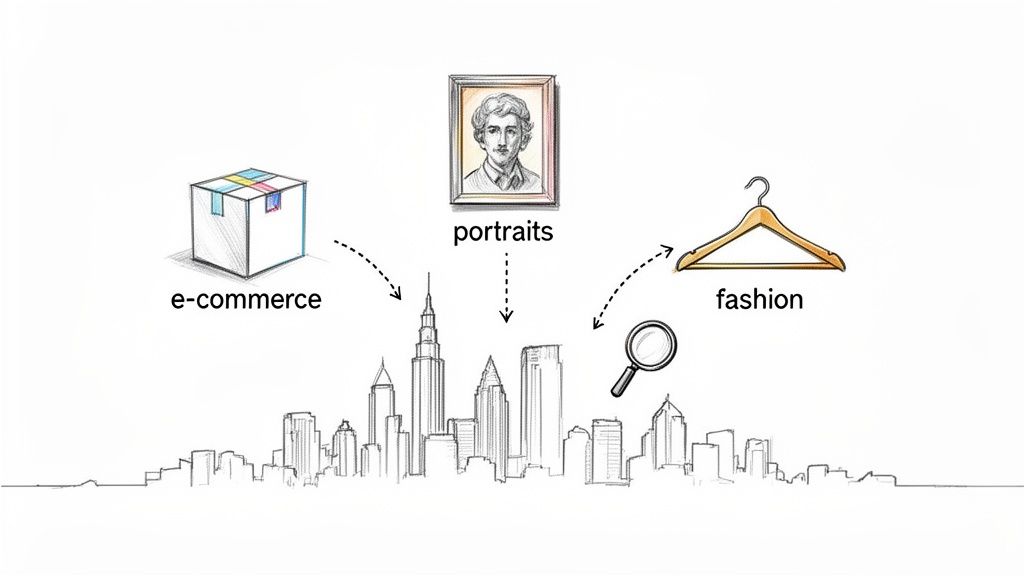
This all starts with a clear-eyed look at the local landscape. The demand for professional photography here is booming, but it’s also highly fragmented. Your job is to find an underserved client base whose needs perfectly match your skills and passion.
Identifying Profitable Niches
So, where are the real opportunities? Manila's economy is a goldmine if you know where to look. Instead of trying to be a generalist, consider specializing in one of these high-demand areas:
-
E-commerce and Product Photography: With thousands of online sellers on platforms like Shopee and Lazada, the need for clean, professional product shots is constant. This is a volume-based niche that can provide steady, reliable income.
-
Corporate and Headshot Photography: The business districts—BGC, Ortigas, Makati—are packed with professionals and entire companies that require polished headshots for LinkedIn, corporate websites, and annual reports.
-
Family and Portrait Photography: Yes, it’s competitive, but there will always be a market for family portraits, maternity shoots, and personal branding sessions, especially in and around the city's residential hubs.
-
Fashion and Lifestyle Content: This is a more creative path. If you can build relationships with local designers, influencers, and brands, you can tap into a lucrative market that thrives in trend-setting districts.
The numbers back this up. The photographic services market in the Philippines is on a solid growth trajectory, with forecasts predicting a compound annual growth rate (CAGR) of around 5.2% from 2025 through 2031. This isn't just a fluke; it's driven by the relentless demand for high-quality visuals for social media and e-commerce, especially in urban centers like Metro Manila. You can dig deeper into the growth of the Philippines' photographic services market to see the trends for yourself.
To help you visualize where you might fit, I've broken down some of the most promising niches in Manila.
Manila Photo Studio Niche Opportunities
This table highlights some key areas where a new studio can make a real impact. Think about which of these client bases you'd genuinely enjoy working with.
| Niche | Primary Clients | Key Success Factor |
|---|---|---|
| E-commerce Product Photography | Online sellers (Lazada, Shopee), SMEs, Instagram-based shops | Speed, consistency, and affordable package pricing. A fast turnaround is everything. |
| Corporate Headshots & Branding | Professionals, startups, law firms, real estate agencies in BGC/Makati | Professionalism, a polished studio environment, and the ability to capture confidence. |
| Food & Restaurant Photography | Cafes, restaurants, food bloggers, cloud kitchens | Strong food styling skills and a network within the local F&B scene. |
| Family & Maternity Portraits | Expecting mothers, young families, and clients in upscale subdivisions | Creating a comfortable, memorable experience. Word-of-mouth referrals are king. |
| Fashion & Influencer Content | Local clothing brands, aspiring models, social media influencers | A unique creative style and strong connections with local talent and agencies. |
Choosing the right niche isn't just a business decision; it's about aligning your work with a market that will value and pay for your specific talent.
Success isn't just about your creative eye; it's about building a sustainable business model that meets real, local demand. Defining your ideal client is the foundation for creating a service menu and marketing strategy that truly stands out.
Handling Business Permits and Choosing Your Location
Once you've nailed down your niche, it's time to get your hands dirty with the logistics. This is the part where your dream of a photo studio in Manila starts to become a real, legal business. The paperwork can feel like a mountain, but if you tackle it one step at a time, it's completely manageable.
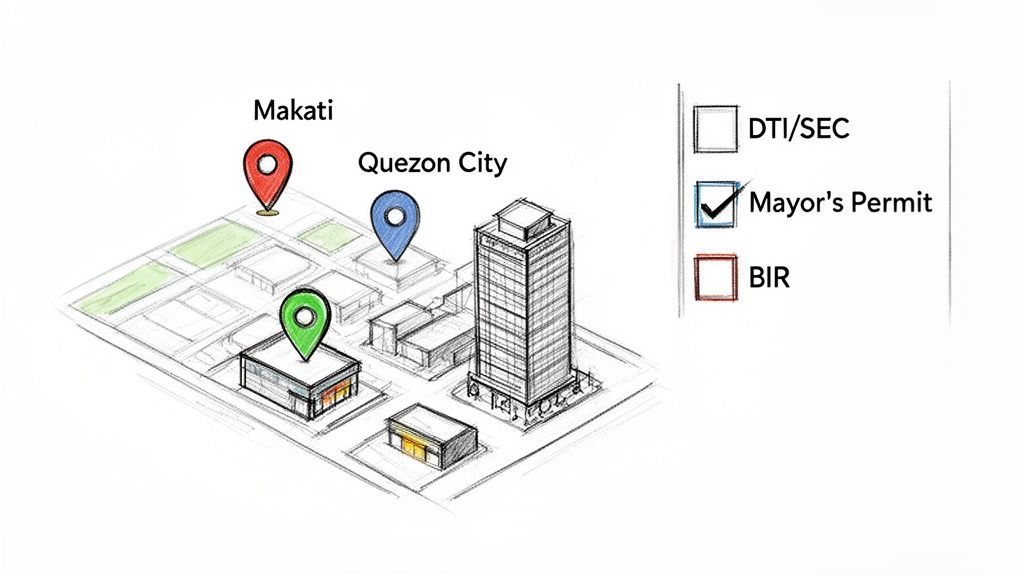
First things first, you need to make your business official. If you're flying solo, the simplest route is registering as a sole proprietorship with the Department of Trade and Industry (DTI). For those teaming up with partners, you'll be looking at a corporation or partnership registration through the Securities and Exchange Commission (SEC).
With your DTI or SEC papers in hand, your next stop is the city hall of your chosen location. This is where you'll apply for a Mayor’s Permit (also called a Business Permit), which requires a Barangay Clearance first. The final piece of the puzzle is registering with the Bureau of Internal Revenue (BIR). This gets you your Certificate of Registration, which is essential for issuing official receipts and being tax-compliant.
Choosing the Right Manila District
Picking a location for your studio is just as crucial as getting your permits sorted. Your address says a lot about your brand, dictates your operational costs, and determines who walks through your door. Metro Manila is a patchwork of different districts, and each has its own vibe.
Here’s a quick rundown of the major players:
- Makati Central Business District (CBD): This is where you go for a premium, corporate feel. It’s perfect if your target clients are executives needing headshots or luxury brands wanting product shots. Be warned, though—the rent is steep.
- Bonifacio Global City (BGC): Much like Makati, BGC is a polished, modern hub ideal for corporate and high-end commercial work. It’s easy to get to, but you'll face stiff competition and high overheads.
- Quezon City: As a sprawling and diverse city, QC offers far more budget-friendly options. Areas around Tomas Morato are a goldmine for food and lifestyle photographers, while the Katipunan strip is a natural fit if you're catering to a younger, student-heavy demographic.
Your best location is always a strategic trade-off. It needs to be accessible for your ideal client, fit within your budget, and reflect the brand you're trying to build. Don't just fixate on the monthly rent; think about practical things like foot traffic, parking, and what other businesses are nearby.
Aligning Location with Your Niche
Think about how your physical space serves your specialty. If you’re all about e-commerce product photography, you don't need a fancy address. A spacious, warehouse-style unit in a more industrial part of Quezon City or Pasig will do the job perfectly, giving you the room you need without the hefty price tag.
On the other hand, if you're a portrait photographer specializing in families from upscale villages, you’d be better off setting up shop in a commercial spot in Alabang or near Greenhills. For these clients, convenience is everything. Finding the right spot is about strategically positioning your brand for success. For a deeper dive, our guide on finding a studio near me for photoshoot has more practical tips.
Ultimately, your choice of location will shape the day-to-day reality of running your photo studio in Manila, so take your time and choose wisely.
Designing Your Studio and Acquiring the Right Gear
The physical space of your Manila studio is so much more than just four walls—it’s a direct reflection of your brand and your professionalism. This is where your creative vision actually comes to life, so a well-thought-out layout and smart equipment choices are absolutely fundamental to your success.
Even a tight commercial space can be turned into a surprisingly functional studio with a bit of thoughtful design. The real goal is to create distinct zones for specific tasks, which keeps the workflow smooth for both you and your clients. This approach helps you maximize every single square meter.
Planning Your Studio Layout
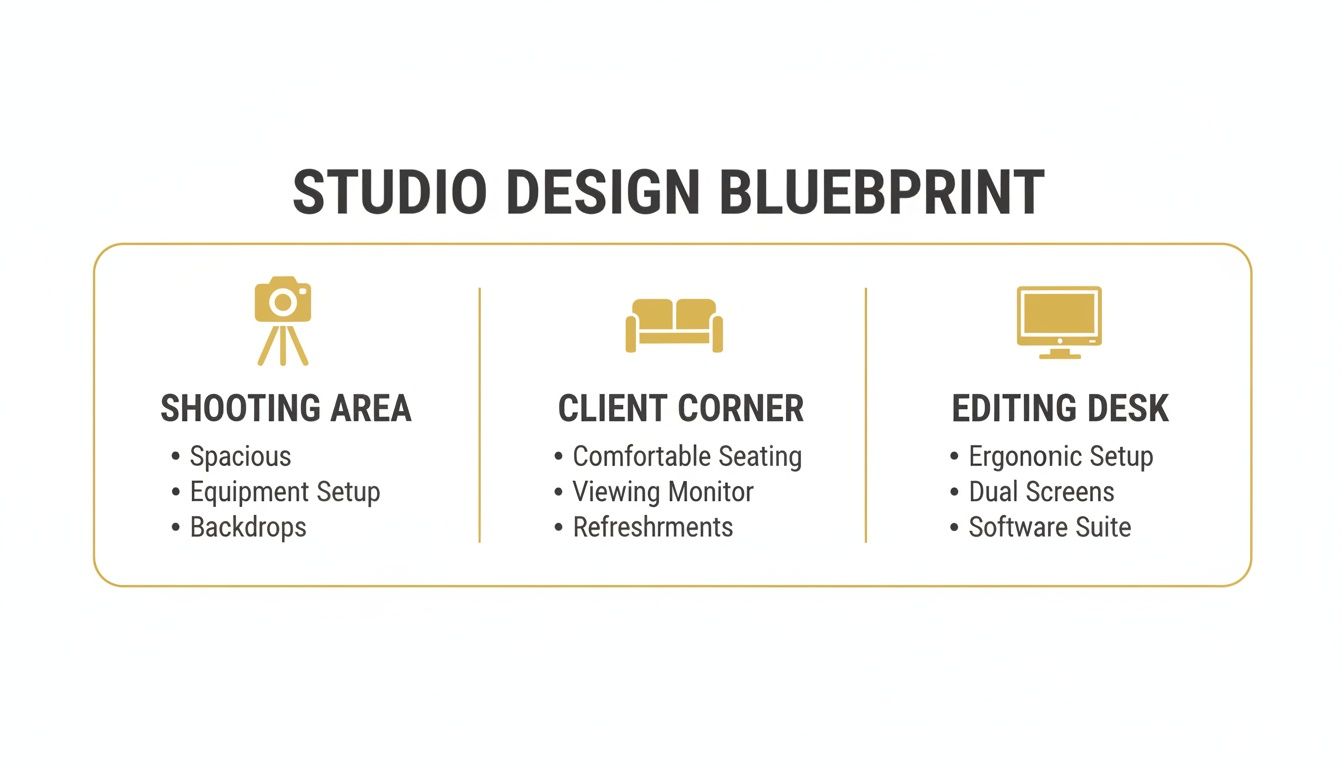
A functional layout does one thing really well: it separates the creative chaos from the client experience. No matter how big or small your space is, try to establish three core areas.
- The Shooting Area: This is your stage. You'll want high ceilings if you can get them, plenty of floor space to move lights and subjects around, and at least one clean, neutral wall that can serve as a default background.
- The Client Reception/Viewing Area: Carve out a comfortable, welcoming corner with good seating, maybe a small table, and a monitor for proofing sessions. This space needs to feel completely separate from the technical clutter of your shooting area.
- The Post-Production Corner: A dedicated desk for your computer, hard drives, and editing tablet is non-negotiable. I'd suggest positioning it away from the main foot traffic to help you stay focused during those critical editing hours.
This zoning strategy isn't just about efficiency; it completely elevates how clients perceive your studio. It feels organized, intentional, and professional. You don't need to build walls—even simple partitions or clever furniture placement can define these spaces effectively.
Your studio's design directly impacts your workflow and client comfort. A smart layout, even in a small Manila space, can make your operations feel seamless and significantly more professional, justifying premium pricing.
Prioritizing Your Equipment Investments
Let's be honest: buying gear is often the most expensive part of setting up shop. The key is to be brutally realistic about what you absolutely need on day one versus what you can rent or buy later as the business grows.
Your initial investment should be laser-focused on versatile, reliable tools that form the foundation of your services. Anything else is a luxury you can get later once you're profitable. Here’s how I'd break down the purchasing decisions.
Essential Day-One Gear
- Lighting: Two reliable studio strobes (monolights) with stands are your workhorses. Look for models known for consistent color temperature and power output—don't cheap out here.
- Modifiers: You can get by with just two to start. Get one large octabox for that soft, flattering main light, and a standard reflector or beauty dish for more dramatic, punchy effects. These two modifiers can honestly cover 80% of typical portrait and product jobs.
- Backdrops: Start simple. A roll of seamless paper in white, grey, and black is the most versatile setup you can have. A good, sturdy portable stand system is also a must.
- Tethering Cable: Shooting tethered directly to a computer is no longer a luxury; it's a professional standard. It lets you and the client review images instantly, which makes the entire session run smoother and avoids surprises later.
For sourcing gear on a budget, it's worth exploring the photography shops in Quiapo for good deals on stands and basic modifiers. For lighting and electronics, online platforms like Lazada and specialized local camera stores will give you a wider selection. And for a deeper dive into setups specifically for portraits, check out our guide on building a portraiture photography studio.
My best advice for your first year? Rent specialized lenses or high-powered lights for specific jobs. It's a much smarter financial move than buying gear you'll only use once in a while.
Structuring Prices That Attract and Convert Clients
Nailing your pricing is probably one of the most stressful parts of opening a photo studio in Manila. Go too high, and you might scare everyone off. Go too low, and you're not just undervaluing your craft—you're running a charity. The trick isn't to pull a number out of thin air, but to build a smart pricing strategy from the ground up.
Before you even think about packages, you have to get intimate with your numbers. This means calculating your Cost of Doing Business (CODB). Seriously, don't skip this. Tally up your monthly studio rent, Meralco bill, internet, insurance, software like Adobe Creative Cloud, gear maintenance, marketing costs, and—most importantly—the salary you need to pay yourself. This CODB is your survival number; anything below it means you're losing money.
Building Your Service Packages
Once you know your baseline, you can start architecting your service packages. Simply listing an hourly rate is a rookie mistake. Packages are powerful because they bundle services together, making the value proposition crystal clear for the client. It guides their choice and often nudges them toward a better, more comprehensive option.
Here are a few proven models that work well in the Manila market:
- Tiered Packages (Good, Better, Best): The bread and butter for portrait, family, or even product photography. Your entry-level tier might be a quick 1-hour session with 5 final edited photos. The top-tier package could include a 3-hour shoot, multiple layouts, 20 edited images, and maybe even professional prints.
- A La Carte & Hourly Rates: This works great for pure studio space rentals or for commercial clients who have very specific, piecemeal needs. Just be sure to set a minimum booking time (I'd suggest at least two hours) to make sure setting up and tearing down is worth your time.
- Project-Based or Retainer Fees: This is the goal for locking in corporate clients. Think of a local fashion brand that needs new product photos every month or a BPO company that needs headshots for new hires on a regular basis. A retainer gives you that sweet, predictable income.
Every square meter of your studio, from the shooting bay to the client lounge, is an investment. Your pricing has to reflect and sustain that entire ecosystem.
Sample Photography Package Structures
To give you a more concrete idea, here’s a look at how you could structure your offerings. These are just templates, of course—you'll want to adjust the specifics and pricing based on your own CODB and target market research.
| Package Tier | Inclusions | Ideal For | Price Point Example (PHP) |
|---|---|---|---|
| The Essential | 1-hour session, 1 backdrop, 5 high-res edited digital photos | Individuals needing a quick headshot, solo portraits, or a simple product shot. | ₱5,000 - ₱8,000 |
| The Standard | 2-hour session, 2 backdrops, 15 high-res edited digital photos, online gallery | Couples, small families, fashion lookbooks, or e-commerce brands needing variety. | ₱12,000 - ₱18,000 |
| The Premium | 4-hour session, multiple backdrops/setups, 30+ edited photos, prints or photobook, styling assistance | Large families, detailed brand campaigns, editorial shoots, comprehensive product catalogs. | ₱25,000+ |
Ultimately, the goal of your packages is to provide clear options that solve your client's specific problem, whether it's a simple, professional headshot or an extensive brand campaign.
Presenting Prices with Confidence
How you show your prices matters just as much as the numbers themselves. Create a clean, professional PDF price guide or a dedicated page on your website. Be explicit about what’s included in every single package—number of hours, photo count, deliverables, and potential add-ons. You want to eliminate any confusion from the get-go.
Transparency is your best sales tool. When a potential client understands exactly what they’re getting for their money, they stop focusing on the cost and start seeing the value. That's when they book.
Don't forget to maximize your studio's earning potential. During your downtime, renting out the space is a fantastic way to generate extra income. Plenty of freelance photographers and small creative teams in Manila are always hunting for a good studio to hire by the hour. This is one of the most effective rental business ideas for a new studio owner, turning your empty hours into pure profit.
Here is the rewritten section, designed to sound completely human-written and natural, following all the provided instructions.
Ditch the DMs: Automating Your Bookings with an Online System
Let's be honest. Juggling booking inquiries from Instagram DMs, Facebook messages, and texts is a fast track to burnout. It’s a chaotic system that inevitably leads to double bookings, lost clients because you replied too late, and a mountain of admin work that steals time from what you actually love doing—creating amazing photos. A modern photo studio in Manila simply can't grow if it's running on manual back-and-forth messages.
An online booking system isn't just a nice-to-have; it's the core of a professional operation. It turns your business from a constant hustle into a smooth, automated engine that works for you 24/7. Imagine clients seeing your real-time availability, picking a slot, and paying their deposit at 2 AM—all without a single message to you. That's the goal.
What to Look for in a Booking Platform
When you start looking at booking software, it's easy to get sidetracked by flashy features you'll never use. Cut through the noise and focus on what actually makes a difference to your bottom line and your client's experience.
Here’s what truly matters:
- Real-Time Calendar Sync: The moment a slot is booked, it needs to be gone. No exceptions. This is the only way to kill the risk of double-booking for good.
- Automated Confirmations and Reminders: The system absolutely must send an instant confirmation email or text, followed by polite reminders before the shoot. This one feature will drastically cut down your no-shows.
- Integrated Payment Processing: Taking deposits or full payments online is non-negotiable. It secures the booking, filters out flaky clients, and protects your income.
- Simple Service Management: You should be able to easily create, edit, and display your packages—whether it's a "Corporate Headshot" session or an hourly "Studio Rental"—without needing a tech degree.
This level of automation is becoming critical, especially as the Asia-Pacific photography market continues to boom. Projections show the regional market hitting around USD 12.21 billion by 2025, with an expected 8.1% annual growth rate through 2033. In a competitive environment like that, anything that makes you more efficient—like a self-serve booking site—gives you a serious edge. You can dig deeper into the Asia-Pacific photography service market trends to see where things are headed.
Launch Your Booking Site in Under an Hour
Getting a system like Kejoola up and running is surprisingly fast. It’s built for photographers and other creatives who need a professional website that takes bookings, without the headache and cost of hiring a developer. You can genuinely go from zero to a live, payment-ready booking site in less than an hour.
It really breaks down into a few simple steps:
- Build Your Services: First, you list what you sell. "Corporate Headshot Package," "Studio Rental (Hourly)," you name it. Add good descriptions, a few sample photos, and set your prices.
- Set Your Schedule: Next, you block out your working hours. You can set a recurring weekly schedule or customize it for specific dates if your availability changes.
- Connect a Payment Gateway: Link your Stripe or PayPal account. This is how you'll securely accept those online deposits and payments.
- Share Your Booking Link: That's it. You'll get a unique link to your new booking page. Put it everywhere—your Instagram bio, your Facebook page, your email signature—and watch the bookings come in.
When you empower clients to book and pay on their own schedule, you remove all the friction. This one change does more than just save you hours of admin work; it instantly makes your studio look more professional, organized, and trustworthy from the very first click.
Marketing Your Studio and Winning Local SEO
So, you've built a beautiful studio space. That’s the fun part. Now, how do you make sure the right clients can actually find you? If you're serious about running a profitable photo studio in Manila, you need a solid marketing plan that brings a steady stream of leads right to your door. It all starts with being impossible to miss when people search online.
Honestly, your most powerful weapon in this fight is your Google Business Profile (GBP). This isn't just a nice-to-have; it's essential. A well-managed GBP is what gets you featured in the coveted "Map Pack" when someone nearby types "photo studio Manila" or "portrait photographer near me."
Mastering Your Google Business Profile
Think of your GBP as a dynamic mini-website, not a static listing you fill out once and forget. To turn it into a client-attracting machine, you need to give it constant attention.
- Fill Out Everything: Don't skip any fields. List all your services, your exact operating hours, and even your health and safety protocols. The more complete your profile is, the more Google will trust you and show you to potential customers.
- Showcase Your Space and Work: Upload high-quality photos of your best shots, behind-the-scenes moments, and clear images of your studio's interior and exterior. This builds immediate trust and helps clients visualize their own session with you.
- Chase Those Reviews: Don't be shy about asking every happy client to leave a review. Positive reviews are a massive ranking factor and provide the social proof that convinces new clients to book.
Beyond Google, your Instagram feed is your modern-day gallery. Get strategic with location-specific hashtags like #PhotographerMakati or #QuezonCityStudio to pull in a targeted local audience.
A Smart Approach to Content and Collaborations
Your own website is prime real estate for local SEO. Instead of a generic "services" page, create dedicated pages for each of your offerings. Weave in location-based keywords naturally, like "professional headshots in BGC" or "e-commerce product photography in Quezon City." This tells Google exactly who you serve and where.
A reliable marketing engine isn't about one big launch; it's about consistent, targeted actions. Optimizing for local search and building a strong online portfolio are the foundational pillars that generate a steady stream of inquiries.
Don't underestimate the power of local partnerships. Teaming up with a Manila-based makeup artist, a local fashion boutique, or an event planner for a joint project can be a game-changer. This kind of cross-promotion instantly introduces your brand to a whole new, highly relevant audience.
This focus on efficiency isn't just a local trend. Globally, studios are leaning on automation and online booking to boost productivity and handle more clients. For studios in Manila, this means tracking key metrics like revenue per booking and then finding ways to cut down on admin time with smart, integrated systems. It's a proven strategy for growth. You can explore more industry insights on photography business operations to see how this plays out on a larger scale.
Ultimately, a winning marketing strategy is a smart mix of digital visibility and real-world connections.
Navigating the Big Questions: A Manila Photo Studio FAQ
When you're first starting out, the path to opening your own photography studio in Manila is filled with questions. Let's tackle some of the most common ones I hear from aspiring studio owners.
What's the Real Startup Cost?
The capital you'll need can swing wildly depending on your vision. For a lean, home-based setup, you could realistically get started with PHP 100,000 to PHP 150,000. That amount covers the essentials: good lighting, a few versatile backdrops, and maybe a lens upgrade.
If you’re aiming for a dedicated commercial space, the numbers jump. A small studio in a less central area might require PHP 300,000 to PHP 800,000. That budget needs to cover everything from rent deposits and basic renovations to business permits and a solid set of professional gear. For those dreaming of a high-end studio in a prime spot like BGC or Makati, you’re easily looking at an initial investment of over PHP 1 million.
How Do I Land My First Paying Clients?
Your first clients are closer than you think. Start by tapping into your personal network—friends, family, old classmates, and former work colleagues. Offer them a special introductory rate to get some shoots under your belt and build a foundational portfolio. It’s the fastest way to get real-world experience and images to show.
From there, shift your focus to local online visibility. A fully optimized Google Business Profile is non-negotiable. Fill it with your best shots, detail your services, and make a habit of asking every early client for a review. You want to pop up whenever someone searches for a photographer in your area. At the same time, get active on Instagram using targeted local hashtags like #ManilaPhotographer or #PhotoStudioMakati. A great tactic is to collaborate with local models, makeup artists, or even small clothing brands on test shoots. This expands your network, gives you fresh content, and generates powerful word-of-mouth buzz.
Pro Tip: Renting out your studio during downtime is a brilliant strategy to generate passive income and help cover overhead costs. It maximizes the use of your investment and connects you with other creatives.
Should I Rent My Studio Space to Other Photographers?
Yes, you absolutely should. Treating your studio as a rentable space is one of the smartest moves you can make. It creates a secondary income stream that can help cover your rent and bills, especially during quieter booking periods.
The key is to manage it professionally. Don't just rely on DMs and text messages. Use a dedicated booking system that allows you to maintain a separate calendar for rentals. This automates the process and prevents double-bookings. Be crystal clear about your rental packages, house rules, and exactly what equipment is included. This protects your gear and ensures every photographer who rents from you has a seamless, positive experience.
Ready to streamline your operations and make booking effortless for your clients? Kejoola gives you a professional, booking-ready website in minutes, so you can focus on your creative work, not your admin. Start your free 14-day trial today at https://kejoola.com.


