Roofing Contract Template: 6 Free Forms to Copy and Use
A roofing contract template names both parties, the scope and materials, the price and payment dates, the warranty and the signatures. Six forms to copy: replacement, repair, payment schedule, change order, warranty and completion sign-off.
Josh · Nov 5, 2026 · 11 min read
- roofing contract template
- roofing contract
- roof replacement contract
- roof repair agreement
- roofing change order
- roofing contractor
A roofing contract template is a written agreement that names the roofer and the homeowner, describes the work and the materials, sets the price and payment dates, and carries both signatures. The six forms below cover the paperwork a roofing job usually needs: a replacement contract, a repair agreement, a payment schedule, a change order, a warranty statement and a completion sign-off. Copy one into a document, replace the brackets with your own details, and have it checked against your state's rules before you use it.
What a roofing contract has to cover
Roofr says a roofing contract should hold, at a minimum, your license number and insurance details, the project scope, the payment terms, a way to end the contract, the timeline, the materials, the contractor and customer details, and a date and signature from both sides. Hook Agency's list adds permits, warranties, dispute resolution and who handles change orders.
The scope and the materials do the most work. Hook Agency suggests naming the brand, type and color of each material, and even details such as the underlayment, because a specific line beats a vague one for the homeowner reading it. Roofr also recommends a weather clause, since snow, rain, extreme wind or heat can push a project back.
A contract also protects you from the unknowns on a roof. Roofr points to a hidden second layer of shingles, dry rot or mold on the sheathing as examples. If the contract says how those finds are priced, you are not negotiating after the old roof is already off.
Before you send a contract
Check three things before the paperwork goes out. They differ by state, so confirm each one with your licensing board or a local attorney.
Deposit limits. Some states cap the down payment. California's contractor licensing board states that a home improvement down payment cannot be more than $1,000 or 10 percent of the contract price, whichever is less. The same board requires a written payment schedule and says payments cannot exceed the value of the work performed, apart from that down payment. Your state may have a different rule, or none.
The three-day cancellation right. The FTC's Cooling-Off Rule gives buyers three days to cancel certain sales made at their home, and it applies when a homeowner invites a salesperson to make a presentation there. The FTC says the seller must tell the buyer about the right to cancel and give two copies of a cancellation form. The rule does not cover sales made after negotiations finish at the seller's permanent place of business, sales needed to meet an emergency, or sales made entirely online, by mail or by phone. Read the FTC's guidance before you decide whether a roofing sale falls inside the rule or one of its exceptions.
License and insurance lines. Roofr says to print your license number if your area requires one, and to attach the insurance paperwork. JobNimbus suggests confirming that the contractor holds a valid insurance certificate.
Template 1: Roof replacement contract
Use this one for a full tear-off and re-roof. It is the long form, and the other five attach to it.
ROOF REPLACEMENT CONTRACT

Date: [date]
Contractor: [company name], [street address], [phone], [email]
License no.: [number, if your state requires one]
Insurance: [carrier and policy number], certificate attached
Homeowner: [name], [property address], [phone], [email]

1. SCOPE OF WORK
Remove the existing roofing down to the deck on [roof sections].
Inspect the deck and replace damaged sheathing as described in Section 4.
Install [underlayment brand and type], [drip edge], [starter strip],
[shingle manufacturer, product line, color], [ridge cap], and
[ventilation items]. Flash [chimney / skylights / walls / vents].
Not included: [gutters, fascia, siding, interior repairs, solar removal].

2. PERMITS
[Contractor / Homeowner] will obtain the building permit.
Permit fees are [included in the price / billed at cost].

3. SCHEDULE
Start date: [date], or within [number] days of material delivery.
Estimated completion: [number] working days after start.
Weather delays move these dates and do not count against the contractor.

4. CONCEALED DAMAGE
If the old roof hides damaged sheathing, rot, a second layer of shingles
or similar conditions, the contractor will stop and notify the homeowner.
Repairs are priced at [$ per sheet of sheathing / hourly rate plus
materials] and are added by written change order before work continues.

5. PRICE AND PAYMENT
Contract price: $[total]. Payments follow the attached payment schedule.

6. HOMEOWNER RESPONSIBILITIES
Provide access to the property, a clear driveway for deliveries,
and a clear area around the house. Tell the contractor about
any pets, irrigation lines or fragile items near the work area.

7. CONTRACTOR RESPONSIBILITIES
Supply the materials, tools and labor named above. Protect the property
during work. Remove debris and run a magnet sweep of the yard
at the end of each day and at completion.

8. WARRANTY
As stated in the attached warranty statement.

9. CHANGES
Any change to scope, price or schedule must be written, signed by both
parties and attached to this contract before the work is done.

10. CANCELLATION AND TERMINATION
Homeowner's right to cancel: [state the notice required by law,
and attach the cancellation form if it applies].
Either party may end this contract for uncured breach after
[number] days' written notice. Work completed is paid for at
the contract rate. Deposit refund: [refundable before delivery /
describe your policy].

11. DISPUTES
The parties will try to resolve disputes by [direct discussion,
then mediation] before any other action. Governing law: [state].

Signed: ____________________ Contractor    Date: ________
Signed: ____________________ Homeowner     Date: ________
The concealed damage clause is the one to read twice. Hatch lists limitation of liability, indemnification, force majeure and an entire agreement clause among the terms a contract can carry. Those clauses vary by state, so add them only with an attorney's review.
Template 2: Roof repair agreement
A leak repair or a few missing shingles does not need eleven sections. This short form keeps the job on one page.
ROOF REPAIR AGREEMENT

Date: [date]
Contractor: [company name], [phone], [license no. if required]
Homeowner: [name], [property address], [phone]

Problem reported: [for example, leak above the hallway ceiling]
Repair to be done: [replace [number] shingles near the south valley,
re-seal [number] roof vents, replace [item] flashing]
Materials: [named products]
Not included: [interior drywall or paint repair, other roof areas]

Price: $[amount], due [on completion / split into deposit and balance]
Work date: [date], weather permitting
Related repairs found during the work: the contractor will call the
homeowner before doing anything beyond this list. Small items up to
$[limit] may be done without a change order only if the homeowner
initials here: [____]

Repair warranty: [number] months on the workmanship of this repair only.
This does not cover new leaks elsewhere on the roof.

Signed: ____________________ Contractor    Date: ________
Signed: ____________________ Homeowner     Date: ________
Hatch raises the question this form answers: will you automatically do small repairs up to a certain cost, or give an estimate for anything larger? Pick one answer and print it on the form.
Template 3: Payment schedule and deposit
Attach this to the replacement contract so the payment terms sit in one place.
PAYMENT SCHEDULE

Contract price: $[total]
Contract date: [date]

Payment 1 - Deposit: $[amount], due at signing.
  [Refundable / refundable until materials are ordered / not refundable.]
Payment 2 - Materials delivered: $[amount], due [number] days after delivery.
Payment 3 - Tear-off and deck complete: $[amount], due on completion
  of that stage.
Payment 4 - Final payment: $[amount], due on signed completion sign-off.

Accepted payment methods: [check, bank transfer, card, other]
Late payments: [your policy, or leave blank if none applies]
Approved change orders are added to the next payment due.

Initialed: ______ Contractor    ______ Homeowner
Hook Agency lays out the same pattern: the total cost, the deposit, progress payments tied to milestones and a final payment on completion. JobNimbus adds that the contract should say whether the deposit is refundable. eForms suggests payments based on performance, such as half at the start and half at completion, as a simpler version for small jobs.
Check your state's down payment cap before you fill in the first line. In California, as quoted above, the deposit can be no more than $1,000 or 10 percent of the price, so a schedule built around a large deposit would not be allowed there.
Template 4: Change order form
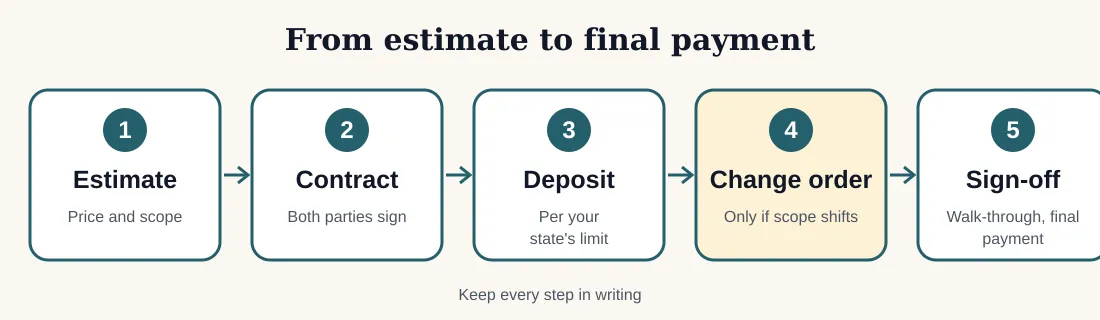
A change order records one change to the signed contract, including its cost and its effect on the schedule. The California board says a change to the price or scope must be made with a written change order signed by both parties before the change, and that it then becomes part of the contract. That is a sound habit in any state.
CHANGE ORDER no. [number]

Contract date: [date]    Property: [address]
Contractor: [company]    Homeowner: [name]

Reason for change: [for example, rotted sheathing found along
the north eave]
Work to be added or removed: [describe]
Materials: [named products and quantities]

Price change: [+/-] $[amount]
Schedule change: [+/-] [number] working days
New contract total: $[amount]
Payment for this change: [added to payment 3 / due on completion]

No work on this change begins until both parties sign below.

Signed: ____________________ Contractor    Date: ________
Signed: ____________________ Homeowner     Date: ________
Number every change order and staple each one to the contract. A homeowner who asks about a line item months later can then see which change order added it.
Template 5: Warranty statement
Keep the warranty on its own sheet so the homeowner can file it. JobNimbus says the contract should include both the manufacturer warranties for the materials and the labor guarantee covering the contractor's work. Hook Agency adds that a warranty should state its duration and any conditions that void it.
WARRANTY STATEMENT

Property: [address]    Completion date: [date]
Contractor: [company], [phone], [email]

1. Workmanship warranty (from the contractor)
Covers: leaks and defects caused by the installation.
Length: [number] years from the completion date.
Excludes: damage from storms, fallen trees, hail, foot traffic by
others, changes made to the roof by other contractors, and
failure to keep gutters clear.

2. Manufacturer warranty (from the material maker)
Product: [manufacturer and product line]
Registered by: [contractor / homeowner] within [number] days.
Terms: see the manufacturer's document, attached.

3. What voids the warranty
[List the conditions, for example repairs by another company or
unreported damage left in place.]

4. How to make a claim
Call [phone] or email [address] with photos and the date of the
problem. The contractor will inspect within [number] working days.

Signed: ____________________ Contractor    Date: ________
Do not copy a warranty length from a competitor's form. Write the term you will honor, because a long warranty from a small company is only as good as the company.
Template 6: Completion and final acceptance sign-off
This form ends the job. Hatch lists an inspection and approval right for the client and a requirement that the contractor leave the premises clean, and both fit on one page.
COMPLETION AND ACCEPTANCE

Property: [address]    Contract date: [date]
Completion date: [date]

Checklist (both parties initial after the walk-through):
[ ] Roof installed as described in the contract and change orders
[ ] Flashing and vents sealed
[ ] Debris removed and yard swept with a magnet
[ ] Gutters and downspouts clear
[ ] Warranty statement and manufacturer paperwork delivered
[ ] Photos of the finished roof sent to the homeowner

Punch list (items still to be corrected):
1. [item]    Due: [date]
2. [item]    Due: [date]

Homeowner accepts the work, except for the punch list above.
Final payment of $[amount] is due [on signing / within [number] days].

Signed: ____________________ Contractor    Date: ________
Signed: ____________________ Homeowner     Date: ________
Do the walk-through the same day the crew finishes. Photos taken at the end of the job, sent to the homeowner, are the quickest way to settle a later question about what the roof looked like on completion.
Questions roofers ask
Does a roofing contract need to be notarized?
Roofr says a roofing contract needs the names of the contractor and the customer, and a signature and date from both. None of the sources reviewed for this post mentions notarization, so ask your licensing board whether your state requires it.
Can I use one template for every roofing job?
Use one master contract and attach the right form to each job. A repair needs the short agreement, a replacement needs the long contract, and any mid-job change needs a change order. The attachments keep each document short enough that people read it.
Should the contract include the estimate?
Yes, attach it or copy its line items into the scope section. Hatch notes that a contract prevents scope creep and unexpected costs, and an attached estimate makes the scope concrete. The roofing estimate template covers the estimate side.
Do I need a lawyer to review the template?
Yes, once. State rules on deposits, cancellation notices, license numbers and lien rights differ, and the forms above are starting points rather than legal advice. A local attorney can adjust the clauses once, and you can reuse the result.
Get inspection requests online
A contract starts after the homeowner has asked for an inspection, and many of those requests arrive by phone while you are on a roof. Kejoola gives a roofing business a four-page website with Home, Services, Blog and Contact pages and an online booking form. The form asks for a name, email, phone number and a notes box, so a homeowner can describe the leak and request a visit at night or on a weekend. The request is waiting when you come down, and you call back to schedule the inspection.
Sources
- Roofr: How to Write a Roofing Contract
- Hook Agency: Ultimate Roofing Contract Template
- Hatch: 7 Free Roofing Contract Templates
- JobNimbus: The Ultimate Roofing Contract
- eForms: Free Roofing Contract Template
- PandaDoc: Roofing Contract Template
- FTC: Buyer's Remorse, the Cooling-Off Rule
- CSLB: Learn About Home Improvement Contracts