Roofing Estimate Template: 6 Free Formats for Every Job
A good roofing estimate template lists roof size in squares, named materials, tear-off, labor, permits, warranty and a valid-until date on one page. Six formats to copy for replacement, repair, metal, flat, tiered and measurement jobs.
Josh · Nov 5, 2026 · 12 min read
- roofing estimate template
- roofing estimate
- roof replacement estimate
- roof repair estimate
- roofing contractor
- roofing quote
A roofing estimate template is a one-page form that lists the roof size, named materials, tear-off, labor, extra costs and terms, so every bid you send is complete and priced the same way. The six formats below cover the jobs roofers quote most: a shingle replacement, a leak repair, a metal roof, a flat roof, a three-option bid and a roof measurement sheet. Copy one into a document or spreadsheet, replace the brackets with your own numbers, and send it.
What every roofing estimate needs
Whatever the roof, the same blocks show up in a complete estimate. Invoice Simple says a roofing estimate should carry client and contractor information, a detailed scope of work, itemized material and labor costs, a timeline, warranty details, and terms and conditions. Eonebill adds an estimate number, an issue date and a validity period, plus the roof size, pitch and current condition.
Put those blocks in a fixed order and you stop forgetting things. Permits are the usual miss. Eonebill calls them a famously overlooked cost and says they typically run from $75 to $500 depending on the municipality and the size of the job.
The estimate also works as a scope document. If a customer asks months later whether the gutters were included, you point to the line that says they were not.
Before you fill in a template
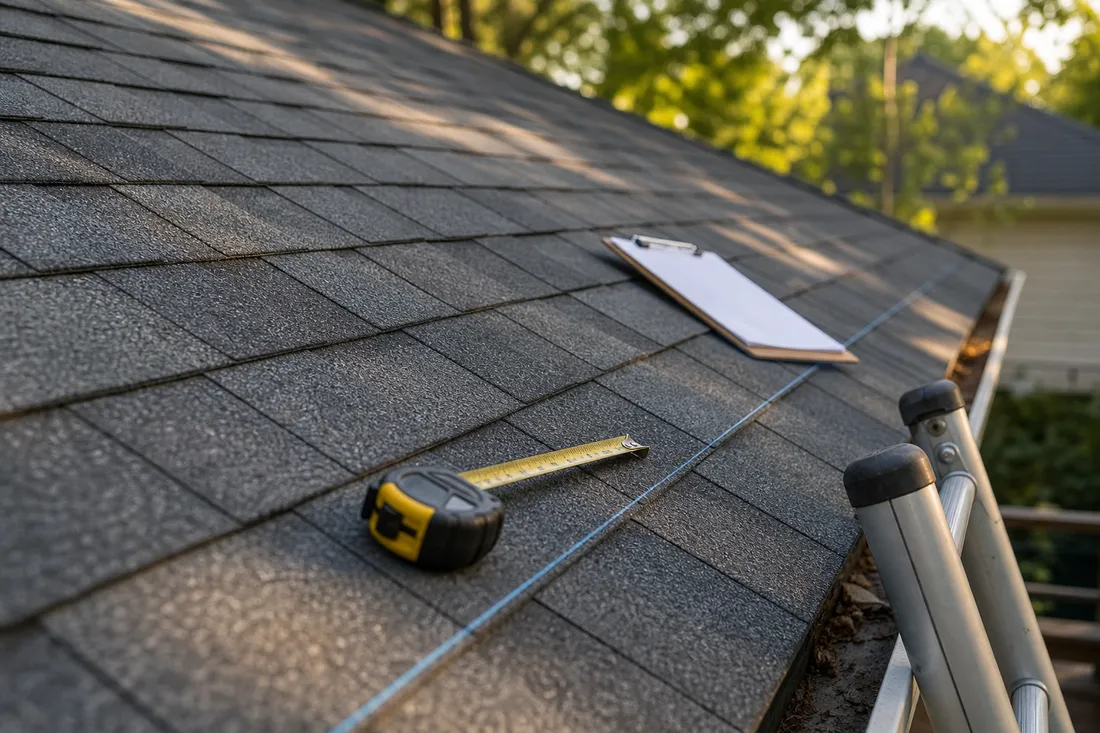
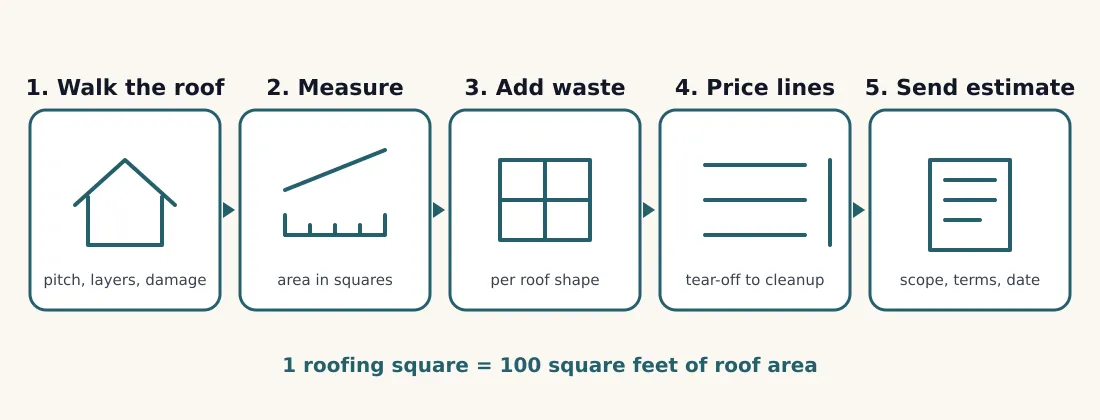
Walk the roof first, then do the arithmetic. SimplyWise advises measuring the roof area in squares, checking for existing damage, noting the pitch and counting penetrations such as vents, skylights and chimneys. Take photos of everything. Satellite measurements are a starting point, SimplyWise adds, but they are not a final answer.
A roofing square is 100 square feet of roof area. Invoice Fly gives the example of a 2,500 square foot roof, which is 25 squares before waste. Eonebill says roofers then add 10 to 15 percent for waste, overlap and cut lines depending on how complex the roof is. Invoice Fly takes a more careful line and recommends using supplier specifications and your own records of similar jobs instead of one standard waste number for every roof.
Name your materials. Eonebill points out that "architectural shingles" is a category, not a specification, and that products in it span roughly $80 to $200 per square. Write the manufacturer, the product line and the color on the estimate. A homeowner comparing your bid with two others can then see that the three bids price the same shingle.
Template 1: Asphalt shingle replacement
Use this for the standard tear-off and re-roof. It keeps tear-off and disposal on their own lines, which Eonebill recommends because burying them in a general labor figure hides your value and makes your bid harder to compare. SimplyWise's sample job is a 30-square re-roof with a three-person crew over two days, listed as tear-off, shingles, underlayment, flashing and ridge vent, labor, and disposal.
ROOF REPLACEMENT ESTIMATE
Estimate no.: [number]        Date: [date]        Valid until: [date]

Contractor: [business name]  |  [phone]  |  [email]
License no.: [number]        Insurance carrier: [name]
Customer: [name]  |  [phone]  |  [email]
Property address: [address]

ROOF DESCRIPTION
Measured area: [number] squares (includes [ ]% waste)
Pitch: [rise]/12        Stories: [number]        Existing layers: [number]
Decking condition seen at inspection: [notes]
Penetrations: [vents #, skylights #, chimneys #]

TEAR-OFF AND DISPOSAL
Remove existing shingles ([number] layers)                          $[ ]
Haul-away and dumpster                                              $[ ]

MATERIALS
Shingles: [manufacturer], [product line], [color], [squares]        $[ ]
Underlayment: [type], [rolls]                                       $[ ]
Ice and water protection: [where], [rolls]                          $[ ]
Drip edge: [linear feet]                                            $[ ]
Flashing: [chimney / walls / valleys / vents]                       $[ ]
Ridge cap and ridge vent: [linear feet]                             $[ ]
Fasteners and sealant                                               $[ ]

LABOR
Installation: [crew size] crew, [number] days                       $[ ]

PERMIT                                                              $[ ]

TOTAL                                                               $[ ]

DECKING REPAIR (not included unless found): $[ ] per sheet replaced
NOT INCLUDED: [gutters, skylight replacement, chimney repair, interior drywall]
START WINDOW: [dates]     ESTIMATED DAYS: [number]
PAYMENT: [deposit], [progress payment], balance at final walkthrough
WARRANTY: Workmanship [years]. Manufacturer shingle warranty per product terms.
Accepted by: ________________   Date: ____________
The decking line matters. You cannot see rotted plywood until the old shingles are off, so state a per-sheet price now and the customer is not surprised later. SimplyWise suggests building in a 10 to 15 percent contingency for hidden damage, rotten decking and unexpected flashing work.
Template 2: Roof repair or leak
A repair does not need the full replacement form. Customers calling about a stain on the ceiling want to know what you will fix, what it costs and whether more damage might show up. SimplyWise puts typical repair jobs at roughly $350 to $1,200 in its benchmark table, though your market will differ.
ROOF REPAIR ESTIMATE
Estimate no.: [number]        Date: [date]        Valid until: [date]

Customer: [name]  |  [phone]  |  [email]
Property address: [address]
Reported problem: [leak above kitchen, missing shingles after wind, lifted flashing]

INSPECTION FINDINGS
Source of leak or damage: [location on roof]
Area affected: [approximate size]
Photos taken: [number]        Attic checked: [Y/N]

REPAIR SCOPE
[ ] Replace shingles ([number])                                     $[ ]
[ ] Reseal or replace flashing at [location]                        $[ ]
[ ] Replace pipe boot or vent                                       $[ ]
[ ] Patch underlayment                                              $[ ]
[ ] Other: [describe]                                               $[ ]

MATERIALS                                                           $[ ]
LABOR: [hours] x $[rate]                                            $[ ]
MINIMUM SERVICE CHARGE (if applied)                                 $[ ]
TOTAL                                                               $[ ]

NOT INCLUDED: [interior ceiling repair, mold, damage found beyond the area above]
IF MORE DAMAGE IS FOUND: We stop, show you photos and quote the added work before continuing.
REPAIR WARRANTY: [coverage and length]
Accepted by: ________________   Date: ____________
The "if more damage is found" line is worth keeping. It tells the customer the price can change and sets the rule for how.
Template 3: Metal roof
Metal jobs carry different materials and trim, so a shingle form leaves gaps. Invoice Simple publishes a separate metal roof estimate template for that reason. Name the panel type, gauge, finish and trim package, and write down what the customer chose in each category.
METAL ROOF ESTIMATE
Estimate no.: [number]        Date: [date]        Valid until: [date]

Customer: [name]  |  [phone]  |  [email]
Property address: [address]

ROOF DESCRIPTION
Measured area: [number] squares        Pitch: [rise]/12
Existing roof: [shingles / metal / other], [layers]
Substrate condition: [notes]

PANEL SYSTEM
Panel type: [standing seam / exposed fastener / other]
Manufacturer and product: [name]
Gauge: [ ]        Color and finish: [name]
Panel quantity: [number of panels or squares]                       $[ ]

TEAR-OFF (if replacing existing roof)                               $[ ]
UNDERLAYMENT: [type]                                                $[ ]

TRIM AND ACCESSORIES
Ridge, hip and eave trim: [linear feet]                             $[ ]
Rake and gable trim: [linear feet]                                  $[ ]
Valley metal and flashing                                           $[ ]
Penetration flashings                                               $[ ]
Snow guards or other accessories: [Y/N]                             $[ ]
Fasteners and sealants                                              $[ ]

LABOR: [crew size], [number] days                                   $[ ]
PERMIT                                                              $[ ]
TOTAL                                                               $[ ]

LEAD TIME: [number] weeks from order to delivery, confirmed with your supplier.
NOT INCLUDED: [gutters, structural repairs, skylights, chimney work]
PAYMENT: [deposit due at order], [progress payment], balance at completion
WARRANTY: Workmanship [years]. Panel and finish warranty per manufacturer.
Accepted by: ________________   Date: ____________
For rough scale only, SimplyWise lists a 30-square metal install at about $14,000 to $25,000 in its benchmark table. Use a figure like that to check your own build, not to replace it.
Template 4: Flat or low-slope roof
Flat roofs are priced by membrane, seams, edges and drainage. A 20-square EPDM job sits at about $5,500 to $9,000 in SimplyWise's benchmark table, but the details below are what actually set your number. Invoice Simple also offers a separate flat roof estimate template, which tells you the trade treats these jobs as their own category.
FLAT ROOF ESTIMATE
Estimate no.: [number]        Date: [date]        Valid until: [date]

Customer: [name]  |  [phone]  |  [email]
Property address: [address]

ROOF DESCRIPTION
Measured area: [number] squares        Slope: [low slope / flat]
Existing membrane: [type], [layers]
Ponding water seen: [Y/N, where]
Drains, scuppers and penetrations: [count and type]

SYSTEM
Membrane: [EPDM / TPO / modified bitumen / other], [thickness]
Manufacturer and product: [name]
Attachment: [fully adhered / mechanically fastened / ballasted]
Insulation or cover board: [type, thickness]                        $[ ]

TEAR-OFF AND DISPOSAL                                               $[ ]
MEMBRANE AND ADHESIVES                                              $[ ]
EDGE METAL AND FLASHING
Perimeter edge: [linear feet]                                       $[ ]
Wall and curb flashing: [linear feet]                               $[ ]
Drain and scupper detail work                                       $[ ]

LABOR: [crew size], [number] days                                   $[ ]
PERMIT                                                              $[ ]
TOTAL                                                               $[ ]

NOT INCLUDED: [structural deck repair, drainage redesign, rooftop equipment moves]
IF DECK DAMAGE IS FOUND: [price per sheet or per square foot]
WEATHER: Work moves to the next dry day; the price does not change for weather delays.
WARRANTY: Workmanship [years]. Membrane warranty per manufacturer terms.
Accepted by: ________________   Date: ____________
Template 5: Three-option bid
Some homeowners compare your price with two others and pick the cheapest because nothing else separates the bids. A tiered format gives them a choice inside your own bid. SimplyWise recommends good-better-best pricing: a basic tier with architectural shingles, a middle tier with designer shingles and a premium tier with metal or slate. Its reasoning is that clients close faster when they have options.
ROOF OPTIONS ESTIMATE
Estimate no.: [number]        Date: [date]        Valid until: [date]

Customer: [name]  |  [phone]  |  [email]
Property address: [address]
Measured area: [number] squares        Pitch: [rise]/12

SCOPE COMMON TO ALL OPTIONS
Tear-off and disposal, underlayment, drip edge, flashing,
ventilation, cleanup, permit

                     OPTION A          OPTION B          OPTION C
Roofing material     [product]         [product]         [product]
Color choices        [list]            [list]            [list]
Underlayment         [type]            [type]            [type]
Ventilation          [type]            [type]            [type]
Manufacturer
warranty             [terms]           [terms]           [terms]
Workmanship
warranty             [years]           [years]           [years]
Estimated days       [number]          [number]          [number]
PRICE                $[ ]              $[ ]              $[ ]

DECKING REPAIR (all options): $[ ] per sheet replaced, quoted before work
NOT INCLUDED: [gutters, skylights, chimney work, interior repairs]
PAYMENT: [deposit], balance at final walkthrough
To accept, circle one option and sign:
Option chosen: [ A / B / C ]
Accepted by: ________________   Date: ____________
Keep the three columns honest. Each option should differ in material and warranty, not in how much work you include. If Option A leaves out flashing that Option C includes, the customer is not choosing a roof but guessing at your scope.
Template 6: Roof measurement and material sheet
This is a worksheet, not a customer document. Fill it in at the walkthrough and carry the totals into Template 1, 3 or 4. ShiftFlow's roofing estimate pairs the customer-facing estimate with a linked takeoff sheet that works from roof sections, slope, waste and the coverage printed on the selected product. This sheet follows the same idea.
ROOF MEASUREMENT SHEET
Job: [address]        Date: [date]        Measured by: [name]

SECTIONS
Section     Length    Width     Pitch     Area (sq ft)
[plane 1]   [ ]       [ ]       [ ]/12    [ ]
[plane 2]   [ ]       [ ]       [ ]/12    [ ]
[plane 3]   [ ]       [ ]       [ ]/12    [ ]
[add rows]

TOTAL AREA: [sq ft]  /  100  =  [number] squares
Waste allowance: [ ]%   (roof shape, valleys, dormers, hips)
ORDER QUANTITY: [number] squares

LINEAR MEASUREMENTS
Eaves: [ft]    Rakes: [ft]    Ridge: [ft]    Hips: [ft]    Valleys: [ft]
Wall flashing: [ft]    Step flashing: [ft]

COUNTS
Pipe vents: [#]    Roof vents: [#]    Skylights: [#]    Chimneys: [#]

PRODUCT COVERAGE (from the manufacturer's packaging)
Shingle: [product] covers [ ] per package
Underlayment: [product] covers [ ] per roll

NOTES AND PHOTOS: [file numbers]
Pull coverage numbers from the product label, as ShiftFlow's approach does, rather than from memory.
Adding your own terms
Payment terms belong on every estimate. SimplyWise suggests never asking for 100 percent up front and gives 40 percent deposit, 30 percent at tear-off and 30 percent at the walkthrough as a standard split. Treat that as one common pattern. Check what your state allows for deposits before you copy it.
Markup is your own call. SimplyWise says 15 to 25 percent is typical for roofing, covering overhead, insurance, warranty reserves and profit. Use your real overhead figures, not a general range.
Validity matters because material prices move. SimplyWise gives 30 to 60 days as common, and Eonebill notes 30 days is typical for most roofing estimates, with some contractors extending to 60 for large projects. Write the valid-until date on the form.
Warranty belongs in two parts. Eonebill separates the workmanship warranty, which covers your installation, from the manufacturer's product warranty, and says to state both.
How to send a roofing estimate so it gets read
Speed counts. SimplyWise advises sending the estimate within 24 hours of the site visit and following up within 48 hours if you have not heard back. Eonebill makes the same point from the customer's side: roofing clients are often collecting several bids, and the first professional, detailed one to arrive has an advantage.
Send a PDF, not an editable file, and put a short summary in the email body. Give the total, the roof system you chose, what is not included, the start window and the valid-until date. Then offer a call to go through it.
If the customer asks for a change, issue a new version with a new date and number. Both sides can then see what moved.
Common mistakes that cost roofers money
- Quoting by the square without naming the shingle. The price is not comparable until the manufacturer and line are written down.
- Lumping tear-off into labor. Customers cannot see the cost of haul-away and dumpsters, so they cannot weigh it against another bid.
- Leaving out the permit. Either you absorb it or you add it to the final invoice, and neither is a good conversation.
- Staying silent on decking. Damaged sheathing can only be priced once it is exposed, so it deserves its own line with a unit price.
- Skipping warranty terms. Two bids at a similar price get compared on warranty, so the clearer one wins.
Frequently asked questions
Should a roofing estimate be free?
Usually yes for a standard residential job. SimplyWise says most residential roofers offer free estimates, while charging $100 to $250 for a detailed assessment on a complex commercial roof is reasonable, credited back if the customer hires you.
How long should a roofing estimate stay valid?
Thirty days is a safe default. Extend it to 60 for a large job if your suppliers hold prices that long, and always write the valid-until date on the form.
Is a roofing estimate the same as a quote?
No. SimplyWise describes an estimate as an approximation based on your initial assessment and a quote as a fixed price you commit to. Say which one you are sending, and say what triggers a change, such as damaged decking.
How many pages should it be?
One or two. SimplyWise recommends putting scope, materials, labor and the total on the first page and moving terms, warranty and payment schedule to an optional second page.
Put the estimate in front of more homeowners
A template helps once someone asks for a price. Getting that request is a separate job. A homeowner with a leak searches for a roofer, and your website needs to show the work you do, where you work, and how to ask for an inspection.
Kejoola gives a roofing business a four-page website (Home, Services, Blog and Contact) with online booking. The booking form collects name, email, phone and a notes box, where a homeowner can describe the leak, the roof age or the storm damage before you arrive. See what a bookable roofing site needs, or read the painting estimate template to see the same format applied to another trade.