Roofing Invoice Template: 8 Free Formats for Every Job
A roofing invoice template lists the roof size in squares, named materials, tear-off, labor, deposits paid and the balance due on one page. Eight formats to copy for replacements, repairs, change orders, insurance jobs and commercial roofs.
Josh · Nov 7, 2026 · 15 min read
- roofing invoice template
- roofing invoice
- roof repair invoice
- roof replacement invoice
- roofing contractor
- insurance roofing invoice
A roofing invoice template is a one-page bill that names the roof, lists materials and labor, and ends with the deposit paid and the balance due. The eight templates below cover a full replacement, a leak repair, a deposit and final bill, a change order, an insurance job, a commercial roof, the email that carries the invoice, and a past-due reminder. Copy one into a document or spreadsheet, replace the brackets with your own numbers, and send it.
Write the invoice before the crew leaves the property. A bill that says what came off and what went on gets paid faster than a bare total.
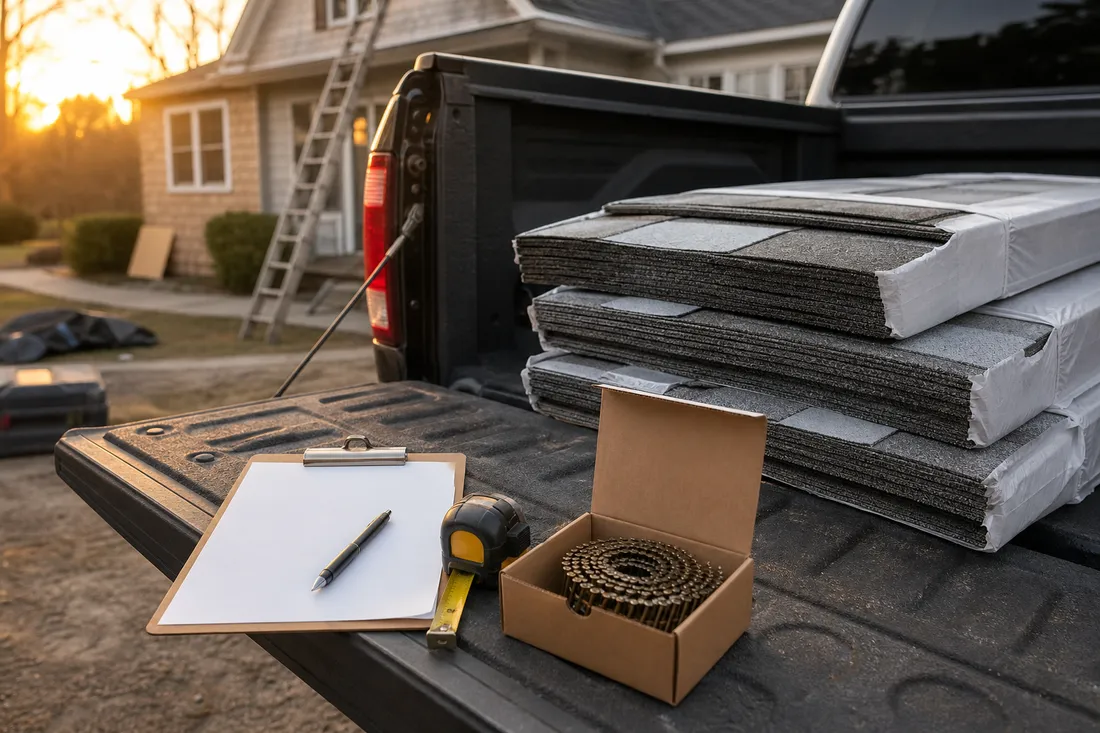
Fill in the invoice while the shingle labels and the dump receipt are still in the truck.
What every roofing invoice needs
An invoice is the customer's record of the work and your record of the sale. The IRS lists invoices among the supporting documents that back up the entries in your books and on your tax return. Write each one for two readers: the homeowner who pays it and you at tax time.
Roofr says a good roofing invoice lists the work done, the materials used, labor charges, dates of service and payment terms, plus your business details and the customer's contact information. It also points to the invoice number, your license and insurance details, and any warranty notes. ServiceTitan's template adds the scope of work, the subtotal, applicable taxes, and extra terms such as late fees and warranty information.
| Part | What to write | Example line |
|---|---|---|
| Header | Business name, phone, license number, invoice number, date | "Lic. #[Number] · INV-2041" |
| Customer and site | Bill-to name, property address, PO number if any | "Roof at: 18 Birch Lane" |
| Scope of work | What you removed and what you installed | "Tear-off and replacement, asphalt shingles" |
| Materials | Named products with quantities | "Underlayment, [X] rolls" |
| Labor | Crew time or a flat labor line | "Labor, tear-off and install" |
| Extras | Disposal, permit, decking repairs, change orders | "Disposal and dumpster" |
| Totals | Subtotal, tax if required, deposit paid, balance due | "Deposit received: -[Amount]" |
| Terms | Due date, payment methods, warranty | "Due within [X] days" |
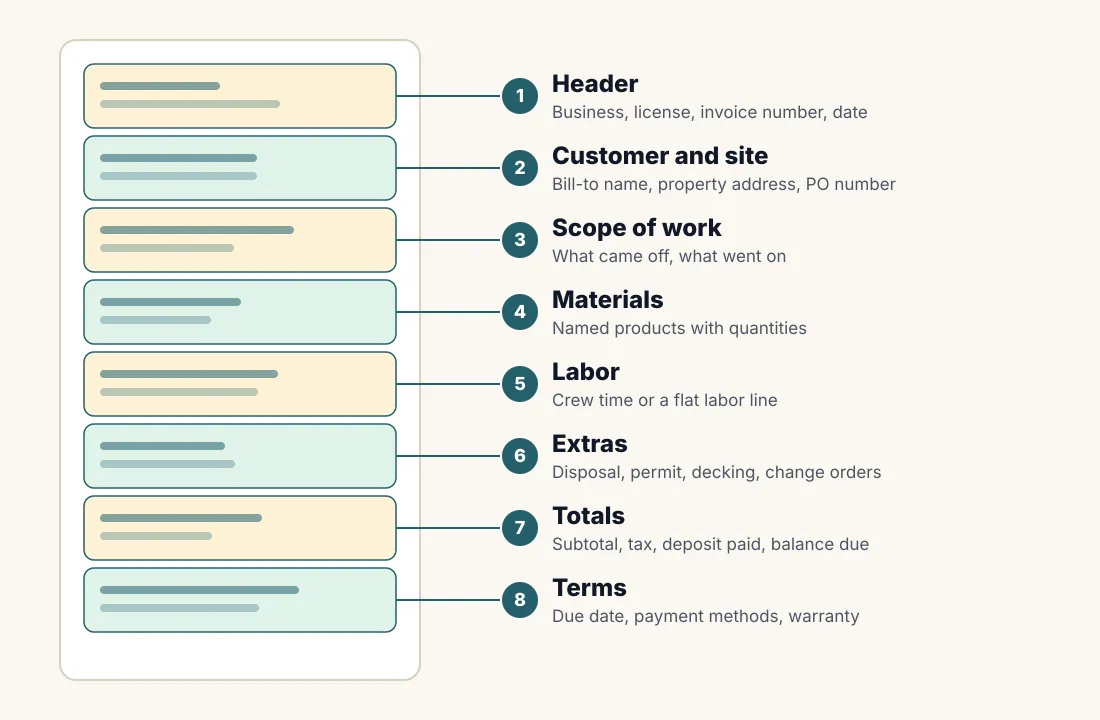
The parts a roofing invoice can carry. Skip the ones a job does not need. Diagram only.
Number invoices in order and never reuse a number. "INV-" plus a running count is enough. When a customer calls about a charge months later, the number takes you straight to the job.
Roofing squares, tear-off and billing materials
Roofing is measured in squares. GAF defines one square as 100 square feet, or 10 feet by 10 feet, and uses it to work out how many shingles a job needs. Its worked example adds two roof planes of 1,260 square feet each, which makes 2,520 square feet, or 25.2 squares.
Print the square count on the invoice so the customer can match it to your estimate. GAF also suggests adding up to 10 percent for overage, and warns against using the home's floor area as the roof size. Its example has a 2,200 square foot house under a roof of about 3,500 square feet, because overhangs, details and slope all add area.
Bill tear-off and disposal as their own lines, even when the price is built into a flat total. Customers ask about them more than any other item, and a separate line answers the question before it is asked. If you bill materials by the bundle, say so. Shingles are sold in bundles, and GAF notes that each product's specifications state how many bundles make a square.
Keep the invoice consistent with the estimate. If you quoted a flat price, do not switch to hourly because the job ran long. Show any extra work as a change order, as template 4 does.
Sales tax, deposits and liens: check your state
Three rules change from state to state, and an invoice template cannot settle them for you.
Sales tax. The Texas Comptroller, for example, says labor to repair or remodel residential real property is not taxable, while the total charged for repairing nonresidential property is taxable, and its section on nonresidential work lists reroofing as repair or remodeling. It also describes lump-sum contracts, where you pay tax on your materials when you buy them, and separated contracts, where you charge tax on materials and the construction labor stays untaxed. Other states differ. Ask your state revenue department how a roofing invoice should be set up.
Deposits. Some states cap them. California's contractor board says a down payment on a home improvement job cannot exceed $1,000 or 10 percent of the contract price, whichever is less. Check your own state's limit before you write a deposit invoice.
Liens. In California, the contractor board advises homeowners to collect conditional releases before paying and unconditional releases after, and says the direct contractor must get release signatures from potential lien claimants. Lien notice and release rules vary by state, so confirm them with your state licensing board or a construction attorney before you rely on any form.
When to send each roofing invoice
| Situation | Send when | Channel |
|---|---|---|
| Repair | Before the crew leaves | Printed copy or email from your phone |
| Replacement with deposit | Deposit invoice at booking, final invoice at completion | |
| Progress billing on a large job | At each stage named in the contract | |
| Change order | When the customer approves the added work | Email, signed copy kept |
| Insurance job | After completion, with the claim details | Email, photos attached |
| Commercial job | Per the customer's billing terms, with the PO number | Email to accounts payable |
| Past due | The day after the due date, then 7 days later | Email first, then a call |
1. Roof replacement invoice
Use this for a full tear-off and install. It carries the square count, named materials and the disposal charge, then subtracts the deposit already paid.
INVOICE
[Business name] · [Phone] · [Email]
License #: [Number]   Insurance: [Carrier / policy on request]
Invoice #: INV-[Number]    Date: [Date]
Due date: [Date or "Due on completion"]

BILL TO
[Customer first name] [Last name]
[Billing address]

PROPERTY
[Roof address]
Roof area: [X] squares (1 square = 100 sq ft)
Pitch: [X]/12   Layers removed: [X]

SCOPE OF WORK
Removed existing roofing down to the deck.
Installed new roof system as listed below.
Completed: [Date]

MATERIALS
Qty   Description                         Price     Amount
[X]   Shingles, [brand / line / color],
      bundles                             [Price]   [Amount]
[X]   Underlayment, [type], rolls         [Price]   [Amount]
[X]   Drip edge, [color], pieces          [Price]   [Amount]
[X]   Ridge cap, [type], bundles          [Price]   [Amount]
[X]   Pipe boots and vents                [Price]   [Amount]
[X]   Nails, starter strip, sealant       [Price]   [Amount]

LABOR AND DISPOSAL
Tear-off, [X] squares                     [Rate]    [Amount]
Installation, [X] squares                 [Rate]    [Amount]
Dumpster and disposal                     [Price]   [Amount]
Permit                                    [Price]   [Amount]

Subtotal:                                           [Amount]
Sales tax (if required):                            [Amount]
Total:                                              [Amount]
Deposit received [Date]:                           -[Amount]
BALANCE DUE:                                        [Amount]

PAYMENT
Accepted: [Check / bank transfer / card]
Payable to: [Business name]

WARRANTY
Workmanship: [X] years. Materials: per manufacturer.
Name each material the way the supplier does, with brand, line and color. "Architectural shingles, [line], [color]" settles a later question about what went on the roof. If decking was replaced, add a line for it with the sheet count so the extra cost is visible.
2. Roof repair invoice
Repairs are small, quick and usually billed by time and materials. This version works for a leak, a few lifted shingles or flashing around a chimney. State what you found, because the customer cannot see it from the ground.
INVOICE
[Business name] · [Phone] · [Email]
License #: [Number]
Invoice #: INV-[Number]    Date: [Date]
Due date: [Date or "Due on completion"]

BILL TO
[Customer name]
[Billing address]

PROPERTY
[Roof address]

REPORTED
[e.g. "Water stain on the ceiling below the chimney"]

FOUND
[e.g. "Cracked step flashing and failed sealant
at the chimney. Three lifted shingles."]

DONE
[e.g. "Replaced step flashing, resealed the
chimney, replaced and nailed three shingles."]

LABOR
Crew: [X]   Arrived: [Time]   Done: [Time]
Qty   Description                  Rate     Amount
1     Service call / trip fee      [Rate]   [Amount]
[X]   Labor, per hour              [Rate]   [Amount]

MATERIALS
Qty   Description                  Price    Amount
[X]   Step flashing, pieces        [Price]  [Amount]
[X]   Shingles, [type], bundles    [Price]  [Amount]
[X]   Sealant, tubes               [Price]  [Amount]

Subtotal:                                   [Amount]
Sales tax (if required):                    [Amount]
BALANCE DUE:                                [Amount]

WARRANTY
Repair labor: [X] days. Does not cover new leaks
elsewhere on the roof.
Write the clock times. Customers question hours less when they can see when the crew arrived and left. Photos of the repaired spot, attached to the email, do the same job for the materials.
3. Deposit invoice and final invoice
On a large job you bill twice, or in stages. Roofr lists progress invoices, billed in stages on big jobs, and a final invoice as the last bill once the work is complete. Send the deposit invoice at booking and the final invoice at completion.
DEPOSIT INVOICE
[Business name] · [Phone]
Invoice #: INV-[Number]    Date: [Date]

BILL TO: [Customer name], [Billing address]
JOB: Roof replacement at [Roof address]
Contract total: [Amount]

Deposit due now (per signed contract):   [Amount]
Due date: [Date]
Remaining after deposit:                 [Amount]
Work starts: [Date, or "after materials are ordered"]

Payable to: [Business name]
FINAL INVOICE
[Business name] · [Phone]
Invoice #: INV-[Number]    Date: [Date]

BILL TO: [Customer name], [Billing address]
JOB: Roof replacement at [Roof address]
Completed: [Date]

Contract total:                          [Amount]
Approved change orders (see CO-[X]):     [Amount]
Total:                                   [Amount]
Deposit received [Date]:                -[Amount]
Progress payment received [Date]:       -[Amount]
BALANCE DUE:                             [Amount]
Due date: [Date]
Match the deposit to what the contract says and to your state's rules. If the contract sets a payment schedule, copy the stage names onto each invoice so the customer sees which milestone is being billed.
4. Change order invoice
A change order covers work added after the contract was signed. Roofr lists it as its own invoice type, for when the scope changes mid-project. Typical causes are rotted decking, extra layers to remove or a skylight the customer adds.
CHANGE ORDER INVOICE
[Business name] · [Phone]
Invoice #: INV-[Number]    Change order #: CO-[Number]
Date: [Date]

BILL TO: [Customer name]
JOB: Roof replacement at [Roof address]
Original contract: [Date signed], [Amount]

REASON FOR CHANGE
[e.g. "Rotted decking found under the north slope
after tear-off. Photos attached."]

APPROVED BY CUSTOMER
Method: [Signed form / email reply]   Date: [Date]

Qty   Description                    Price    Amount
[X]   Decking sheets, [size]         [Price]  [Amount]
[X]   Labor, decking replacement     [Rate]   [Amount]

Change order total:                           [Amount]
Original contract total:                      [Amount]
Revised contract total:                       [Amount]
Due: [Date or "with the final invoice"]
Get the approval before you do the work and keep it with the job file. A signed form or a dated email reply both work. The photo taken at the moment you found the problem is worth more than any explanation afterward.
5. Insurance roofing invoice
Insurance jobs need more detail. Roofr says an insurance roofing invoice should add the claim number, the policyholder's details and policy number, a scope of work tied to the storm, fire or hail damage, photos of the damage, materials and labor subtotals, the deductible, and the final cost after coverage.
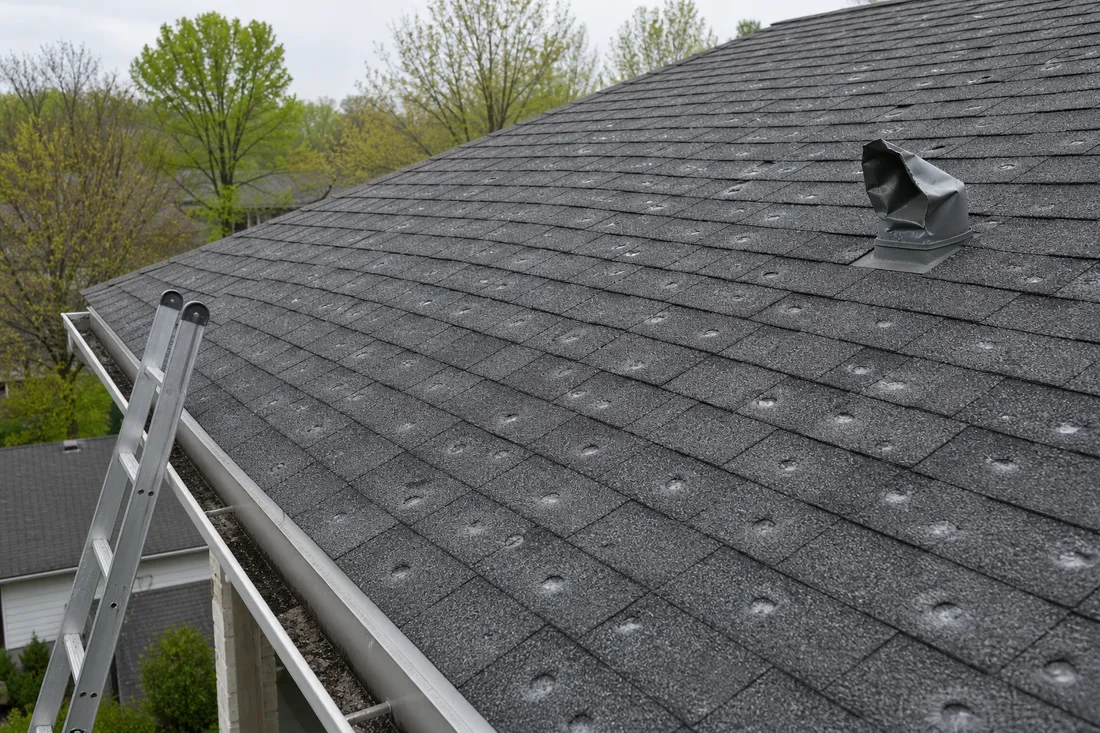
Photograph damage before and after the work. Attach the photos to the invoice or send them with it.
INVOICE: INSURANCE CLAIM
[Business name] · [Phone] · [Email]
License #: [Number]
Invoice #: INV-[Number]    Date: [Date]

BILL TO (POLICYHOLDER)
[Homeowner name]
[Property address]
Insurance company: [Carrier]
Claim #: [Number]    Policy #: [Number]
Date of loss: [Date]    Cause: [Hail / wind / fire]

SCOPE OF WORK
[e.g. "Removed hail-damaged shingles and underlayment
on all slopes. Installed new underlayment, shingles,
ridge cap and vents."]
Photos of damage: attached ([X] photos)

MATERIALS                                   [Amount]
LABOR                                       [Amount]
DISPOSAL                                    [Amount]
Total cost of work:                         [Amount]

Insurance payment(s) received [Date]:      -[Amount]
Deductible (owed by homeowner):             [Amount]
BALANCE DUE FROM CUSTOMER:                  [Amount]
Due date: [Date]
The deductible is the amount the homeowner pays before the policy pays. The National Association of Insurance Commissioners explains that actual cash value coverage accounts for age and wear and tear, while replacement cost coverage pays to repair or replace with like kind and quality, in each case minus the deductible. What the insurer pays is between the homeowner and the carrier. Your invoice only needs to show the work, the payments received and the balance owed.
6. Commercial roofing invoice with PO number
Commercial customers usually pay through accounts payable, which looks for a purchase order number before it releases a payment. ServiceTitan notes that invoices can carry payment terms and PO numbers, and that commercial clients may need an invoice sent to several stakeholders at once.
INVOICE
[Business name] · [Phone] · [Email]
License #: [Number]
Invoice #: INV-[Number]    Date: [Date]
PO #: [Number]    Contract/Project #: [Number]
Payment terms: [Net X days]    Due date: [Date]

BILL TO
[Company name]
Attn: Accounts Payable
[Billing address]
Billing email: [Email]

SITE
[Building name and address]
Roof area: [X] squares   System: [e.g. TPO / modified bitumen]

WORK COMPLETED
[e.g. "Removed failed membrane on the east section.
Installed new insulation board and membrane."]
Completed: [Date]

Qty   Description                    Price    Amount
[X]   Membrane, [type], squares      [Price]  [Amount]
[X]   Insulation board, sheets       [Price]  [Amount]
[X]   Labor, installation            [Rate]   [Amount]
      Disposal                       [Price]  [Amount]

Subtotal:                                     [Amount]
Sales tax (if required):                      [Amount]
Retainage held (if any):                     -[Amount]
AMOUNT DUE:                                   [Amount]

Remit to: [Business name, address / payment details]
Check whether the sales tax rules for nonresidential work differ in your state. In Texas the whole charge for repairing nonresidential property is taxable, which is a different outcome from a homeowner's roof. Put the PO number at the top, where the payment clerk looks first.
7. Invoice email to the customer
The email carries the invoice, so keep it short. Attach the invoice as a PDF and put the amount and due date in the body, so nobody has to open the attachment to see what is owed.
Subject: Invoice INV-[Number] for your roof at [Address]

Hi [First name],

Thank you for choosing [Business name]. Your invoice for
the [replacement / repair] at [Address] is attached.

Amount due: [Amount]
Due date: [Date]

You can pay by [check / bank transfer / card]. Checks go
to [Business name], [Address].

The after photos are attached too. If anything looks
different from what we discussed, reply or call me at
[Phone] and I will sort it out.

Thank you,
[Your name]
[Business name]
8. Past-due invoice reminder
Send the first reminder the day after the due date. Keep the tone plain and give the customer an easy way to pay or to talk to you.
Subject: Reminder: invoice INV-[Number] was due [Date]

Hi [First name],

This is a reminder that invoice INV-[Number] for the roof
at [Address] was due on [Date]. The balance is [Amount].

If you have already paid, thank you, and please ignore
this note. If something about the invoice is unclear, call
me at [Phone] and we will go through it.

You can pay by [method and details].

Thank you,
[Your name]
[Business name]
If you charge late fees, state them on the original invoice and in your contract before the job, not for the first time in a reminder. ServiceTitan lists late fees among the optional terms for a roofing invoice, and eForms' roofing template has a field for a late fee as a percentage. Check what your state allows before you add one.
Mistakes that slow down roofing payments
- A total with no scope. "Roof: [Amount]" invites a call. Three lines on what came off and what went on answer it first.
- Unnamed materials. Without the brand, line and color, a later warranty question or a matching repair starts from scratch.
- Hidden extras. Show disposal, permits and decking repairs as their own lines so nothing looks like a surprise.
- Verbal change orders. Get the added work approved in writing before you do it.
- Losing the paper trail. The IRS says to keep records for 3 years in most cases, and longer in some situations. Save every invoice, photo and payment record in one folder per year.
If you are still working out what to charge before the invoice, the roofing estimate template covers the bid, and the roofing contract template covers the agreement that sits between the two. After a paid job, a happy customer is the best moment to ask for a Google review.
Questions roofers ask about invoices
What should a roofing invoice include?
Your business name, contact details and license number, then an invoice number and date, the customer's name and billing address, and the property address. Add the scope of work, named materials with quantities, labor, disposal and permit lines, any change orders, tax if your state requires it, deposits received, the balance due, the due date, payment methods and your warranty.
Should I list labor and materials separately on a roofing invoice?
Usually, yes. A customer can check a bill that shows materials and labor on separate lines, and separate lines head off questions about the total. It can also matter for sales tax, because some states treat labor and materials differently. Check your state's rules before you decide.
When should a roofer send the invoice?
Before the crew leaves, if you can. Send repair invoices from your phone while the customer can still see the work. For a replacement, send the deposit invoice at booking and the final invoice once the roof is finished. Commercial customers may set their own billing dates, so follow those.
How do I invoice an insurance roofing job?
Bill the full cost of the work, then show the insurance payments received and the deductible the homeowner owes. Add the claim number, policy number, date of loss and photos of the damage. The insurer decides what it pays, so keep your invoice to the work done and the amounts received.
How long should I keep roofing invoices?
Keep them for at least 3 years in most cases, according to the IRS, and longer if your situation falls under one of its other rules. A workmanship warranty can outlast that period, so keep each invoice for as long as the warranty runs. Store the invoice, the photos and the payment record together.
Get the next roof inspection booked
A clear invoice closes out one job. The next step is making the following one easy to book. If you want a website where homeowners can see your roofing services and ask for an inspection, you can get a booking site for your roofing business with Kejoola. It is a four-page site with Home, Services, Blog and Contact pages, and the booking form takes a name, email, phone number and a notes box where a homeowner can describe the leak or the storm damage. For what that site should cover, see what a bookable roofing site needs.
14-day free trial, no card needed. Online booking starts on the Starter plan.
Sources
- Free Roofing Invoice Templates, Roofr
- Free Roofing Invoice Template, ServiceTitan
- Roofing Invoice Template, eForms
- How to Measure a Roofing Square, GAF
- Actual Cash Value vs Replacement Cost Coverage, NAIC
- Real Property Repair and Remodeling, Texas Comptroller
- Learn About Home Improvement Contracts, CSLB
- How to Prevent a Mechanics Lien, CSLB
- What Kind of Records Should I Keep, IRS
- How Long Should I Keep Records, IRS