Scheduling software for gyms: A Guide to Streamlining Your Gym Operations
Discover the essential features of scheduling software for gyms and learn how to choose the right platform to streamline operations, reduce no-shows, and unlock growth.
Josh · Jan 13, 2026 · 19 min read
- gym management
- scheduling software
- fitness technology
Scheduling Software For Gyms
Running a gym without dedicated scheduling software often feels like chasing your tail. You juggle spreadsheets, text threads, and scattered DMs just to keep classes and appointments in line. It’s both exhausting and error-prone, leaving members and staff more frustrated than fit.
Why Manual Scheduling Holds Your Gym Back
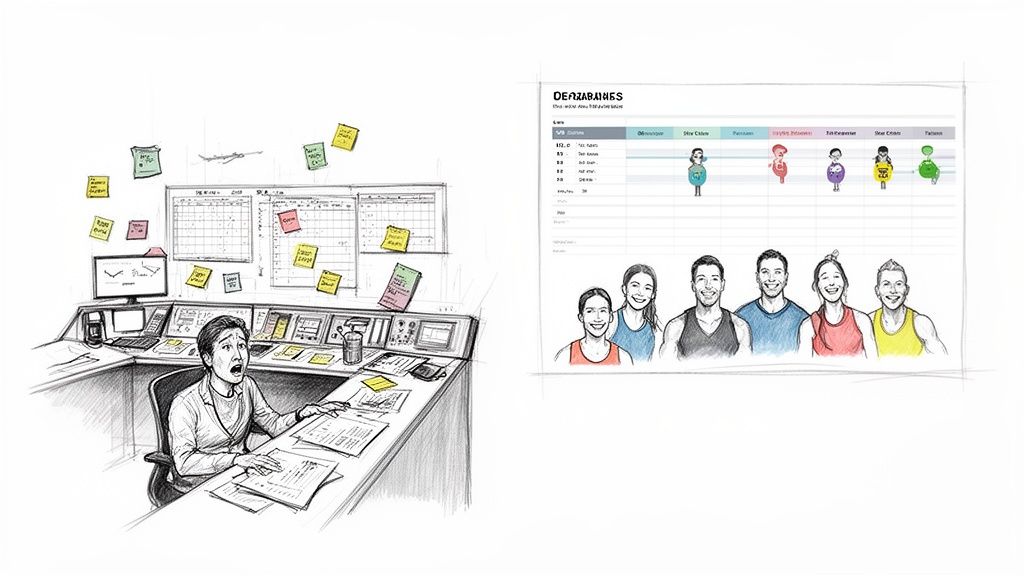
Think about your reception desk as a makeshift control tower. Every new booking or cancellation becomes a scramble to update multiple records.
Meanwhile, your team spends more time on clerical chores than on engaging members. That’s time best spent on the gym floor, not on data entry.
The True Cost Of Manual Chaos
Every double-booked trainer session or missed confirmation chips away at your gym’s reputation—and its revenue. No one notices spreadsheets behind the scenes; they only feel the frustration when a class is full or a session falls through.
This is costly: the gym software market, valued at USD 16.88 billion in 2024, is on track to hit USD 38.05 billion by 2032. Operators embracing automation often see income boost by 20–30%.
Automating your schedule turns the chaos of constant changes into a reliable, revenue-generating thread. It’s like having a 24/7 front desk that never misses an update.
Manual Chaos Vs Automated Control A Gym Scheduling Snapshot
To grasp the everyday difference, compare these core tasks:
| Operational Task | Manual Method (Spreadsheets & Texts) | Automated Software Solution |
|---|---|---|
| Class Bookings | Multiple sheets, risk of overbooking | Real-time availability, instant member confirmations |
| Appointment Management | Phone calls and DMs, slow updates | Online calendar with auto-sync for trainers and members |
| Member Communication | Individual texts, no shared history | Centralized messages with automated reminders via email/SMS |
| Staff Scheduling | Manual roster juggling, constant back-and-forth | Role-based access and self-service shift swaps |
| No-Show Handling | Tracking by hand, delayed follow-up | Automated reminders and waitlist notifications |
| Data Reporting | Time-consuming exports, manual analysis | One-click reports on attendance, revenue, and engagement |
This snapshot underlines a clear truth: manual methods breed bottlenecks, while automation delivers clarity and speed.
Moving From Reactive To Proactive Operations
When you spend each day fixing booking mistakes, growth initiatives get shelved. A gym-focused scheduling platform frees you to plan ahead.
A dedicated scheduling software for gyms empowers you to:
- Reduce Client Frustration: Members self-manage bookings, cancellations, and swaps, cutting down on front-desk calls.
- Minimize No-Shows: Automated reminders via email and SMS slash missed sessions, securing your revenue.
- Empower Your Staff: Trainers control their own availability and watch changes appear instantly.
- Resolve Schedule Conflicts: Clear alerts and auto-adjust features help you https://kejoola.com/blog/schedule-conflict-meaning.
Switching to automation is more than an efficiency upgrade. It’s a strategic shift that strengthens member loyalty, sharpens your operations, and fuels sustainable growth.
The Non-Negotiable Features of Great Gym Software
Picking the right scheduling software for gyms isn't just about ticking boxes on a feature list. Think of it as hiring a new team member—one that works 24/7 to manage your revenue, keep clients happy, and cut down your admin headaches. The best platforms stop being simple booking tools and become the central nervous system for your entire operation.
Every feature should solve a real-world problem you face daily. As you look at different options, it’s worth reviewing the essential features of gym scheduling software to see what the industry standard is, but let's break down the core components you absolutely can't do without.
Class and Appointment Booking
First and foremost, the software has to nail the basics. It needs to manage the intricate dance of your gym's schedule—from the recurring Tuesday spin class to a one-off personal training session—without a single misstep. Can it handle multi-session passes, drop-in clients, and different membership levels all at once?
The whole point is to make double bookings a thing of the past and scheduling a breeze for both your team and your members. If your staff struggles to add a new yoga class or a trainer can't block off their holiday time in a few clicks, the system is creating more problems than it solves. This booking engine is the foundation for everything else.
Automated Waitlists and Reminders
No-shows and last-minute cancellations are the silent killers of a gym's profitability. An empty bike in a sold-out spin class is money left on the table, plain and simple. This is where automated waitlists and reminders stop being a "nice-to-have" and become a serious revenue tool.
A great system doesn’t just log a cancellation; it immediately goes to work to fill that spot. By automatically pinging the next person on the waitlist, you salvage that income and keep your classes packed.
On top of that, automated SMS or email reminders are proven to slash no-show rates. These quick pings keep your gym on your members' radar and make sure they follow through on their bookings. This feature alone is one of the fastest ways to plug financial leaks.
Integrated Payment Processing
Making members book in one place and pay in another creates unnecessary friction and a cash flow nightmare for you. Modern gym software absolutely must have integrated payment processing, letting members pay for classes, packages, or memberships the second they book.
This simple connection delivers huge wins:
- Better Cash Flow: You get paid upfront, so you're not chasing people down for payment after the fact.
- A Smoother Client Experience: Members love the convenience of handling everything in one quick, easy step.
- Less Admin Work: Your front desk team can stop being cashiers and start building relationships with members.
By tying your schedule directly to your bank account, the software starts working for your financial health. To learn more, check out our guide on finding the right class scheduling software that puts these financial tools front and center.
Client Self-Service Portals
Giving your members more control is one of the best ways to reduce your own workload while making them happier. A client self-service portal lets them manage their own fitness journey, freeing them from having to call your front desk for every little thing.
Through their own secure login, members should be able to:
- Book, reschedule, or cancel their own sessions.
- Check their upcoming schedule and see past visits.
- Update their credit card or personal info.
- Buy new class packs or upgrade their membership.
This kind of autonomy doesn't just save your staff countless hours; it’s what today's clients expect. They want on-demand access and control, and providing it turns a simple customer relationship into a more engaged and loyal one.
How To Choose The Right Software For Your Gym Model
Picking the wrong scheduling software for gyms is one of those expensive mistakes that you feel for months, wasting both time and money you simply don't have. To get it right the first time, you need a clear framework for matching a platform’s features to your specific business.
After all, a solo personal trainer and a multi-location fitness center are playing two completely different games. Your software has to fit the game you’re playing right now, and the one you want to play in the future. There are four make-or-break criteria to focus on: scalability, ease of use, integrations, and mobile design.
This decision tree gives you a visual on how different gym models should weigh these features.
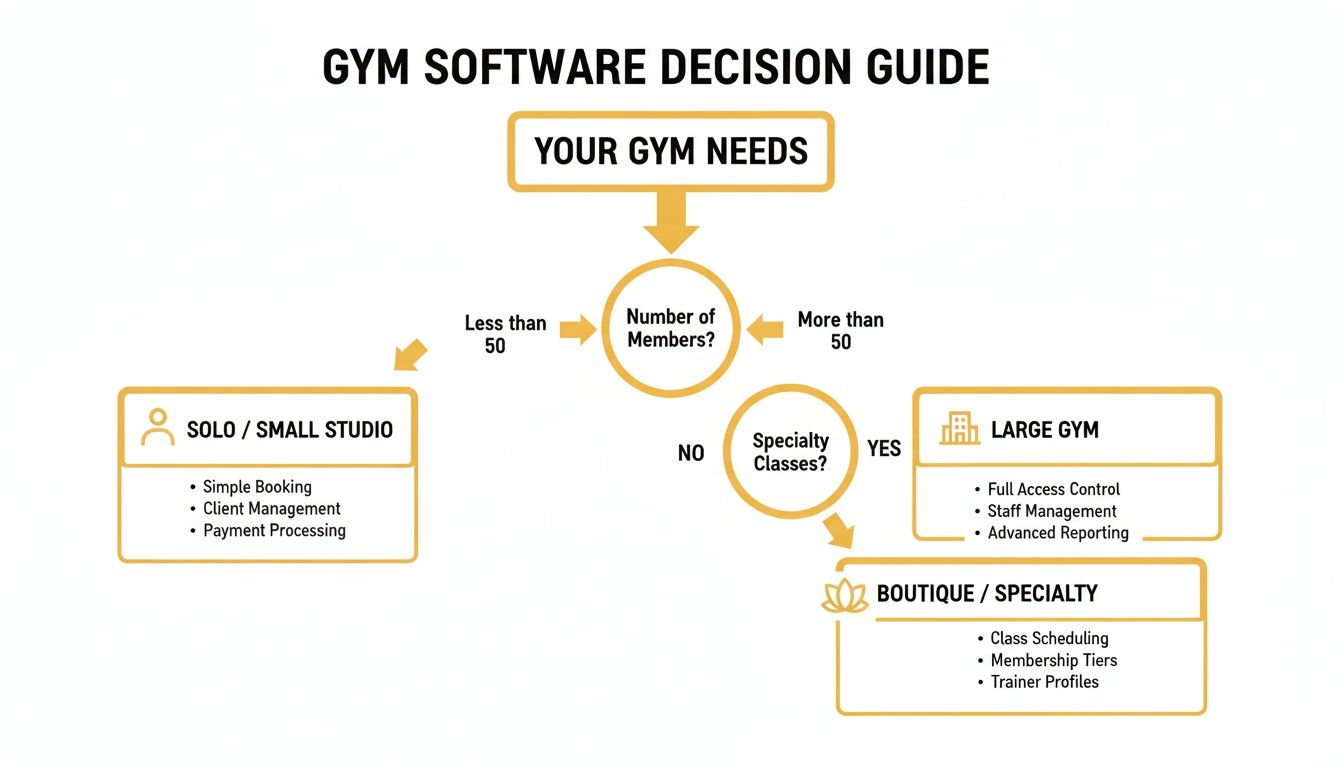
As you can see, core scheduling is a given for everyone. But for a boutique studio, specialized class management is everything. For a large facility, it’s all about having a rock-solid, scalable system that won’t crash during peak sign-ups.
Can The Software Scale With Your Ambition
Scalability isn't just an industry buzzword; it's a very practical question. Can this software handle your five-year plan? Will it support you when you're ready to open that second location? Can it manage a growing roster of trainers, each with their own schedules and client lists?
Look for a platform that doesn’t box you in or penalize you for growing. A system that’s a dream for 100 members might completely fall apart at 1,000. You need to know that the software can handle multi-location management, different staff permission levels, and a much higher volume of bookings without slowing down.
Investing in a scalable solution from the start prevents a painful and expensive migration down the line. Your software should be a partner in your growth, not a barrier to it.
How Effortless Is The User Experience
A platform can have all the bells and whistles in the world, but it’s useless if your staff and members can’t figure it out. You have to look at "ease of use" from two different angles: the back-end experience for your team and the front-end experience for your clients.
For your team, the admin interface needs to be intuitive. Can your front desk staff add a new yoga class in under a minute? Can a trainer block off their vacation time with just a few clicks? A clunky system breeds mistakes and frustrated employees.
For your members, the experience has to be totally frictionless. The booking process should be so easy they don't even have to think about it. If they have to hunt around for the schedule or get stuck on a confusing payment page, they’ll just give up and text you instead—which is exactly what you're trying to avoid. If you're still using spreadsheets, it’s worth checking out some popular https://kejoola.com/blog/free-online-scheduling-tools just to see how smooth a modern, user-friendly interface can be.
Does It Integrate With Your Existing Tools
Your scheduling software doesn't live on an island. It has to talk to all the other tools you use to run your business, from your accounting package to your email marketing service.
Solid integrations are what prevent data silos and kill manual data entry. You’re looking for a few key connections right out of the box:
- Payment Gateways: It must connect directly with services like Stripe or Square for seamless, reliable payments.
- Marketing Platforms: It should sync your member list with tools like Mailchimp so you can run automated email campaigns.
- Accounting Software: The ability to export financial data to platforms like QuickBooks will make your bookkeeper’s life infinitely easier.
Without these connections, your team is stuck copying and pasting information between systems—a massive time-waster that’s practically guaranteed to introduce errors.
Is It Designed For Mobile First
Let's be realistic: your members live on their phones. A mobile-first design isn’t a nice-to-have anymore; it's an absolute necessity. And that doesn't just mean "mobile-friendly," which is often just a shrunken, hard-to-use version of the desktop site. It means the entire experience was designed for a small screen from the ground up.
Members need to be able to book, pay, and manage their entire schedule without ever pinching or zooming. A dedicated, brandable mobile app is the gold standard here, as it offers a far superior user experience and keeps your gym constantly visible on their home screen. Once you have a handle on these key areas, this guide to choosing scheduling software for gyms can give you some more detailed pointers for making your final selection.
7. Unlocking Growth With Advanced Scheduling Capabilities
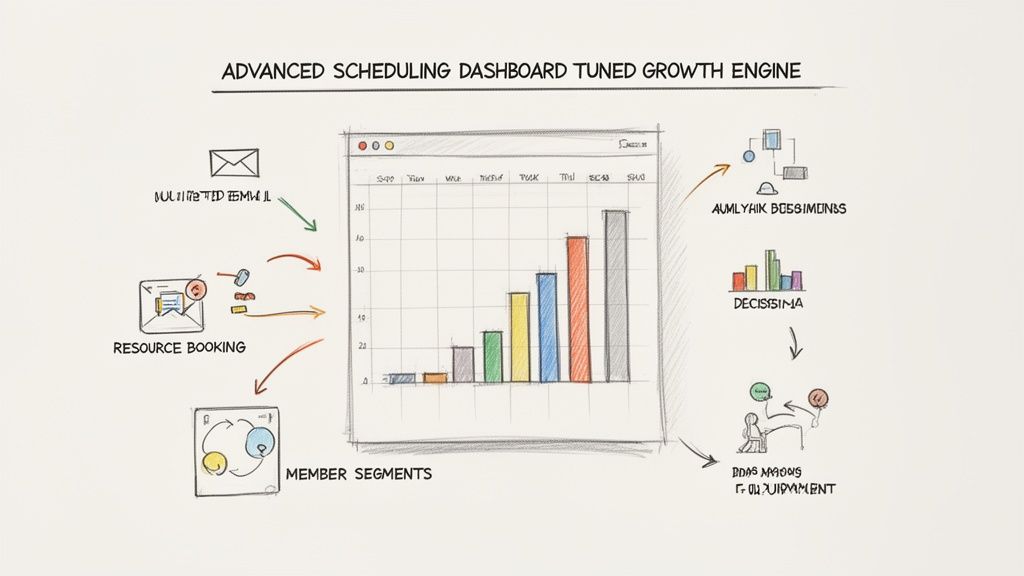
Once you’ve nailed the day-to-day operations, the right scheduling software for gyms stops being just a management tool and starts acting like a powerful engine for growth. It goes beyond simply booking classes and becomes a source of business intelligence, shining a light on opportunities you might otherwise miss.
These advanced capabilities are what separate a basic digital calendar from a genuine strategic asset. By digging into your data and automating client outreach, a modern platform helps you build a smarter, more profitable gym.
Transform Data Into Decisions With Reporting And Analytics
Your scheduling software is sitting on a goldmine of data. Every single booking, check-in, and cancellation tells a story about your members' habits and what they value. The reporting and analytics features are your tools for translating that story into smart, actionable insights.
Instead of just guessing what might work, you can finally make decisions backed by real numbers. You’ll be able to see, clear as day, which classes are consistently packed and which ones are struggling to fill up.
This clarity allows you to:
- Optimize Class Schedules: Double down on popular time slots or instructors and re-evaluate underperforming classes to maximize every spot.
- Identify Your Most Valuable Members: Pinpoint your most loyal clients, the ones who show up week after week, and create special offers or loyalty programs to keep them happy and engaged.
- Forecast Revenue: Track booking trends over time to get a real sense of your busy seasons, helping you plan staffing and marketing budgets with confidence.
By turning raw numbers into clear, understandable reports, you stop running your gym on gut feelings. You start making strategic moves based on how your members actually behave.
Build A Retention Engine With Automated Marketing
Keeping your members is the absolute bedrock of a successful gym, and automated marketing features can turn your scheduling software into a proactive retention machine. These systems can be set up to send out personalized messages based on a member's activity—or lack thereof.
Think of it as having a digital assistant who never forgets to check in or misses a chance to connect with your clients. You can build automated workflows that send perfectly timed emails or text messages for specific events.
For example, if a member hasn't booked a class in 30 days, the system can automatically send them a "We miss you!" email with a special offer to get them back in the door. This proactive touch keeps your brand top-of-mind and helps stop churn before it happens.
This isn’t just a nice-to-have; it's becoming critical. The latest AI integrations in gym software can now predict member churn with 85-90% accuracy just by analyzing booking patterns. These insights allow for proactive interventions that can retain 20-25% more members—a massive win in a fitness and wellness software market projected to hit USD 133.70 billion by 2030. You can read more about how these hybrid digital models are changing the game on Business Wire.
Maximize Your Assets With Resource Management
For many gyms, your space and equipment are valuable, limited resources. A spin studio only has so many bikes, and a popular squat rack can quickly become a bottleneck during peak hours. Advanced resource management features let you schedule these physical assets just like you schedule classes.
This means you can attach specific resources—like a particular room, a Pilates reformer, or even a specific piece of equipment—to a booking. Members can then reserve not just their spot in a class, but the exact equipment they plan to use.
This level of detail helps you maximize every square foot of your facility, preventing overbooking and ensuring a smooth, frustration-free experience for your members. It transforms your physical space from a simple cost into a fully optimized, revenue-generating asset.
The leap from basic scheduling to a fully integrated growth platform can feel big, but it’s really a series of small, strategic upgrades. The table below shows how standard features evolve into advanced capabilities that drive real business results.
From Basic Scheduling To Strategic Growth
| Standard Feature | Advanced Capability | Business Impact |
|---|---|---|
| Simple Class Calendar | Data-Driven Schedule Optimization | Maximizes attendance, increases revenue per class, and reduces wasted instructor time. |
| Manual Member Communication | Automated Marketing Workflows | Proactively reduces churn, boosts member engagement, and saves hundreds of admin hours. |
| Generic Booking | Specific Resource Management | Increases equipment and room utilization, prevents member frustration, and creates new revenue streams. |
| Basic Payment Processing | Integrated Revenue Reporting | Provides clear financial oversight, helps in forecasting, and identifies top-performing services. |
As you can see, each advanced feature builds on a basic need but elevates it from a simple operational task to a strategic advantage. This is how you move from just running your gym to actively growing it.
A Simple Plan For A Smooth Software Transition
Let's be honest: the thought of switching software can be daunting. The fear of a chaotic, disruptive change is what keeps many gym owners shackled to clunky, outdated systems. But it doesn't have to be that way. With a solid plan, moving to a new system can be an energizing upgrade for your business, your team, and your members.
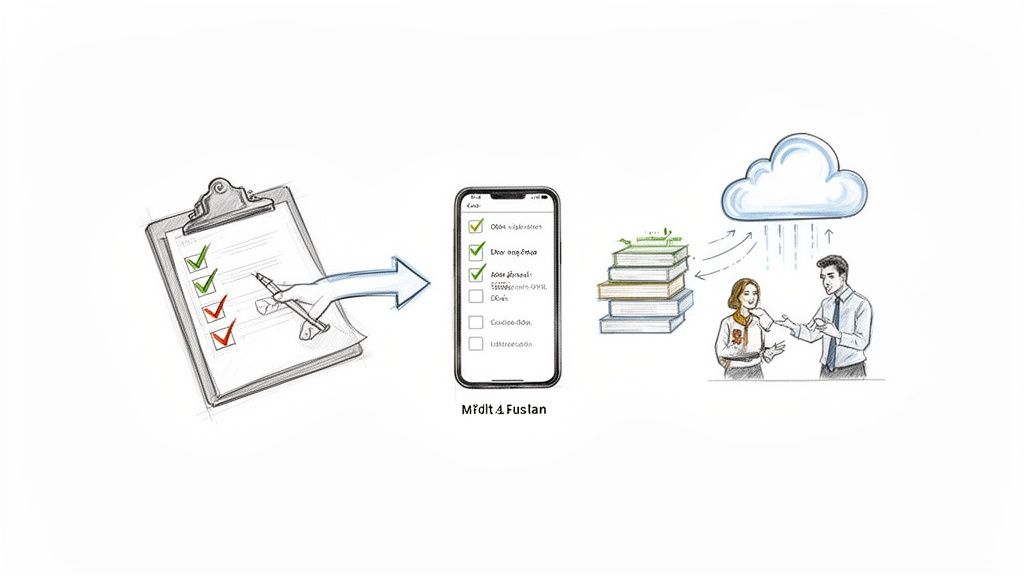
The secret is to break the whole process down into manageable chunks. A little bit of proactive planning can turn a project that feels overwhelming into a well-organized, step-by-step rollout. When you focus on preparation and clear communication, everyone involved feels confident and ready for the change.
Prepare Your Data For Migration
Before you can even think about flipping the switch, you need to get your existing data in order. This is arguably the most important step for preventing major headaches down the line. Think of it like packing for a house move—you wouldn't just toss everything into boxes randomly. You'd sort, label, and organize.
Start by pulling all the crucial information out of whatever you're using now, whether that's a series of spreadsheets or an old software platform. We're talking about member names, contact info, current membership types, and any payment details. Go through this data with a fine-tooth comb, hunting down duplicates, old accounts, and weird formatting errors before you import a single line into the new scheduling software for gyms.
A clean data migration is the bedrock of a successful launch. The time you invest now in scrubbing your member lists and payment details will save you from an avalanche of support tickets and administrative clean-up later.
Configure Your New System And Train Your Team
With your data prepped and ready, it's time to set up your new software to actually run your gym. This isn't about just turning it on; it’s about tailoring the platform to fit your specific classes, staff roles, and the unique way you do business.
This setup phase is also the perfect opportunity to get your team trained up. Your staff are the face of this change, and their confidence will make or break how your members feel about it.
Here’s a practical checklist for a structured setup and training period:
- Build Your Schedule: Start by recreating all of your class types, trainer assignments, and appointment slots in the new system. Make sure you set the right class capacities, pricing, and booking rules for every single service.
- Define Staff Roles: Create different permission levels for managers, front-desk staff, and trainers. This ensures everyone has access to the tools they need to do their job, and nothing more.
- Conduct Hands-On Training: Don't just give your team a demo. Get them in there, clicking around. Have them practice booking a member into a class, running a payment, and processing a cancellation. This builds real-world confidence and helps you spot confusing parts of the workflow before you go live.
- Create A Reference Guide: A simple one-page "cheat sheet" with answers to common questions can be a lifesaver. It empowers your staff to solve small problems on their own without having to ask a manager every time.
Communicate The Change To Your Members
The final piece of the puzzle is your members. They need to know what’s changing, why it’s a good thing for them, and exactly what they need to do. Clear, consistent, and early communication is absolutely non-negotiable here.
Give everyone a heads-up at least a few weeks in advance. Use all your channels—email newsletters, social media posts, and even signs at the front desk. Frame the switch as an upgrade that will improve their experience, highlighting benefits like easier online booking or a clearer view of their schedule. As you get closer to launch day, send out detailed, step-by-step instructions on how to log in and book their next class. Ultimately, a smooth transition for your members comes down to how well you prepare them for it.
Tying Up the Loose Ends: Your Top Questions Answered
Even when you see the potential, a few practical questions always pop up. It's totally normal. Let's tackle some of the most common things gym owners ask before they commit to a new scheduling system, so you can move forward with confidence.
What’s This Going to Cost Me?
The price tag on scheduling software for gyms can really run the gamut, but you'll mostly see monthly subscription plans. The cost usually scales with your business—think number of members, staff accounts, or even how many locations you have. For a small, single-location studio, you might find basic plans starting around $50 to $100 a month. For larger, multi-location gyms needing all the bells and whistles, that number can easily climb past $250 a month.
But here's the thing: don't get fixated on just the monthly fee. The real question is about value. If a system slashes your no-show rate and gives you back five hours of admin work every week, it's not a cost; it's an investment that pays for itself. Always dig a little deeper and ask about one-time setup fees, the percentage they take on payment processing, and any extra charges for add-on features you might need down the line.
Can I Bring My Existing Client Data with Me?
Absolutely. Any software provider worth their salt has a plan for this. You're not going to be starting from scratch. The process usually involves pulling your member list from wherever it lives now—be it an old-school spreadsheet or another software—and exporting it as a common file type, like a CSV.
From there, you upload that file into the new system. A good company won't just leave you to figure it out; they'll provide clear instructions, and often, a real person to walk you through it. Your member data is gold, and they know a smooth transition is non-negotiable.
Is This Going to Be a Headache for My Members to Use?
This is probably one of the biggest fears I hear from gym owners, and it's a valid one. But the good news is that modern platforms are built for your members first. The best systems have clean, mobile-friendly designs that make booking a class as easy as ordering a pizza on an app. A few taps are all it takes to view the schedule, grab a spot, and handle payment.
The goal of today's software isn't just to be functional; it's to be invisible. The booking experience should be so smooth that your members don't even have to think about it. That's the new standard.
How Does This Actually Help Keep My Members Around?
It’s all about removing the little annoyances that add up. Think about it: automated class reminders mean fewer no-shows, which ensures members actually use the membership they're paying for. Giving them the power to book a class at 10 p.m. from their couch removes a major barrier to showing up. It’s all about making it incredibly easy for them to stay engaged.
On top of that, when you automate all the tedious scheduling tasks, you free up your team. Instead of being stuck behind a desk, they can be on the gym floor, talking to members, correcting form, and building the kind of community that people don't want to leave. That mix of high-tech convenience and high-touch connection is exactly how you boost member retention.
Ready to stop juggling spreadsheets and start growing your business? Kejoola gives you an AI-powered website with smart booking built-in, so you can manage your schedule, clients, and payments all in one place. Launch your professional, SEO-optimized site in minutes and give your clients the seamless booking experience they deserve.
Start your free trial today at https://kejoola.com.


