Electrical Estimate: How to Price and Write One in 5 Steps
An electrical estimate is a written, itemized price for electrical work, given before the job starts. Build it in five steps: scope the job, take off materials, price labor, add overhead and profit, then write it up.
Josh · Nov 13, 2026 · 11 min read
- electrical estimate
- electrical estimating
- how to estimate electrical work
- electrician pricing
- electrical business
An electrical estimate is a written, itemized price for electrical work, given to the customer before the job starts. You build it in five steps: scope the job on site, take off the materials, price the labor hours, add overhead and profit, then write it up with scope, exclusions and a valid-until date. The steps below use published figures from trade and pricing sources, so you can check each number against your own. They fit residential service and remodel work best, with notes where commercial bids differ.
What an electrical estimate is
Housecall Pro separates two words that get used as one. Estimating is the method you use to work out what a job will cost you. The estimate is the document the customer receives. A good method with a sloppy document still loses work, and a tidy document built on a guess loses money.
Commercial work adds a third word. Jobber notes that commercial and construction jobs usually start with a request for proposal, a package that sets out the scope, the specifications and the timeline. Your answer to that package is a bid. The math is the same as for a house call, but the plans and specifications replace the walkthrough.
What the customer compares your number to
Before a homeowner reads your estimate, they have usually searched for what an electrician costs. It helps to know what they found.
HomeAdvisor reports that licensed electricians charge $50 to $130 per hour, plus a service-call fee of $100 to $200 for the first hour. It puts the average job at $351. Fixr gives an hourly range of $70 to $131 and says most homeowners pay $176 to $327 for a service call.
Those sites publish job ranges too. HomeAdvisor lists an electrical panel upgrade at $1,200 to $2,000 and an outlet installation at $200 to $300. Jobber, writing for contractors, puts a main panel upgrade at $2,000 to $4,500 and an EV charger installation at $800 to $2,500.
The ranges disagree, and that is the point. A customer holding a $1,200 figure from one site will question a $3,800 panel estimate unless the document shows why. Itemizing the service size, the grounding work and the permit answers the question before it is asked.
Step 1: Scope the job on site
You cannot price what you have not seen. For residential work, Jobber recommends starting with a walkthrough of the house, and lists what to check:
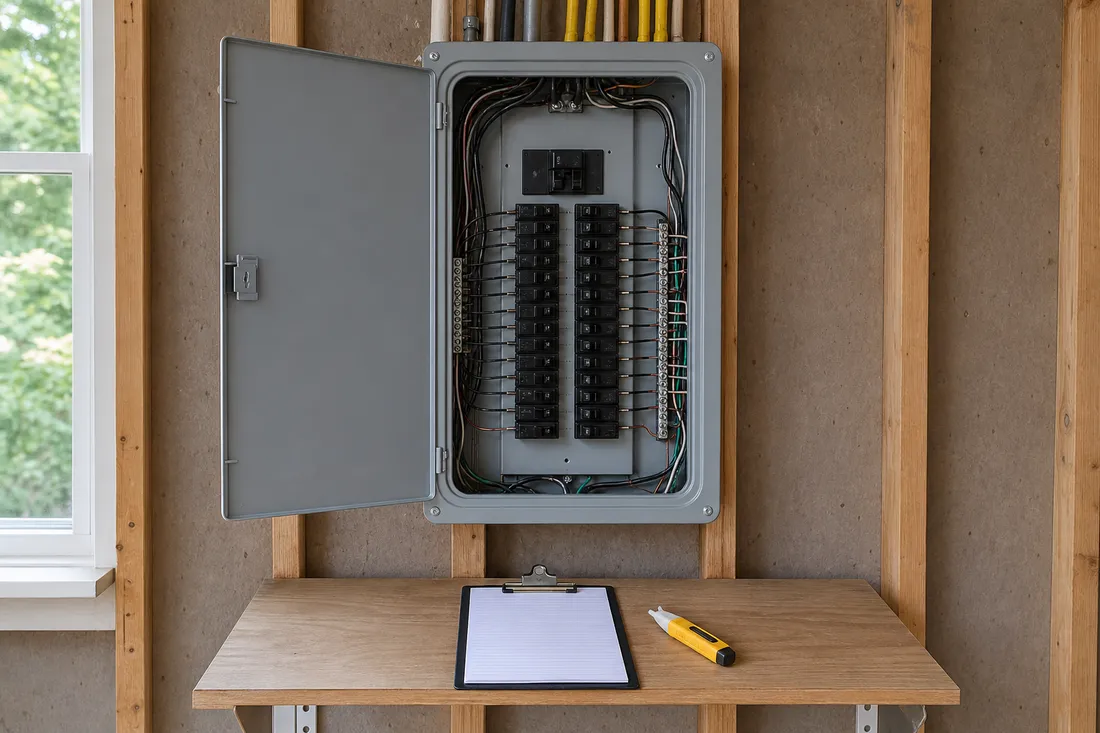
- The main panel. Does it have room for new circuits, or does the whole unit need replacing?
- Access. Can you reach the work area, or will you cut drywall to get there?
- Existing wiring. Is it old or modern, and does it meet current safety and code standards?
- Smoke alarms. Do they all work?
- Locations. Where does the homeowner want the new lights and outlets?
Take photos as you go. A photo of a full panel or a crawlspace run earns its line on the estimate later.
Jobber also suggests judging the job itself before you price it. A tidy, high-end house may need floor protection laid and lifted every day. A customer who wants every wire explained takes hours you will not bill. Both belong in your labor hours, or in a decision to pass on the job.
For commercial bids, the drawings do this work. Housecall Pro advises reading the general requirements and the electrical division of the specifications before you count anything. If the drawings and the specifications disagree, send a request for information before you price.
Step 2: Take off the materials
A takeoff is a count of every item the job needs. Stephen Carr, writing in Electrical Contractor magazine, calls it one of the foundations of estimating: you count and measure each electrical item the job documents require, then move the counts to a pricing sheet.
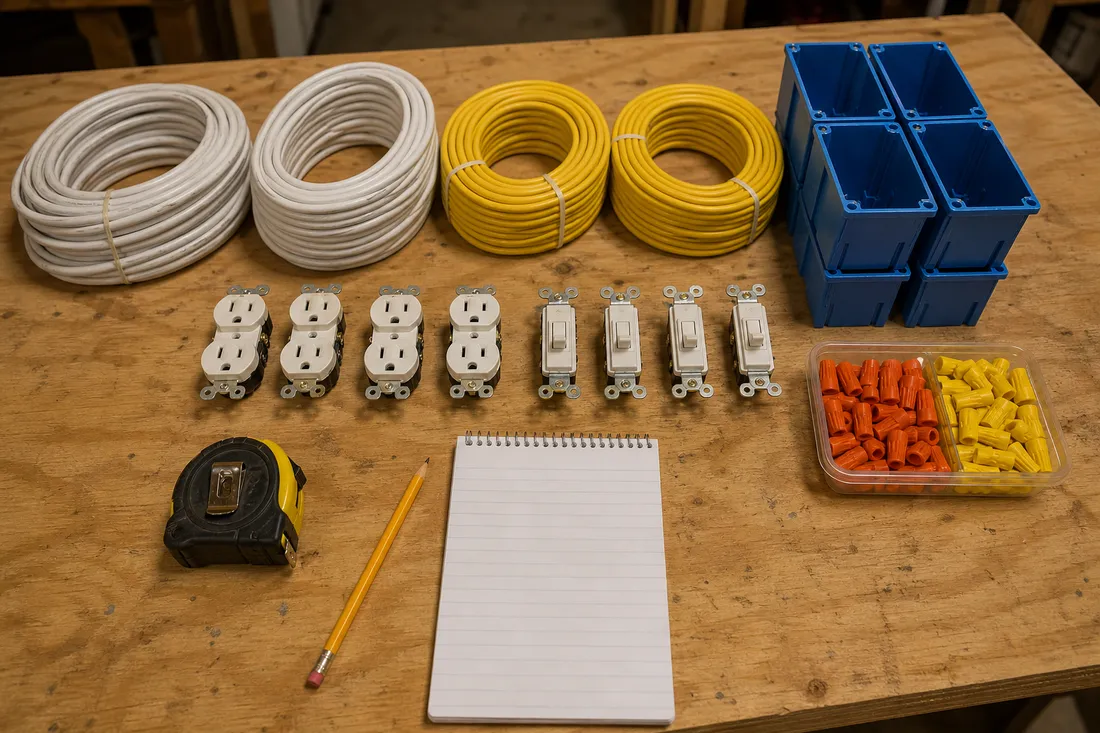
Single items transfer as they are. Assemblies need expanding. Carr uses a single-pole switch as the example, which at minimum means a box, a plaster ring, the switch and a cover. He skips the screws, wire nuts and ground pigtails on each line and adds a markup on the material total for miscellaneous materials instead. For commercial work he says 7% is typical.
Housecall Pro describes a manual takeoff that works on any job:
- Pick one category, such as light fixtures.
- Count every one and write the total on the sheet.
- Record that total on a master takeoff log.
- Repeat for switches, receptacles, panels and wire.
Then price the list with current numbers. Housecall Pro warns that material prices can change weekly, especially copper, steel conduit and LED lighting. It recommends keeping at least two local suppliers and cross-checking their quotes before you settle on a cost.
Protect yourself on the document as well. Jobber suggests a line such as "material pricing is valid for 14 days due to market volatility." A dated price lets you requote a job the customer sat on for two months.
Step 3: Price the labor hours
Labor is where electrical estimates go wrong. Housecall Pro says labor usually makes up 40% to 60% of an electrical job's total cost.
The formula is short. Jobber writes it as hourly labor rate times the number of labor hours. The work is in getting each half right.
Count the hours by task
Break the job into phases and give each one hours. Jobber's example for a residential panel upgrade runs to 14 hours: 4 for prep and demolition, 6 to rough in and mount, and 4 to trim and test.
For repeat tasks, use labor units, which are set times for installing one item. Housecall Pro points to the NECA Manual of Labor Units as a standard reference for the time to install an outlet, run a length of conduit or hang a fixture.
Then adjust for the site. Housecall Pro notes that tight or high-access spaces may double installation time, and that occupied buildings and shift work slow a crew down. It also passes on a lesson from one contractor: price on the average time your technicians take, not on how fast you can do it yourself.
Use a rate that covers the hour
The Bureau of Labor Statistics puts median pay for electricians at $30.38 per hour, or $63,190 a year, as of May 2025. That is what a worker earns. It is not what an hour costs your business, and it is far from what a customer pays.
Jobber's panel example prices its 14 hours at an average wage of $29.51, for $413.14 of labor. At the $50 to $130 per hour that HomeAdvisor says customers pay, the same 14 hours bills at $700 to $1,820. The gap is overhead and profit, which the next step adds.
Carr makes the same split in his method. The labor rates on the cost sheet are cost per hour, without markups. Overhead and profit go on afterward, so you can see each one.
Step 4: Add overhead and profit
Overhead is what it costs to keep the business open whether or not you are on a job. Jobber's list includes vehicles and fuel, insurance, licenses, tools, safety equipment, phones, advertising and office rent.
There are two common ways to charge it.
The first is per hour. Jobber divides total monthly overhead by billable hours per month. Its example is $4,000 of overhead over 500 billable hours, which comes to $8.00 per hour. Multiply that by the hours on the job.
The second is a percentage. Housecall Pro's example divides $120,000 of annual overhead by $1,200,000 of annual revenue to get 10%, then applies that to each job's cost. Carr reports seeing overhead markups between 7% and 15%, and suggests having an accountant work out yours.
Then add profit. Housecall Pro says most electricians aim for 10% to 20%. Jobber gives 12% to 18% as the benchmark and 15% as a starting point.
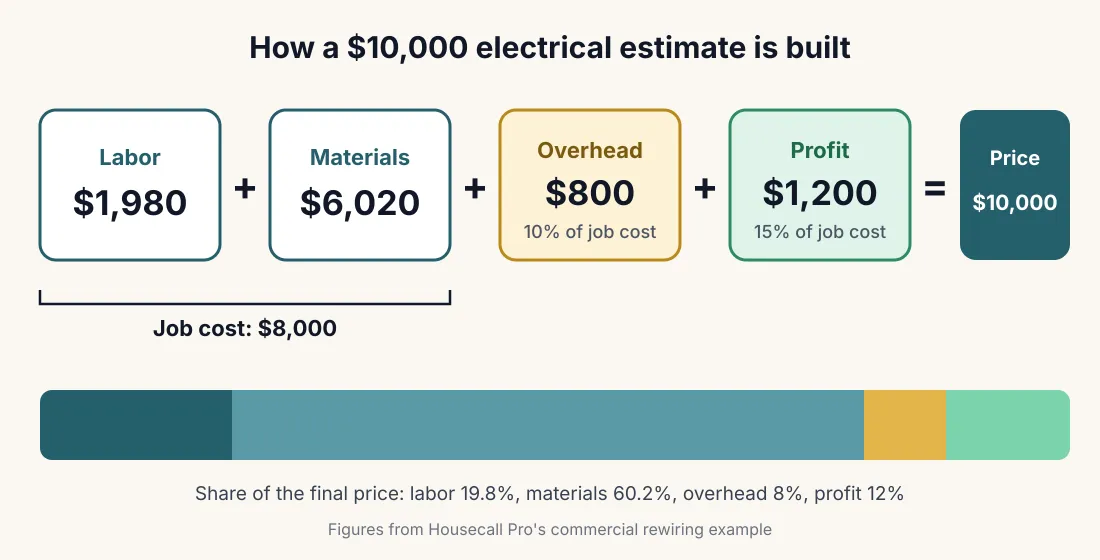
Housecall Pro's worked example puts the pieces together for a commercial rewiring job:
- Labor: $1,980
- Materials: $6,020
- Job cost: $8,000
- Overhead at 10%: $800
- Profit at 15%: $1,200
- Price: $10,000
Jobber's residential example works the same way. A bathroom remodel has $450.00 of materials, $236.08 of labor and $137.22 of overhead, for a cost of $823.30. Multiplying by 1.15 gives a price of $946.80.
One caution on the arithmetic. Adding 15% to your cost does not leave 15% of the price as profit. In Jobber's example the profit is $123.50 on a $946.80 price, which is about 13%. In the Housecall Pro example, $1,200 on $10,000 is 12%. If you want 15% of the price, divide the cost by 0.85 instead. On the bathroom job that gives about $968.59.
Step 5: Pick a pricing format and write it up
You now have a price. How you present it depends on the job.
Jobber describes three models. Hourly pricing bills time, which is honest but unpredictable for the customer. Flat rate gives one price for the job, which customers like and which costs you if you underestimate. Per-unit pricing sets a fixed price per item installed.
Carr explains the per-unit method with a duplex receptacle priced at $150, a figure that holds the material, the labor and enough markup to cover everything else. He calls it good for residential work and risky for commercial bids, because run lengths and material prices vary too much from job to job.
Jobber's ceiling fan example shows how far the models can sit apart. Three fans at 1.5 hours each comes to $132.80 at the hourly wage alone. A flat rate with a $100 travel and setup fee comes to $232.80. A per-unit price of $125 per fan comes to $375.00.
For larger work, Housecall Pro lists the formats general contractors expect. Lump sum is one fixed total and the most common. Time and materials suits a scope that is not fully defined. Cost-plus bills the actual cost plus an agreed fee.
What goes on the document
Jobber lists what an electrical estimate should include:
- Your business name, logo and contact details
- The customer's name and contact details
- An estimate number
- A breakdown of the services and the cost of each
- The materials and each material's cost
- How long the estimate is valid
- The total, including taxes
Housecall Pro adds that you should spell out what is included and what is not. Here is a layout that puts those items in order. Copy it and replace the bracketed text.
ELECTRICAL ESTIMATE                   Estimate no. [2051]
[Business name] | [License no.] | [Phone] | [Email]
Date: [MM/DD/YYYY]          Valid until: [MM/DD/YYYY]

Customer: [Name], [Service address], [Phone], [Email]

Existing service: [Panel size, age, open spaces]
Site notes: [Access, wiring type, photos attached]

SCOPE OF WORK
1. [Remove existing panel and install new panel]    $[  ]
2. [New circuits: number, amperage, location]       $[  ]
3. [Devices and fixtures: count and type]           $[  ]
4. [Grounding and bonding corrections]              $[  ]
5. Permit and inspection                            $[  ]
6. Testing, labeling and walkthrough                $[  ]

MATERIALS
[Item]                [Qty]    [Unit cost]          $[  ]
[Item]                [Qty]    [Unit cost]          $[  ]

Subtotal $[  ]   Tax $[  ]   Total $[  ]
Deposit due on acceptance: $[  ]

NOT INCLUDED: [Drywall patching and paint, trenching,
utility company fees, any work not listed above]

PRICE MAY CHANGE IF: [Hidden wiring damage, corrections
required by the inspector, material price changes after
the valid-until date]

Accepted by: ____________________   Date: __________
When the job is finished, the same lines carry over to the bill. An electrical invoice template with matching sections makes the two documents easy to compare.
Check it before you send it
Housecall Pro lists the errors that cost contractors money: bidding outside your expertise, ignoring scope exclusions, using outdated material or labor pricing, forgetting overhead or equipment rentals, and relying on rules of thumb. Jobber adds overlooked permits and travel.
Read the estimate once against that list. Then log it. Housecall Pro recommends a bid log with the project type, the amount, whether you won, and the margin you achieved. A few months of entries show whether your labor hours match what the work takes.
Frequently asked questions
How do you estimate an electrical job?
Price it from your costs in five steps. Scope the job, count the materials, multiply labor hours by your hourly cost, add overhead, then add profit. Housecall Pro's example turns $8,000 of labor and materials into a $10,000 price with 10% overhead and 15% profit.
Should an electrical estimate be free?
Often yes for defined work, and no for diagnosis. HomeAdvisor reports that quotes for clearly defined fixes are often provided at no additional cost, while consultations and inspections fall under a service-call fee of $100 to $200. Say which applies before you book the visit.
What profit margin should an electrician put on an estimate?
Between 10% and 20% is the range the sources give. Housecall Pro says most electricians aim for 10% to 20%, and Jobber suggests starting at 15%. Remember that 15% added to cost leaves about 13% of the price as profit.
How long should an electrical estimate stay valid?
Keep the window short and print the date. Jobber suggests stating that material pricing is valid for 14 days, because prices move. Housecall Pro notes that copper, steel conduit and LED lighting can change weekly.
What is the difference between an electrical estimate and a bid?
An estimate is your price for a customer's job, and a bid answers a formal request. Jobber describes commercial work as starting with a request for proposal sent to several contractors. Housecall Pro notes that even a missing signature can disqualify a bid.
Get more estimate requests
An estimate starts with a customer asking for one. Kejoola gives an electrical business a four-page website (Home, Services, Blog and Contact) with online booking. The booking form collects name, email, phone and a notes box, where a customer can describe the panel, the room or the problem before you visit. See what an electrician website needs, or read the electrician marketing guide for more ways to fill the calendar.
Sources
- Electrical Estimating: How-To Guide, Housecall Pro
- How to Estimate Electrical Work, Jobber
- A Beginner's Guide to Electrical Estimating, Electrical Contractor Magazine
- How Much Does an Electrician Cost?, HomeAdvisor
- How Much Does It Cost to Hire an Electrician?, Fixr
- Electricians, Bureau of Labor Statistics