Electrical Maintenance: 13 Tasks for a Home Service Visit
Electrical maintenance means checking the panel, exercising breakers, testing GFCIs and AFCIs, and looking over receptacles, cords, smoke alarms and surge protection before a fault becomes a fire. Here are 13 tasks an electrician can turn into a service visit.
Josh · Nov 25, 2026 · 15 min read
- electrical maintenance
- electrical maintenance checklist
- home electrical maintenance
- GFCI testing
- electrical business
Electrical maintenance is the routine work that keeps a home's wiring safe and working: checking the panel, exercising the breakers, testing the GFCI and AFCI devices, and looking over receptacles, cords, smoke alarms and surge protection. Most of it fits into one visit, with a few short tests the homeowner repeats every month. The 13 tasks below follow the order an electrician would work through a house, from the first questions at the door to the report at the end. Use them as your checklist on a maintenance call, or as the scope of a plan you sell to homeowners.
Why a maintenance visit is worth selling
Electrical faults are common, and most of them give no warning a homeowner would notice. The National Fire Protection Association (NFPA) estimates that fire departments responded to an average of 46,652 home electrical fires a year from 2020 to 2024. Those fires caused an estimated 527 deaths, 1,580 injuries and $2.4 billion in property damage each year.
The same report says arcing was the heat source in 64 percent of those fires. Wire or cable insulation was the first thing to ignite in 36 percent. Both point to worn wiring and loose connections, which are faults a trained person can find.
The Consumer Product Safety Commission (CPSC) reached the same view in its guide to home wiring hazards. Its studies found that most serious electrical fires need not have happened, because an inspection would probably have caught the cause. A maintenance visit is the appointment where someone looks.
1. Ask about warning signs before you open anything
Start with five minutes of questions. A homeowner lives with the system every day and has usually noticed something, even if they never connected it to the wiring.
The NFPA tells people to call an electrician for any of these:
- Fuses that blow or breakers that trip often
- A tingling feeling when touching an appliance
- Wall outlets that are discolored or warm
- A burning or rubbery smell from an appliance
- Lights that flicker or dim
- Sparks from an outlet
The Electrical Safety Foundation International (ESFI) adds sizzling or buzzing sounds and cut or cracked wire insulation to that list. It also says any shock, even a mild tingle, may be a warning.
Write each answer down with the room it happened in. A breaker that trips "whenever the space heater and the vacuum run" tells you where to spend your time. It also gives you the first line of the report.
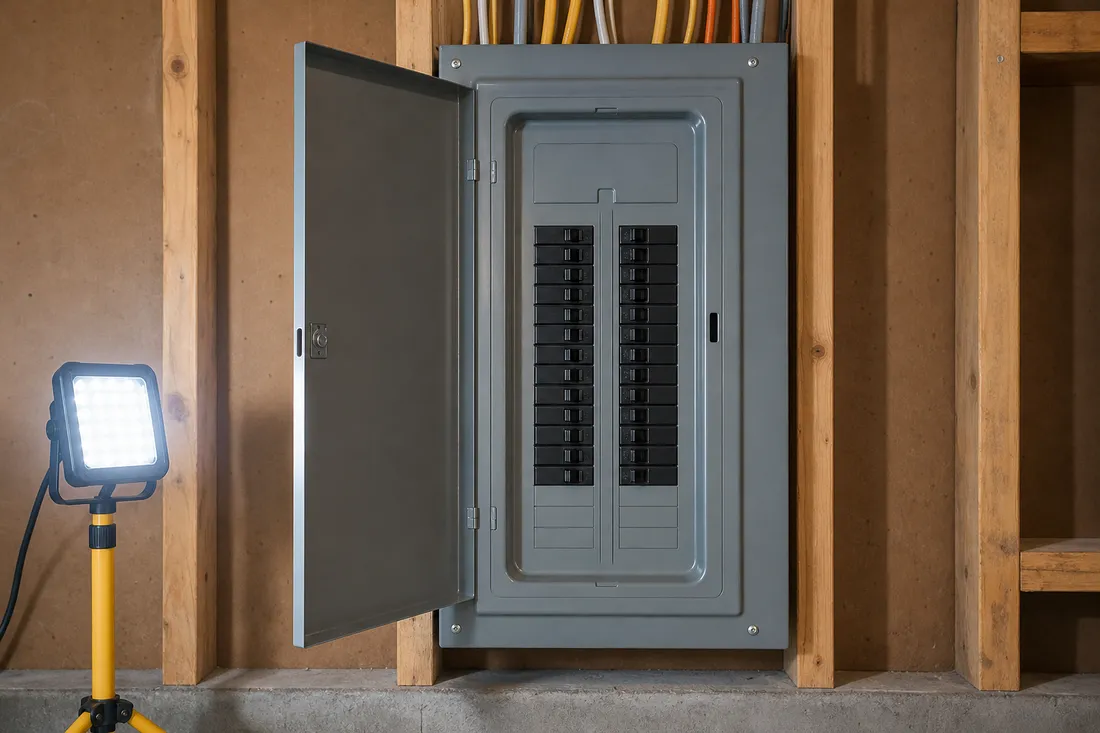
2. Read the panel label and date the last inspection
The panel door often tells you how long the system has gone unchecked. The CPSC says to look on the door and cover for a label or tag with a date and a signature or initials. If there are several dates, the newest is the last inspection.
The CPSC's guidance by age is simple:
| Last inspection | CPSC guidance |
|---|---|
| 40 or more years ago | Inspection is overdue |
| 10 to 40 years ago | Advisable, especially if big loads were added or warning signs are present |
| Less than 10 years ago | Should not be needed unless warning signs are present or temporary wiring was added |
ESFI gives homeowners three triggers of its own. It recommends an inspection for a home that is 40 or more years old, for a home 10 or more years old that has had a major renovation, an addition or a major new appliance, and for a previously owned home with a new owner.
Check the circuit directory while the door is open. ESFI tells homeowners to label their panels so they can turn power off and restore it quickly. Correcting a directory that says "misc" on six lines is a small job the customer will remember.
3. Check that fuse and breaker ratings match the wiring
An oversized fuse or breaker lets a circuit carry more current than its wire can handle. The CPSC calls this an overrated panel. Its example is a fuse or breaker rated 25 amperes or higher protecting a 15 or 20 ampere lighting and receptacle circuit.
Older fuse panels need a closer look. The CPSC notes that in a four-fuse, 60-ampere service, most fuses should be rated 15 amperes, or at most 20. A fuse above 20 amperes suggests someone swapped in a bigger one to stop it blowing. ESFI gives the same warning about a 30 amp fuse on a 20 amp circuit.
Edison-base plug fuses make that swap easy, because fuses of different ratings fit the same socket. The CPSC's fix is to fit Type S socket inserts, which accept only a fuse of the correct rating.
Record the rating and the wire size for every circuit you correct. If the panel is a fuse box that the household has outgrown, the replacement is a separate quote.
4. Exercise every breaker
Breakers that sit untouched for years can stick. The CPSC's home electrical safety checklist says breakers must be exercised periodically to make sure they have not become stuck and to keep them in working order.
Its method is short. Flip each breaker off and on three times, and do it at least once a year.
Protect the appliances first. The CPSC says to turn off the freezer, the refrigerator and the air conditioner before you start, because repeated power interruptions can damage compressor motors. Tell the homeowner which clocks and devices will need a reset, and ask about medical equipment or a home office before you cut anything.
A breaker that feels loose, will not reset, or runs warm under a normal load goes on the report. ESFI's guidance is that frequent trips of a breaker indicate a problem and should be inspected by a qualified electrician.
5. Test every GFCI
A ground fault circuit interrupter (GFCI) cuts power when current leaks to ground, which is what happens when it passes through a person. ESFI says a GFCI can shut off power in as little as 1/40 of a second.
These devices fail quietly. The CPSC warns that a GFCI can fail without showing any sign, and ESFI reports that 26 percent of people who tested their GFCI receptacles found one that was not working properly.
The CPSC's test for a receptacle has three steps:
- Plug a light into the outlet and turn it on.
- Press the test button. The light should go out. If it does not, replace the GFCI.
- Press the reset button. The light should come back on. If it does not, replace the GFCI.
For a GFCI breaker, the CPSC says to push the test button and watch the handle move to the middle or off position. Reset it by moving the handle to off and then to on.
The CPSC recommends that homeowners repeat this test once a month. Show the customer how to do it on one receptacle before you leave. Note any kitchen, bathroom, garage, unfinished basement or laundry sink location that has no GFCI protection at all.
6. Test AFCIs and list the circuits without them
An arc fault circuit interrupter (AFCI) is built to catch a different fault. The CPSC describes it as a special breaker that detects the arcing that can occur when a wire or connection is damaged. Without one, that arcing can overheat unnoticed and start a fire.
ESFI says arcing faults cause about 30,000 home fires a year in the United States. It also cites a CPSC estimate that AFCIs could prevent more than 50 percent of the electrical fires that occur each year.
Test each AFCI breaker with its test button, the same way as a GFCI breaker. The CPSC says AFCIs can stop working without showing signs of failure and should be tested monthly. A defective one should be replaced by a qualified electrician.
Then record which circuits have no arc fault protection. ESFI's summary of the 2020 National Electrical Code lists AFCI protection for bedrooms, common rooms, hallways, closets, kitchens, laundry areas and finished basements when those areas are renovated. The CPSC notes that older homes with ordinary breakers may benefit most. That list is an upgrade proposal the homeowner can act on room by room.
7. Check every receptacle and switch
Work room by room and touch every device. The CPSC checklist gives you four things to look for:
- Outlets and switches that are warm. This can mean a loose connection, though the CPSC notes some dimmer switches run warm in normal use.
- Plugs that fit loosely. A loose connection cannot carry much current without getting hot, and the CPSC says to have the outlet replaced.
- Missing faceplates, which leave wiring exposed.
- Outlets or switches that work only sometimes, which can point to a loose terminal screw or a worn switch.
Pull a sample of devices on older circuits. The CPSC warns that back-wire push-in connections on receptacles and switches may tend to loosen and overheat.
Ask whether young children live in or visit the home. ESFI says about 2,400 children a year suffer severe shock and burns from pushing objects into receptacle slots. Tamper resistant receptacles have an internal shutter system that keeps foreign objects out, and ESFI notes the 2020 code requires them for all receptacles in homes. Replacing the worn outlets with tamper resistant ones solves two problems on one invoice.
8. Look for aluminum branch wiring
Aluminum branch wiring changes what a maintenance visit has to cover. The CPSC says homes built before 1965 are unlikely to have it. Cable installed between 1965 and the mid 1970s, in new homes, additions and rewired circuits, may contain it.
The risk is at the connections. A national survey done for the CPSC found that homes built before 1972 and wired with aluminum were 55 times more likely to have a connection at an outlet reach fire hazard conditions than homes wired with copper.
To identify it, the CPSC says to read the cable jacket in an unfinished basement, attic or garage. Aluminum cable is marked "Al" or "Aluminum" every few feet. A flashlight held at a low angle makes embossed markings easier to read. Cable marked "Copper-clad" is a different product and is not covered by the CPSC's repair advice.
The CPSC lists three permanent remedies: replacing the aluminum wire with copper, the COPALUM crimp connector, and the AlumiConn connector as an acceptable alternative. COPALUM work is limited to electricians trained to use its dedicated tool. If you find unremediated aluminum, say so plainly in the report and quote the repair separately.
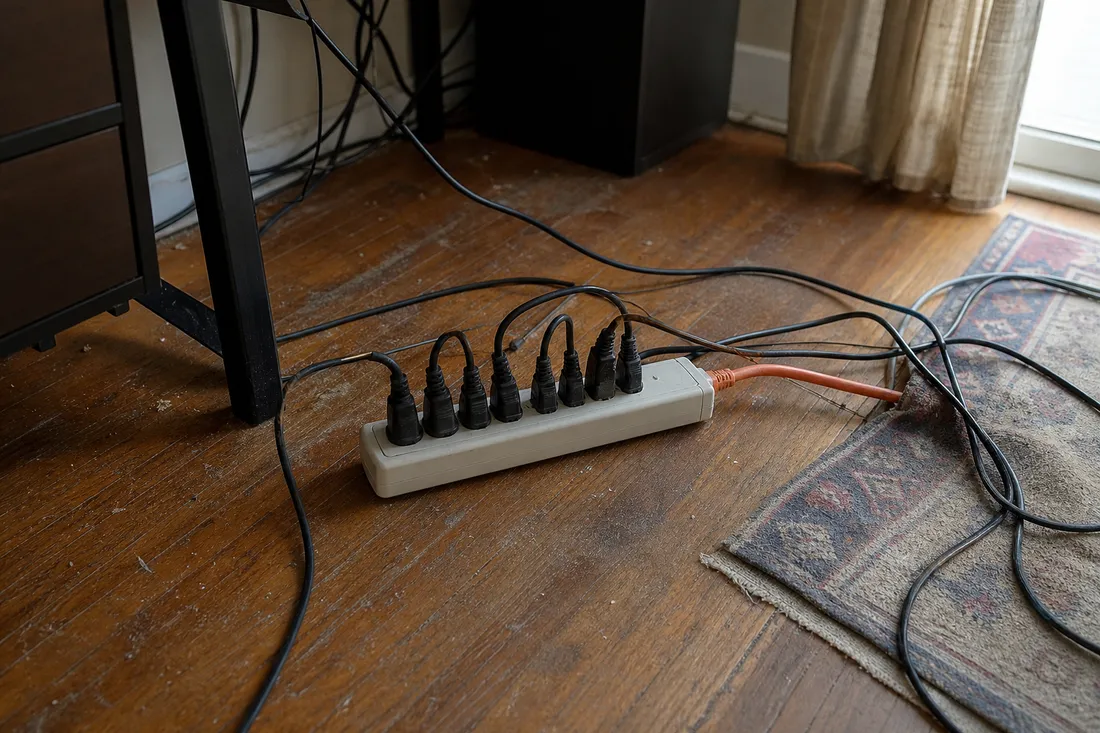
9. Walk the cords and power strips
Extension cords show you where the house is short of receptacles. ESFI says roughly 3,300 home fires start in extension cords each year, killing 50 people and injuring 270.
Look for the patterns ESFI and the CPSC both warn about:
- Cords running under rugs, through doorways or behind furniture, where heat cannot escape
- Cords nailed or stapled to walls and baseboards
- Cords plugged into other cords
- A space heater or a fan on an extension cord or power strip
- A major appliance on anything other than a wall receptacle
Check the load on any cord in permanent use. The CPSC notes that a 16 AWG cord handles 1,375 watts, and that heavier loads need 14 or 12 AWG.
Then offer the real fix. ESFI says heavy reliance on extension cords is a sign of too few outlets, and that power strips add outlets without adding capacity. A new receptacle behind the desk, or a dedicated circuit for the garage freezer, is a clear and modest quote.
10. Check lamps and light fixtures
Fixtures get skipped because they seem to work. The CPSC checklist asks one question of every lamp and ceiling fixture: is the bulb the right wattage for the fixture?
A bulb with a higher wattage than the fixture allows can overheat the fixture, the wiring or nearby combustible material. Where a fixture has no marking, the CPSC's advice to homeowners is a bulb of 60 watts or less, and 25 watts for unmarked ceiling fixtures with miniature bulbs.
Look at the fixture itself while you are on the ladder. Scorched sockets, brittle insulation on the fixture leads and a loose canopy all go on the report. Flickering at one fixture is often the fixture. Flickering across a room is a circuit problem, so trace it back.
11. Go outside
Outdoor wiring takes weather, sun and yard tools. ESFI's summary of the 2020 code lists GFCI protection for outdoor receptacles and for garages, so test each one as you did indoors and note any that have none.
Check the cords the household uses outside. ESFI says an extension cord must be rated for its intended use, indoor or outdoor, and must meet or exceed the power needs of the tool on it. Outdoor cords should be kept clear of snow and standing water.
Look at covers, boxes and fixtures for cracks, missing gaskets and water marks. Open any outdoor receptacle that tripped during your GFCI test and would not reset. Check the service entrance from the ground too, and report damaged cable or a loose mast to the homeowner and, where it applies, the utility.
12. Test the smoke alarms
Smoke alarms matter most for the fires this visit is meant to prevent. The NFPA found that electrical fires between midnight and 8 a.m. were 22 percent of the total but caused an estimated 52 percent of the deaths.
An NFPA guide to smoke alarm upkeep gives the schedule. Alarms should be tested at least monthly and maintained according to the manufacturer's instructions, which usually means cleaning with a vacuum or compressed air. Under NFPA 72, smoke alarms need to be replaced every 10 years.
Press the test button on every alarm and read the date on the back of each one. Record the dates in the report, so next year you can tell the customer which alarms are due. The CPSC suggests that homeowners tie their own check to moving in and to changing the clocks.
13. Check for surge protection
A surge is a short overvoltage that can damage equipment or shorten its life. ESFI estimates that 80 percent of surges come from inside the home, from large appliances switching, loose connections and overloaded circuits. It cites a National Electrical Manufacturers Association figure that the average home has $15,000 of equipment a surge can damage.
Look at the panel for a surge protective device. ESFI describes three types:
| Type | Where it goes | What it does |
|---|---|---|
| Type 1 | Permanently connected, inside or outside the home | Protects against external and internal surges |
| Type 2 | Permanently connected in or next to the breaker box | Protects against internal and external surges |
| Type 3 | At the point of use, such as a plug-in strip | Extra protection, used with Type 1 or Type 2 |
ESFI notes that the 2020 code requires a listed Type 1 or Type 2 device when service equipment is new or replaced. An older home with only plug-in strips has no protection at the panel. Note that in the report as an optional upgrade.
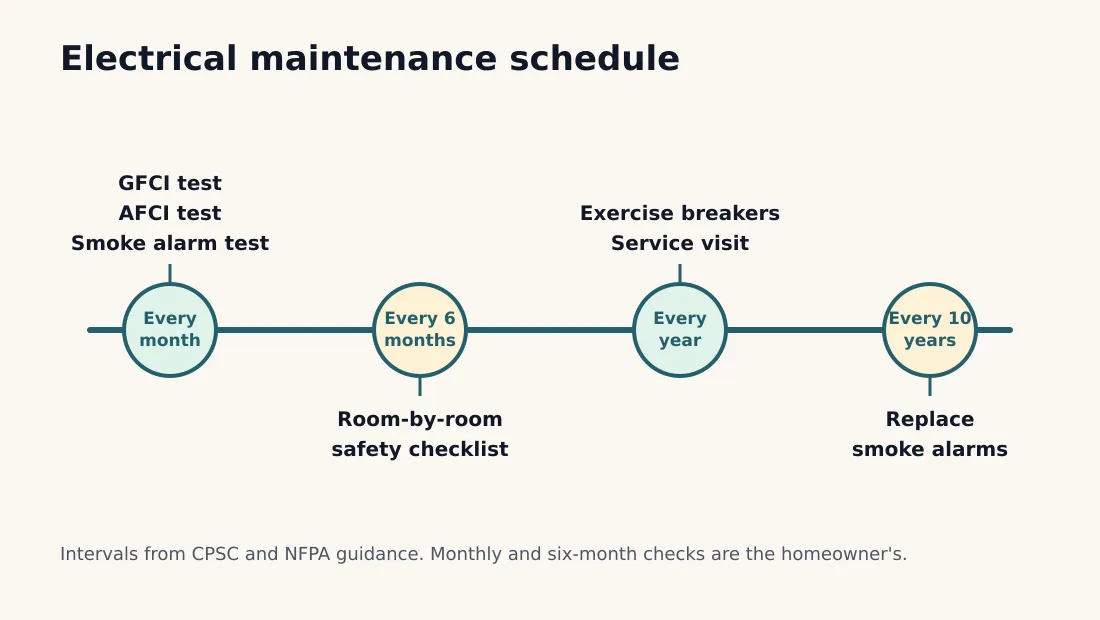
How often each task comes due
One visit covers the whole list, but several tasks belong to the homeowner between visits. This table collects the intervals quoted above.
| Task | Interval | Source |
|---|---|---|
| GFCI test | Once a month | CPSC |
| AFCI test | Once a month | CPSC |
| Smoke alarm test | At least monthly | NFPA |
| Room-by-room safety checklist | Every 6 months | CPSC |
| Breaker exercise | At least once a year | CPSC |
| Smoke alarm replacement | Every 10 years | NFPA |
| Electrical inspection | Overdue at 40 years, advisable from 10 | CPSC |
Write up what you found
The report is what the customer keeps, and it is the reason they book the next visit. Keep it to one page and sort every finding into three groups.
| Group | What goes in it | Example |
|---|---|---|
| Done today | Work completed on the visit | "Exercised 24 breakers, tested 7 GFCIs, corrected panel directory" |
| Fix soon | Faults that will get worse | "Garage GFCI failed test, will not trip" |
| Watch or upgrade | Ages, dates and optional work | "Hall smoke alarm dated nine years ago, no AFCI on bedroom circuits" |
Write each finding as a plain fact with a location, and add a dated photo for anything in the second group. Price that group the same day. This electrical estimate guide has a format you can adapt, and these electrical contract templates cover a repeating maintenance agreement.
Frequently asked questions
How often should home electrical maintenance be done?
Once a year suits most homes, with monthly device tests in between. The CPSC sets the yearly pace with its advice to exercise breakers at least once a year. It also recommends monthly GFCI and AFCI tests and a room-by-room safety check every six months, which homeowners can do themselves.
What does electrical maintenance include?
It includes testing and small corrective work across the whole system. That covers the panel, fuse and breaker ratings, GFCI and AFCI devices, receptacles and switches, cords, light fixtures, outdoor wiring, smoke alarms and surge protection. Repairs and upgrades found along the way are quoted separately.
Is electrical maintenance the same as an electrical inspection?
No, though the two overlap. An inspection records the condition of the system, often for a sale, a permit or an insurer. Maintenance also does work, such as exercising breakers and correcting the panel directory. For the inspection side, see this electrical inspection checklist.
Can homeowners do electrical maintenance themselves?
Yes, for the tests and visual checks. The CPSC's checklist is written for homeowners and covers GFCI and AFCI test buttons, cords, bulbs and warm outlets. Anything behind the panel cover is different. The CPSC says not to remove the service panel cover, and calls that a job for a qualified electrician.
Make maintenance visits easy to book
A maintenance plan only sells if homeowners can find you and ask for the visit. Your site should say which services you offer, which areas you cover, and how to request a time.
Kejoola gives an electrician a four-page website (Home, Services, Blog and Contact) with online booking. The booking form collects name, email, phone and a notes box, where a homeowner can mention the age of the house, a breaker that keeps tripping, or an outlet that feels warm. For what else that site should cover, see this guide to website design for electricians.
Sources
- Home Electrical Fires, NFPA Research
- Electrical Safety in the Home, NFPA
- How To Maintain Smoke Detectors, NFPA
- Home Electrical Safety Checklist, CPSC
- Guide to Home Wiring Hazards, CPSC
- Repairing Aluminum Wiring, CPSC
- Home Wiring Safety Tips, ESFI
- Fuse and Breaker Breakdown, ESFI
- 5 Easy Steps to a Safer Home, ESFI
- Arc Fault Circuit Interrupters, ESFI
- Home Safety Devices: Renovate Your Home to Code, ESFI
- Childproofing Your Home: Tamper Resistant Receptacles, ESFI
- Reaching to Safety: Use Extension Cords Properly, ESFI
- Don't Overload Your Home, ESFI
- Surge Protective Devices, ESFI