How to Start a Cleaning Business: From License to First Clients
How to start a cleaning business in the U.S.: pick residential or commercial work, register and get a free EIN, check local licenses, get insured, set prices, and book first clients.
Josh · Oct 5, 2026 · 12 min read
- how to start a cleaning business
- cleaning business
- house cleaning business
- commercial cleaning
- small business
- business license
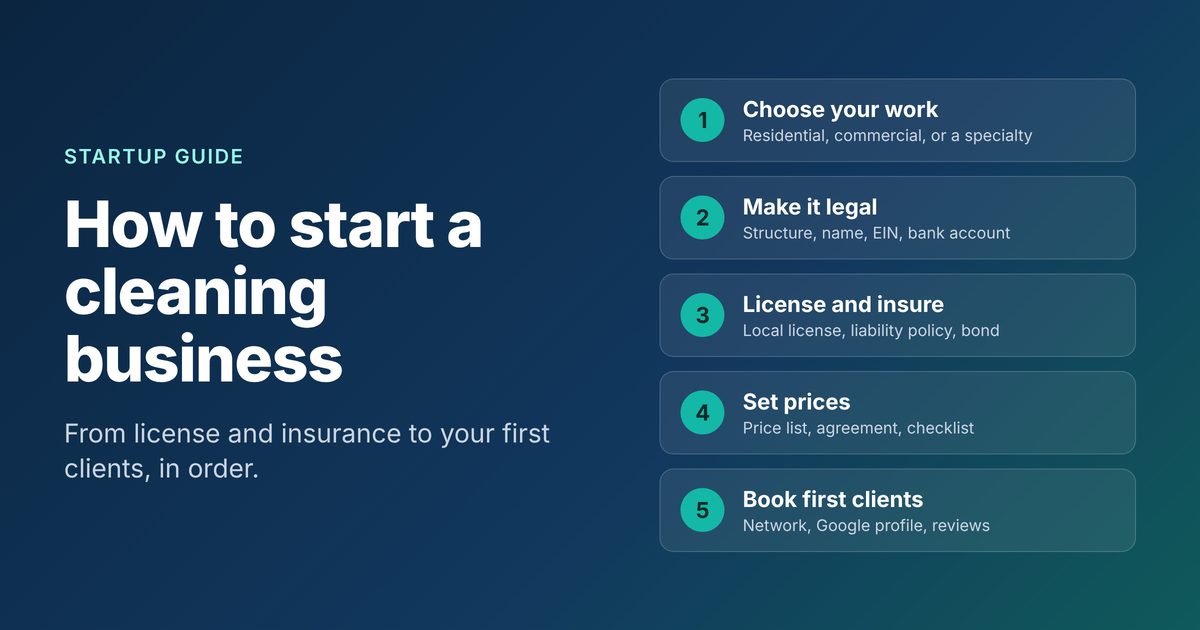
If you are working out how to start a cleaning business, the short answer is five steps in order. Choose residential or commercial work, make the business legal, get licensed and insured, set your prices, then book your first clients. The order matters because a cracked glass shower door before your policy starts can become a personal bill.
The steps fit a U.S. house cleaning or small office cleaning business with one to fifteen people. Rules change by state, county, and city, so every legal step below points to the official office that makes the call.
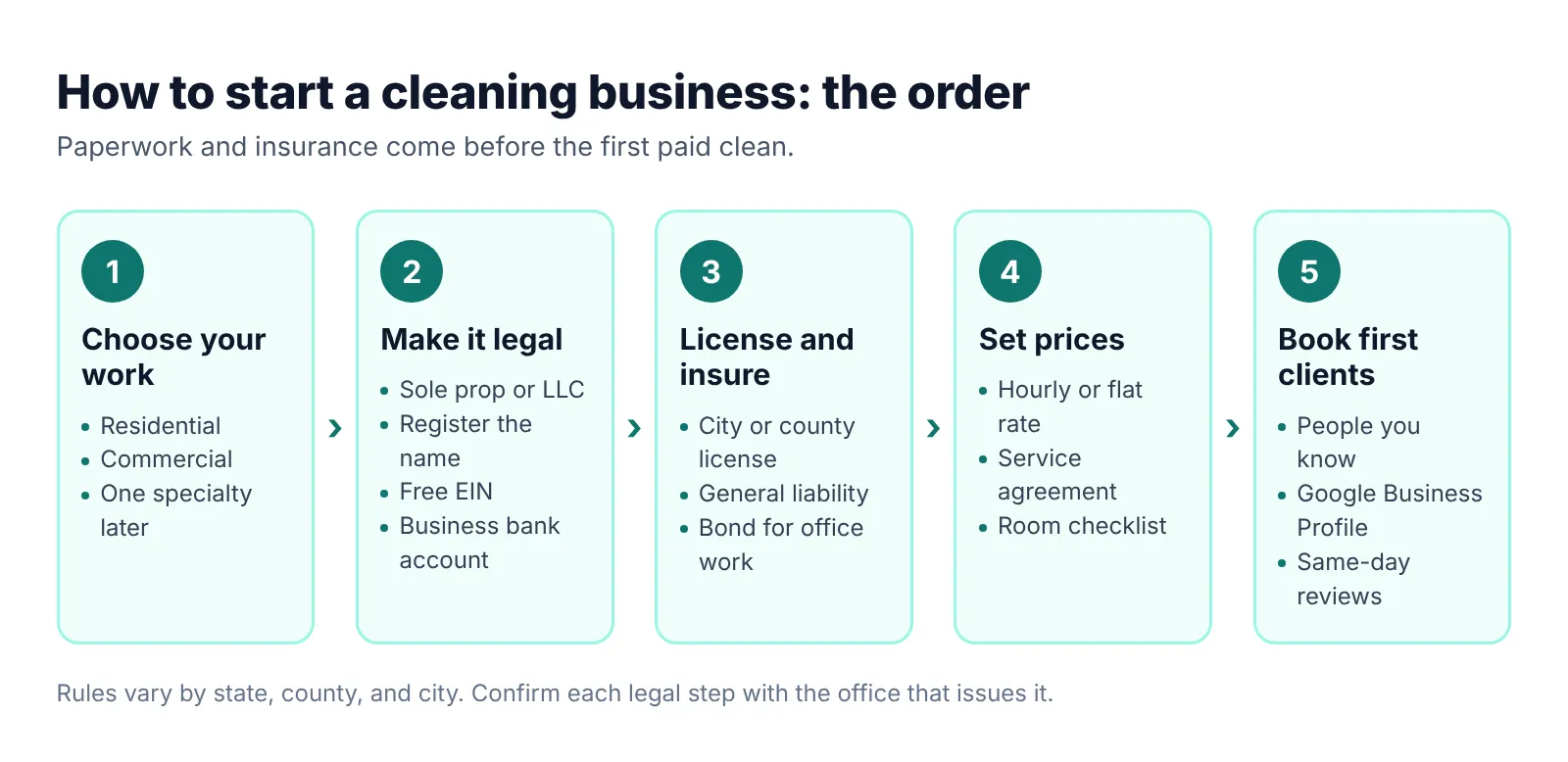
The order keeps paperwork and insurance ahead of the first paid clean. Diagram only.
Why the startup order matters for a cleaning business
Cleaners work inside other people's spaces. You hold house keys, garage codes, and alarm codes. You walk past jewelry on a dresser and a laptop on the kitchen island. One knocked-over lamp or a bleach spot on a rug can turn into a claim, and the client will ask who pays.
Commercial work raises the bar again. A dental office or a property manager will usually ask for a certificate of insurance before you get a key card. The U.S. Bureau of Labor Statistics counts about 2.4 million janitor and building cleaner jobs in 2025, and 35% of them sat in services to buildings and dwellings, the industry group that includes cleaning companies.
The money side punishes a rushed start too. Owners who skip pricing work fill a week with first-time deep cleans quoted like light upkeep visits. They finish late, drive between far-apart towns, and earn less per hour than they planned. Owners who skip the bank account mix grocery runs with supply runs and spend tax season sorting receipts.
Step 1: Choose residential, commercial, or a specialty
Pick the kind of cleaning you will sell first. The choice decides your hours, your supply list, the insurance questions you get, and how you find clients.
Residential house cleaning
Homeowners and renters book standard upkeep cleans, first-time deep cleans, and move-in or move-out cleans. You work daytime hours, usually with one or two people per house. Trust sells this work, so referrals and reviews matter more than a polished pitch.
Commercial and office cleaning
Small offices, clinics, gyms, and retail shops hire cleaners on a contract, often for evening or early-morning visits. BLS notes that many cleaners work evening hours because offices are cleaned while they are empty. Expect a written scope, a walkthrough, proof of insurance, and slower decisions from the client.
Specialty cleans
Move-out cleans for property managers, post-construction dust cleanup, and short-term rental turnovers pay for speed and detail. They also come with tighter deadlines. Add one specialty after your core service runs smoothly.
| Work type | Typical client | When you clean | What clients ask first | Kit to start |
|---|---|---|---|---|
| Residential upkeep | Homeowners, renters | Weekday daytime | Are you insured, who comes, how long | Caddy, vacuum, microfiber, mop |
| Residential deep or move-out | Homeowners, landlords, agents | Daytime, often tight dates | What is included, inside oven and fridge | Upkeep kit plus scrub tools, ladder |
| Small office or clinic | Office managers, owners | Evenings or early mornings | Certificate of insurance, bonding, scope | Commercial vacuum, restroom supplies, trash liners |
| Post-construction | General contractors, remodelers | Before handover dates | Dust control, crew size, timeline | HEPA vacuum, scrapers, extra PPE |
Use a simple rule. If you are solo and your network is mostly neighbors and parents from school, start residential. If you have run a crew before or know a few office managers, a commercial start can work.
Step 2: Make the business legal
The legal steps are mostly online and take a few evenings. Do them before you print a single flyer.
Pick a structure
Most small cleaning businesses choose between a sole proprietorship and a single-member LLC. The SBA explains that a sole proprietorship does not create a separate business entity, so business debts and claims can reach your personal assets. An LLC protects your personal assets in most cases, though members still pay self-employment tax. If you will hold client keys or hire soon, the LLC is usually worth the filing.
Choose and register a name
Pick a name a client can spell after hearing it once on the phone. A list of cleaning business name ideas with clearance checks walks through the trademark and state searches. Then register your business with your state. The SBA says the total cost to register is less than $300 in most cases, though it varies by state and structure. If you trade under a name that differs from your legal name, file a DBA with your state, county, or city as required.
Get a free EIN
Apply for your Employer Identification Number on the IRS site. It is free, and the IRS warns you never have to pay a fee for one. Form your LLC with the state first, then apply. Finish the form in one sitting, because the session expires after 15 minutes of inactivity. Print the confirmation letter and keep it with your formation papers.
Open a business bank account and check sales tax
Open a business checking account once you have your EIN and formation documents. Run every client payment and every supply purchase through it. Before you send the first invoice, ask your state's department of revenue whether cleaning services are taxable where you work.
Step 3: Get licensed, insured, and bonded
Clients check this step before they hand you a key, so finish it before your first booking.
Find your local license
Cleaning is not on the SBA's list of federally regulated activities, so your requirements come from state, county, and city offices. Start with the SBA page on licenses and permits, then call your city or county clerk. Ask three questions. Do you need a general business license, does your state require any registration for cleaning work, and does a home-based business need a zoning approval? Write down each fee and the processing time, since that sets your real start date.
Buy general liability insurance
The SBA describes general liability insurance as coverage for bodily injury, property damage, and defending lawsuits. For a cleaner, that means the client who slips on a wet floor or the stone counter etched by the wrong product. Get quotes from a licensed agent who already insures cleaning companies. Ask whether the policy covers lost client keys and damage to the items you are cleaning, since some policies limit both. Keep your certificate of insurance as a PDF you can send the same day.
Decide on a janitorial bond
A janitorial bond is a type of surety bond. It repays a client if one of your workers is found to have stolen from them. Many solo house cleaners start without one. Office managers and property managers often ask "are you bonded?" before they hand over a key, so price a bond with your agent when you plan commercial work or your first hire.
Plan for workers' comp before you hire
The SBA notes that businesses with employees need workers' compensation, unemployment, and disability insurance, and state rules add more. Ask your agent and your state's workers' compensation office what applies before your first helper starts.
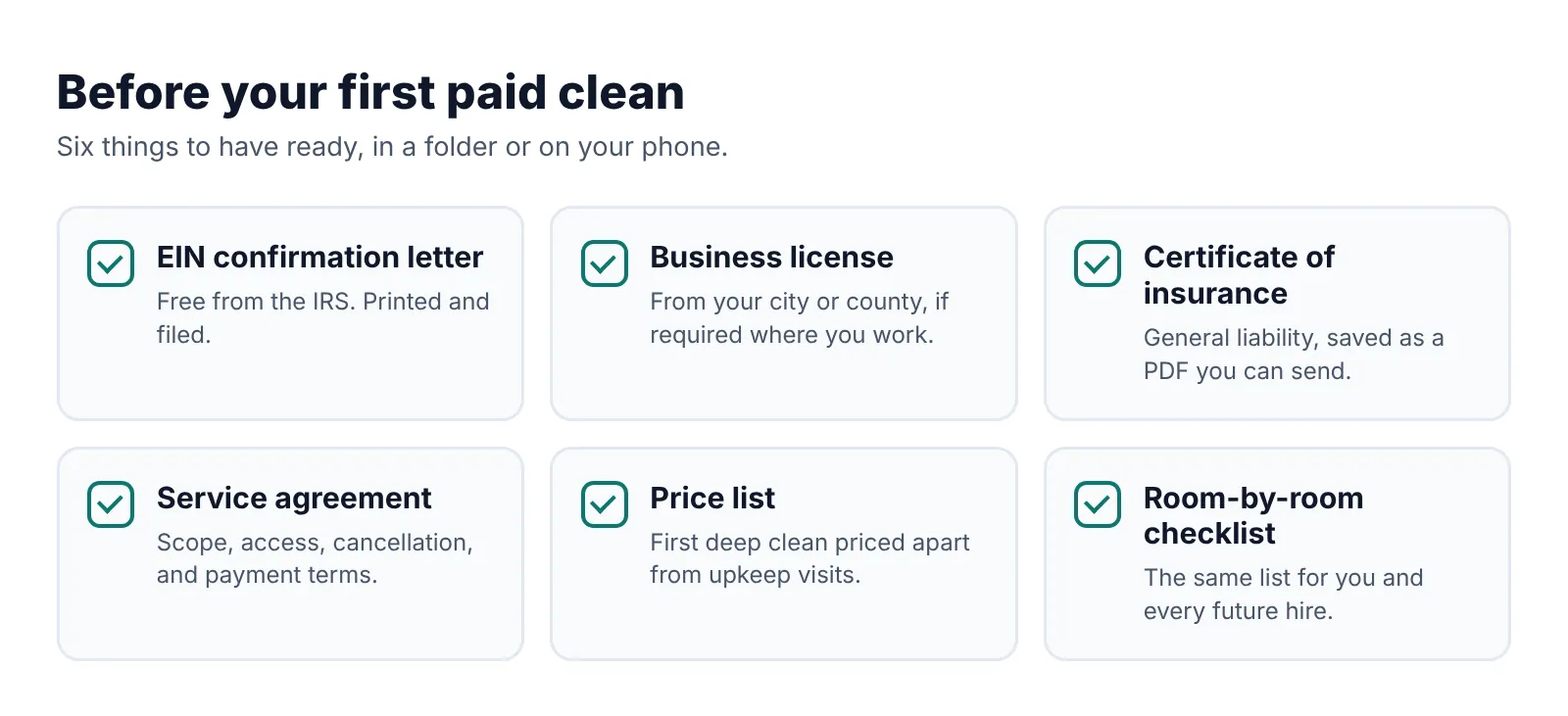
Six items to have ready before the first paid clean. Diagram only.
Step 4: Set prices and write the paperwork clients see
Your price list and service agreement decide whether a full week makes money. Write both before you take a booking.
Choose hourly or flat-rate pricing
Many cleaners quote first-time and deep cleans by the hour, because the condition of the home is unknown. Once you have cleaned a home and timed it, a flat rate per visit is easier for the client to budget. Do a short walkthrough or a video call before you quote. Count bedrooms, bathrooms, pets, and the state of the oven and fridge. Price the first deep clean separately from the upkeep visits that follow.
Count labor before you set the rate
If you plan to hire, your price has to cover wages and payroll taxes, not only supplies and fuel. BLS reports a median hourly wage of $17.71 for janitors and building cleaners in May 2025. The lowest 10% earned under $13.77, and the top 10% earned more than $24.17. Check your local wage, then add drive time between jobs.
Decide early whether helpers are employees or contractors. The IRS says you generally withhold and pay employment taxes for employees, and it weighs behavioral control, financial control, and the type of relationship. Supplying the products, setting the checklist, and assigning the houses all point toward control. If you are unsure, ask an accountant before the first paycheck.
Write a service agreement and a room-by-room checklist
Keep the agreement to one or two pages. Cover these points:
- What each service includes and excludes, such as inside the oven, inside cabinets, or walls.
- How you get in: a key, a lockbox code, or the client at home.
- Pets, alarm codes, and any rooms that stay closed.
- Your cancellation and lockout policy, with the notice you need.
- How and when the client pays.
Pair it with a room-by-room checklist. The client sees what you will do, and every cleaner you hire later follows the same list.
Step 5: Buy supplies and book your first clients
Buy for the services you chose in Step 1, then spend most of your energy on the first ten clients.
Start with a lean kit
A residential start needs a caddy, a good vacuum, color-coded microfiber cloths, a mop system, an extension duster, gloves, and a short list of products. Carry an all-purpose cleaner, glass cleaner, a bathroom cleaner, and a disinfectant labeled for the surfaces you clean. Read each label before you use it on stone, wood, or stainless. Keep the Safety Data Sheet for every product, especially once you hire.
Find the first clients
Start with people who already trust you. Tell neighbors, coworkers, and parent groups what you offer and which towns you cover. Set up a Google Business Profile as a service-area business so you show up when people search nearby. Ask every happy first client for a review the same day, while the kitchen still shines.
For move-out work, introduce yourself to local property managers and real estate agents. For commercial work, walk into small offices near your home and ask who handles cleaning. As jobs come in, group them by area so you are not driving across the county twice in one day. Once you have more clients than you can track on paper, compare a few cleaning service scheduling software options.
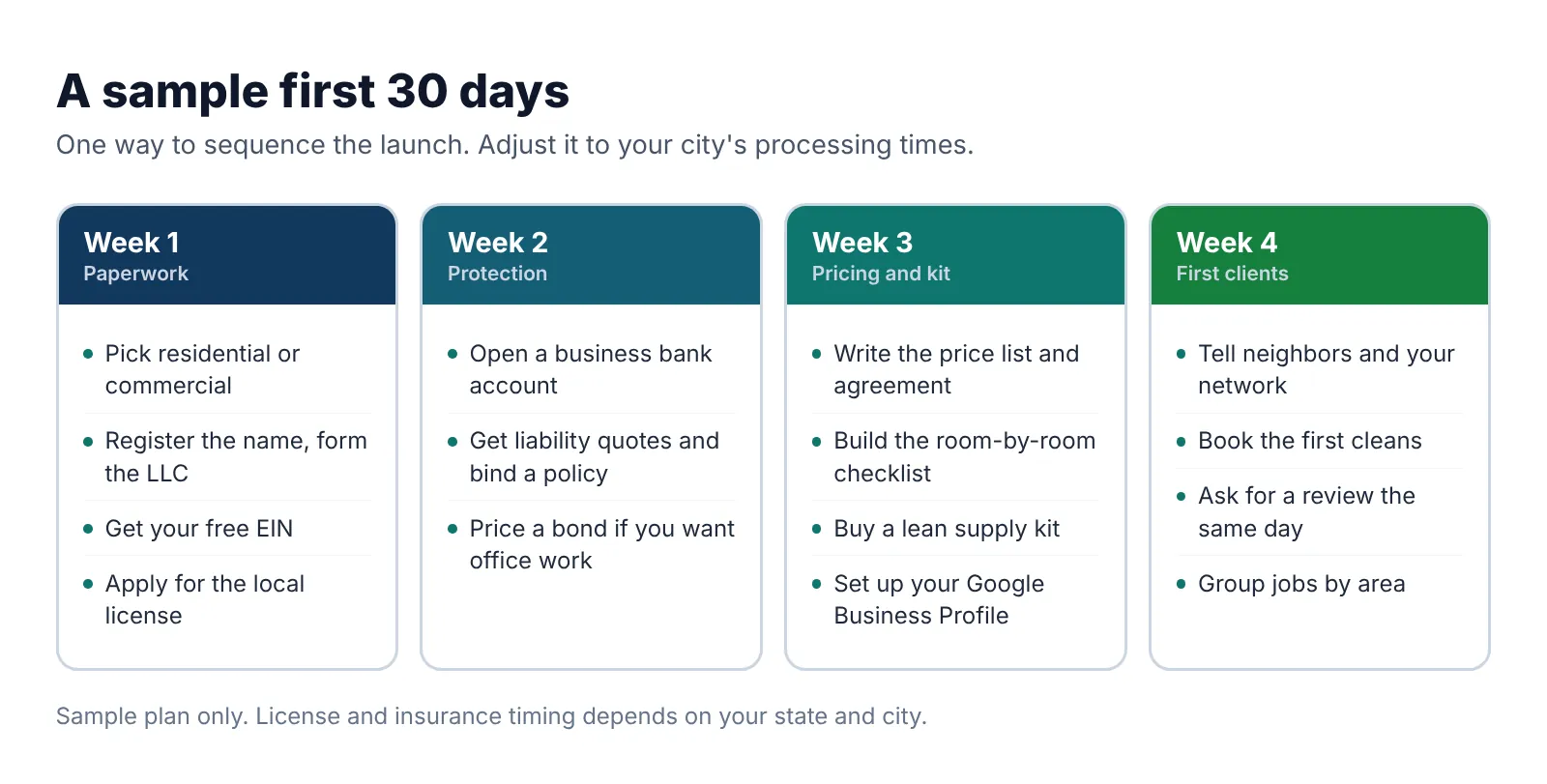
A sample first month. Processing times in your city may stretch week one. Diagram only.
Common problems and how to fix them
The first clean took twice as long as you quoted
Price first visits by the hour, or set a flat rate with a clear time cap. Note what slowed you down, such as pet hair or a greasy range hood. Use those notes to set the upkeep price.
A client asks for a certificate of insurance you don't have
Call your agent and ask for a certificate naming the client as the certificate holder. Some offices also want to be listed as an additional insured. Ask the client exactly what they need in writing.
You arrive and can't get in
A lockbox that won't open or a client who forgot costs you a slot. Put a lockout policy in your agreement, confirm access the day before, and note the entry method on every job.
Your week is full but the account is thin
Look at drive time and first-clean pricing. Cluster clients by town, raise rates on homes that run long, and stop discounting deep cleans. A full week of underpriced jobs is worse than four good days.
Where a bookable site fits
Once people start asking "how do I book you?", a simple site with your services and a booking button catches the requests you miss while your hands are wet. A Kejoola site, for example, is four pages (Home, Services, Blog, Contact), and customers leave the address, the number of bedrooms, and any pets in the booking notes box. If you want to compare tools, see what a cleaning business website needs and these website builder options for cleaning services.
Questions owners ask about starting a cleaning business
Do you need a license to start a cleaning business?
Usually you need a local business license, not a cleaning-specific one. There is no federal license for cleaning, so the rules come from your state, county, and city. Some areas require only a general business license or tax registration. Others add zoning rules for home-based businesses. Start with the SBA's licenses and permits guide, then call your city or county clerk to confirm.
How much does it cost to start a cleaning business?
It depends on your state, your vehicle, and how much equipment you already own. The SBA says state registration costs less than $300 in most cases, and the IRS issues EINs for free. The rest of your budget is a local license, an insurance premium, supplies, and basic marketing. Get real quotes for each line instead of trusting an online average.
Should a new cleaning business be an LLC?
An LLC is a good fit for most cleaners who will hold client keys or hire soon. It keeps business claims away from your personal assets in most cases, according to the SBA. A sole proprietorship is simpler for testing demand with a few clients. You can form an LLC later, then get a new EIN if the IRS requires one.
Is residential or commercial cleaning easier to start?
Residential is easier for most solo owners. You can start with a small kit, daytime hours, and clients from your own network. Commercial accounts pay on contracts and can be steadier, but they expect insurance certificates, bonding, a written scope, and evening work. Many owners start residential and add a few small offices later.
Give customers a way to book your cleans
If you want a site where customers can see your services and book a time, you can get a site customers can book from with Kejoola. Already have a Google Business listing? Paste your listing link to get a first draft of your site, then finish it with your own services, towns, and photos.
14-day free trial, no card needed. Online booking starts on the Starter plan.
Sources
- Register your business (U.S. Small Business Administration)
- Apply for licenses and permits (U.S. Small Business Administration)
- Get business insurance (U.S. Small Business Administration)
- Get an employer identification number (IRS)
- Independent contractor or employee (IRS)
- Janitors and Building Cleaners, Occupational Outlook Handbook (U.S. Bureau of Labor Statistics)