How to Start a Landscaping Business: Licenses, Gear, and First Clients
How to start a landscaping business in the U.S.: pick your first services, register and get a free EIN, check local and pesticide licenses, insure, buy lean gear, price visits, and win nearby clients.
Josh · Oct 6, 2026 · 14 min read
- how to start a landscaping business
- landscaping business
- lawn care business
- pesticide applicator license
- small business
- business license
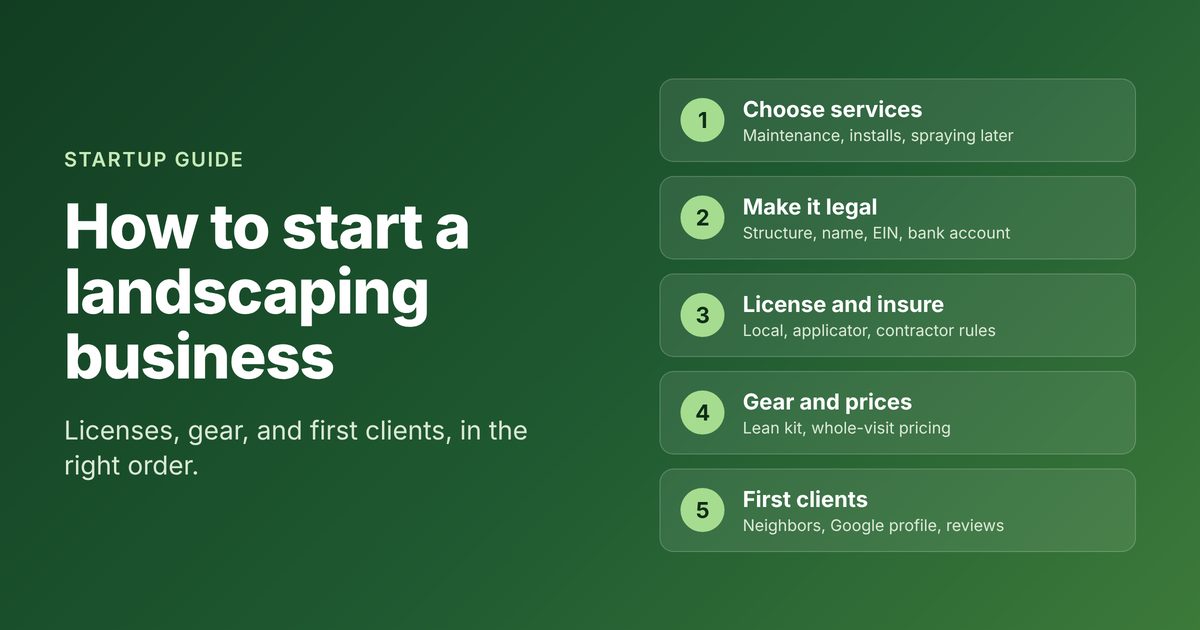
To start a landscaping business, work through five steps in order. Pick a narrow first service, make the business legal, check your licenses and get insured, buy lean gear and price every visit, then win clients a few streets at a time. Licensing and insurance come before the first paid yard because one rock thrown through a patio door can become a personal bill.
The steps fit a U.S. lawn maintenance or small install business with one to fifteen people. Rules change by state, county, and city, so each legal step points to the office that decides.
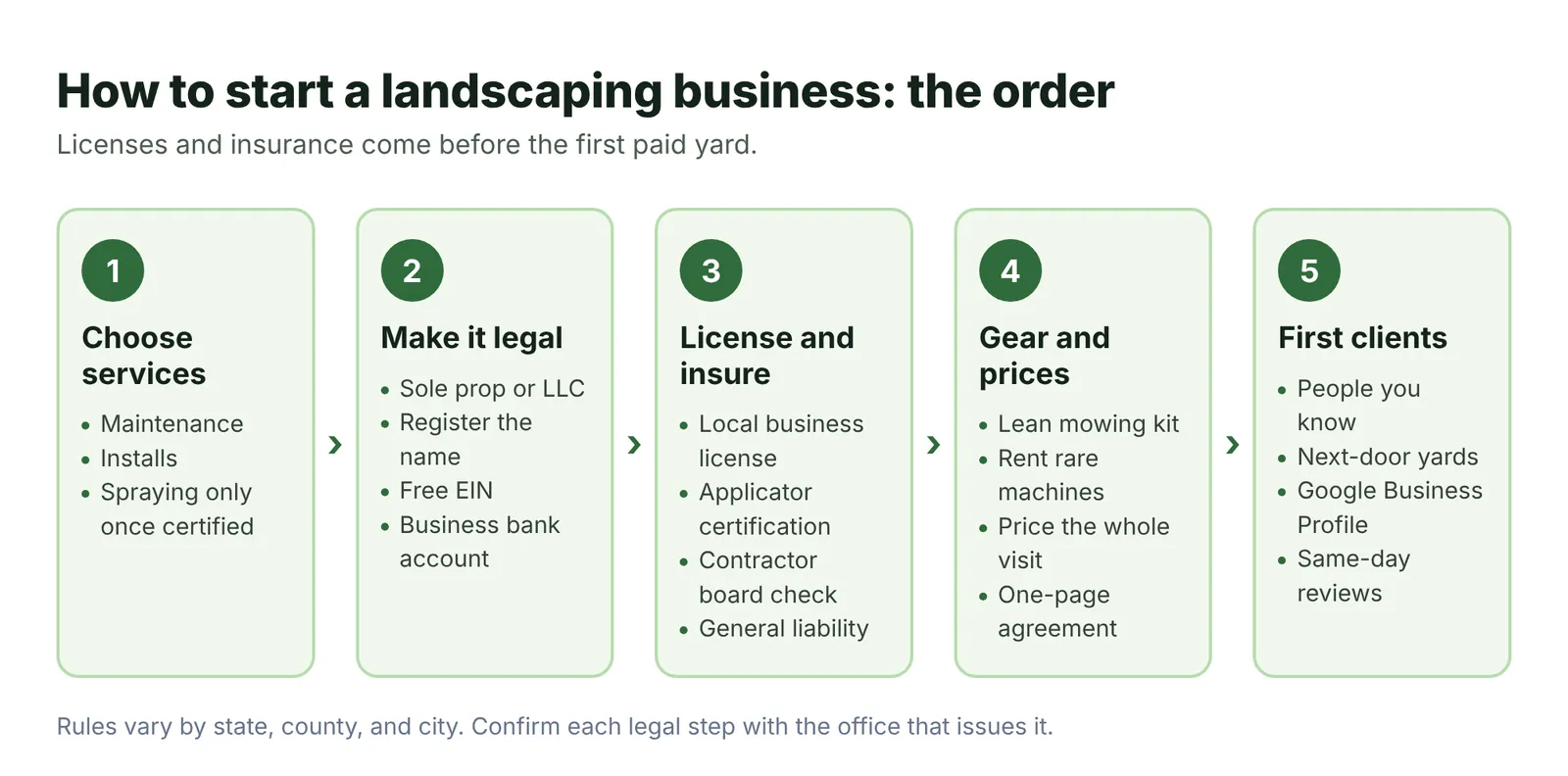
Paperwork, licenses, and insurance come before the first paid yard. Diagram only.
Why the startup order matters for a landscaping business
Landscaping looks simple from the street, but the risk hides in the details. A mower blade kicks a stone into a parked car. Trimmer line nicks the siding. A shovel finds a buried cable while you plant a shrub. Each one turns into a claim, and the homeowner will ask who pays.
Chemicals raise the stakes. The U.S. Bureau of Labor Statistics notes that most states require licensing for workers who apply pesticides, and that licensing for fertilizer work varies by state. The same page counts about 1,188,600 landscaping and groundskeeping worker jobs in 2025. It lists 20% of grounds maintenance workers as self-employed, and says 48% work in the services to buildings and dwellings industry.
Money is the other trap. BLS describes the work as partly seasonal, busiest in spring, summer, and fall. Owners who skip pricing fill April with underpriced first cuts, then find out in July that fuel, repairs, and dump fees ate the margin.
Step 1: Choose maintenance, installs, or chemical lawn care
Pick what you will sell first. That choice decides your licenses, your gear list, your insurance questions, and how steady your cash flow is.
Lawn and yard maintenance
Mowing, string trimming, edging, blowing, hand weeding, leaf cleanup, and shrub trimming. This is the most common start because the gear is modest and the work repeats every week or two through the growing season.
Landscape installs and hardscape
Planting beds, mulch and rock installs, sod, small retaining walls, paver walkways, drainage, and lighting. Tickets are larger, but each job needs an estimate visit, a materials order, and more labor. Installs also run into contractor licensing and buried utility lines sooner than mowing does.
Fertilizer and weed control
Feeding programs, pre-emergent, and weed spraying. Customers ask for these constantly, and the work fits between mowing visits. It is also the line most likely to need a state applicator license, so don't add it until that paperwork is done.
| Service line | Typical first jobs | What to check before selling it | Starter gear |
|---|---|---|---|
| Maintenance | Weekly mow, trim, edge, blow, leaf cleanup | City or county business license | Mower, trimmer, edger, blower, trailer |
| Installs and hardscape | Mulch, plants, sod, pavers, small walls | State contractor board rules, 811 before digging | Wheelbarrows, shovels, tamper, rented machines |
| Fertilizer and weed control | Feeding rounds, weed spraying | State pesticide applicator certification | Spreader, sprayer, PPE, product labels |
Use a simple rule. If you are solo and starting with savings rather than a loan, begin with maintenance. If you have spent years on an install crew and know how to estimate materials, a mix of maintenance and small installs can work from day one.
Step 2: Make the business legal
The legal setup is mostly online and takes a few evenings. Finish it before you print door hangers.
Pick a structure
Most small landscaping businesses choose between a sole proprietorship and a single-member LLC. The SBA explains that a sole proprietorship is not a separate business entity, so you can be held personally liable for its debts and obligations. An LLC protects your personal assets, like your house and savings, in most instances, though members still pay self-employment tax. With a trailer full of moving blades and other people's property all around you, the LLC is usually worth the filing.
Choose and register a name
Pick a name a homeowner can spell after hearing it once, and check that the domain is free. Then register your business with your state. The SBA says the total cost to register is less than $300 in most cases, though fees vary by state and structure. If you trade under a name that differs from your legal name, file a DBA with your state, county, or city as required. The broader checklist for starting a service business covers the same paperwork from another angle.
Get a free EIN
Apply for your Employer Identification Number on the IRS site. It is free, and the IRS warns that you never have to pay a fee for one. If you are forming an LLC, file with the state first, then apply. Finish the form in one sitting, because the session expires after 15 minutes of inactivity. Print the confirmation letter and keep it with your formation papers.
Open a business bank account and check sales tax
The SBA notes you can open a business bank account once you have your EIN. Banks commonly ask for the EIN, your formation documents, and your business license. Run every customer payment, fuel stop, and parts order through that account. Before you send the first invoice, ask your state's department of revenue whether lawn care or landscaping services are taxable where you work.
Step 3: Get licensed and insured before the first yard
This is the step that changes most from state to state. Do it before you take a paid job, even a favor for a neighbor.
Start with your city or county license
Landscaping is not on the SBA's list of federally regulated activities, so your requirements come from state, county, and city offices. The SBA page on licenses and permits lists construction among the activities commonly regulated at the local level. Call your city or county clerk and ask whether you need a general business license, whether a home-based business needs a zoning approval, and whether parking a trailer at home is allowed. Write down each fee and processing time, since that sets your real start date.
Get certified before you spray anything
Weed killer and insect control fall under pesticide rules. The EPA says federal law requires anyone who applies or supervises the use of restricted use pesticides to be certified, and that states, territories, and tribes certify applicators. It also notes that many states require all commercial applicators to be certified, not only those using restricted products. In practice, spraying a customer's lawn for pay usually means a state license or certification first.
Contact your state's pesticide regulatory agency, often the department of agriculture, through the EPA page. Ask which certification category covers lawn and ornamental work, what the exam covers, and whether fertilizer applications need a separate license. Until you are certified, pull weeds by hand and turn down spray requests.
Check whether your state licenses landscape contractors
Some states license landscape contractors, and some cities add their own rules. California is a clear example. Its Contractors State License Board says anyone who contracts for work valued at $1,000 or more in combined labor and materials, work that needs a building permit, or work that uses employee labor must hold a license. Landscapers fall under the C-27 classification there. Other states set different lines, or none at all. Search for your state's contractor licensing board and ask whether installs, irrigation, or hardscape need a license.
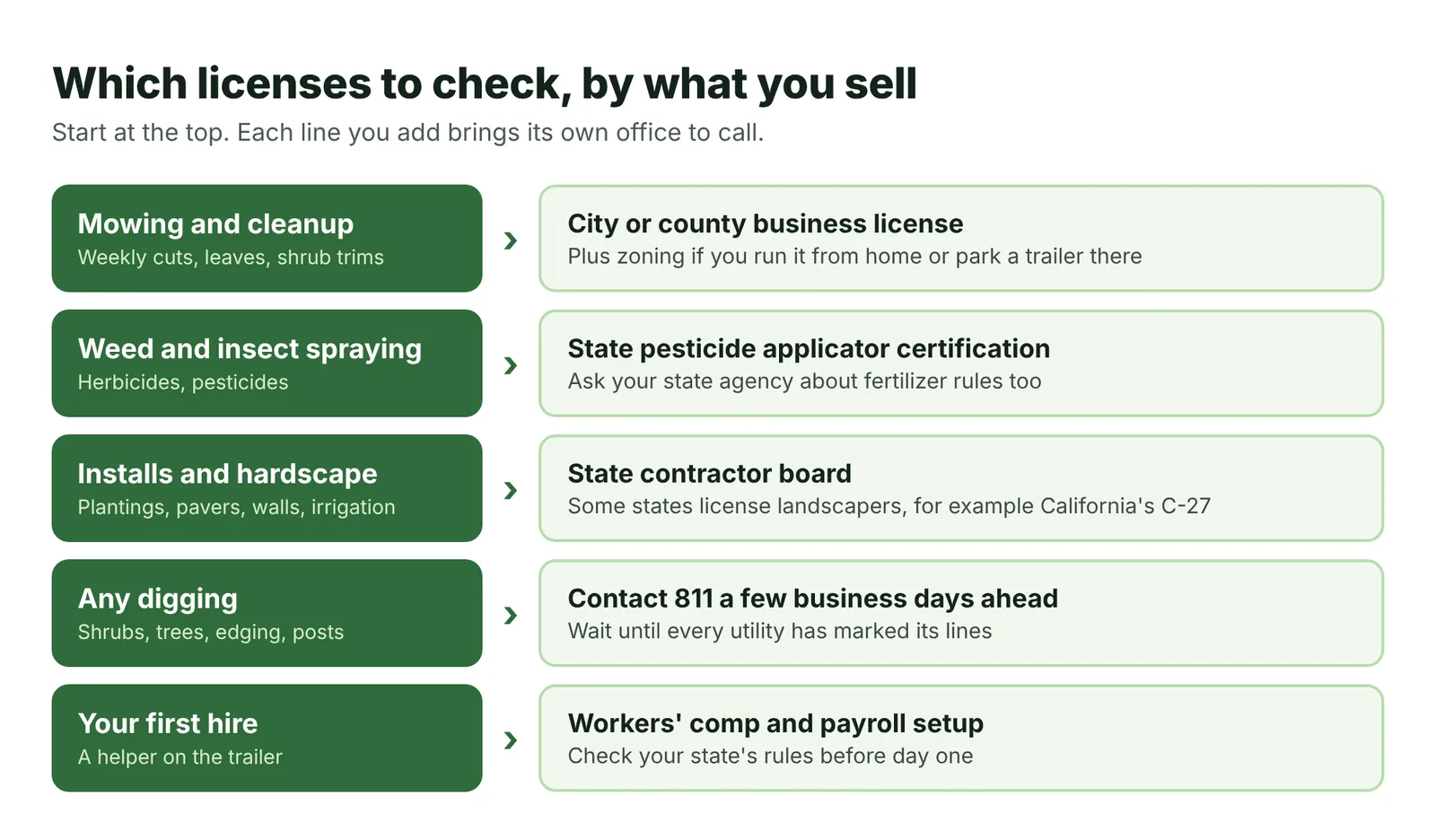
What to check depends on what you sell. Confirm each item with your state and local offices. Diagram only.
Buy general liability insurance
The SBA describes general liability insurance as coverage for bodily injury, property damage, medical expenses, and defending lawsuits. For a landscaper, that is the cracked window, the scraped car, or the customer who trips over a hose. Get quotes from a licensed agent who already insures lawn and landscape companies. Ask how the policy treats damage from chemical work and whether your personal auto policy covers a truck towing a trailer for business. Keep your certificate of insurance as a PDF you can send the same day an HOA or property manager asks.
Call 811 before every dig
811 is the free national before-you-dig service. Call 811 or use your state 811 center a few business days before you plant trees and shrubs, set edging, or install a fence post. Wait until every utility has marked its lines, then dig carefully around the marks. Build that wait into every install quote.
Plan for workers' comp before you hire
The SBA notes that businesses with employees need workers' compensation, unemployment, and disability insurance, and some states require more. Ask your agent and your state's workers' compensation office what applies before your first helper rides along. Also decide early whether helpers are employees or contractors, and ask an accountant if you are unsure.
Step 4: Buy lean gear and price every visit
Buy for the services you chose in Step 1, not for the company you hope to run in three years. Then set prices before you take a booking, because they decide whether a full week of mowing makes money.
A lean maintenance kit
A solo maintenance start needs a dependable mower sized for the lots you will cut, a string trimmer, an edger, a backpack blower, and hand tools: rakes, a flat shovel, pruners, hedge shears, and tarps for debris. Add gas cans that meet your local rules, a spare blade, trimmer line, and a basic sharpening setup. BLS notes that workers using mowers and chain saws must wear protective clothing, eyewear, and earplugs, so buy safety glasses, hearing protection, gloves, and boots before the first cut.
Buy, buy used, or rent
| Option | Best for | Trade-off |
|---|---|---|
| Buy new | Mower, trimmer, and blower you use every day | Highest upfront cost, but warranty and fewer breakdowns in peak season |
| Buy used | A second mower or a trailer | Cheaper, but inspect hours, belts, and decks, and expect repairs |
| Rent | Aerators, sod cutters, tillers, small excavators | No storage or upkeep, but you pay each time and book around availability |
| Subcontract | Tree removal, irrigation, large hardscape | Keeps the customer, but you need a partner who shows up and carries insurance |
Rent the machines you need a few times a year. Buy the ones you start every morning, and price each from local dealers rather than online averages.
Price the whole visit
Quote by the visit, not by the minutes the mower runs. A weekly cut includes drive time, unloading, mowing, trimming, edging, blowing, loading, and the trip to the next yard. Cleanups and installs add dump fees and materials. Walk the property before you quote, and measure the lawn with an online map tool.
Price the first cut of the season separately. Overgrown grass, leaves left from fall, and hidden toys take longer than a regular visit. Once you have timed a yard twice, set a flat weekly price the customer can budget for.
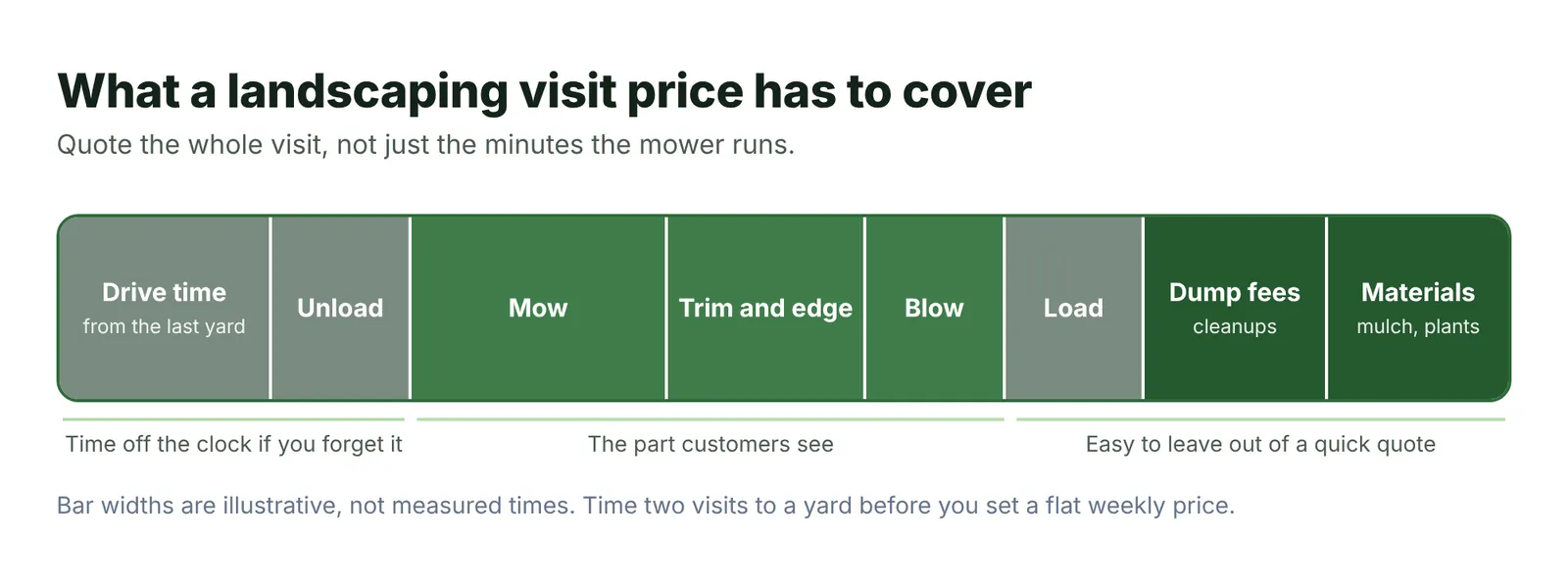
A visit price covers every minute from the last driveway to the next one. Diagram only.
Count labor before you hire
If you plan to add a helper, your price has to cover wages and payroll costs, not only fuel and blades. BLS reports a median hourly wage of $18.82 for landscaping and groundskeeping workers in May 2025. Across all grounds maintenance workers, the lowest 10% earned under $15.01 and the top 10% earned more than $28.10. Check your local wage, then add drive time between yards.
Write a one-page service agreement
Keep it short and plain. Cover these points:
- What each visit includes, such as whether clippings are bagged or mulched and whether beds are edged.
- How often you visit and what happens in a drought or a rainy week.
- Gate access, dogs in the yard, and anything you should not touch.
- When the season starts and ends, and how either side cancels.
- How and when the customer pays.
Step 5: Win your first clients street by street
A landscaping business makes money on route density. Ten yards on four streets beat ten yards spread across the county.
Start with people who know you
Tell neighbors, friends, and coworkers what you offer and which neighborhoods you cover. After the first yard looks sharp, knock on the doors on either side and leave a door hanger with your phone number and your two main services.
Set up a Google Business Profile
Create a Google Business Profile as a service-area business, list the towns you actually cover, and add real photos of finished yards. Ask every happy customer for a review the same day, while the stripes are fresh.
Reach property managers and HOAs later
Once you have an insurance certificate and a few reviews, small apartment complexes, HOAs, and office parks can fill weekday gaps. Send a one-page summary of your services, towns, and insurance.
As the customer list grows past what a notebook can hold, compare a few lawn care software options before peak season.
Common problems and how to fix them
Your route zigzags across town
Stop taking yards outside your core area, or price them higher to cover the drive. Group customers by day and neighborhood.
The first cut took twice as long as you quoted
Price first cuts and cleanups by the job, with a note that overgrown lawns cost more. Write down what slowed you down, then set the weekly price from your second visit.
A customer asks you to spray weeds and you aren't certified
Say no, or refer them to a licensed applicator. Spraying for pay without it can break state pesticide rules. Pull weeds by hand for now and study for the exam over the winter.
Rain pushes the whole week back
Put a rain policy in your agreement. Shift every customer one day forward instead of squeezing two days into one, and tell them that morning.
You can't answer the phone over the mower
Missed calls cost estimates. Set a voicemail that lists your towns and services, return calls at lunch, and read how other owners grow a landscaping business without answering the phone all day.
Where a bookable site fits
Once neighbors start asking how to book you, a simple site with your services and a booking button catches requests while your hands are on the mower. A Kejoola site, for example, is four pages (Home, Services, Blog, Contact). Customers book a time for an estimate walk or a one-time cleanup and type the address, gate details, and dog notes in the notes box. Each booking lands in your bookings. To see what a landscaper's site should show, read about a landscaping website that customers can book from.
Questions owners ask about starting a landscaping business
Do you need a license to start a landscaping business?
Usually yes, at least a local business license. There is no federal landscaping license, so the rules come from your state, county, and city. Mowing and cleanup often need only a general business license. Installs can need a state contractor license, as in California at $1,000 or more in labor and materials. Spraying pesticides usually needs state certification.
Do I need a license to spray weed killer for customers?
In most states, yes. BLS says most states require licensing for workers who apply pesticides, and the EPA notes that many states certify all commercial applicators, not only those using restricted products. Weed killers are herbicides, a type of pesticide. Contact your state pesticide agency before you spray a lawn for pay.
How much does it cost to start a landscaping business?
It depends on the gear and the truck you already own and on which services you sell. The SBA says state registration costs less than $300 in most cases, and the IRS issues EINs for free. The rest is a local license, insurance, equipment, fuel, and basic marketing. Get real quotes from dealers and agents for each line before you commit.
Should a landscaping business be an LLC?
For most owners, yes. Landscaping involves moving blades, chemicals, and digging on other people's property. The SBA says an LLC protects your personal assets in most instances. A sole proprietorship is simpler if you only want to test demand with a few yards. You can form an LLC later and get a new EIN if the IRS requires one.
Is a landscaping business only seasonal?
In many areas, the busiest months are spring, summer, and fall. BLS notes that some grounds maintenance workers provide other services in winter, such as snow removal. Plan your year around your climate. Add leaf cleanup and holiday lighting, or snow work if your insurance allows it, and save part of each summer month for the slow season.
Give customers a way to book your estimate visits
If you want a site where customers can see your services and book a time, you can get a site customers can book from with Kejoola. Already have a Google Business listing? Paste your listing link to get a first draft of your site, then finish it with your own services, towns, and photos.
14-day free trial, no card needed. Online booking starts on the Starter plan.
Sources
- Launch your business: structure, registration, tax IDs, licenses, insurance (U.S. Small Business Administration)
- Get an employer identification number (IRS)
- Grounds Maintenance Workers, Occupational Outlook Handbook (U.S. Bureau of Labor Statistics)
- How to get certified as a pesticide applicator (U.S. EPA)
- What kind of contractor do you need? (California Contractors State License Board)
- 811 before you dig (Common Ground Alliance)