Plumbing Estimate: How to Price a Job and Write It Up
A plumbing estimate prices a job from your true hourly labor cost, the parts at full cost and the margin you need, then states scope, exclusions and a valid-until date. Four ways to build one, plus a template to copy.
Josh · Nov 12, 2026 · 12 min read
- plumbing estimate
- plumbing estimate template
- plumbing quote
- plumbing pricing
- plumbing business
A plumbing estimate is a written, approximate price for a defined piece of plumbing work, sent to the customer before the job starts. You build it from three numbers: your true hourly labor cost, the parts at their full cost, and the margin your business needs. Then you write down the scope, what is excluded, the payment terms and a valid-until date. The four methods below cover cost-plus pricing, flat rates, time and materials, and tiered options, and a template you can copy follows them.
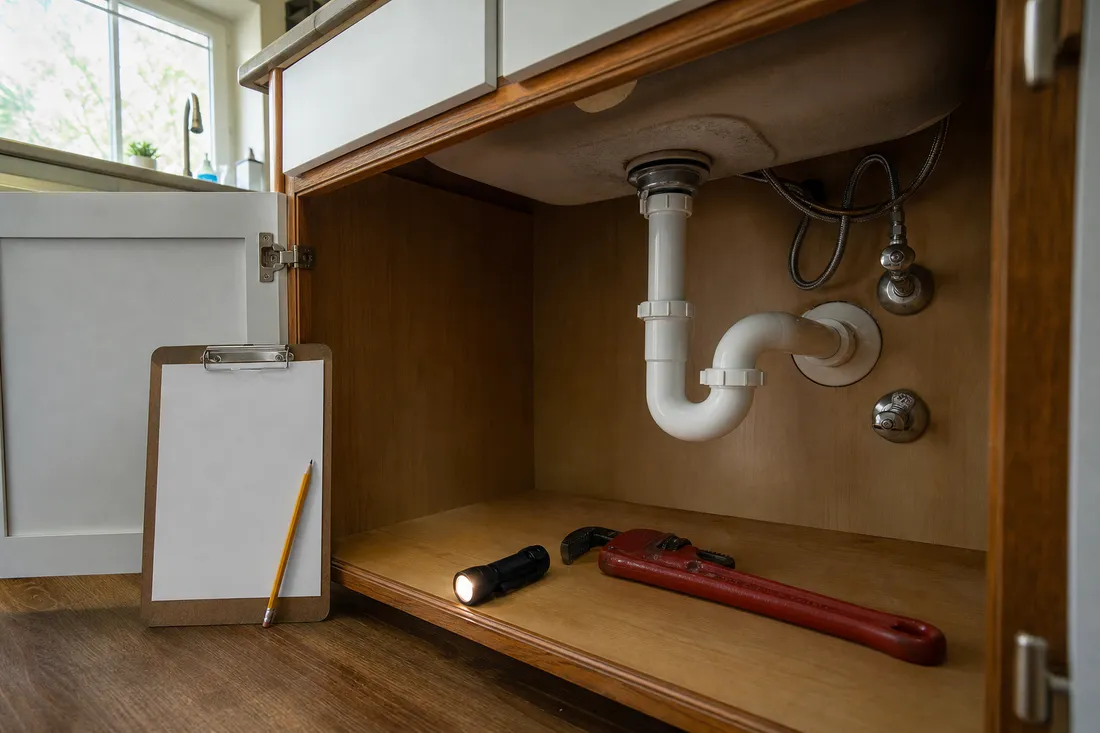
Estimate, quote or bid
The three words get used as one, and they should not be. Jobber describes an estimate as a rough but educated guess at the time, work and materials a job will take, which leaves room if something unexpected turns up. A quote tells the customer exactly what they will pay.
Service Fusion draws the same line. An estimate suits jobs with unknowns, such as work behind walls or old pipework. A quote suits a clear scope, such as a water heater swap or a fixture install. With a quote, you carry the risk if your costs run over.
A bid is the third kind. Simpro describes bids as formal competitive proposals, common in commercial construction, that are typically binding once accepted.
Say which one you are sending, in the title of the document. Service Fusion notes that the exact legal treatment can vary by state and by the wording, so also say what could cause the price to change.
Before you price: see the job
A price given over the phone is a guess about a house you have not seen. Simpro warns that phone estimates miss the complications that show up the moment a tech opens a wall or gets into a crawl space.
Service Fusion suggests asking what the problem is, where it is, and how old the system is. Visit the site where you can. Photos help, but a short look often catches the corroded valve or the cramped crawl space that changes your time on the job. Take notes on access, shut-off locations and anything that might need a permit.
For larger work, Procore adds a step before any arithmetic: decide whether the project fits your crew's experience. A job your crew has not done before can run over in both time and waste. Procore also recommends reading the full specification and listing every item on the plans before pricing, then checking the list a second time.
Then break the job into tasks. "Remove old fixture," "install new shut-off valves" and "test for leaks" are easier to price than one large job. They also show the customer where the money goes.
Method 1: Build the price from your costs
This is the base method, and the other three depend on it. You add labor and materials to get the job cost, then set the price so your margin is left over after those costs.
Start with labor, because that is where most estimates go wrong. The Bureau of Labor Statistics puts the median wage for plumbers, pipefitters and steamfitters at $30.67 an hour, or $63,800 a year, as of May 2025. That is what a plumber earns. It is not what an hour of plumbing costs your business.
Simpro says payroll taxes, insurance and benefits add 20% to 40% on top of base wages for most contractors. Service Fusion adds truck and fuel, tools, and the unbillable time spent driving, quoting and doing paperwork. Its way of finding your number has three steps:
- Add up your total annual operating cost, including wages, insurance, vehicles, tools, rent and your own pay.
- Estimate your annual billable hours. Driving to jobs and writing estimates do not count.
- Divide the cost by the billable hours.
Service Fusion's example is a two-technician shop that costs $250,000 a year to run and bills 2,500 hours. Its true labor cost is $100 an hour. Your own figure will differ, and it is worth an afternoon to work it out.
Next, price materials at full cost. List every part you expect to use, and include delivery and the time spent sourcing it. Some shops apply a standard markup to cover those costs, and others recover them in the overall margin. Service Fusion's advice is to choose one approach, apply it consistently, and avoid counting the same overhead twice.
Markup and margin are different numbers, and mixing them up costs money. In Service Fusion's example, a part that costs you $100 with a 25% markup sells for $125. The $25 difference is a 20% margin on that sale. If you want a 20% margin, divide your cost by 0.80. Adding 20% to the cost leaves you short.
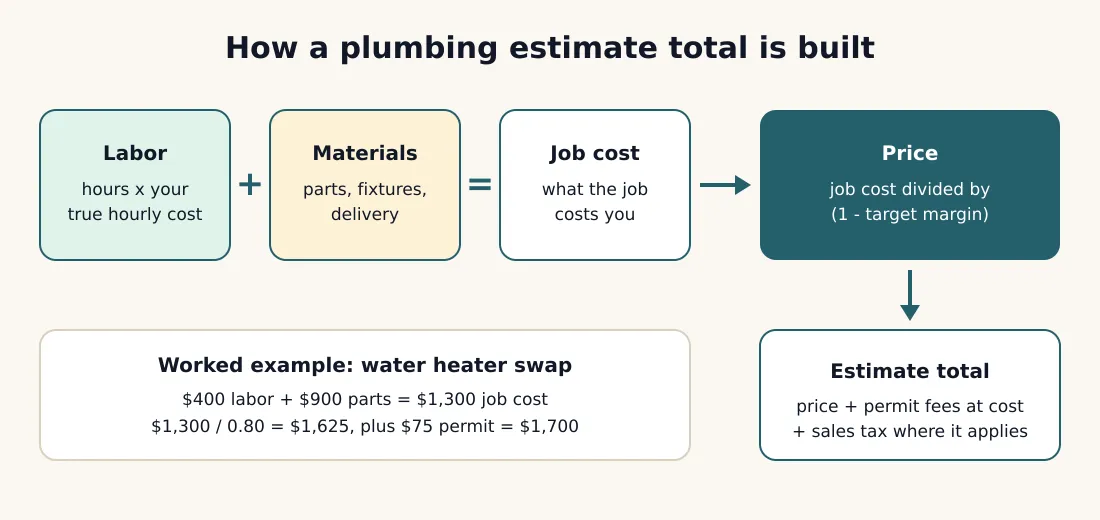
Here is Service Fusion's worked water heater replacement, using $100 an hour and a 20% target margin:
| Line | Amount |
|---|---|
| Labor: 4 hours at $100 | $400 |
| 50-gallon water heater, your cost | $750 |
| Connectors, valves and fittings, your cost | $150 |
| Job cost before permit | $1,300 |
| Price at 20% margin ($1,300 ÷ 0.80) | $1,625 |
| Permit fee, passed through at cost | $75 |
| Price to the customer | $1,700 |
The permit is added after the margin calculation, so the margin applies only to labor and materials. Treat the figures as an illustration and replace them with your own costs.
Method 2: Flat-rate prices for repeat jobs
Once you know your costs, you can stop rebuilding the same price. A flat rate gives the customer one number for a job you have done many times.
Service Fusion says a flat rate suits repeatable work where you know the time well, such as fixture swaps and water heater installs. It also rewards you for working faster, because the price stays the same while your hours fall.
Build each flat rate with Method 1, using your average time for that job, and write it into a price list. Simpro recommends saving a version of your estimate for each common job type, such as service calls, water heater replacements and drain clearing. That way you are not starting from a blank page every time.
Small repairs need a floor. Service Fusion's kitchen drain example comes to 1.5 hours including travel at $100 and $10 in supplies, a $160 cost that prices at $200 with a 20% margin. For jobs like that, many plumbers set a minimum service fee instead of estimating each visit, so a 20-minute repair still covers the drive and the setup.
Review the list when your supplier prices move. A flat rate built on last year's water heater cost quietly gives your margin away.
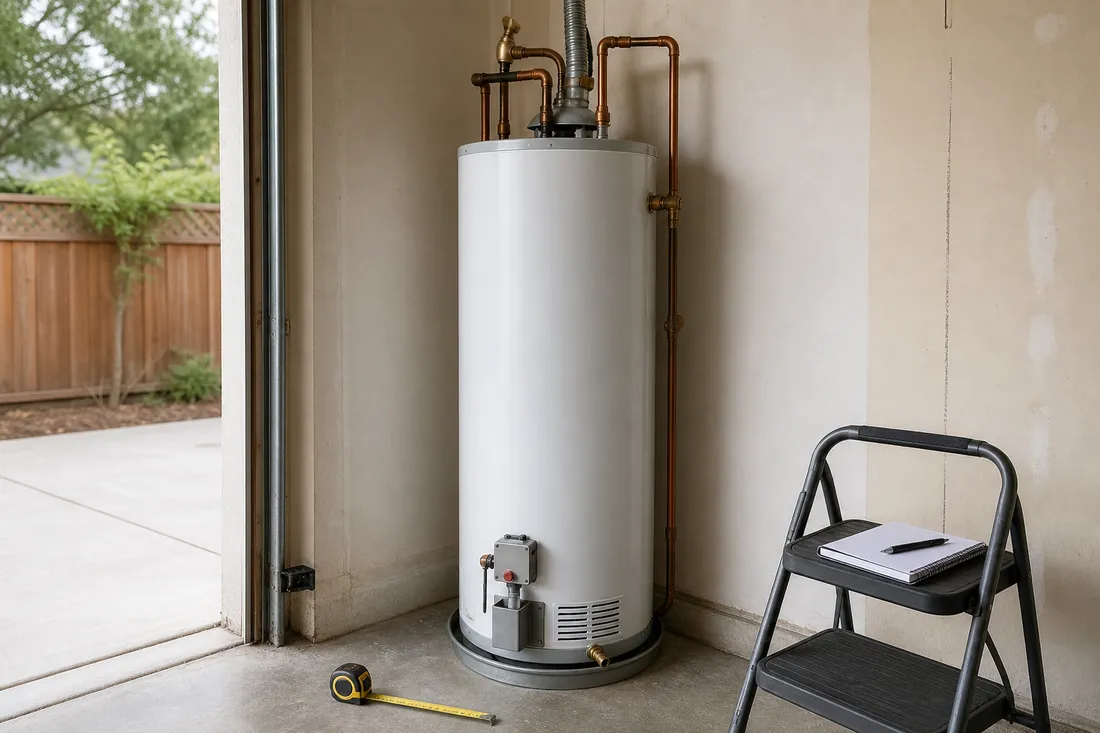
Method 3: Time and materials when the scope is unknown
Some jobs cannot be priced honestly in advance. A leak inside a wall, a drain line of unknown condition or a remodel in an old house all hide the real scope until work begins.
A time-and-materials estimate bills the hours and parts as they happen. Service Fusion recommends it for jobs with unknowns, and says that when the uncertainty is too great to price with confidence, an estimate or time-and-materials approach may fit better than a fixed quote.
The customer still needs a number to plan around. Give your hourly rate, a likely range of hours, the parts you expect, and the conditions that would push the job past the range. For a slab leak, that might be the rate, your expected range of hours, and a note that rerouting the line is priced separately once the leak is located.
Two tools control the risk. Simpro lists a 5% to 10% contingency buffer for unforeseen complications as an optional addition to an estimate. Service Fusion's alternative is to exclude hidden conditions in writing and handle them through written change orders. Use one or the other on every open-ended job, and tell the customer which.
If you start with an estimate for diagnostic work, Service Fusion suggests saying in writing when you will send a firm quote. The customer then knows the first number is provisional and when the final one arrives.
Method 4: Offer good, better and best
A single price asks the customer for a yes or a no. Three prices ask which one. Service Fusion says a good, better, best choice lets customers pick a price without leaving, and Simpro lists pricing tiers among the additions that can raise your average ticket.
For a water heater, the three options might be a like-for-like tank replacement, a tank with a longer warranty and new shut-off valves, and a tankless unit. Price each with Method 1 so every tier carries the same margin.
Keep the scope of each option complete. The lowest tier should still be a job you are willing to put your name on, with the permit and haul-away included where they apply. Label what changes between tiers in plain words, such as the warranty length, the tank size or the brand, so the customer compares like with like.
Jobber makes a related suggestion: add optional line items for repairs or services that would improve the work. An expansion tank or a drain pan can sit below the total as an add-on with its own price.
A plumbing estimate template to copy
Whichever method sets the number, the document needs the same fields. Invoice Simple lists contractor and client information, a detailed description of the services, itemized costs for materials and labor, the total estimated cost, and terms and conditions. Housecall Pro recommends a separate line for every charge, including other fees such as a permit fee or a disposal fee. Simpro adds a validity period, a place for the customer to accept, and a note on how the customer books the job.
Copy this into a document or spreadsheet and replace the brackets.
PLUMBING ESTIMATE
Estimate no.: [number]        Date: [date]        Valid until: [date]

Contractor: [business name]  |  [phone]  |  [email]
License no.: [number]
Customer: [name]  |  [phone]  |  [email]
Service address: [address]

This is an estimate. The final price may change if the scope
changes, as described under "Changes" below.

SCOPE OF WORK
1. [Task, e.g. Remove existing 40-gallon gas water heater]
2. [Task, e.g. Install new 50-gallon unit, connectors and valves]
3. [Task, e.g. Test for leaks and haul away old unit]

LABOR
[Description]                 [hours] x $[rate]             $[ ]

MATERIALS
[Item, brand or model]        [qty] x $[unit price]         $[ ]
[Item]                        [qty] x $[unit price]         $[ ]

OTHER CHARGES
Permit fee                                                  $[ ]
Disposal fee                                                $[ ]

Subtotal                                                    $[ ]
Sales tax                                                   $[ ]
ESTIMATE TOTAL                                              $[ ]

OPTIONAL ADD-ONS (not in the total)
[Item, e.g. Expansion tank]                                 $[ ]

NOT INCLUDED
[e.g. Drywall repair, painting, electrical work]

TERMS
Deposit: $[ ] due on acceptance
Balance: due [on completion / within # days]
Timeline: start [date or window], expected finish [date]
Warranty: [period] on labor; parts carry the manufacturer warranty
Changes: any change to scope or price is agreed in writing first

ACCEPTANCE
Customer signature: ____________________   Date: ________
To schedule the work: [how the customer books]
A few notes on filling it in. Write the scope as specific tasks. Service Fusion's example line is "Remove existing 40-gallon gas water heater and install a new 50-gallon unit," which leaves much less room for argument than "replace heater."
Fill in the exclusions every time. Simpro names excavation, permits and drywall repair as the usual items to document, and Service Fusion adds painting and electrical work. The exclusion list is what you point to when the customer asks who patches the wall.
Check your state's rules on deposits and contracts before you set the terms. Service Fusion cites California as an example, where the Contractors State License Board caps a down payment at $1,000 or 10 percent of the contract price, whichever is less, and requires a written contract for home improvement projects over $500. Other states set their own limits, and your licensing board can tell you which apply. None of this is legal advice.
When the job is done, the same line items carry over to the bill. A plumbing invoice template with matching sections makes the two documents easy to compare.
Send it fast and follow up
Speed matters once the price is ready. Simpro advises sending the estimate the same day as the visit if possible, and says customers are more likely to book when it arrives within 24 hours. Service Fusion points out that customers often collect two or three prices, so a clear document that arrives quickly keeps you in the comparison.
If you can, walk the customer through it by phone or in person. A short call lets you explain the warranty or the quality of the parts.
Then follow up. Simpro suggests a phone call within seven days if there is no reply, and notes that an unanswered estimate is usually a customer who got busy. Service Fusion's tip is to ask whether they have questions instead of asking whether they have decided. Procore gives the same instruction for larger bids: once the estimate is submitted, follow up on it.
Before sending, read the document once more for missing prices and spelling. Procore notes that clean spelling and grammar show professionalism.
Frequently asked questions
How do you estimate a plumbing job?
Price it from your own costs. Inspect the job, list each task and material, price labor at your true hourly cost, add materials at full cost, and set the price to leave the margin you need. Then write the scope, exclusions, terms and a valid-until date.
Should a plumbing estimate be free?
That is your choice, as long as you say so up front. Service Fusion notes that some plumbers charge a diagnostic or site visit fee and credit it toward the job if the customer goes ahead. Some states limit fees for estimates, so check yours.
How long should a plumbing estimate stay valid?
Thirty days is the common answer. Simpro calls a 30-day window standard because copper, PVC and fixture prices can shift within weeks. Pick a period that matches how fast your supplier prices move, and print the date on the estimate.
What if the job costs more than the estimate?
Stop and put the change in writing before doing the extra work. Service Fusion points to California, where a change order must be signed by both the customer and the contractor before any price or scope change. The habit protects you everywhere.
Is a plumbing estimate the same as an invoice?
No. Jobber describes the estimate as the first step, sent before work begins, and the invoice as the final bill for completed work. The invoice amount can differ from the estimate if the work changed along the way.
Get more requests for estimates
An estimate only helps after someone asks for a price. A homeowner with a failing water heater searches for a plumber first, and your website has to show what you do, where you work and how to reach you.
Kejoola gives a plumbing business a four-page website (Home, Services, Blog and Contact) with online booking. The booking form collects name, email, phone and a notes box, where a customer can describe the leak or the age of the water heater before you visit. See what a plumbing website needs, or read the roofing estimate template for another trade's version of this document.
Sources
- How to Write a Plumbing Quote and Price Plumbing Jobs, Service Fusion
- Free Plumbing Estimate Template, Simpro
- 9 Essential Steps to Accurate Plumbing Job Estimates, Procore
- Free Plumbing Estimate Template, Jobber
- Plumbing Estimate Template, Housecall Pro
- Plumbing Estimate Templates, Invoice Simple
- Plumbers, Pipefitters, and Steamfitters, Bureau of Labor Statistics