How to Start a Plumbing Business: Licenses, Tools, and First Jobs
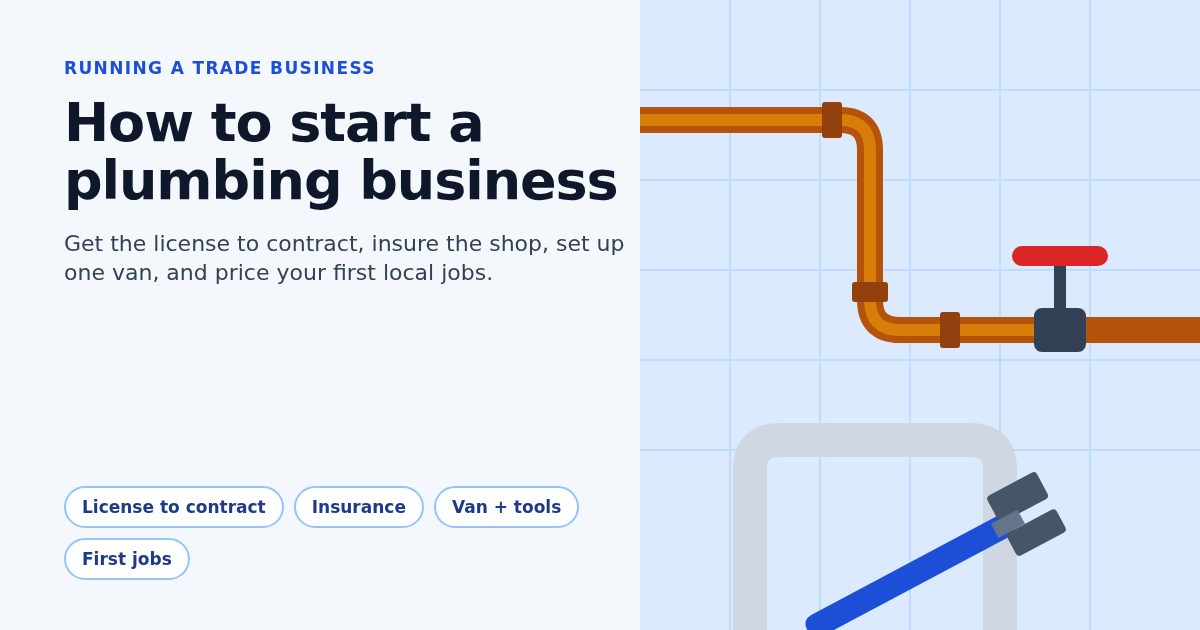
How to start a plumbing business: get the license your state requires to run a shop, register and insure it, stock one van for the jobs you'll take, price from real costs, and win local work.
Josh · Oct 17, 2026 · 14 min read
- how to start a plumbing business
- plumbing business
- plumbing license
- master plumber
- plumbing startup
- small business
To start a plumbing business, first get the license your state requires to run a plumbing shop, which is often a step above the one you work under today. Then register and insure the business, stock one van for the jobs you plan to take, price every job from your real costs, and win your first calls from people who already trust your work.
The steps fit a licensed journeyman or master plumber in the U.S. going out on their own, solo or with one helper. Licensing rules change from state to state and sometimes city to city, so treat every rule below as a question to confirm with your own board.
Why licensing comes first for a plumbing business
In some trades you can register an LLC, print cards, and start taking calls the same week. Plumbing works differently. The Bureau of Labor Statistics says most states and some localities require plumbers to be licensed, and that some states require master plumber status before you can get a plumbing contractor's license. It also notes that starting your own business may require additional licensing beyond what you hold as an employee.
That license sits under almost everything else. Permits and inspections run through it, insurance carriers ask for it, and in some states your van lettering comes from it. A homeowner with water on the floor won't check your license, but the city inspector will.
So sort out the license that lets you contract on your own first. Doing it the other way around leaves you with a van and paid ads you can't legally use.
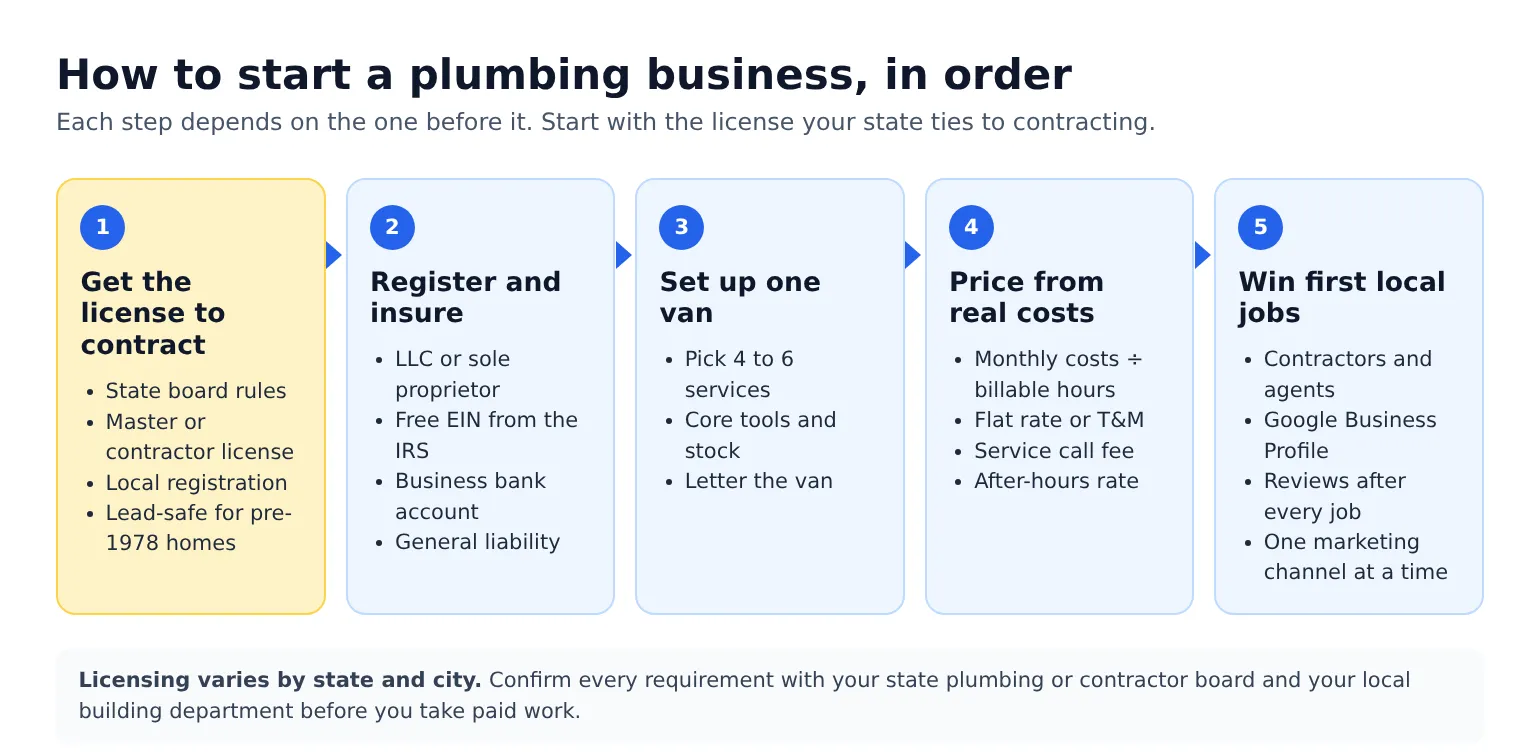
The order to work through before your first paid call. Diagram only.
Step 1: Get the license that lets you run the shop
Find out which license level your state ties to contracting before you spend money on anything else.
Know which license level you need
The BLS describes the usual path. Most plumbers learn through a 4- or 5-year apprenticeship with about 2,000 hours of paid on-the-job training each year, pass an exam to reach journey level, then take another exam after several more years to earn master status. States and localities often ask for 2 to 5 years of experience and an exam before a plumber can work independently.
| License level | What it usually lets you do | How plumbers usually get it |
|---|---|---|
| Apprentice or registered helper | Work under direct supervision of a licensed plumber | Enroll in an apprenticeship or register with the state |
| Journeyman (journey level) | Do plumbing work on your own, often for a licensed shop | Finish an apprenticeship and pass the journey-level exam |
| Master plumber | Plan and supervise work, and in many states qualify a business | Several more years of experience and a second exam |
| Contractor or company license | Bid jobs, pull permits, and operate a plumbing company | A qualifying license holder, plus insurance or a bond, depending on the state |
The names and limits vary, and some states leave most of it to cities and counties.
See how two states handle it
Texas and California show how different the rules can be.
In Texas, a plumbing company works under a Responsible Master Plumber. To get that designation from the Texas State Board of Plumbing Examiners, you must already be a licensed Texas master plumber in good standing with proof of at least $300,000 of commercial liability insurance. The board lists a $225 application fee. The RMP pulls the permits, requests inspections, makes sure everyone doing plumbing holds a current license or registration, and makes sure every service vehicle shows the company name and the RMP's license number.
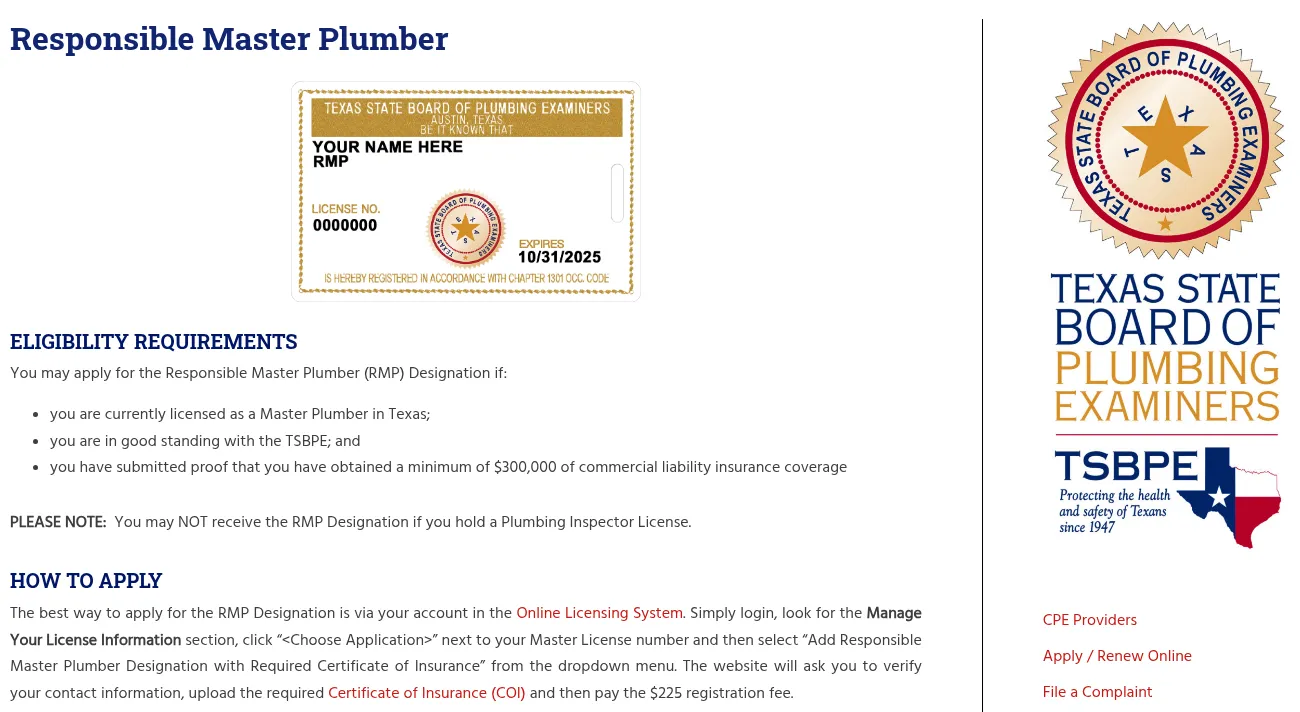
The Texas board's Responsible Master Plumber page, captured October 2026. Rules and fees can change, so check the live page.
California handles plumbing through the Contractors State License Board and its C-36 Plumbing Contractor classification. The CSLB says a license is required when a job needs a building permit, uses any additional workers, or totals $1,000 or more in labor and materials. The license needs a qualifying individual with at least four full years of journey-level, foreman, supervisor, or contractor experience in the last 10 years. You also need a $25,000 bond in place before the license is issued.
Find your own state's rules
Find your state's plumbing board or contractor licensing board and read its page on contractor or business licenses. Then call your city or county building department with three questions:
- Which license do I need to pull a plumbing permit in my own company's name?
- Do I need a separate local contractor registration or business license?
- Does gas piping, backflow testing, or medical gas work need its own endorsement?
The BLS notes that some states require a special license to work on gas lines. If you plan to install gas water heaters, sort this out now.
Get lead-safe certified before you open walls in older homes
The EPA's lead rules reach plumbers too. Anyone paid to disturb paint in homes and child-occupied facilities built before 1978 generally needs certification, and that includes sole proprietorships. EPA lists plumbers by name among the special trade contractors covered. Minor repairs that disturb six square feet or less of paint per room inside, or 20 square feet or less outside, are not covered. Opening a bathroom wall to reach a leaking drain can pass that quickly, so get certified before you bid repipes in older neighborhoods.
Step 2: Register, insure, and set up the money side
Choose a structure and register it
The SBA explains that a sole proprietor can be held personally liable for the business's debts, while an LLC protects personal assets like your vehicle, house, and savings in most instances. Plumbing carries real damage risk, from a failed fitting behind a wall to a flooded basement, so ask an accountant which structure fits before you file. The SBA also says registration usually costs less than $300, though fees vary by state and structure.
Pick a name customers can say on the phone and read on a van door from across the street.
Get a free EIN and open a business account
Apply for an EIN directly from the IRS. It's free, and the IRS warns about websites that charge for one. If you're forming an LLC, file with your secretary of state first, because the IRS says applying before the entity exists can delay your EIN. Open a business bank account and run every supply house order, fuel stop, and customer payment through it.
Buy insurance that matches the work
The SBA describes general liability insurance as protection against losses from bodily injury, property damage, and lawsuits. In plumbing, that means a slab leak repair that cracks a tile floor or a water heater that leaks into a finished basement. If your state sets a minimum, as Texas does, buy at least that amount and file the certificate the board asks for.
The SBA also says businesses with employees are required to carry workers' compensation, unemployment, and disability insurance, and some states require more. Ask a licensed commercial agent three questions before you buy:
- Does the policy cover water damage from my work after I leave the job?
- Is my van covered for business use, including tools stored in it overnight?
- What changes when I hire my first helper?
Set money aside for taxes from the first job
Once you own the shop, nobody withholds tax from your pay. Move a share of every payment into a separate savings account, and ask your accountant whether you need to make estimated tax payments during the year.
Step 3: Set up one van for the jobs you'll take
Buy for the work you'll do in the first six months, not for the shop you hope to run in five years. That starts with choosing your services.
Pick your first services
Many new owners start in residential service and repair, because homeowners call directly and pay when the job is done. Pick four to six services you can do well alone, such as drain clearing, water heater replacement, toilet and faucet repair, leak repair, and garbage disposal installs.
| Service focus | Best for | Trade-off |
|---|---|---|
| Residential service and repair | A solo owner who wants to be paid at the end of each job | Night and weekend calls, and lots of short jobs to schedule |
| Remodels and repipes | An owner with a helper and patience for bigger bids | Longer jobs, permits and inspections, slower payment |
| New construction rough-in | An owner with builder relationships and a crew | Bids against larger shops, and payment on the builder's schedule |
Build the core kit
The BLS lists plumbers' tools as drills, saws, welding torches, press fitting tools, and drain cleaning tools. For a service van, group the rest the same way you'll grab it on a call:
- Hand tools: pipe wrenches, basin wrench, tubing cutters, adjustable pliers, and a full driver set.
- Joining: torch kit and solder, a press tool if your area uses it, and PEX crimp or expansion tools.
- Drain and diagnosis: a drain machine sized for household lines, a hand auger, and a moisture meter. Add an inspection camera once drain calls justify it.
- Safety: gloves, eye protection, knee pads, a respirator, and a fire extinguisher for torch work.
- Stock: the fittings, supply lines, wax rings, and valves you use every week, kept in labeled bins.
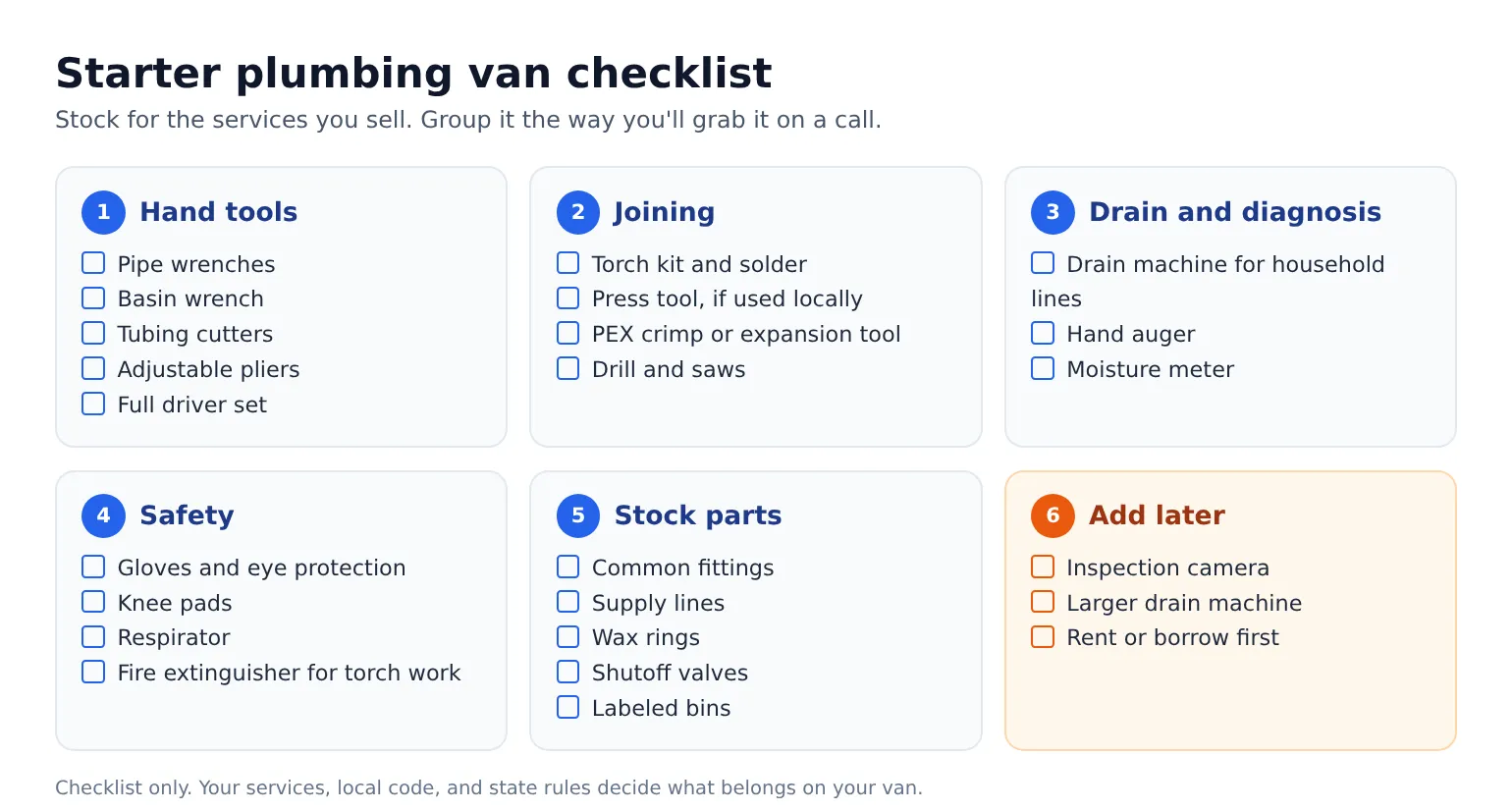
Stock for the services you sell. Rent or borrow big-ticket tools until the calls justify buying. Diagram only.
Letter the van
A lettered van advertises in every driveway you park in. In Texas, the board also requires the company name and the RMP's license number on every service vehicle, so check your state's rule before you order the vinyl.
Step 4: Price jobs so each one covers the whole day
Your price has to cover the drive, the supply house run, the van, insurance, tools, taxes, and the hours spent quoting jobs that never book.
Start from what the work is worth
The BLS lists the median pay for plumbers at $30.67 per hour in May 2025. That's a wage, paid by an employer who also covers the van, tools, and insurance. As the owner, your billed rate has to cover your own pay plus everything the shop used to cover for you. Add up a month of expected costs, divide by the hours you can realistically bill, and add your pay and a profit margin on top.
Choose flat rate or time and materials
| Pricing method | Best for | Trade-off |
|---|---|---|
| Flat rate per job | Common repeat jobs like a toilet rebuild or a disposal install | You need good time records, or one bad job eats the profit |
| Time and materials | Diagnosis, old houses, and jobs with unknowns behind walls | Customers worry about the final bill, so give a written range |
| Written bid | Repipes, remodels, and water heater upgrades with code work | Takes unpaid time to measure and write up |
Set a service call fee and an after-hours rate
The BLS notes that plumbers are often on call for emergencies, so evening and weekend work is common. Decide what a 2 a.m. call costs before you get one. A service call fee covers the drive and diagnosis even if the customer declines the repair. Say both prices on the phone before you roll.
Step 5: Win your first jobs
Start with people who already trust your work
Tell general contractors, remodelers, real estate agents, property managers, and past customers you're now on your own. Before you contact anyone from a former employer's customer list, reread any non-compete or non-solicitation agreement you signed. Hand every contact a card with your license number on it.
Set up a Google Business Profile as a service-area business
Most plumbers drive to the customer, so set up the profile as a service-area business with the towns you actually cover. If you run the shop from home, the steps to hide your address on Google Business Profile keep your house off the map. Add your services, hours, and real photos of your van and finished work.
Ask for reviews after every completed job
Ask while you're packing up and the customer has hot water again. The steps to get Google reviews from happy customers take a few minutes once your review link is saved on your phone.
Add marketing in the right order
Once the profile and reviews are working, add one channel at a time. The plumbing marketing ideas list goes through them in order, from Local Services Ads to realtor partnerships. When your jobs outgrow a notebook and a spreadsheet, compare plumbing software for small shops for scheduling and invoicing.
Common problems and how to fix them
You hold a journeyman license but not a master license
In many states that means you can't contract on your own yet. Ask your board whether you can work as a subcontractor under a master plumber, or whether a licensed master can qualify your company. Keep logging hours toward your master exam either way.
A customer asks for work outside your license
Gas lines, backflow testing, and medical gas often need separate endorsements. Say no politely and refer the job to someone who holds the right license.
Emergency calls are taking over your nights
Set after-hours prices that make the calls worth it, and decide which nights you're on call. Change your voicemail to say when you answer and what counts as an emergency.
The bank balance lags behind the booked work
Collect payment when the job is done, and send any invoice the same day. Pay the supply house from the business account so every job's materials are easy to track.
Where a bookable site fits
Once referrals and reviews start working, many homeowners will look you up before they call. Burst pipes still need a phone call. Routine jobs, like a water heater estimate or a slow drain, can be booked online while you're on another job. A Kejoola site, for example, is four pages (Home, Services, Blog, Contact) with online booking. A homeowner picks a time and types the address and the problem in the notes box, and the booking lands in your bookings. For what the pages themselves should show, read about website design for plumbers.
Questions plumbers ask about starting a plumbing business
How much does it cost to start a plumbing business?
It depends mostly on your state and the tools and van you already own. The SBA says registering usually costs less than $300, and the IRS issues EINs for free. State costs vary. Texas charges a $225 RMP application fee and requires at least $300,000 in liability coverage, and California requires a $25,000 bond. Get quotes for the van, tools, and insurance before you commit.
Can you start a plumbing business without a master plumber license?
Sometimes, but it depends on the state. The BLS says some states require master status to get a plumbing contractor's license. In Texas, a plumbing company needs a licensed master plumber as its Responsible Master Plumber. In California, the C-36 license needs a qualifying individual with four years of journey-level experience. Ask your state board.
How long does it take to become a plumber who can run a business?
Usually several years. The BLS says most plumbers train through a 4- or 5-year apprenticeship, then reach journey level by exam. Master status takes several more years of experience and another exam. Where your state ties contracting to the master license, plan on the full path before you open your own shop.
Do I need insurance before my first plumbing job?
Yes, in practice. Texas won't let a master plumber act as an RMP without proof of at least $300,000 in commercial liability coverage. Where your state sets no minimum, one water damage claim can still be more than a new shop can pay. Buy general liability before your first job, and add workers' compensation before you hire.
Is a plumbing business a good business to start?
Demand looks steady. The BLS projects employment of plumbers, pipefitters, and steamfitters to grow 7 percent from 2025 to 2035, with about 42,000 openings each year. The BLS expects that demand to come from repair and maintenance in existing buildings as well as new construction. The business side is harder than the trade itself, so set up licensing, insurance, and pricing before you chase volume.
Give homeowners a way to book your first plumbing jobs
If you want a site where customers can see your services and book a time, you can get a site customers can book from with Kejoola. Already have a Google Business listing? Paste your listing link to get a first draft of your site, then finish it with your own services, towns, and photos.
14-day free trial, no card needed. Online booking starts on the Starter plan.
Sources
- Plumbers, Pipefitters, and Steamfitters: Occupational Outlook Handbook (U.S. Bureau of Labor Statistics)
- Responsible Master Plumber (Texas State Board of Plumbing Examiners)
- Before applying for the examination (California Contractors State License Board)
- Renovation, Repair and Painting Program: Contractors (U.S. EPA)
- Launch your business: structure, registration, and insurance (U.S. Small Business Administration)
- Get an employer identification number (IRS)