Plumbing Maintenance: 12 Tasks for an Annual Service Visit
Plumbing maintenance means testing the shutoff, hunting leaks, measuring pressure, servicing the water heater, and checking drains, the sump pump and outdoor lines, usually once a year. Here are 12 tasks a plumber can turn into a service visit.
Josh · Nov 19, 2026 · 14 min read
- plumbing maintenance
- plumbing maintenance checklist
- preventive plumbing maintenance
- water heater maintenance
- plumbing business
Plumbing maintenance is the routine work that keeps a home's water system from leaking, clogging or failing: testing the main shutoff, checking for hidden leaks, measuring water pressure, servicing the water heater, and looking over drains, the sump pump and outdoor lines. For most homes it fits into one visit a year, with a few short tasks that come due more often. The 12 tasks below follow the order a plumber would work through a house, from the meter to the yard. Use them as your checklist on a maintenance call, or as the scope of a plan you sell to homeowners.
Why a yearly visit pays for itself
Most plumbing trouble starts small and out of sight. The EPA's WaterSense program says the average household's leaks waste more than 9,300 gallons of water a year, and that nine percent of homes have leaks of 50 gallons or more a day. The usual causes are worn toilet flappers, dripping faucets and leaking valves.
Those are cheap repairs when someone goes looking for them. The EPA estimates that fixing easily corrected leaks saves a homeowner about 10 percent on the water bill. A maintenance visit is simply the appointment where someone goes looking.
It also gives you a reason to see a customer before something breaks. A plumber who tested the shutoff in October is the plumber that household calls when a pipe splits in January.
1. Find and test the main shutoff
Start at the valve that controls the whole house. Paul Davis Restoration, a water damage company, says it is usually in the basement, crawl space, utility room or a closet, or next to the water heater. In warm climates it may sit outside near the foundation or in a meter box by the street.
Close the valve fully, open a faucet to confirm the water stops, then reopen it. Most valves turn clockwise to close. Highlands Ranch Water, a Colorado utility, notes that a lever handle is open when it sits parallel with the pipe, and that a round handle opens counterclockwise.
A valve that will not turn, or will not stop the flow, goes on the report as a priority repair. Tag the valve and show the homeowner where it is before you move on. That two-minute walkthrough is often what limits the damage when a supply line bursts and nobody from your shop is there.
2. Run a whole-house leak check at the meter
The meter tells you whether water is moving when nothing is turned on. The EPA's test is to read the meter before and after a two-hour period when no water is used. If the reading changes at all, there is probably a leak.
You will not sit in a driveway for two hours, so split the job. Take a reading when you arrive, with every fixture and appliance off, and watch the meter for as long as the visit allows. Then ask the homeowner to run the full two-hour version that evening and send you both readings.
Ask about the bills too. The EPA suggests looking at use in a colder month such as January or February. A family of four using more than 12,000 gallons in a month like that may have a serious leak.
3. Dye-test every toilet
A leaking flapper makes no noise, so it rarely gets reported. The EPA's test is simple: put a few drops of food coloring in the tank and wait 10 minutes. Color in the bowl means the tank is leaking past the flapper. Flush right after the test so the dye does not stain the tank.
Start the dye in every toilet at the beginning of the visit and read the bowls on your way back through. While each lid is off, check the fill valve, the chain length and the water level against the overflow tube.
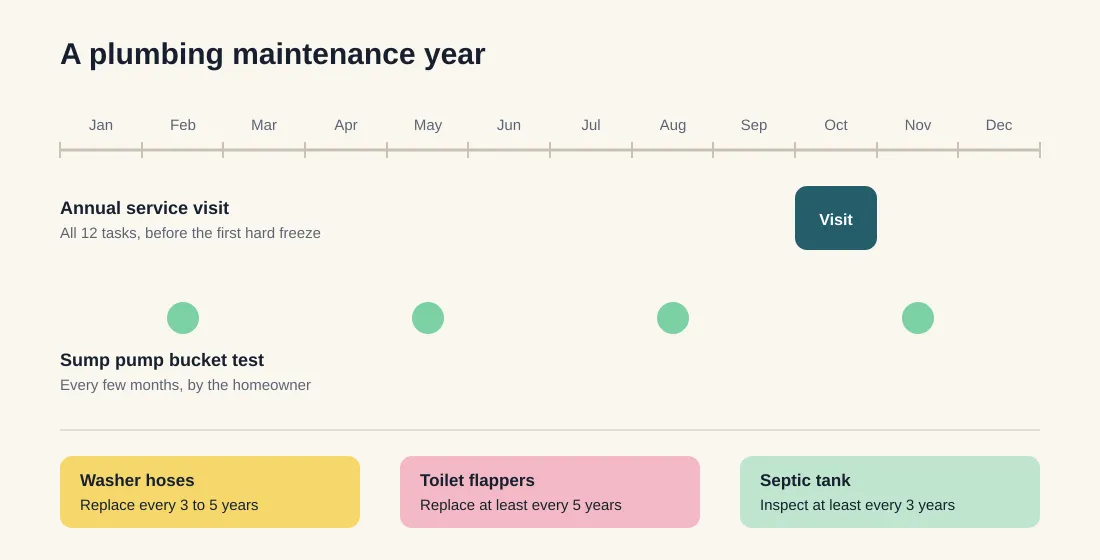
The EPA says flappers should be checked periodically and replaced at least every five years, because the rubber wears out. Note the install date inside the tank lid with a marker. Next year you will know at a glance whether a flapper is due.
4. Check faucets, showerheads and aerators
Run every faucet hot and cold, then shut it off and watch the spout. The EPA puts a faucet dripping once per second at more than 3,000 gallons wasted a year, and blames worn washers and gaskets for most of it. A showerhead leaking 10 drips a minute wastes more than 500 gallons a year.
Some shower drips are a loose connection at the shower arm, which pipe tape and a wrench can fix. A shower valve that drips when it is off is a cartridge or seat repair, and belongs on the estimate.
Unscrew the aerators while you are at each sink. Highlands Ranch Water lists plugged aerators as one cause of low pressure at a faucet. Rinsing out the grit takes a minute and is a result the homeowner feels the same day.
5. Look under every sink
Open each cabinet with a flashlight. The EPA advises examining faucet gaskets and pipe fittings for water on the outside of the pipe, which is the sign of a surface leak. Look for stained cabinet floors, green or white crust on fittings, and a trap that weeps when the basin drains.
Turn each fixture stop off and back on. A stop that is seized is as useless in an emergency as a seized main valve, and it will stall any future faucet repair.
Check the flexible supply lines to faucets, toilets, the dishwasher and the ice maker. Ullrich Insurance, a home insurance agency, puts the life of these lines at 5 to 10 years, braided steel included, because the inner liner can deteriorate while the outside still looks fine. If nobody knows how old a line is, recommend replacing it.
6. Measure the water pressure
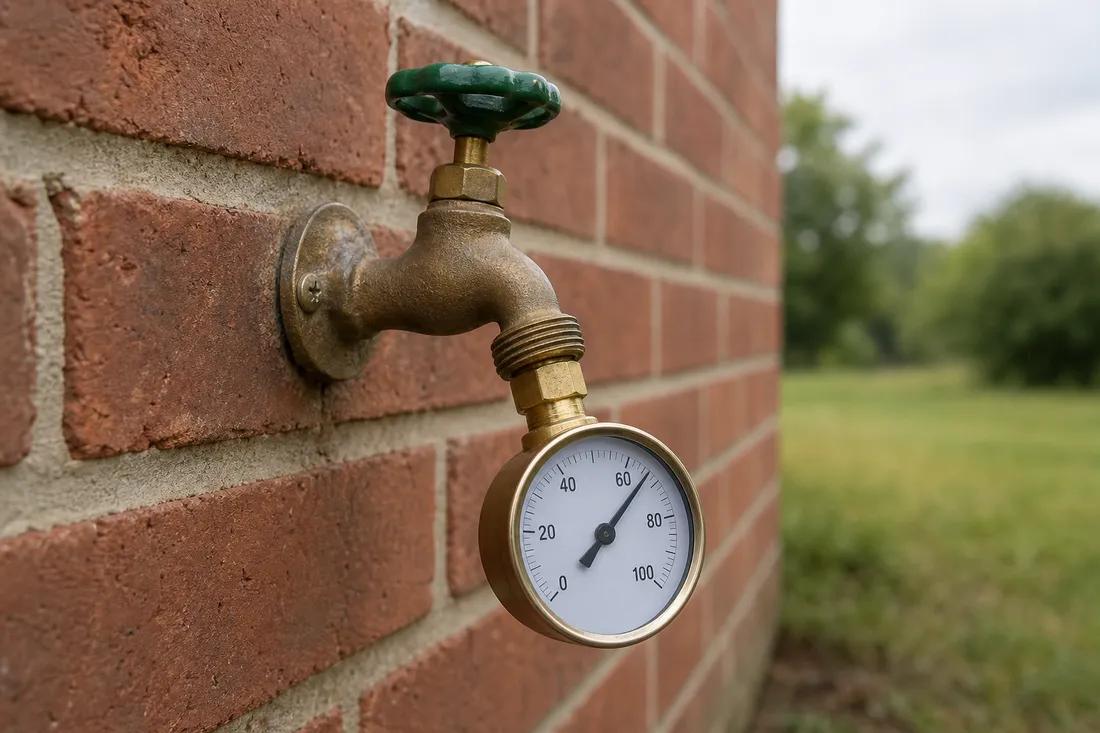
High pressure wears out everything downstream of it. Highlands Ranch Water says it can cause leaks, pipe damage and wasted water, and that pressure above 70 psi can damage household appliances. The utility gives 40 to 70 psi as the standard household range and treats anything under 40 psi as low.
The test takes a minute. With no water running in the house or the irrigation system, thread a gauge onto an outside hose faucet and open the faucet all the way. Highlands Ranch Water notes that a gauge costs less than $15 at a home improvement store.
If the reading is high, find the pressure reducing valve, usually near the meter or the main shutoff. The utility's signs of a failing one are a sudden loss of pressure, suddenly high pressure, and flow that starts strong and then tapers off. Record the reading on the report every year, so a slow change shows up.
7. Service the water heater
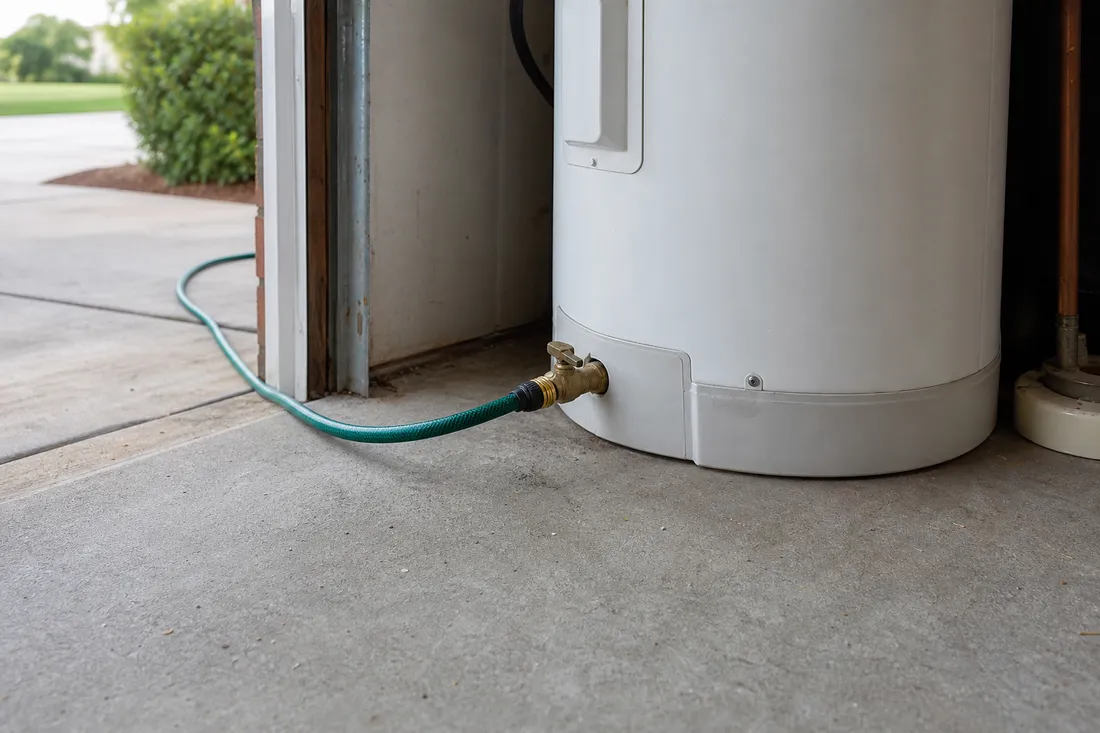
The water heater gets the most time on the visit. A. O. Smith, a water heater manufacturer, says most tank models need flushing at least once a year, more often in hard water areas.
The same guide covers the two safety and lifespan checks:
- Lift the lever on the temperature and pressure relief valve a few times to confirm it discharges water. A. O. Smith recommends a homeowner check once a year and a professional inspection every five years.
- Inspect the anode rod once a year, since its life depends on water chemistry, hot water use and how the water is treated.
A relief valve that drips is not always a bad valve. A. O. Smith says to control water pressure and add a thermal expansion tank before replacing it, which is one more reason to take the gauge reading first.
Set the thermostat to 120 degrees Fahrenheit when you finish, as the guide advises.
Tell the homeowner the unit's age. The Department of Energy says most storage water heaters last 10 to 15 years, while tankless models can last more than 20.
8. Inspect the washing machine hoses
Washing machine hoses sit behind the machine where nobody looks. Pull the washer forward far enough to see both hoses end to end.
Ullrich Insurance recommends replacing washing machine hoses every 3 to 5 years, noting that they carry high flow and fail more often than people expect. Look for bulges, cracks, rust at the couplings, and kinks where the machine has been pushed against the wall.
Close and reopen both laundry valves while you are there. If the homeowner travels, show them how to shut those valves before a trip. The agency describes a toilet supply line that let go early in a family's week away and ran until they came home.
Run a short fill and drain cycle before you slide the machine back, and watch the standpipe. A standpipe that backs up during the drain is a partial clog, and it is easier to clear on this visit than after a flooded laundry room.
9. Clear slow drains and reset the kitchen habits
Fill and release each sink, tub and shower, and time how they drain. Pull and clean the stoppers and pop-ups, where hair and soap collect, before reaching for a cable. A drain that stays slow after that goes on the report with a recommendation.
The kitchen line is usually a grease problem. The City of Kent, Washington, explains that fats, oils and grease poured down a drain, even in small amounts, coat and clog pipes over time and lead to blockages, backups and odors.
Leave the homeowner with the city's short list of habits:
- Pour cooled grease into a covered disposable container and put it in the garbage.
- Scrape plates and pans into the garbage before washing.
- Wipe out remaining oil with a paper towel.
- Use strainers in kitchen, bathroom and laundry sinks, and clean them routinely.
Kent also warns that wipes labeled flushable do not dissolve and can cause backups in the home. Say so plainly if you pull one out of a line.
10. Test the sump pump
A sump pump only proves itself during a storm, which is a bad time to learn it failed. Farmers Insurance describes the test: pour a bucket of water slowly into the pit, watch the float switch rise, and confirm the pump starts and moves water out through the discharge pipe. If it does not turn on, runs without draining or will not shut off, it needs repair or replacement.
Farmers suggests testing every few months, cleaning the basin twice a year, and checking the discharge line every three to four months and before winter. On an annual visit, do all three and teach the homeowner the bucket test for the months between.
Allstate's inspection list adds the check valve, the backup power source, the alarm, the cover and the discharge location. It recommends that the discharge end at least 20 feet from the house and not drain onto a neighbor's property. If there is a battery backup, test it the way the manufacturer describes.
11. Protect outdoor faucets and exposed pipes before a freeze
In cold climates, schedule the visit so this task lands before the first hard freeze. The American Red Cross lists the pipes that freeze most often: outdoor hose bibs, sprinkler and pool supply lines, supply pipes in unheated basements, crawl spaces, attics and garages, and pipes along exterior walls with little insulation.
Its steps for hose bibs are specific. Remove, drain and store the hoses. Close the inside valve that feeds each hose bib, then open the outside faucet and leave it open so any water left in the pipe can expand without breaking it.
Walk the unheated spaces and note every bare supply line, hot and cold. The Red Cross suggests pipe sleeves or UL-listed heat tape on exposed pipes. Quote that work on the spot if the lines are easy to reach.
In spring, the same visit covers the irrigation system. The EPA says a leak just 1/32 of an inch across can waste about 6,300 gallons of water a month.
12. Ask about the septic system
This task only applies to homes that are not on city sewer. Ask at booking whether the home has a septic tank, so you know before you arrive.
If it does, ask when it was last inspected and pumped. The EPA says the average household system should be inspected at least every three years by a septic professional, and that tanks are typically pumped every three to five years. Systems with float switches, pumps or other mechanical parts should be inspected about once a year.
You may not pump tanks yourself, but the record matters to your work. The EPA notes that a garbage disposal can increase how often a tank needs pumping, and that sump pumps and roof drains should discharge away from the drainfield. If the sump discharge line you checked earlier points at the drainfield, put that in the report and refer the customer to a septic company you trust.
How often each task comes due
One visit covers most of the list, but not every task runs on a one-year clock. This table collects the intervals quoted in the tasks above, so you can tell a customer which checks are theirs between visits.
| Task | Interval | Source |
|---|---|---|
| Sump pump bucket test | Every few months | Farmers Insurance |
| Sump discharge line check | Every 3 to 4 months, and before winter | Farmers Insurance |
| Water heater flush | At least once a year | A. O. Smith |
| Relief valve and anode rod check | Once a year | A. O. Smith |
| Washing machine hoses | Replace every 3 to 5 years | Ullrich Insurance |
| Toilet flappers | Replace at least every 5 years | EPA WaterSense |
| Septic inspection | At least every 3 years | EPA |
| Septic pumping | Typically every 3 to 5 years | EPA |
Write up what you found
The report is what the customer keeps, and it is what sells next year's visit. Keep it to one page and sort every finding into one of three groups.
| Group | What goes in it | Example |
|---|---|---|
| Done today | Work completed on the visit | "Flushed water heater, cleaned four aerators, tested sump pump" |
| Fix soon | Faults that will get worse | "Hall toilet failed dye test, flapper worn" |
| Watch | Readings and ages to compare next year | "Pressure 68 psi, water heater 11 years old" |
Write findings as plain facts with a location, such as "kitchen sink hot stop seized." Add a dated photo for anything in the second group. A homeowner can approve a repair from a photo of a corroded fitting far more easily than from a line of text.
Price the second group before you leave or the same day. If you need a format, this plumbing estimate guide includes a template you can adapt. For customers who want the visit every year, a short maintenance agreement sets the scope and the price, and these plumbing contract templates include one.
Frequently asked questions
How often should plumbing be maintained?
Once a year is a workable schedule for most homes. The annual items, such as the water heater flush and the relief valve check, set that pace. A few tasks come due sooner, like the sump pump test every few months, and those can be the homeowner's job.
What does plumbing maintenance include?
It includes testing and small service work across the whole system. That means the main shutoff, a meter leak check, toilets, faucets, supply lines, water pressure, the water heater, drains, the sump pump and outdoor lines. Repairs found along the way are quoted separately.
Is plumbing maintenance the same as a plumbing inspection?
No, though the two overlap. An inspection records the condition of the system, often for a sale or a permit. Maintenance also does work, such as flushing the heater and cleaning aerators. For the inspection side, see this plumbing inspection checklist.
Can homeowners do plumbing maintenance themselves?
Yes, for part of it. The EPA's dye test and meter test, the sump pump bucket test, and draining hose bibs are all written for homeowners. Pressure problems, anode rods, seized valves and anything involving gas are better left to a licensed plumber.
Make maintenance visits easy to book
A maintenance plan only works if homeowners can find you and ask for the visit. A plumbing site should say which services you offer, where you work, and how to request a time.
Kejoola gives a plumbing business a four-page website (Home, Services, Blog and Contact) with online booking. The booking form collects name, email, phone and a notes box, where a homeowner can mention the age of the water heater, a septic tank, or the toilet that keeps running. For what else that site should cover, see this guide to website design for plumbers.
Sources
- Fix a Leak Week, EPA WaterSense
- How to Care for Your Septic System, EPA
- Energy Saver Guide, U.S. Department of Energy
- Water Heater Maintenance Guide, A. O. Smith
- Water Pressure, Highlands Ranch Water
- Where to Find Your Main Water Shutoff Valve, Paul Davis Restoration
- Fats, Oils, and Grease (F.O.G.), City of Kent
- Sump Pump Maintenance: A Homeowners Guide, Farmers Insurance
- Sump Pump Maintenance and Inspection Tips, Allstate
- Preventing and Thawing Frozen Pipes, American Red Cross
- Replace Rubber Appliance Hoses With Braided Steel, Ullrich Insurance