Building Maintenance Checklist: 8 Free Templates to Copy
A building maintenance checklist splits upkeep into daily, weekly, monthly, quarterly, seasonal and annual tasks, with life-safety tests on their own monthly sheet. Here are 8 templates a handyman or maintenance crew can copy.
Josh · Nov 20, 2026 · 13 min read
- building maintenance checklist
- commercial building maintenance
- preventive maintenance checklist
- property maintenance checklist
- handyman business
A building maintenance checklist is a set of short task lists sorted by how often each job comes around: daily, weekly, monthly, quarterly, by season and once a year. The life-safety checks, such as extinguishers, emergency lights and exit routes, belong on their own monthly sheet because they carry legal schedules. The eight templates below are written for a handyman or maintenance crew that looks after small offices, shops and apartment buildings. Copy them, swap the brackets for your own details, and print them or load them on a tablet.
What every building maintenance checklist needs
A checklist only helps if the next person can read what happened. Every sheet in this pack uses the same five parts, so a client or a new tech never has to learn a new layout:
- A header with the building, address, date, the tech's name and the client contact.
- One line per task, marked OK, fixed, not applicable, or needs repair.
- Blanks for anything you measure or read, such as a gauge or a date on a tag.
- A findings box that lists each problem in plain words, with whether it was fixed on the spot or needs a quote.
- A sign-off for the client's name and the date.
Keep the frequencies honest. Some tasks have a schedule set by a rule or a code body, and those are cited in the templates below. Everything else is a sensible default you can tighten or loosen for the building in front of you. Mr. Handyman makes the same point in its own commercial checklist: each building, climate and location is different, so the list should be adapted to the property.
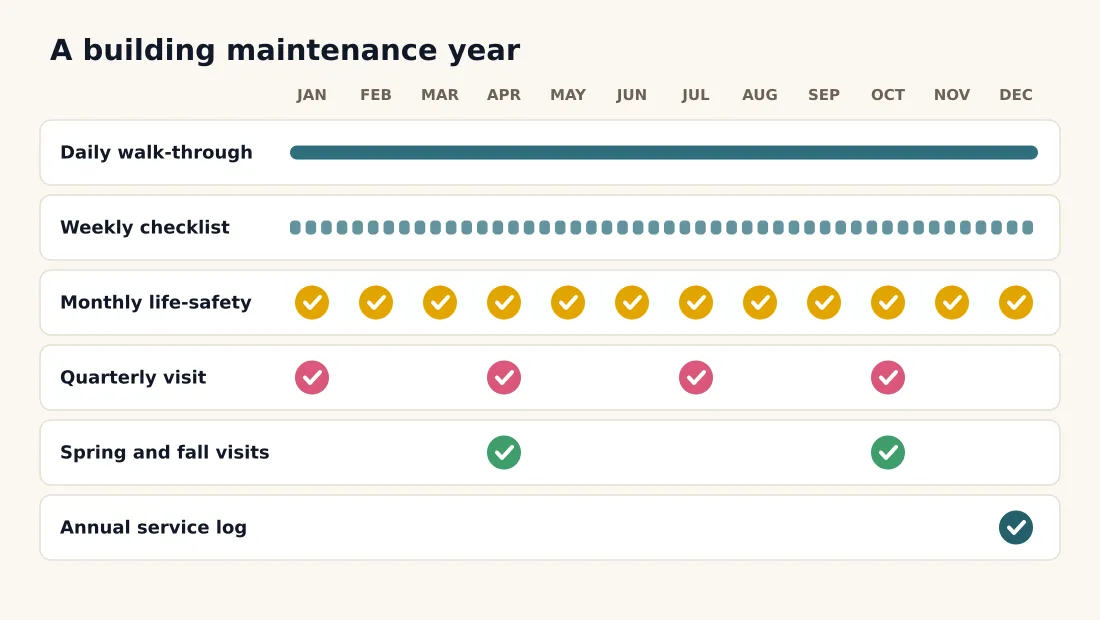
How the eight templates fit into one year. Diagram only.
1. Daily walk-through checklist
This is the five-minute loop an on-site maintenance person or a building manager runs at opening. It catches the problems that turn into slips, complaints and after-hours calls. Keep it on one card by the main entrance or in the janitor's closet.
DAILY BUILDING WALK-THROUGH
Building: [Name]    Address: [Street, city]
Date: [Date]    Time: [Time]    Checked by: [Name]

Mark each line: OK / FIXED / N/A / NEEDS REPAIR

ENTRANCES AND COMMON AREAS
[ ] Entry doors open, close and latch
[ ] Floors dry, no spills, mats flat
[ ] Lights on in halls, stairs and lobby
[ ] Trash and recycling emptied, area clean
[ ] Restrooms stocked, no running toilets or leaks

EXIT ROUTES
[ ] Every exit route clear of boxes, carts and furniture
[ ] Exit doors open freely and close fully
[ ] Exit signs lit

OUTSIDE
[ ] Walkways clear of debris, ice or standing water
[ ] Parking lot lights working (check at dusk)

Notes: ______________________________________
The exit lines are not just good housekeeping. OSHA's exit route standard (29 CFR 1910.37) says exit routes must be free and unobstructed, with no materials or equipment placed in them, even temporarily. It also requires each exit to be marked with an illuminated "Exit" sign. A daily glance is the cheapest way to stay on the right side of both.
2. Weekly building checklist
The weekly sheet covers what drifts slowly: a dripping faucet, a door closer that no longer pulls the door shut, a light that flickers. Run it on the same day each week so gaps in the log are easy to spot.
WEEKLY BUILDING CHECKLIST
Building: [Name]    Week of: [Date]    Tech: [Name]

Mark each line: OK / FIXED / N/A / NEEDS REPAIR

PLUMBING
[ ] Faucets, toilets and urinals checked for drips and running water
[ ] Under-sink areas dry, no stains or swelling
[ ] Floor drains flowing, no sewer smell

DOORS AND HARDWARE
[ ] Door closers pull doors fully shut
[ ] Locks, latches and hinges working
[ ] Weatherstripping intact on exterior doors

LIGHTING AND ELECTRICAL
[ ] Burned-out bulbs or tubes replaced    Count: [__]
[ ] No warm, buzzing or scorched outlets or switch plates
[ ] Electrical room clear, panel covers closed

EXTERIOR
[ ] Gutters and downspouts free-running after rain
[ ] Dumpster area clean, lids closed
[ ] Signs of pests or droppings    Location: [______]

Findings: ___________________________________
The pest line matters more than it looks. Mr. Handyman's list includes inspecting the property for signs of rodent or pest damage as a year-round task, and a weekly walk is where you will notice it first.
3. Monthly life-safety checklist
This is the sheet clients and inspectors care about most, because every line has a published schedule. Keep it separate from the general maintenance log, and keep the completed copies.
MONTHLY LIFE-SAFETY CHECKLIST
Building: [Name]    Month: [Month, year]    Tech: [Name]

Mark each line: OK / FIXED / N/A / NEEDS REPAIR

PORTABLE FIRE EXTINGUISHERS (visual, every unit)
Location          Gauge in green   Pin and seal   Tag date   Mounted, visible
[__________]      [ ]              [ ]            [____]     [ ]
[__________]      [ ]              [ ]            [____]     [ ]
[__________]      [ ]              [ ]            [____]     [ ]

EMERGENCY LIGHTING AND EXIT SIGNS
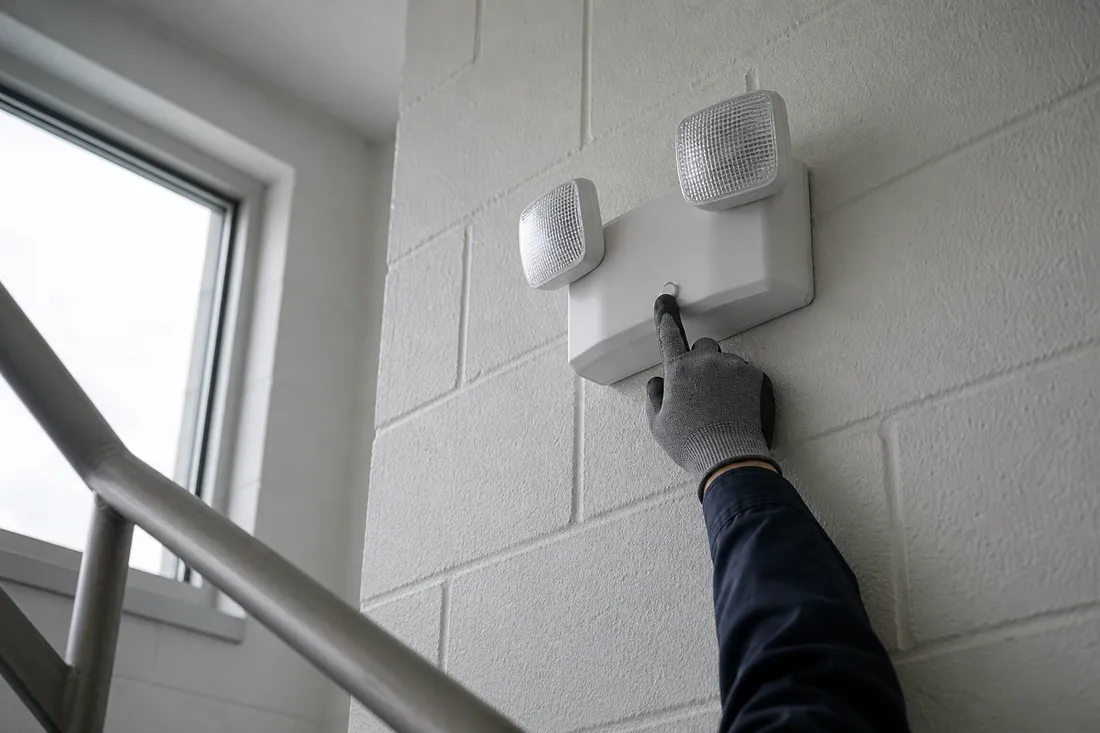
[ ] Battery units tested at least 30 seconds with the test button
[ ] Self-test units: no fault light showing
[ ] All exit signs lit and readable    Units failed: [__]

SMOKE AND CO ALARMS
[ ] Each alarm tested with its test button    Units failed: [__]
[ ] Manufacture dates noted on any alarm near 10 years old

GFCI OUTLETS
[ ] Each GFCI tripped with TEST and restored with RESET
    Locations failed: [______]

EXIT ROUTES
[ ] Routes clear, no lockable room on the path to an exit

Client sign-off: [Name]    Date: [Date]
Here is where each schedule comes from:
| Item | Schedule | Source |
|---|---|---|
| Portable fire extinguishers | Visual inspection monthly, maintenance check annually | OSHA 29 CFR 1910.157 |
| Battery emergency lights | 30-second test monthly, 90-minute test annually | NFPA Journal on NFPA 101 |
| Smoke alarms | Test monthly, replace the alarm every 10 years | U.S. Fire Administration |
| GFCI outlets | Test every month | Electrical Safety Foundation International |
NFPA's article adds a useful detail for buildings with self-testing emergency lights. Those units do not need the manual monthly button test, but someone still has to look at them every 30 days for damage and fault lights. Building fire alarm and sprinkler systems have their own testing rules and are usually serviced by a licensed fire protection company, so note the date of their last visit rather than testing them yourself.
4. Quarterly checklist
Quarterly tasks are the ones that are easy to forget because they come around only four times a year. Put the next due date at the bottom of each sheet so it lands in your schedule before you leave the building.
QUARTERLY BUILDING CHECKLIST
Building: [Name]    Quarter: [Q_ year]    Tech: [Name]

Mark each line: OK / FIXED / N/A / NEEDS REPAIR

HVAC
[ ] Filters checked and changed    Size: [__ x __ x __]    Qty: [__]
[ ] Return and supply grilles clear and dust-free
[ ] Condensate drain lines flowing, pans dry
[ ] Thermostats set to the client's schedule

WATER HEATERS
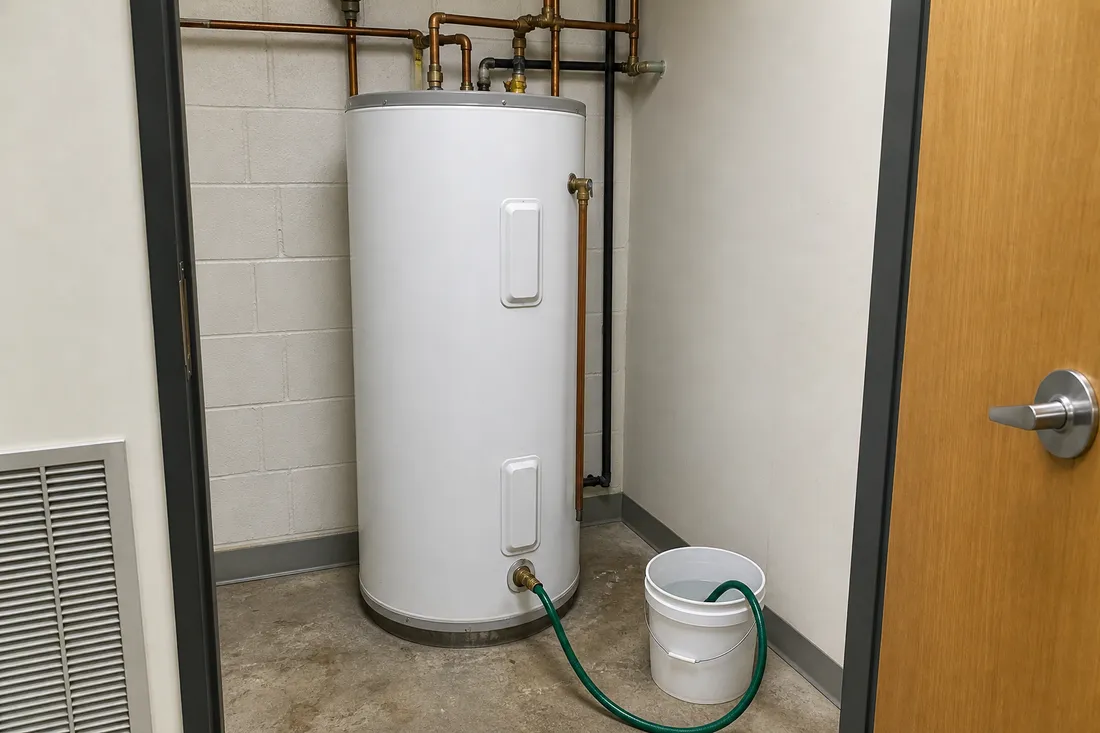
[ ] About a quart drained from each tank to clear sediment
[ ] No leaks at the valves, fittings or tank base
[ ] Temperature and pressure relief valve discharge pipe in place

BUILDING ENVELOPE
[ ] Windows open, close and seal; cracked glass noted
[ ] Caulk and sealant around windows and doors intact
[ ] Ceiling tiles checked for new water stains    Locations: [______]

GROUNDS
[ ] Sidewalks and steps checked for trip hazards
[ ] Exterior lighting and timers working

Next quarterly visit: [Date]
Two lines here come from Department of Energy and ENERGY STAR guidance. The Energy Saver Guide suggests draining a quart of water from a tank water heater every 3 months to remove sediment that cuts heat transfer. ENERGY STAR recommends inspecting, cleaning or changing HVAC filters once a month, so in a dusty shop or a busy building, move the filter line up to the monthly sheet.
5. Spring checklist
Spring is when you find what winter did to the outside of the building. It is also the moment to get cooling equipment checked before the first hot week.
SPRING BUILDING CHECKLIST
Building: [Name]    Date: [Date]    Tech: [Name]

Mark each line: OK / FIXED / N/A / NEEDS REPAIR

ROOF AND DRAINAGE
[ ] Roof inspected (or roofer booked)    Date: [Date]
[ ] Roof drains and scuppers cleared of debris
[ ] Gutters and downspouts cleaned and reattached where loose
[ ] Signs of ponding water or new leaks noted

HVAC
[ ] Cooling pre-season check booked with HVAC contractor    Date: [Date]
[ ] Outdoor units clear of leaves and plant growth

EXTERIOR
[ ] Walkways, building face and dumpster pad pressure washed
[ ] Winter damage to siding, trim and paint noted
[ ] Parking lot cracks and potholes measured    Sizes: [______]
[ ] Exterior lights checked for damage

GROUNDS
[ ] Irrigation turned on, heads checked, schedule set
[ ] Trees and shrubs trimmed back from the building

Findings and quotes needed: __________________
The roof line follows the National Roofing Contractors Association, which recommends inspecting a roof at least twice a year, in spring and fall, and after any severe storm. NRCA also stresses clearing roof drains, because loose debris gets swept into them by the next heavy rain. ENERGY STAR advises checking the cooling system in spring, before contractors get busy once summer starts.
6. Fall and winter prep checklist
The fall sheet gets the building ready for cold, wet months and short days. In warm climates, drop the freeze lines and keep the rest.
FALL AND WINTER PREP CHECKLIST
Building: [Name]    Date: [Date]    Tech: [Name]

Mark each line: OK / FIXED / N/A / NEEDS REPAIR

ROOF AND GUTTERS
[ ] Second roof inspection of the year done or booked    Date: [Date]
[ ] Leaves cleared from roof drains, gutters and downspouts

HEATING
[ ] Heating pre-season check booked with HVAC contractor    Date: [Date]
[ ] Filters changed before heating season

FREEZE PROTECTION
[ ] Irrigation lines drained and winterized
[ ] Exposed pipes and hose bibbs insulated or shut off
[ ] Doors and windows sealed against drafts

SNOW AND ICE
[ ] Snow removal contractor confirmed    Contact: [Name, phone]
[ ] Driveway and lot edges staked for plows
[ ] Ice melt stocked    Amount: [______]

LIGHTING
[ ] Exterior and parking lot timers reset for shorter days

Findings and quotes needed: __________________
Several of these lines come straight from Mr. Handyman's fall list: winterizing irrigation, checking pipe insulation, marking drives with stakes for plows and confirming the winter plan. ENERGY STAR puts the heating check-up in fall for the same reason as the cooling one in spring.
7. Annual service and inspection log
The annual log is less a checklist than a record of who did what and when. Many of these jobs go to a licensed specialist, so the useful thing on this sheet is the date, the company and where the report is filed.
ANNUAL SERVICE AND INSPECTION LOG
Building: [Name]    Year: [Year]    Kept by: [Name]

Item                                  Date done   Done by (company)   Report filed
Fire extinguisher annual maintenance  [____]      [__________]        [ ]
Emergency lights 90-minute test       [____]      [__________]        [ ]
Fire alarm and sprinkler service      [____]      [__________]        [ ]
Backflow preventer test               [____]      [__________]        [ ]
HVAC cooling check-up (spring)        [____]      [__________]        [ ]
HVAC heating check-up (fall)          [____]      [__________]        [ ]
Roof inspection (spring)              [____]      [__________]        [ ]
Roof inspection (fall)                [____]      [__________]        [ ]
Smoke alarm batteries replaced        [____]      [__________]        [ ]
Elevator inspection (if any)          [____]      [__________]        [ ]

Items overdue: ______________________________
Keep the paperwork, not just the dates. OSHA requires the employer to record each extinguisher's annual maintenance date and keep that record for one year after the last entry, or the life of the shell if that is shorter. For backflow preventers, the EPA's cross-connection fact sheet says testing should be done by trained, certified staff, and that the local program sets the testing frequency. Ask the water utility what it requires rather than guessing.
8. Maintenance visit report
The report is what the client actually reads. It turns a stack of ticked boxes into a short list of what is fine, what you fixed and what needs a decision.
MAINTENANCE VISIT REPORT
[Business name] · [Phone] · [Email]
Client: [Name, company]    Building: [Name, address]
Visit date: [Date]    Tech: [Name]    Checklist used: [Daily / Weekly / Monthly / Quarterly / Seasonal]

SUMMARY
Items checked: [__]    OK: [__]    Fixed today: [__]    Need repair: [__]

FIXED TODAY
1. [Item, location, what was done, parts used]
2. [Item, location, what was done, parts used]

NEEDS A DECISION
1. [Item, location, problem, photo #, rough cost or "quote to follow"]
2. [Item, location, problem, photo #, rough cost or "quote to follow"]

REFERRED TO A SPECIALIST
1. [Item, trade needed (roofer, electrician, fire protection), reason]

NEXT SCHEDULED VISIT: [Date]

Tech signature: ________    Client signature: ________    Date: [Date]
Attach dated photos for every "needs a decision" line, taken from the same spot each visit. A property manager can approve a repair faster when the stain on the ceiling tile is right there in the report.
How to turn the checklist into recurring work
A checklist is also a scope of work. If you run a handyman or maintenance business, the frequencies above are the services you can sell: a monthly life-safety round, a quarterly visit and two seasonal visits a year. Price each one as a flat visit, then quote repairs separately from the report.
Put the agreement in writing before the first visit. A handyman contract can list which checklists you run, how often, what is included, and what counts as extra work. Bill each visit with a handyman invoice that matches the report, so the client sees the same line items twice.
Know where your scope ends. Refer roofing, electrical panel work, refrigerant handling and fire protection systems to licensed trades, and note the referral on the report. For deeper system checks, the HVAC maintenance checklist, plumbing inspection checklist and electrical inspection checklist go further than these sheets.
Frequently asked questions
How often should a commercial building be inspected?
Every day for a quick walk-through, and on a monthly, quarterly and seasonal cycle for everything else. Some items have fixed schedules: OSHA requires a monthly visual check of portable fire extinguishers, NFPA 101 calls for a monthly 30-second emergency light test, and NRCA recommends a roof inspection every spring and fall.
What should be on a monthly building maintenance checklist?
Life-safety items first. That means fire extinguishers, emergency lights, exit signs, smoke alarms, GFCI outlets and clear exit routes. In dusty buildings, add HVAC filters, which ENERGY STAR suggests checking monthly.
Can a handyman do all the tasks on a building maintenance checklist?
No. A handyman can run the walk-throughs, swap filters and bulbs, test alarms and GFCIs, and fix doors and drips. Backflow testing needs certified staff according to the EPA, and fire protection systems, roof repairs and electrical panel work usually go to licensed specialists.
How long should I keep building maintenance records?
At least as long as any rule requires, and longer is safer. OSHA requires extinguisher annual maintenance records to be kept for one year after the last entry, or the life of the shell if shorter. Keeping every visit report for several years also helps when a client disputes when a problem started.
Let property managers book a walk-through
Property managers and small business owners look for maintenance help online, usually when something has already gone wrong. A simple site that lists your checklist services and lets them ask for a first walk-through turns that moment into a recurring client. For what that site should include, see this guide to a handyman website.
Kejoola gives a handyman business a four-page website (Home, Services, Blog and Contact) with online booking. The booking form collects name, email, phone and a notes box, where a manager can describe the building, its size and the leak or flickering light that made them search.
Sources
- Building Maintenance Checklist, Mr. Handyman
- 29 CFR 1910.37, Maintenance, Safeguards and Operational Features for Exit Routes, OSHA
- 29 CFR 1910.157, Portable Fire Extinguishers, OSHA
- Verifying Emergency Lighting and Exit Marking, NFPA Journal
- Smoke Alarms, U.S. Fire Administration
- Ground Fault Circuit Interrupters, ESFI
- Maintenance Checklist, ENERGY STAR
- Energy Saver Guide, U.S. Department of Energy
- Roof Inspection and Maintenance Recommendations, NRCA
- Cross-Connection Control and Backflow Prevention Fact Sheet, EPA