How to Start a Junk Removal Business: Truck, Pricing, and Leads
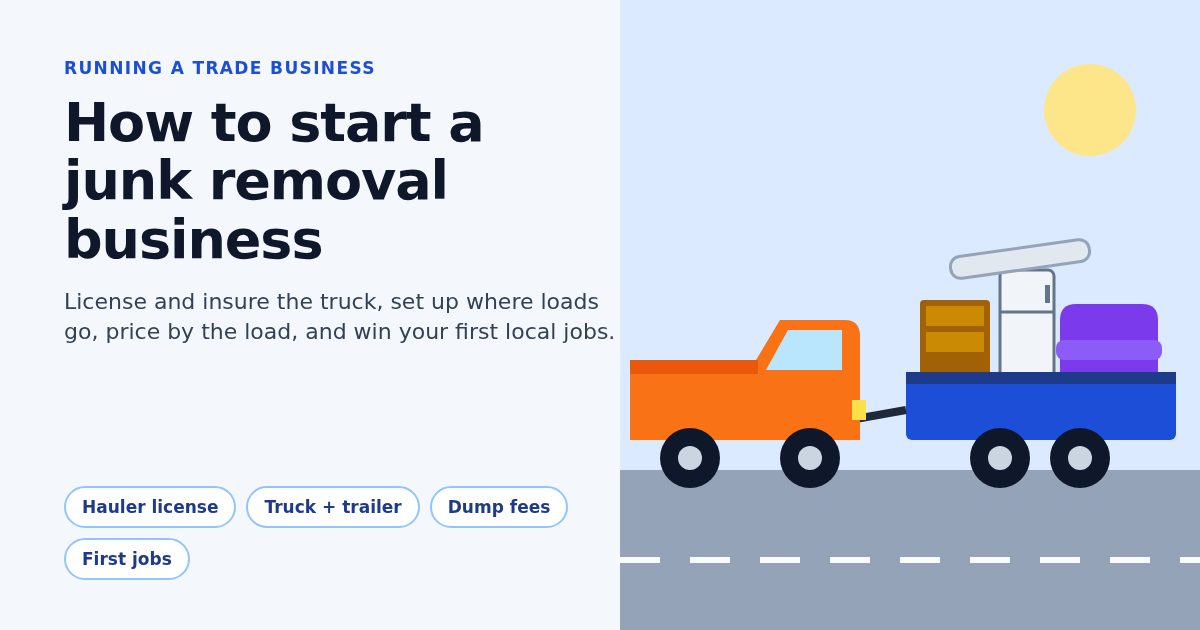
How to start a junk removal business: register and insure it, get any hauler license your city requires, set up where each load goes, price by the load, and win your first local jobs.
Josh · Oct 18, 2026 · 13 min read
- how to start a junk removal business
- junk removal business
- junk hauling
- hauler license
- dump fees
- small business
To start a junk removal business, register the company, get any hauler license your city requires, and insure your truck for commercial work. Then open accounts at the places your loads will go, price every job from your dump fees and labor, and win your first calls from neighbors, real estate agents, and property managers.
The steps fit a U.S. owner starting with one truck, or a pickup and a dump trailer, solo or with one helper. Cities, counties, and states set most hauling and disposal rules, so treat each rule below as a question to confirm with your own local offices.
Why dump fees and hauling rules matter first in junk removal
Anyone with a pickup can haul a couch. Running it as a business means knowing where the load goes, what it costs to drop it, and whether you're allowed to haul it for pay.
Disposal is a cost on every job. Seattle's city transfer station rates, in effect since April 1, 2026, are $174 per ton for garbage, with a $37 minimum that covers up to 420 pounds. An appliance-only load costs $34 per appliance, with a limit of two, and refrigerators must be empty with the doors removed. Price a full-house cleanout without knowing those numbers and the scale house takes your profit.
Hauling for pay can also need its own license. The City of Austin says every private waste hauler operating for a fee inside city limits must hold a Private Waste Hauler License. A vehicle that isn't licensed may not collect or haul solid waste from any site in the city.
So sort out the license, insurance, and disposal plan before you buy a bigger truck or pay for ads.
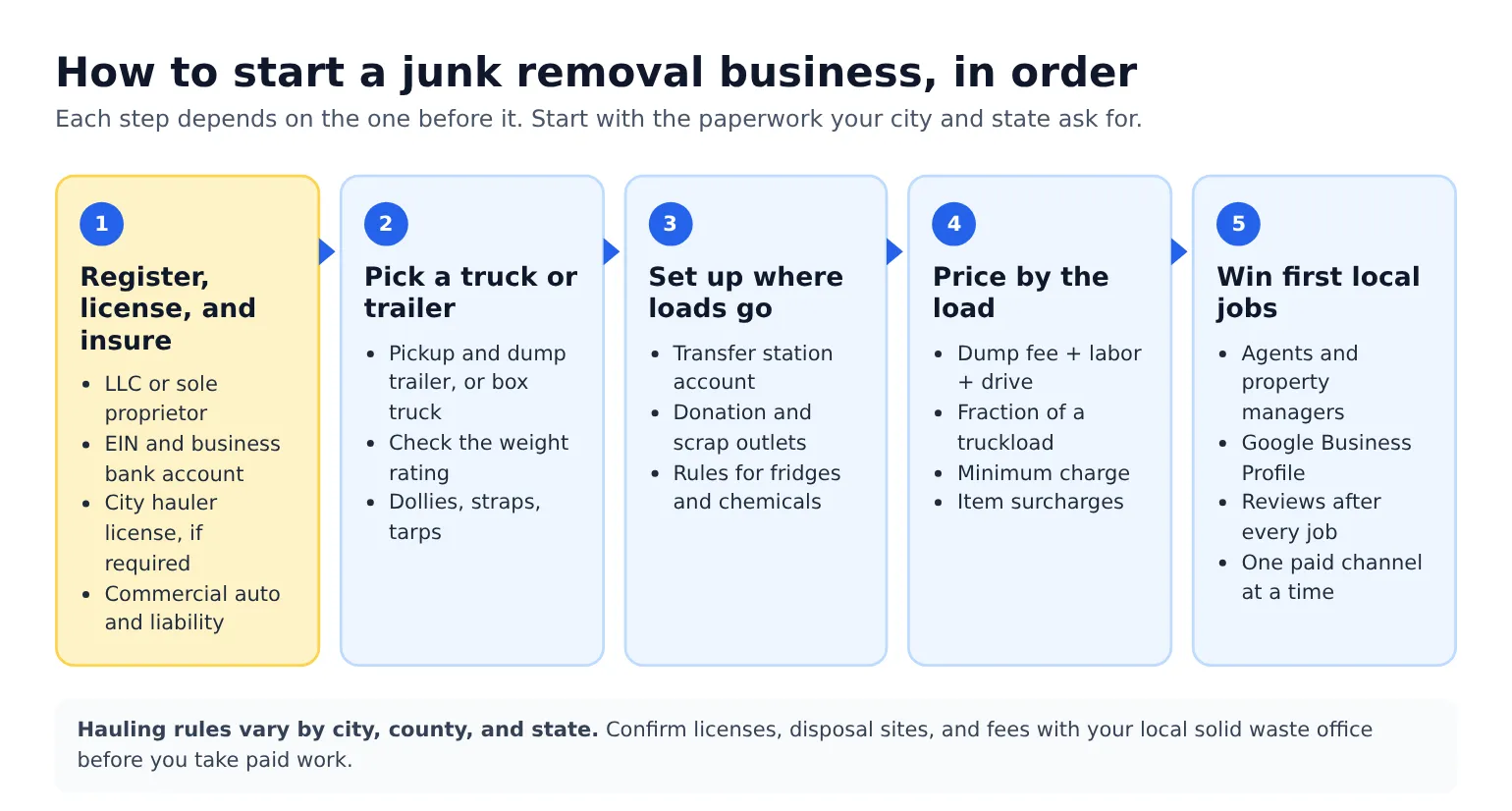
The order to work through before your first paid haul. Diagram only.
Step 1: Register, license, and insure the business
Get the paperwork done first. Several of these items depend on each other, so the order matters.
Choose a structure and register it
The SBA explains that a sole proprietor can be held personally liable for the business's debts, while an LLC protects personal assets like your vehicle, house, and savings in most instances. Junk removal carries real risk, from a dresser that gouges a hallway wall to a load that shifts on the highway. Ask an accountant which structure fits before you file. The SBA also says registration usually costs less than $300, though fees vary by state and structure.
Then apply for an EIN directly with the IRS, after your LLC is filed with the state. Open a business bank account and run every dump ticket, fuel stop, and customer payment through it.
Check for a city or county hauler license
Many cities license haulers separately from the general business license. Austin is a useful example of what a hauler license can involve:
- A certificate of insurance for general liability and commercial auto liability.
- Auto limits of at least $250,000 per individual and $500,000 per occurrence for bodily injury and $100,000 for property damage, or $1,000,000 combined single limit.
- An annual Texas vehicle inspection for each licensed vehicle, plus a tonnage report.
- A fee of $380 per vehicle hauling to the landfill, with city decals on both front doors.
Austin also lists fines of up to $2,000 for violations. Your city may have no hauler license at all, or a stricter one. Call your city or county solid waste office and ask three questions:
- Do I need a hauler license or vehicle permit to haul junk for pay here?
- Do I need to report the tonnage I haul, and how often?
- Which landfills and transfer stations am I allowed to use?
Check whether your truck needs a USDOT number
The FMCSA requires a USDOT number for vehicles in interstate commerce with a gross vehicle weight rating or gross combination weight rating of 10,001 pounds or more. The combination rating matters for junk haulers. A pickup towing a loaded dump trailer can cross that line even when the truck alone doesn't. The FMCSA also lists states, including California, Texas, Florida, and New York, that require USDOT numbers for intrastate commercial vehicles. Check your state's rule even if you never leave it, and ask your state DMV whether your truck and trailer need a commercial license.
Buy insurance that matches the work
The SBA describes general liability insurance as protection against losses from bodily injury, property damage, and lawsuits. In junk removal, think of a refrigerator dolly that scratches hardwood or a mattress that knocks a light fixture off the ceiling. Tell your agent you'll haul for pay so the auto policy is written for business use. If your city sets minimums, as Austin does, buy at least that amount.
The SBA also says businesses with employees are required to carry workers' compensation, unemployment, and disability insurance. Lifting is the job, so plan for that cost before you hire a helper. Ask a commercial agent:
- Does the policy cover damage to a customer's home while we carry items out?
- Is my trailer covered when it's loaded and parked overnight?
- What changes when I add a part-time helper?
Step 2: Pick a truck or trailer and the gear to load it
Buy for the jobs you'll take in the first few months. A single-item pickup and a garage cleanout need very different capacity.
| Truck setup | Best for | Trade-off |
|---|---|---|
| Pickup only | Single items, small curbside pickups, and testing demand | Small capacity means more dump runs per day |
| Pickup and dump trailer | Most residential cleanouts, with a trailer that tips its own load | Check the combined weight rating, and practice backing into tight driveways |
| Box truck or dump-body truck | High-volume cleanouts and weekly commercial work | Higher cost, and the truck's own rating may cross the 10,001-pound line |
Build the core kit
Group your gear the way you'll grab it on a job:
- Moving: an appliance dolly, a furniture dolly, moving blankets, and lifting straps.
- Securing the load: ratchet straps, tarps, and a cargo net. Seattle adds a fee for unsecured loads, and debris falling off a trailer is a hazard to every driver behind you.
- Breaking things down: a cordless drill and driver, a pry bar, a reciprocating saw for cutting down old furniture and play sets, and a utility knife.
- Cleanup: contractor bags, a flat shovel, a push broom, and a shop vacuum. Leave the floor cleaner than you found it.
- Safety: work gloves, safety glasses, dust masks, and a first aid kit.
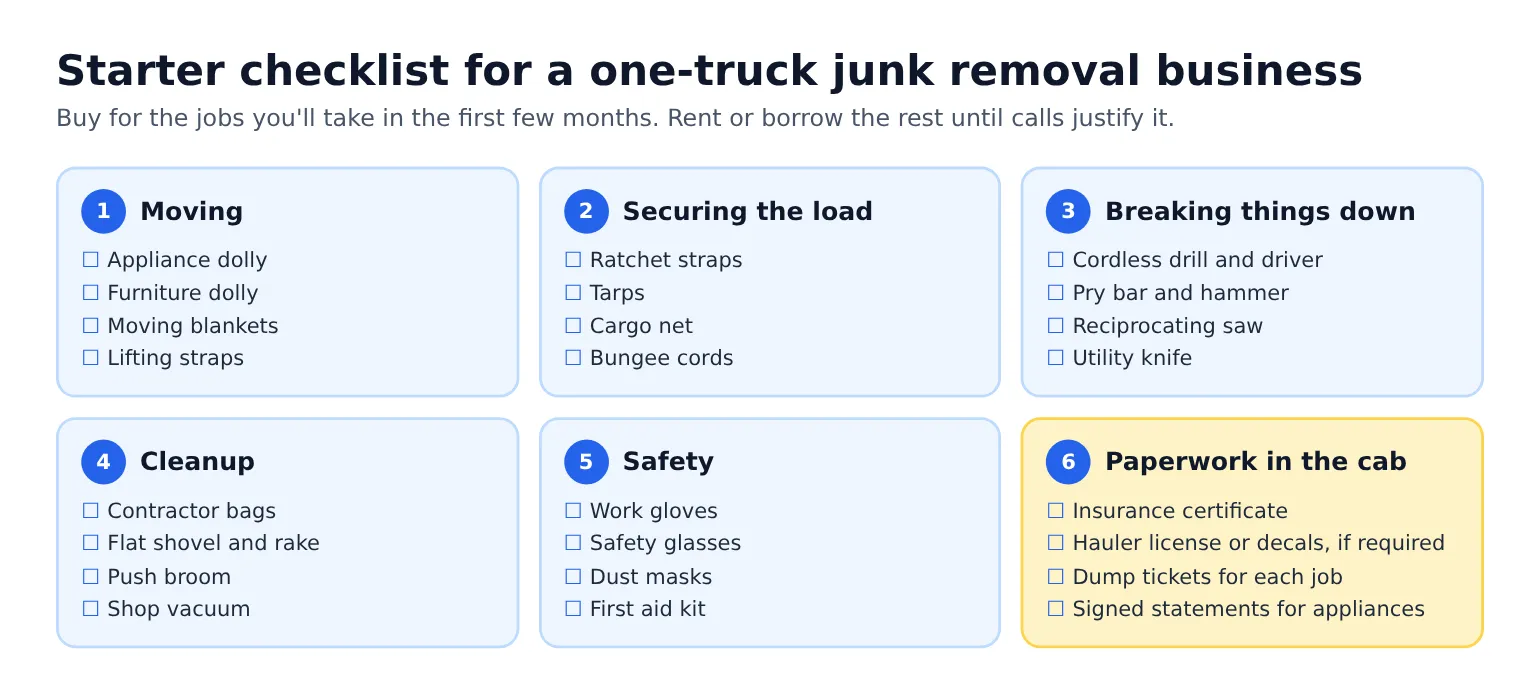
Rent or borrow bigger tools until the jobs justify buying them. Diagram only.
Letter the truck
A lettered truck advertises at every curb you park on. If your city issues hauler decals, as Austin does, leave room on the doors for them before you order the vinyl.
Step 3: Set up where every load goes
Your disposal plan decides your margin. Map it out before the first call, so a full trailer never sits in your driveway overnight.
Open accounts at the transfer station or landfill
Call each site near your service area and ask about commercial accounts, hours, payment, accepted materials, and sorting rules. Sorting often pays. Seattle charges $132 per ton for clean yard waste and clean wood, compared with $174 for garbage, if you separate them before you arrive. Recyclables-only loads are free. Load the truck so you can drop each pile at the right spot without restacking.
Line up donation and recycling outlets
Working furniture, usable appliances, leftover building materials, and scrap metal don't have to go to the landfill. Call local donation centers and scrap yards to ask what they take and whether they need a drop-off time. Every item you donate or recycle is weight you don't pay garbage rates on, and customers like hearing their old dining set found a home.
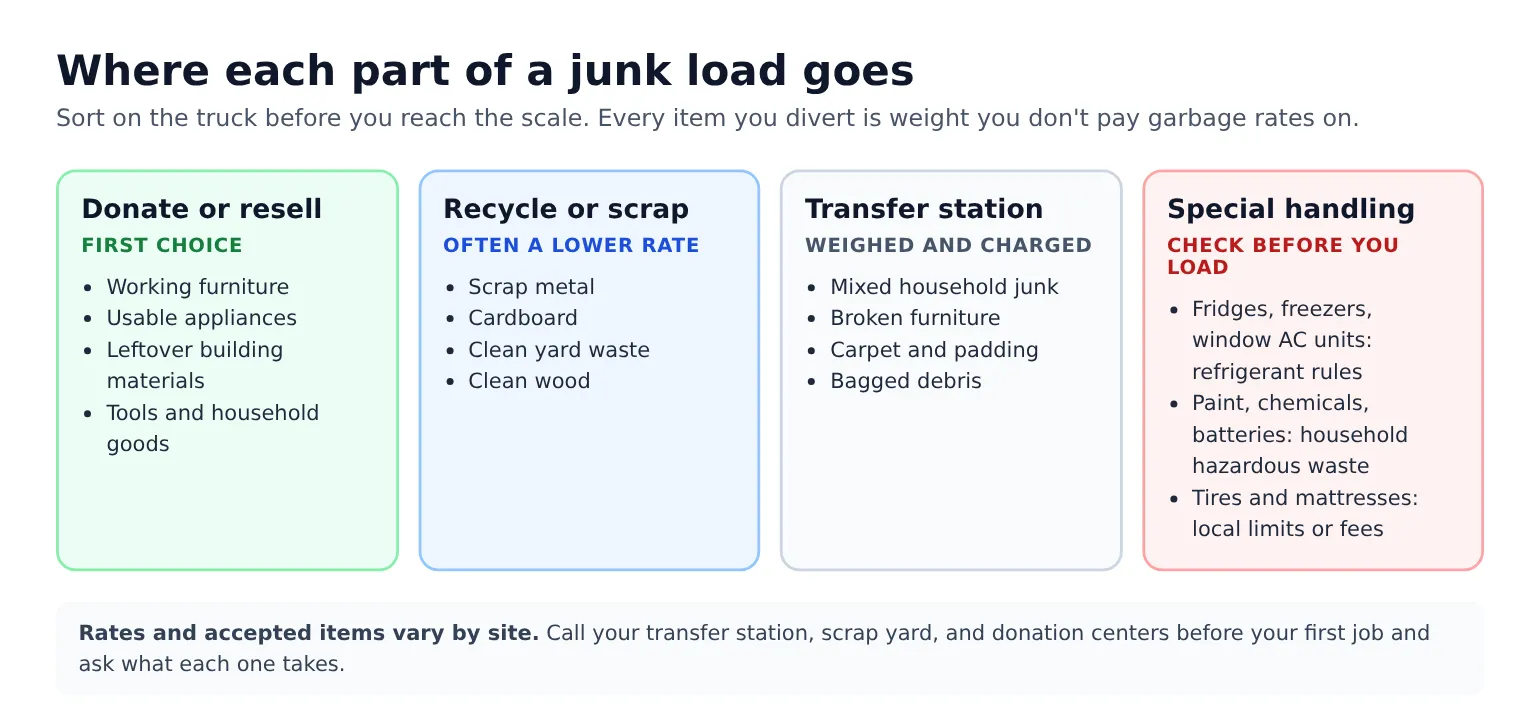
Sort on the truck before you reach the scale. Rules and fees vary by site. Diagram only.
Know the items that need special handling
Some items carry rules that reach you as the hauler.
- Refrigerators, freezers, and window AC units. The EPA's appliance disposal rules make the final person in the disposal chain, such as a scrap recycler or landfill, responsible for making sure the refrigerant is recovered. If you drop off a unit whose refrigerant has already been recovered, expect to sign a statement with the name and address of the person who recovered the refrigerant and the date. EPA doesn't accept a sticker in place of that statement.
- Paint, chemicals, and batteries. The EPA lists paints, cleaners, oils, batteries, and pesticides as household hazardous waste and says it's regulated at the state and local level. Never mix leftovers, and point customers to their local collection site instead of loading these items.
- Tires and mattresses. Many sites charge separately or set limits. Seattle, for example, takes tires at $16 per load with a limit of four.
Write a short "won't take" list and read it to customers on the phone, so nobody is surprised when the truck arrives.
Step 4: Price by the load so every job covers the dump
Your price has to cover the dump fee, fuel, drive time, labor, the truck payment, insurance, and the calls you quote that never book.
Know your cost per load
Weigh in and out on your first few jobs and keep every ticket. Add up a month of fixed costs, like the truck payment, insurance, and license fees, and divide by the loads you expect that month. Then add each job's dump fee, fuel, and labor. That gives you a floor. Your price sits above it, with your pay and a profit margin built in.
Choose a pricing method
| Pricing method | Best for | Trade-off |
|---|---|---|
| By volume (a quarter, half, or full load) | Most household cleanouts | You need to judge volume on site, so walk the job or ask for clear descriptions first |
| Single-item price | One couch, one hot tub, or one refrigerator | Easy to quote on the phone, but heavy items can take longer than expected |
| Hourly plus dump fees | Jobs with unknowns, like an attic you can't see | Customers worry about the final bill, so give a written range |
| Written bid | Estate cleanouts, hoarding cleanups, and light demolition | Takes unpaid time to walk and write up |
Set a minimum charge and item surcharges
A minimum charge covers the drive and the dump's own minimum, like Seattle's $37 garbage minimum. Add surcharges for items that cost you extra to drop, such as appliances, tires, and mattresses where your site charges for them. Mention stairs, long carries, and heavy items too. Say every charge on the phone before you roll. If you're weighing whether to show those prices online, read about putting your prices on your website.
Step 5: Win your first junk removal jobs
Start with people who see junk every week
Real estate agents, property managers, landlords, estate sale companies, and remodelers all deal with leftover stuff. Tell them you're open, hand them a card, and offer a fast turnaround on their first job. A property manager with a move-out every week can fill your weekday slots.
Set up a Google Business Profile as a service-area business
You drive to the customer, so set up the profile as a service-area business with the towns you actually cover. If you work from home, the steps to hide your address on Google Business Profile keep your house off the map. Add your services and real before-and-after photos of cleared garages and basements.
Ask for reviews after every job
Ask while the customer is standing in a garage they can finally park in. The steps to get Google reviews from happy customers take a few minutes once your review link is saved on your phone.
Add paid channels one at a time
Once the profile and reviews are working, test one paid channel at a time and track where each call came from. The post on home services advertising covers where to spend first and where those clicks should land.
Common problems and how to fix them
The dump bill is eating your profit
Pull your scale tickets and compare each one to what you charged. If loads weigh more than you guessed, raise your volume prices or add a heavy-material surcharge for concrete, dirt, and shingles. Sort more of each load into lower-rate piles.
A customer wants you to take paint cans or chemicals
Say no politely, and give them the name of the local household hazardous waste site. Transfer stations can inspect loads at the scale, and a leaking paint can in a pile of furniture becomes a problem for the whole load.
The scrap yard asks for paperwork on a refrigerator
That's the EPA rule at work. Either take the unit to a site that recovers refrigerant itself, or have the refrigerant recovered first and bring the signed statement with the recoverer's name, address, and date.
Your truck sits idle on weekdays
Many homeowners want weekend jobs. Fill weekdays with property managers, agents, and contractors who need units, listings, and job sites cleared during business hours.
Where a bookable site fits
Once referrals and reviews start working, many customers will look you up before they call. A Kejoola site, for example, is four pages (Home, Services, Blog, Contact) with online booking. A customer picks a time and types the address, the items, and any stairs in the notes box, and the booking lands in your bookings. For what the pages themselves should show, read what a junk removal website customers can book from needs.
Questions owners ask about starting a junk removal business
How much does it cost to start a junk removal business?
It depends mostly on the truck and trailer you already own. The SBA says registering usually costs less than $300. Local costs vary. Austin charges $380 per vehicle hauling to the landfill, and Seattle's transfer stations charge at least $37 per garbage trip. Get quotes for the truck, trailer, insurance, and licenses before you commit.
Do you need a license to start a junk removal business?
Usually yes, at least a general business registration, and many cities add a hauler license. Austin requires a Private Waste Hauler License for anyone hauling waste for a fee in the city. If you cross state lines with a vehicle or combination rated at 10,001 pounds or more, the FMCSA requires a USDOT number. Ask your city first.
Can you start a junk removal business with just a pickup truck?
Yes, for single items and small cleanouts. A pickup alone means more dump runs, so consider a dump trailer once calls pick up. Check the combined weight rating before you tow, because a loaded truck and trailer together can cross the 10,001-pound USDOT threshold for interstate work.
What can't a junk removal business take?
Household hazardous waste is the main one. The EPA lists paints, cleaners, oils, batteries, and pesticides, and says states and localities regulate them. Refrigerators and freezers need refrigerant recovered before final disposal. Tires and mattresses often carry limits or fees. Ask your disposal sites what they refuse.
How do junk removal businesses charge?
Many charge by volume, such as a quarter, half, or full truckload, with a minimum charge for small jobs. Single heavy items often get a flat price, and jobs with unknowns go hourly plus dump fees or by written bid. Build your dump fees, labor, and drive time into every price.
Give customers a way to book your first junk removal jobs
If you want a site where customers can see your services and book a time, you can get a site customers can book from with Kejoola. Already have a Google Business listing? Paste your listing link to get a first draft of your site, then finish it with your own services, towns, and photos.
14-day free trial, no card needed. Online booking starts on the Starter plan.
Sources
- Transfer Station Rates (Seattle Public Utilities)
- Private Waste Hauler License (City of Austin Development Services)
- Launch your business: structure, registration, and insurance (U.S. Small Business Administration)
- Do I need a USDOT number? (Federal Motor Carrier Safety Administration)
- Stationary refrigeration safe disposal requirements (U.S. EPA)
- Household hazardous waste (U.S. EPA)