How to Start an Electrical Business: Licenses, Insurance, and First Jobs
How to start an electrical business: earn the license your state ties to contracting, insure and register the company, stock one truck, price from real costs, and win local service calls.
Josh · Oct 22, 2026 · 14 min read
- how to start an electrical business
- electrical contractor license
- master electrician
- electrician business
- electrical startup
- small business
To start an electrical business, first get the license your state ties to contracting, which usually means a master electrician or an electrical contractor license on top of the one you work under now. Then insure and register the company, set up one truck for the work you plan to sell, price each job from your real costs, and win your first calls from people who already know your work.
These steps are written for a licensed electrician in the U.S. going out on their own, solo or with one apprentice. Rules differ by state and often by city, so confirm each one with your own licensing board.
Why the contractor license comes before everything else
Electrical work is tightly licensed in most of the country. The Bureau of Labor Statistics says most states require electricians to pass a test and be licensed, with exam questions on the National Electrical Code and on state and local codes. Many states then add a second layer for the business itself.
Texas is a clear example. The Texas Department of Licensing and Regulation licenses electrical contractors to engage in the business of installing, repairing, or altering electrical wiring, and every electrical contractor must employ a licensed master electrician. A journeyman license lets you do the work. It doesn't let you sell it under your own company name.
That contractor license is what permits, inspections, insurance certificates, and supply house credit all hang on. Get it lined up first. A lettered truck and a paid ad do you no good if you can't pull the permit for the panel swap they bring in.
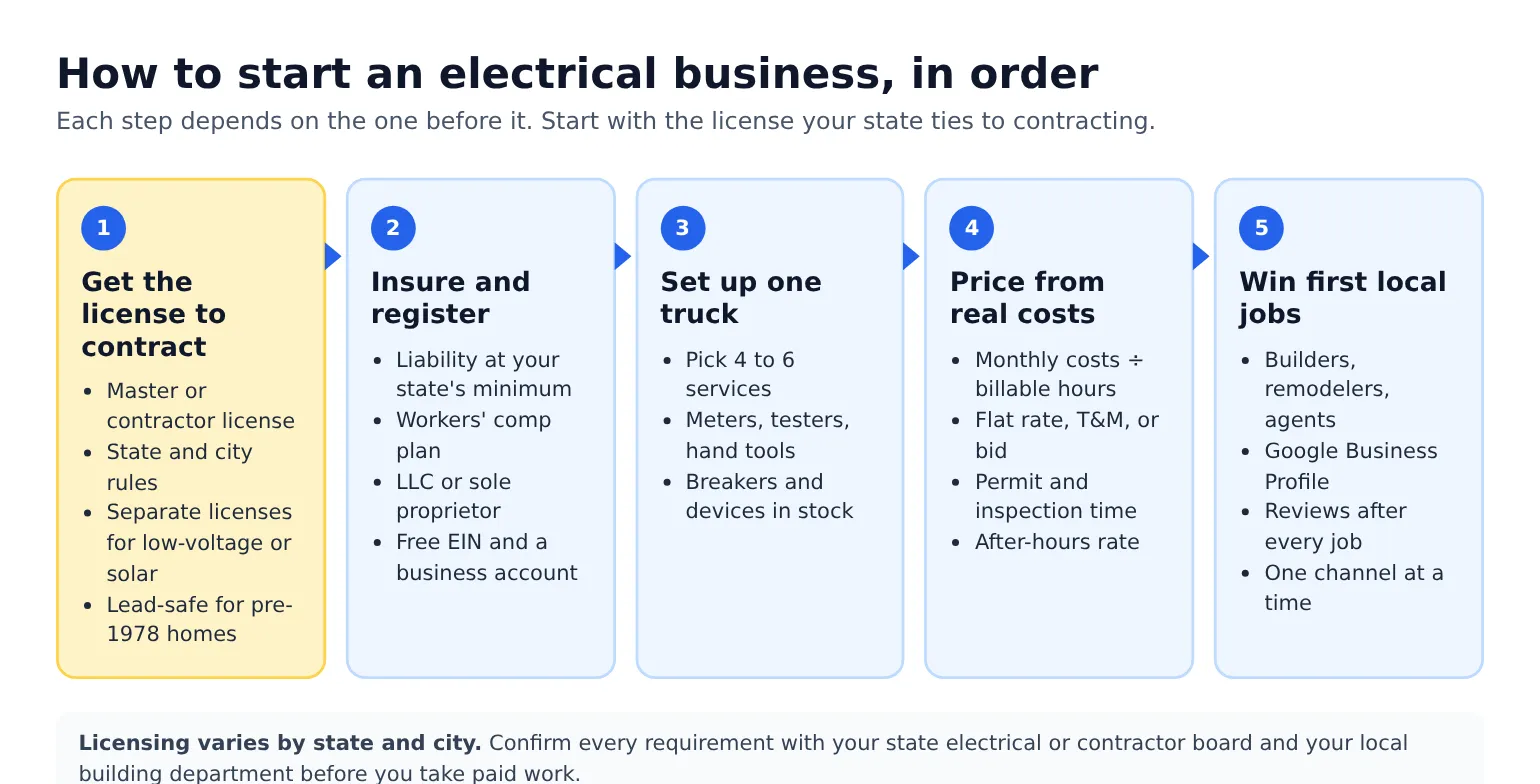
The order to work through before your first paid call. Diagram only.
Step 1: Get the license that lets you run the company
Before you buy anything, find out which license your state requires to contract, and whether you already qualify for it.
Know where you are on the license ladder
The BLS describes the usual path. Most electricians train through a 4- or 5-year apprenticeship, with about 2,000 hours of paid on-the-job training each year plus technical instruction. After the apprenticeship they are journey workers, and after meeting more requirements they may advance to master electrician.
| License level | What it usually lets you do | How electricians usually get it |
|---|---|---|
| Apprentice | Work under the supervision of a licensed electrician | Enroll in a registered apprenticeship or register with the state |
| Journeyman | Do electrical work on your own, usually for a licensed contractor | Finish the apprenticeship hours and pass the journeyman exam |
| Master electrician | Plan and supervise work, and in many states qualify a company | More years of experience and a second exam |
| Electrical contractor | Bid jobs, pull permits, and run an electrical company | A qualifying license holder, plus insurance or a bond, depending on the state |
Some states also offer narrower licenses, such as residential wireman or sign electrician, with their own limits.
See how Texas and California handle it
In Texas, you must employ a licensed master electrician to apply for an electrical contractor license, and that master may be you. TDLR calls this person the Master Electrician of Record. A master's license can be assigned to only one electrical contractor, unless the master owns more than 50 percent of the business. The application fee is $110, and the license is valid for one year and must be renewed annually.
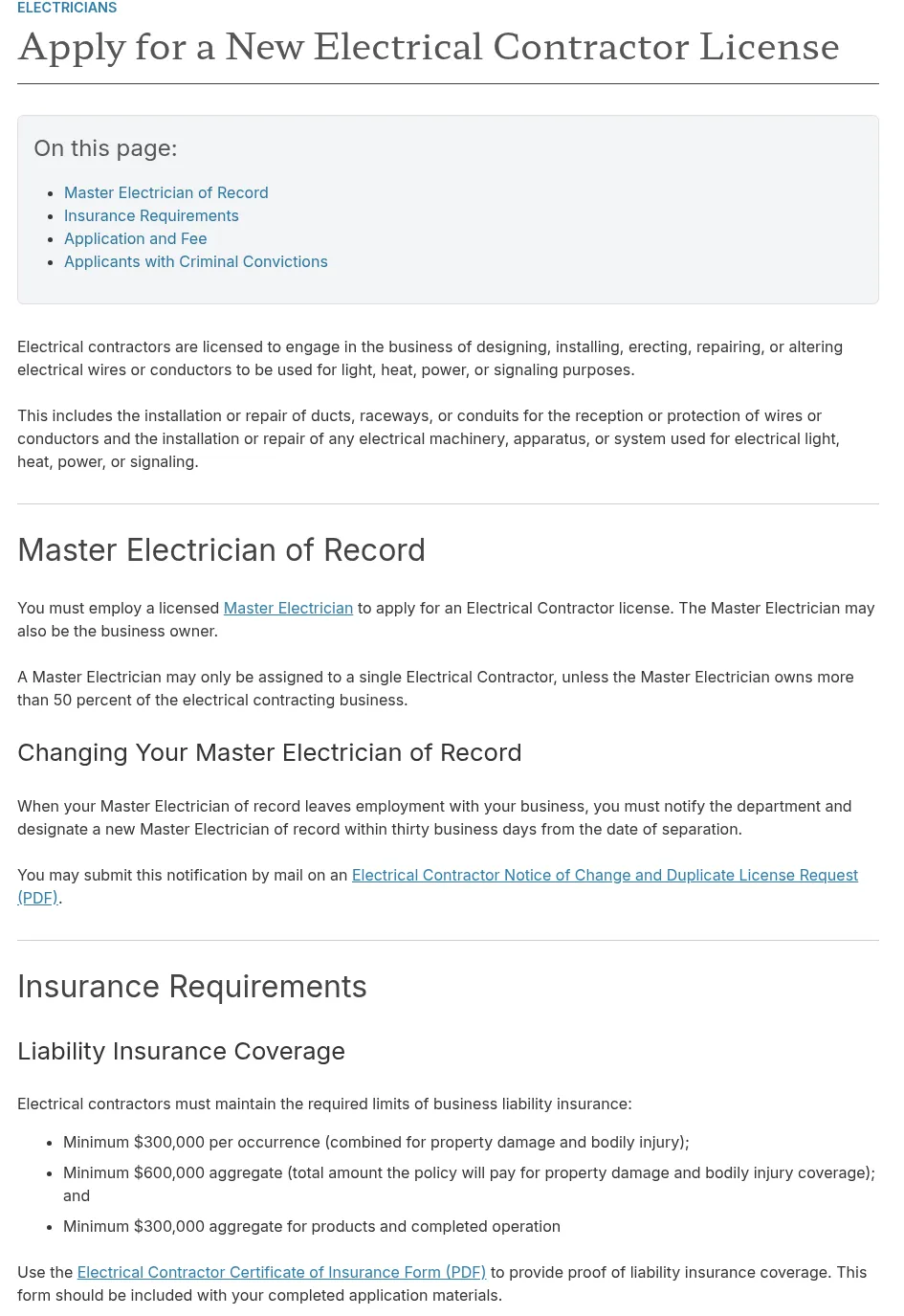
TDLR's page for a new electrical contractor license, captured October 2026. Rules and fees can change, so check the live page.
California licenses electrical companies through the Contractors State License Board under the C-10 Electrical Contractor classification. The CSLB says you need a license if a job requires a building permit, uses any additional workers, or costs $1,000 or more in labor and materials. The qualifying individual needs at least four full years of journey-level, foreman, supervisor, or contractor experience within the last 10 years. You also need a $25,000 bond in place before the license is issued, and every new applicant completes an open-book asbestos exam.
Find your own state's rules
Look up your state electrical board or contractor licensing board and read its page on contractor or business licenses. Then call your city or county building department and ask:
- Which license do I need to pull an electrical permit in my company's name?
- Do I need a separate city contractor registration or business license?
- Does low-voltage, solar, or fire alarm work need its own license here?
The BLS notes that electricians may need continuing education to keep their licenses, usually on safety and code changes. Put renewal dates and course hours on your calendar now, so a lapsed license never stops a job.
Get lead-safe certified before you cut into old walls
Fishing new circuits through plaster in an older house disturbs paint. The EPA says firms paid to disturb paint in homes and child-occupied facilities built before 1978 must be certified, including sole proprietorships, and it names electricians among the trades covered. Minor repair work that disturbs six square feet or less of paint per room inside, or 20 square feet or less outside, is not covered. A rewire in a 1950s ranch can pass that limit by lunch, so get certified before you bid older neighborhoods.
Step 2: Insure, register, and set up the money side
Buy the insurance your state and your work require
Electrical mistakes can start fires long after you leave a job, so liability coverage matters more than it does in many trades. TDLR sets clear minimums for Texas electrical contractors:
- $300,000 per occurrence, combined for property damage and bodily injury
- $600,000 aggregate
- $300,000 aggregate for products and completed operations
Texas also asks for proof of workers' compensation coverage, a certificate to self-insure, or a statement that you've elected not to carry it, filed with the Texas Department of Insurance. Other states set different minimums or none at all. Ask a commercial insurance agent three questions before you buy:
- Does the policy cover damage from my work after the job is finished?
- Are my truck and the tools and meters stored in it covered?
- What changes when I hire my first apprentice?
Choose a structure and register it
The SBA explains that a sole proprietor can be held personally liable for the business's debts. An LLC protects personal assets like your vehicle, house, and savings in most instances. Talk with an accountant before you file, since the choice affects your taxes too. The SBA says registration usually costs less than $300, though fees vary by state and structure.
Pick a name people can say on the phone and read on a truck door, and use the same legal name on your license, insurance, and bank account.
Get a free EIN and keep the money separate
Apply for an EIN directly from the IRS. It's free, and the IRS warns against websites that charge for one. If you're forming an LLC, file with your secretary of state first, because applying before the entity exists can delay your EIN.
Open a business bank account the same week. Run every supply house order, fuel stop, permit fee, and customer payment through it, and move a share of each payment into a savings account for taxes. Nobody withholds tax from an owner's pay.
Step 3: Set up one truck for the work you'll sell
Buy for the jobs you'll do in the next six months, not the shop you hope to have in five years. That starts with choosing what to sell.
Pick your first services
The BLS notes that self-employed electricians often work in residential construction and may be able to set their own schedule. For a new solo shop, residential service is usually the easiest place to start, because homeowners call you directly and pay when the work is done. Pick four to six services you can do well alone, such as:
- Troubleshooting dead outlets and tripping breakers
- Panel upgrades and service changes
- EV charger circuits
- Lighting, ceiling fans, and fixture swaps
- Generator inlets and transfer switches
- Kitchen and bath remodel wiring
| Service focus | Best for | Trade-off |
|---|---|---|
| Residential service and repair | A solo owner who wants to be paid at the end of each job | Many short jobs to schedule, plus some evening calls |
| Remodel and addition wiring | An owner with remodeler relationships | Rough-in and trim visits weeks apart, with inspections in between |
| New construction | An owner with builder contacts and a crew | Bids against bigger shops, and payment on the builder's schedule |
| Light commercial | An owner comfortable with plans and bids | Longer payment terms and more paperwork |
Build the core kit
The BLS lists the tools electricians rely on: conduit benders, screwdrivers, wire strippers, drills, and saws, plus ammeters, voltmeters, thermal scanners, and cable testers for troubleshooting. For a service truck, group the rest the way you'll grab it on a call:
- Hand tools: insulated screwdrivers, lineman's pliers, strippers, nut drivers, fish tape, and a level.
- Testing: a multimeter, a clamp meter, a non-contact voltage tester, and an outlet tester. Add a thermal camera once troubleshooting calls justify it.
- Power tools: drill and impact driver, a right-angle drill for studs, a reciprocating saw, and hole saws.
- Access and safety: fiberglass ladders, rated gloves, eye protection, and a lockout/tagout kit.
- Stock: breakers for the panel brands common in your area, devices, boxes, wire nuts, and wire in the sizes you use most.
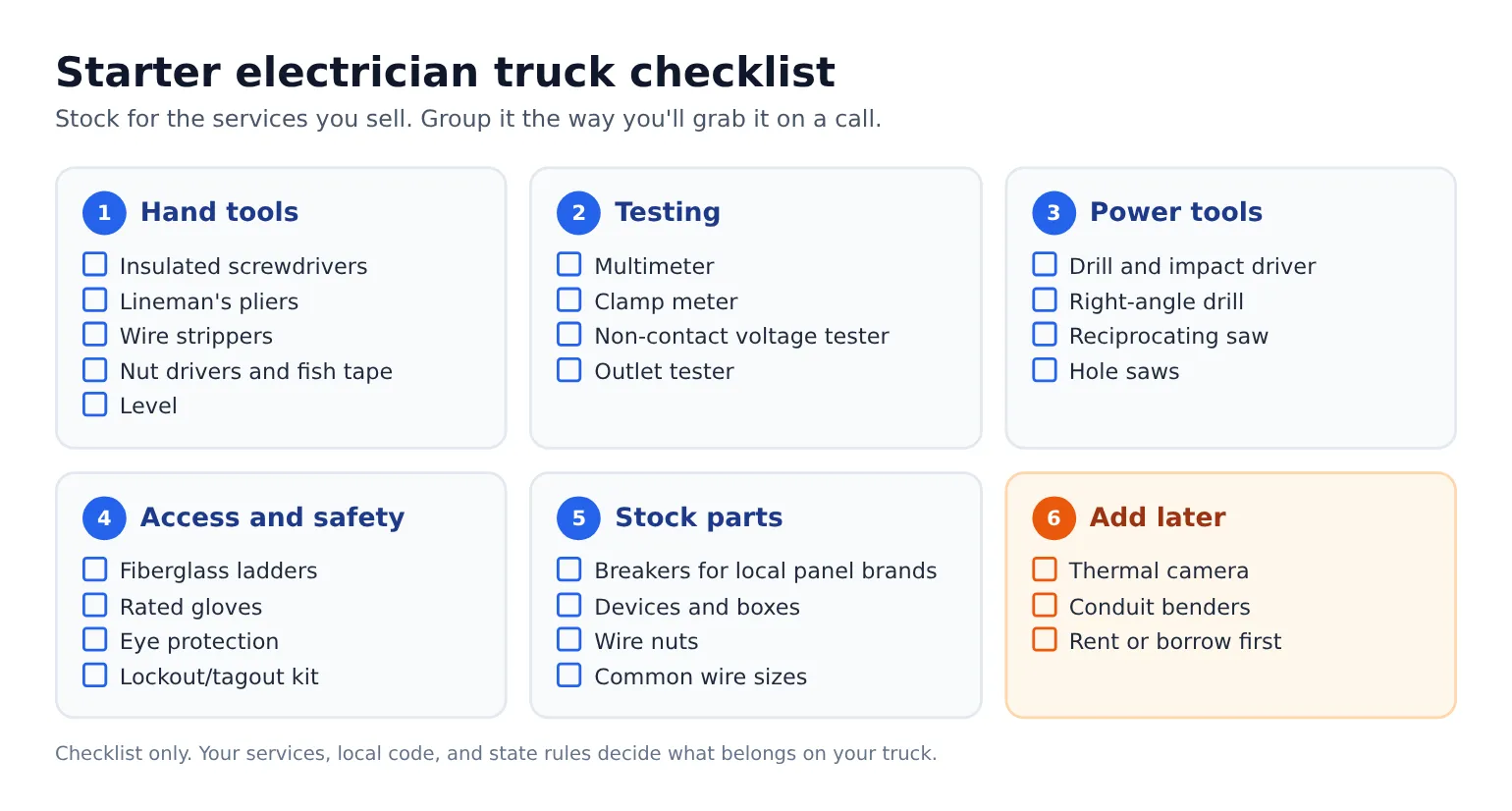
Stock for the services you sell, and rent big-ticket tools until the work justifies buying them. Diagram only.
Step 4: Price jobs so each one covers the whole day
Your price has to cover the drive, the supply house run, permit fees, the truck, insurance, tools, taxes, and the hours you spend quoting jobs that never book.
Start from what the work is worth
The BLS lists the median pay for electricians at $30.38 per hour in May 2025. That's a wage, paid by an employer who also covers the truck, insurance, and overhead. As the owner, your billed rate has to cover all of that plus your own pay.
To find your number, add up a month of expected costs. Divide by the hours you can realistically bill, which is far fewer than the hours you work. Then add your pay and a profit margin on top.
Choose a pricing method for each kind of job
| Pricing method | Best for | Trade-off |
|---|---|---|
| Flat rate per task | Repeat jobs like a fixture swap, a dedicated circuit, or an outlet replacement | You need good time records, or one bad attic run eats the profit |
| Time and materials | Troubleshooting and old wiring with surprises behind the walls | Customers worry about the final bill, so give a written range |
| Written bid | Panel upgrades, EV charger circuits, and remodels with permits | Takes unpaid time to measure, load-calculate, and write up |
Price permits and inspections into the job
Many panel and circuit jobs need a permit and an inspection visit. Include the permit fee and your time for the inspection in the price, and tell the customer up front that an inspector will come by. The inspection visit goes smoother when the customer hears about it from you first.
Set a service call fee and an after-hours rate
The BLS notes that electricians' schedules may include evenings and weekends. Decide what a Saturday night outage call costs before the phone rings. A service call fee covers the drive and diagnosis even if the customer declines the repair. Say both prices before you head out.
Step 5: Win your first jobs
Start with people who already know your work
Tell general contractors, remodelers, HVAC and solar installers, property managers, and real estate agents that you're now on your own. Before you contact customers from a former employer, reread any non-compete or non-solicitation agreement you signed. Hand every contact a card with your license number on it.
Set up a Google Business Profile as a service-area business
You drive to the customer, so set up the profile as a service-area business with the towns you actually cover. If you work from home, follow the steps to hide your home address on Google Business Profile. Add your services, hours, license number, and real photos of finished panels and trim work.
Ask for a review after every finished job
Ask when the lights are back on and the panel cover is closed. The steps to get Google reviews from happy customers take a few minutes once your review link is saved on your phone.
Add marketing one channel at a time
Once the profile and reviews are working, add channels in order of cost, and judge each one by booked jobs, not clicks. This guide to electrician marketing that books service calls covers which channels tend to turn into real appointments.
Common problems and how to fix them
You hold a journeyman license but not a master license
In many states that means you can't contract on your own yet. In Texas, a licensed master can serve as your company's Master Electrician of Record, but that master can be assigned to only one contractor unless they own more than half of it. Ask your board what's allowed, and keep logging hours toward your master exam.
A customer asks for work outside your license
Low-voltage, solar, and fire alarm work often fall under separate licenses or classifications. Say no politely and refer the job to someone who holds the right license. Doing it anyway puts your main license at risk.
You're tempted to take side jobs before you're licensed
California treats a first offense of contracting without a license as usually a misdemeanor, with up to six months in jail and/or a $500 fine, plus a possible administrative fine of $200 to $15,000. Wait until the license is issued, then take the work in your own name.
A job fails inspection
Treat it as a scheduling problem, not just a code problem. Fix the item, book the reinspection right away, and tell the customer the new date yourself. Then add a line for that item to your pre-inspection checklist.
Where a bookable site fits
Once referrals and reviews start working, many homeowners will look you up before they call. Outages and burning smells still need a phone call. Routine work, like a panel upgrade estimate or an EV charger quote, can be booked online while you're on another job. A Kejoola site, for example, is four pages (Home, Services, Blog, Contact) with online booking. The homeowner picks a time and types the address and job details in the notes box, and the booking lands in your bookings. For what those pages should show, read about website design for electricians.
Questions electricians ask about starting an electrical business
How much does it cost to start an electrical business?
It depends mostly on your state and on the tools and truck you already own. The SBA says registering a business usually costs less than $300, and the IRS issues EINs for free. In Texas, the electrical contractor application fee is $110 and liability coverage starts at $300,000 per occurrence. California requires a $25,000 bond. Get quotes for the truck, tools, and insurance before you commit.
Can you start an electrical business without a master electrician license?
Sometimes, but it depends on the state. Texas requires every electrical contractor to employ a licensed master electrician as its Master Electrician of Record, and that can be the owner. California's C-10 license needs a qualifying individual with four years of journey-level experience. Ask your state board what it requires.
How long does it take to become an electrician who can run a business?
Usually several years. The BLS says most electricians train through a 4- or 5-year apprenticeship before reaching journey level, and master status takes more experience and another exam. If your state ties contracting to a master license, plan on the full path before you open your own shop.
Do I need insurance before my first electrical job?
Yes, in practice. Texas won't issue an electrical contractor license without proof of liability coverage at its minimums. Where your state sets no minimum, one fire claim can still be more than a new shop can pay. Buy general liability before your first job, and sort out workers' compensation before you hire.
Is an electrical business a good business to start?
Demand looks strong. The BLS projects electrician employment to grow 9 percent from 2025 to 2035, much faster than average, with about 72,700 openings each year. It links that demand to connecting solar and wind systems and to rising electricity demand from data centers. The harder part is the business side, so set up licensing, insurance, and pricing before you chase volume.
Give homeowners a way to book your first electrical jobs
If you want a site where customers can see your services and book a time, you can get a site customers can book from with Kejoola. Already have a Google Business listing? Paste your listing link to get a first draft of your site, then finish it with your own services, towns, and photos.
14-day free trial, no card needed. Online booking starts on the Starter plan.
Sources
- Electricians: Occupational Outlook Handbook (U.S. Bureau of Labor Statistics)
- Apply for a new electrical contractor license (Texas Department of Licensing and Regulation)
- Before applying for the examination (California Contractors State License Board)
- Renovation, Repair and Painting Program: Contractors (U.S. EPA)
- Launch your business: structure and registration (U.S. Small Business Administration)
- Get an employer identification number (IRS)