How to Start a Window Cleaning Business: Steps, Gear, and Pricing
How to start a window cleaning business: register and insure it, buy a small kit and a safe ladder, price by the window, and win your first route of homes and storefronts.
Josh · Oct 25, 2026 · 14 min read

- how to start a window cleaning business
- window cleaning business
- window washing business
- window cleaning pricing
- ladder safety
- small business
To start a window cleaning business, register the company and ask your city which licenses it needs, then buy insurance that covers the glass and property you work around. Next, put together a small kit with a sound ladder, price each job by the window, and build your first route from storefronts and homes close to where you live.
These steps are written for someone in the U.S. starting solo or with one helper, with no big van or crew yet. Rules and taxes differ by state and city, so check each one with your own local offices.
Why safety and insurance come first in window cleaning
Window cleaning looks like a low-risk trade from the sidewalk. Up close, most of the risk sits in a few places. There's the ladder against a second-story sill, the metal pole near a service drop, and the old pane that cracks while you work it.
One fall can end a solo business for a season. One cracked picture window or scratched patio door can wipe out a month of profit if you're paying for it yourself. Neither shows up in your startup budget, and both are far more likely than a customer refusing to pay.
That's why the order matters. Get the paperwork and the insurance in place before your first paid job. Then learn the basic ladder and power line rules before you buy a longer ladder or a longer pole. Speed comes later, after you can work every job safely.
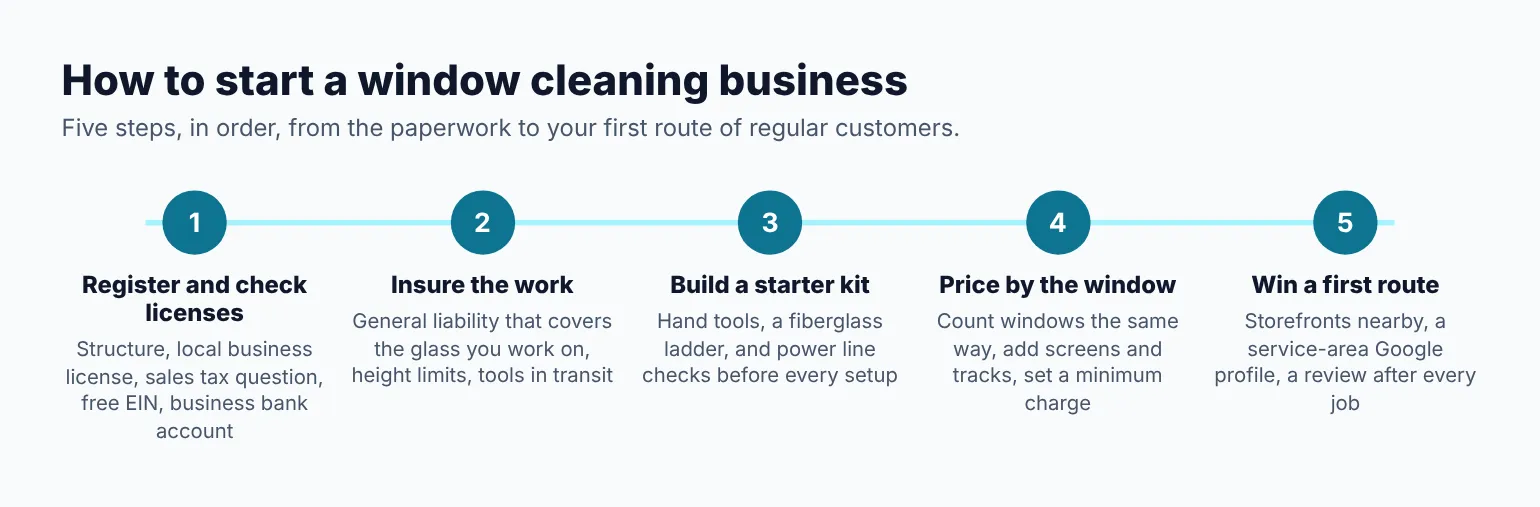
The order to work through, from paperwork to a first route. Diagram only.
Step 1: Register the business and check local licenses
Most places don't require a special license to clean windows. What you usually need is a general business registration, a local business license, and a tax setup that matches your state.
Choose a structure and register it
The SBA explains that a sole proprietor can be held personally liable for the debts and obligations of the business. An LLC protects personal assets like your vehicle, house, and savings in most instances. Talk with an accountant before you file, because the choice affects your taxes too. The SBA says the total cost to register is less than $300 in most cases, though fees vary by state and structure.
Pick a name that's easy to say on the phone and read on a yard sign. Use the same legal name on your registration, insurance, and bank account.
Ask your city and state what they require
Call your city or county business license office and ask three questions:
- Do I need a general business license to clean windows here, and in each town I plan to cover?
- Does working on commercial buildings change what I need?
- Do I need a separate permit to set up ladders or equipment on a public sidewalk?
Then check with your state's revenue or tax department. The SBA notes that income tax, sales tax, and other taxes can vary a lot from place to place. Some states tax cleaning services and some don't, so ask whether you need to collect sales tax on residential or commercial jobs before you send your first invoice.
Get a free EIN and keep the money separate
Apply for an EIN directly from the IRS. It's free, and the IRS warns that you never have to pay a fee for one, so skip the websites that charge.
Open a business bank account the same week. Run every supply order, fuel stop, and customer payment through it. Move a share of each payment into a savings account for taxes, since nobody withholds tax from an owner's pay.
Step 2: Insure the work, including the glass
Window cleaners work on and around things that are easy to break and costly to replace. Buy general liability coverage before your first paid job, and read what it actually covers.
Ask a commercial insurance agent these questions before you buy:
- Does the policy cover damage to the glass, frames, and screens I'm working on, or only damage to other property?
- Is there a height limit, or an exclusion for work above a certain story?
- Are my ladders, poles, and water system covered in my vehicle and in my garage?
- What changes when I hire my first helper, and when do I need workers' compensation?
The answers shape what you sell. If your policy excludes work above the second story, leave three-story homes off your service list for now. Keep a copy of your certificate of insurance on your phone. Property managers and storefront owners often ask for one before they let you start.
Step 3: Build a starter kit for the jobs you'll take
Buy for the work you'll do in the next six months. A new owner doesn't need every tool on day one, and the right kit depends on which jobs you sell first.
Pick your first services
| Service | Best for | What to watch |
|---|---|---|
| Storefront glass on a regular route | Steady weekly or monthly income, short jobs | Low price per visit, so you need many stops close together |
| Residential exterior windows | Your first larger tickets | Ladder work, landscaping under windows, and pets in the yard |
| Residential inside and outside | Spring and fall cleanings | Moving furniture, protecting floors, and more time per window |
| Screens and tracks | An add-on to almost every home job | Takes longer than it looks, so price it separately |
| Hard water stain removal | Glass near sprinklers or pools | Results vary by glass, so test a small spot and set expectations |
| Post-construction cleaning | Builders and remodelers | Paint, stickers, and debris on glass, plus a higher scratch risk |
Many new owners start with storefronts during the week and homes on weekends. Storefront stops are short and repeat often. Home jobs pay more per visit and lead to referrals.
Build the core kit
Most of the starter kit is hand tools you can carry from one job to the next:
- Squeegee handles and channels in two or three sizes, plus spare rubber
- A strip washer (applicator) and a bucket wide enough to dip it in
- A scraper with fresh blades for paint specks and stickers
- Lint-free towels and detail cloths for edges and frames
- A tool belt or holster so your hands are free on the ladder
- An extension pole for first-floor glass you can reach from the ground
- A fiberglass extension ladder, a ladder stabilizer, and a stepladder for inside work
- Drop cloths and shoe covers for inside jobs
- A screen tool, a nylon brush, and a spray bottle for screens and tracks
A water-fed pole system is the next big purchase for many owners. It pushes purified water through a long pole and brush, so you can clean upper windows from the ground. It costs far more than hand tools, so most owners add it after a few months of steady exterior work.
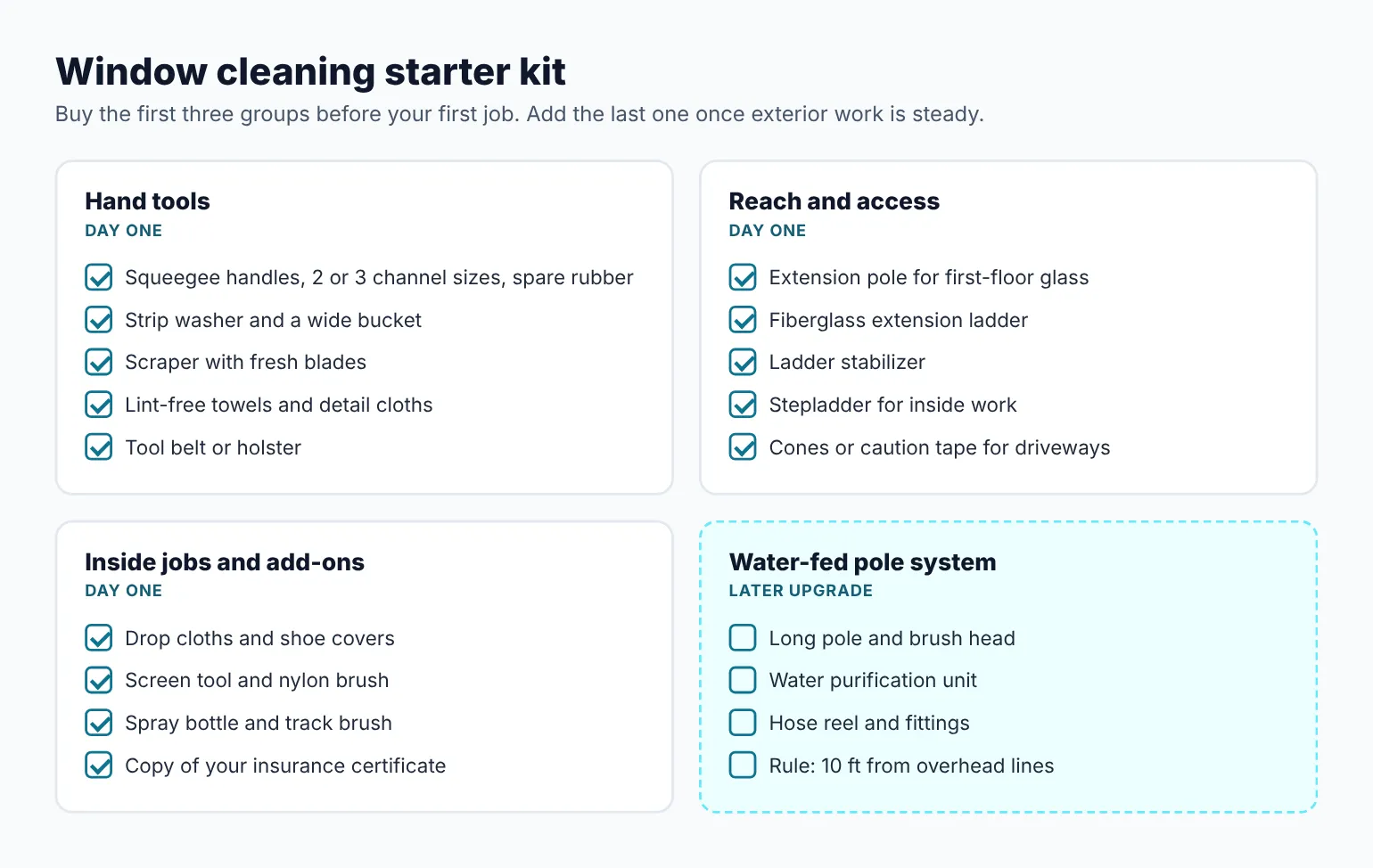
A starter kit sorted by when you'll need it. Checklist only, not a shopping list for any one brand.
Use OSHA's ladder rules as your baseline
OSHA's ladder rules apply to employers, but they make a good standard even when you work alone. Under the OSHA portable ladder rules, an employer must make sure that:
- Ladders are inspected before first use in each work shift, and a damaged ladder is tagged and taken out of service.
- No ladder is moved, shifted, or extended while someone is on it.
- Portable ladders on slippery surfaces are secured and stabilized.
- A ladder used to reach an upper landing, like a roof, extends at least 3 feet above that landing.
- Ladders in driveways or doorways are secured or guarded with a barricade, such as cones or caution tape.
- Workers face the ladder and keep at least one hand on it while climbing.
That last rule matters in this trade. Carry your tools in a belt, not in your hands, so one hand stays on the ladder.
Look up before you raise a pole
Long poles and aluminum ladders are the biggest electrical risk in window cleaning. OSHA's rules for work near overhead lines say an unqualified person working near them must keep themselves and the longest conductive object they could touch at least 10 feet from an unguarded, energized line rated 50kV or less. The same section requires portable ladders with nonconductive side rails where the worker or ladder could contact exposed energized parts.
Walk every property before you set up. Find the line from the street to the house, and plan each pole and ladder move around it. A wet pole can conduct, so treat any pole as conductive unless it has an insulating rating for the voltage involved.
Leave rope work to trained crews
High-rise window cleaning is a different business. OSHA's rope descent system rules require written confirmation from the building owner that each anchorage has been tested and certified to support at least 5,000 pounds per attached worker. They also call for training, a separate fall arrest system for each worker, and a prompt rescue plan. Start with homes and ground-level storefronts, and pass on rope jobs until you've trained under an experienced crew.
Step 4: Price by the window, then check the day
Your price has to cover your time on the glass, the drive, supplies, insurance, and the quotes that never book.
Count windows the same way every time
Decide what one "window" means in your pricing, and use it on every quote. Some owners count each pane of glass. Others count a window unit as one price, with extra charges for French panes, skylights, and large picture windows. Either works if you're consistent and explain it on the phone.
Write down a few rules before your first quote. Decide whether inside and outside are priced separately, whether screens are extra, and how you price windows that need a ladder.
Choose a pricing method
| Pricing method | Best for | Trade-off |
|---|---|---|
| Per window or per pane | Most homes | You need an accurate count, so ask for photos or walk the house |
| Flat price by house size | Quoting fast on the phone | Big glass walls or many small panes can make it a losing job |
| Per visit on a route | Storefronts cleaned weekly or monthly | Small tickets only work when stops are close together |
| Hourly | Post-construction or jobs with unknowns | Customers worry about the total, so give a written range |
Check every quote against your day
Before you settle on a rate, work out what a day has to bring in. Add up your monthly fixed costs, like insurance, the vehicle, your phone, and software. Divide that by the days you plan to work, and add the pay you want for each day. That's your day target.
Then check each job against it. Multiply the window count by your rate and add screens, tracks, or hard water work. Then compare that total to the share of your day the job will take, drive time included. If a job takes half your day, it should bring in at least half your day target.
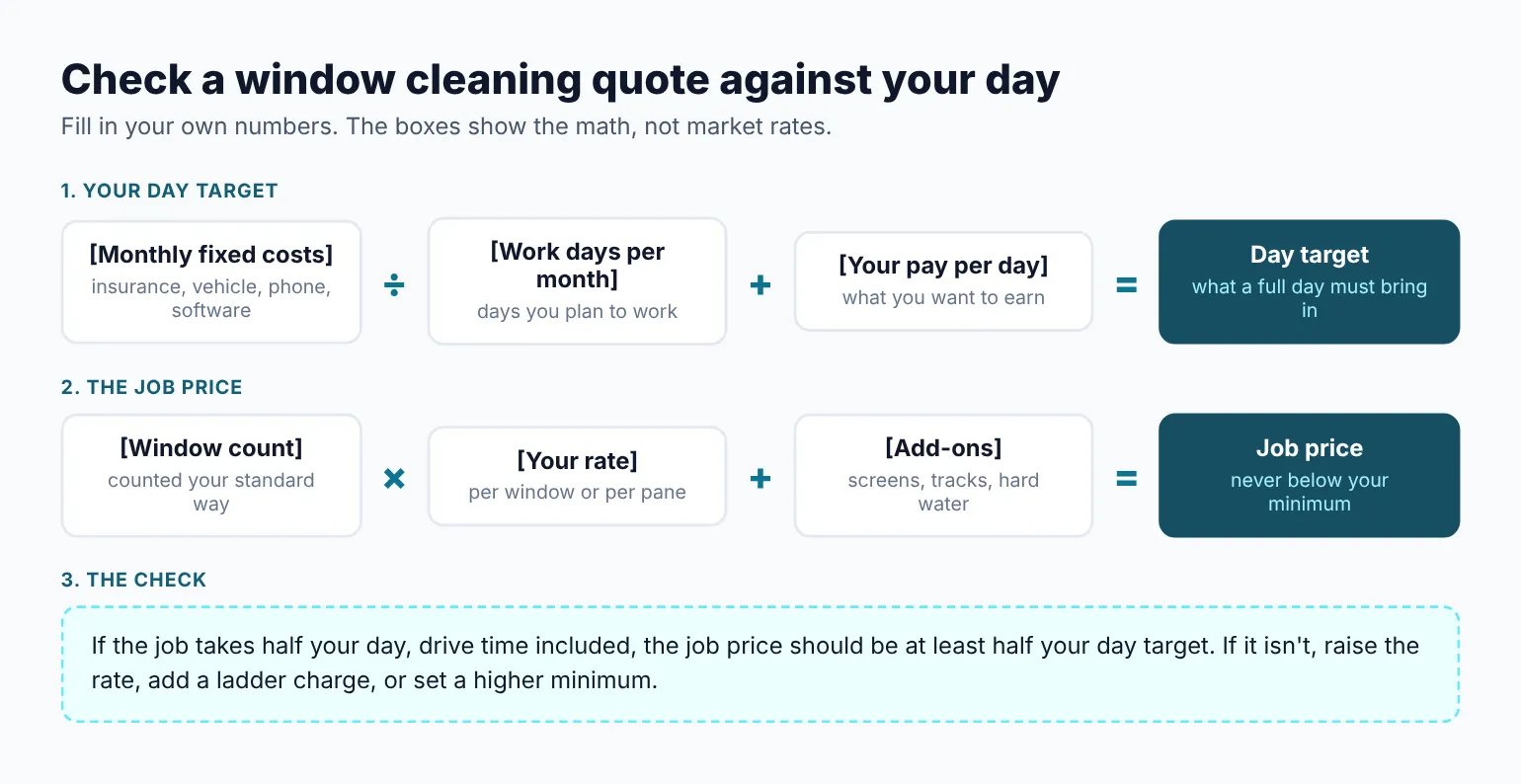
A worksheet for checking a quote. Fill in your own costs and rates.
Set a minimum charge and price the add-ons
A minimum charge keeps a two-window job from costing you money once the drive is counted. Price screens, tracks, hard water removal, and second-story ladder work as separate lines, so a customer can see why one house costs more than another. If you're weighing whether to show those prices online, read about putting your prices on your website.
Step 5: Win your first window cleaning jobs
Start with a single street of storefronts
Walk a strip of shops, cafes, and offices near your home on a weekday morning. Look for smudged doors and dusty display glass, then go in and offer to clean the front today at your standard price. Owners who like the result often agree to a weekly or monthly visit. A short row of regular stops on one street can fill your mornings.
Set up a Google Business Profile as a service-area business
You go to the customer, so set up the profile as a service-area business with the towns you actually cover. If you work from home, the steps to hide your address on Google Business Profile keep your house off the map. Add your services and before-and-after photos of real glass you've cleaned.
Ask for a review after every job
Ask while the customer is looking through a clear window. The steps to get Google reviews from happy customers take a few minutes once your review link is saved on your phone.
Add services and channels one at a time
Gutter cleaning, screen repair, and house washing fit naturally alongside windows. If you're thinking about adding a pressure washer, the guide on how to start a pressure washing business covers what changes. Test paid ads one channel at a time and track where each call came from. The post on home services advertising covers where to spend first.
Common problems and how to fix them
Streaks show up when the sun hits the glass
Most streaks come from too much soap, dirty rubber, or drying edges in direct sun. Use less solution, replace worn squeegee rubber, and wipe the edges with a dry detail cloth. On hot days, work the shady side of the house first.
You scratch a pane with a scraper
Stop and tell the customer the same day. Then call your insurer. Before you scrape again, wet the glass, use a fresh blade, and test a corner. On new construction, check the glass maker's cleaning instructions before you scrape at all.
A customer asks for windows your ladder can't safely reach
Say no to that part of the job, and quote the windows you can reach safely. A lost third-story job costs you one ticket. A fall can cost you the business. Add higher work later, once you have the right equipment, training, and insurance.
Rain wipes out a week of jobs
Call or text customers the morning of the job with a new day, and keep one open day each week for rain makeups. Do inside-only jobs and storefront routes under awnings when the weather is bad.
Where a bookable site fits
Once referrals and reviews start working, many homeowners will look you up before they call. A Kejoola site, for example, is four pages (Home, Services, Blog, Contact) with online booking. A homeowner picks a time and types the address, the window count, and any second-story glass in the notes box, and the booking lands in your bookings. You can confirm the count and the price before you show up.
Questions owners ask about starting a window cleaning business
How much does it cost to start a window cleaning business?
It's one of the cheaper trades to start, since the core kit is hand tools and a ladder. The SBA says registering a business usually costs less than $300, and the IRS issues EINs for free. Insurance, a ladder, and any vehicle you need are the bigger costs, so get real quotes for each before you commit.
Do you need a license to start a window cleaning business?
Usually you need a general business license rather than a trade license. Ask your city or county business license office, and check each town you plan to work in. Ask your state's revenue department whether you need to collect sales tax on cleaning services, since that varies by state.
Do you need insurance to clean windows?
Yes, in practice. General liability is the minimum, because you work around glass, frames, and landscaping that are costly to replace. Ask whether the policy covers the property you're working on and whether it limits height. Add workers' compensation before your first hire.
Is a water-fed pole worth buying when you start?
Not usually on day one. Hand tools and a ladder handle most first jobs at a small part of the cost. A water-fed pole makes sense once you're doing steady exterior work on two-story homes. Wherever you use one, keep it at least 10 feet from overhead lines.
How do window cleaners charge for their work?
Most charge per window or per pane for homes, with separate prices for screens, tracks, and hard water removal. Storefronts usually pay a set price per visit on a weekly or monthly route. Post-construction work is often hourly. Set a minimum charge so small jobs still cover the drive.
Give homeowners a way to book your first window cleaning jobs
If you want a site where customers can see your services and book a time, you can get a site customers can book from with Kejoola. Already have a Google Business listing? Paste your listing link to get a first draft of your site, then finish it with your own services, towns, and photos.
14-day free trial, no card needed. Online booking starts on the Starter plan.